Eucalyptus Fiber Length Variations and Unrefined Sheet Formation
Unrefined eucalyptus sheet formation demands short, low-coarseness fibres to limit the crowding factor, prevent flocculation, and ensure uniform pore density.


Furnish
Morphological Dimensions across Hardwood Species
Delivered sheet quality begins with the anatomical dimensions of the pulp source. Bleached hardwood kraft pulps derived from eucalyptus species display measurable morphological shifts depending on the genetic background, clone selection, and forestry conditions. Mill test data gathered under ISO 16065-1 automated optical testing establish that Eucalyptus globulus produces an average length-weighted fibre length between 0.75 mm and 0.85 mm, accompanied by a cell wall thickness nearing 3.5 µm and a low population of vessels per gram.
In contrast, Eucalyptus grandis and its hybrid crosses with Eucalyptus urophylla, commonly harvested in tropical forestry regimes, routinely measure between 0.62 mm and 0.72 mm in weighted length, with wall thicknesses spanning 2.2 µm to 2.8 µm. This dimensional gap directly alters the population count of individual fibres per gram of dry pulp. A sheet produced from tropical urograndis hybrids contains approximately 18 million to 22 million fibres per gram, whereas a sheet manufactured from Iberian globulus contains between 12 million and 14 million fibres per gram.
The total population density within the suspension governs network percolation thresholds on the paper machine wire. When fibres are shorter, more discrete units occupy a given dry mass, increasing the statistical probability of inter-fibre contacts during wet web consolidation. However, the slenderness ratio, defined as fibre length divided by width, shifts alongside absolute length.
Globulus fibres balance length with a wider lumen and substantial cell wall, yielding higher fibre coarseness values typically ranging from 7.0 mg/100m to 8.5 mg/100m according to ISO 23714. Tropical hybrids yield coarseness numbers between 5.5 mg/100m and 6.8 mg/100m. Lower coarseness translates to greater flexibility in the wet state, promoting flat collapse and greater optical contact even without mechanical treatment in a refiner.
A shift in fibre coarseness from 7.5 to 5.8 milligrams per hundred metres increases the fibre count per gram by more than thirty percent.
Unrefined Fibre Dynamics
Unrefined virgin hardwood pulps enter the approach flow of the paper machine with low external fibrillation and high Canadian Standard Freeness values, commonly exceeding 580 mL to 620 mL CSF under ISO 5267-2. The natural stiffness of the unrefined cell wall limits conformability when water drains through the forming fabric. A longer eucalyptus fibre, such as that found in mature globulus, possesses higher flexural rigidity prior to mechanical brushing.
This resistance to bending impairs the wet web from settling into a dense, closed sheet during initial vacuum application at the forming board and early vacuum boxes. The fibres bridge across micro-voids rather than flattening into them.
The shorter hybrid fibres pack tightly under pure hydrostatic suction, generating smaller average pore diameters within the forming mat. The specific surface area of unrefined eucalyptus fibre sits at roughly 1.1 m²/g to 1.4 m²/g, an order of magnitude lower than refined stock. Inter-fibre bonding in this state relies entirely on capillary force pulling cell walls into proximity during evaporative drying, governed by the Campbell effect.
Consequently, the anatomical variation between eucalyptus species dictates the initial structure of the unpressed mat, setting the physical limits for formation quality before mechanical energy enters the system.
A supplier will occasionally explain cloudy formation in unrefined grades by asserting that raw hardwood fibres behave uniformly until refiner bars strike them.

Flocculation

Hydrodynamic Forces in Headbox Suspensions
The suspension travelling through the headbox manifold contains suspended hardwood elements subject to viscous shear and turbulent eddies. Flocculation tendency scales with the crowding factor, a dimensionless metric representing the number of fibres present inside a spherical volume whose diameter equals the average fibre length. The mathematical expression for the crowding factor states:
N = (5 / 3) π C_v (L / d)²
Here, C_v represents volumetric consistency, L represents average fibre length, and d represents fibre width. Because length enters the relationship as an exponent, subtle shifts in length produce non-linear expansions in the crowding factor. A suspension of globulus fibres measuring 0.82 mm generates a crowding factor nearly 40 percent higher than a hybrid pulp measuring 0.68 mm at an identical consistency of 0.70 percent.
When the crowding factor exceeds a critical value of 60, mechanical entanglement becomes the dominant mechanism resisting hydrodynamic dispersion. The longer elements collide and interlock, forming cohesive flocs that withstand the shear fields generated inside the turbulence tubes of modern hydraulic headboxes.
| Eucalyptus Furnish Origin | Length Weighted Length (mm) | Fibre Width (µm) | Coarseness (mg/100m) | Crowding Factor (N) | Drainage Index (CSF mL) |
|---|---|---|---|---|---|
| Eucalyptus globulus (Iberian plantation) | 0.84 | 19.8 | 8.1 | 73.5 | 615 |
| Eucalyptus nitens (Temperate highland) | 0.78 | 18.5 | 7.4 | 68.2 | 605 |
| E. grandis x urophylla (Subtropical hybrid) | 0.69 | 16.2 | 6.2 | 57.8 | 590 |
| Eucalyptus dunnii (Commercial plantation) | 0.74 | 17.6 | 7.1 | 64.1 | 598 |

Length Regimes and Floc Structural Integrity
Flocs formed from longer hardwood fractions exhibit distinct physical cohesion compared to short-fibre assemblies. The shear stress required to disrupt a network of entangled unrefined fibres depends directly on the number of contact points per fibre. In unrefined stocks, surface roughness and residual micro-compressions from wood chipping produce friction at every contact point.
When the forming jet exits the slice lip at speeds matching or differing from the wire speed, shear forces operate on these structural domains.
- Cohesive core dimensions expand rapidly when local fibre length exceeds 0.80 mm, resisting the micro-scale turbulence generated by rectifier rolls or stepped-diffuser blocks.
- Decoupling velocities across the free jet vary according to species coarseness, producing localized mass variations across the wire that resist blade re-dispersion.
- Hydrodynamic drag forces act unevenly across the unrefined cell walls, causing longer fibres to align in the flow direction faster than shorter elements, creating cross-machine mass variations.
If headbox consistency is kept constant while switching from a short-fibre tropical pulp to a longer-fibre southern source, the stock flocs early, producing high local mass density zones flanked by low-density pinholes.


Drainage
Dewatering Behavior on the Wire
Initial dewatering mechanics govern how effectively hydrodynamically dispersed fibres remain separated during web consolidation. Water removal on a Fourdrinier or twin-wire gap former occurs through gravity, table blades, and vacuum pulses applied sequentially. Unrefined eucalyptus stocks feature exceptional drainage rates because the internal and external fibrillar swelling remains minimal.
Water drains rapidly, leaving little time for shear blades to shake or re-disperse the forming web. A rapid drainage event freezes the floc architecture established in the headbox before table agitation can redistribute the fibres evenly.
The drainage resistance of the consolidating mat relates directly to specific cake resistance. For unrefined sheets, specific filtration resistance remains exceptionally low, typically measuring between 0.8 x 10¹¹ m/kg and 1.5 x 10¹¹ m/kg under standard TAPPI T 221 conditions. Because fluid velocity through the forming mat is high, the drag forces wash unattached short fibres and parenchyma cells downward toward the wire side.
Shorter-length eucalyptus furnishes, bearing higher fine-cell counts and smaller average fibre diameters, generate a tighter filter cake that slows the drainage rate. This retardation works to the papermaker’s advantage on the wire: it sustains the fluid state of the suspension across a longer distance over the forming table, extending the operational window where forming blades can break down flocs.
A low specific filtration resistance freezes initial headbox flocs onto the fabric before forming blades can shear them apart.
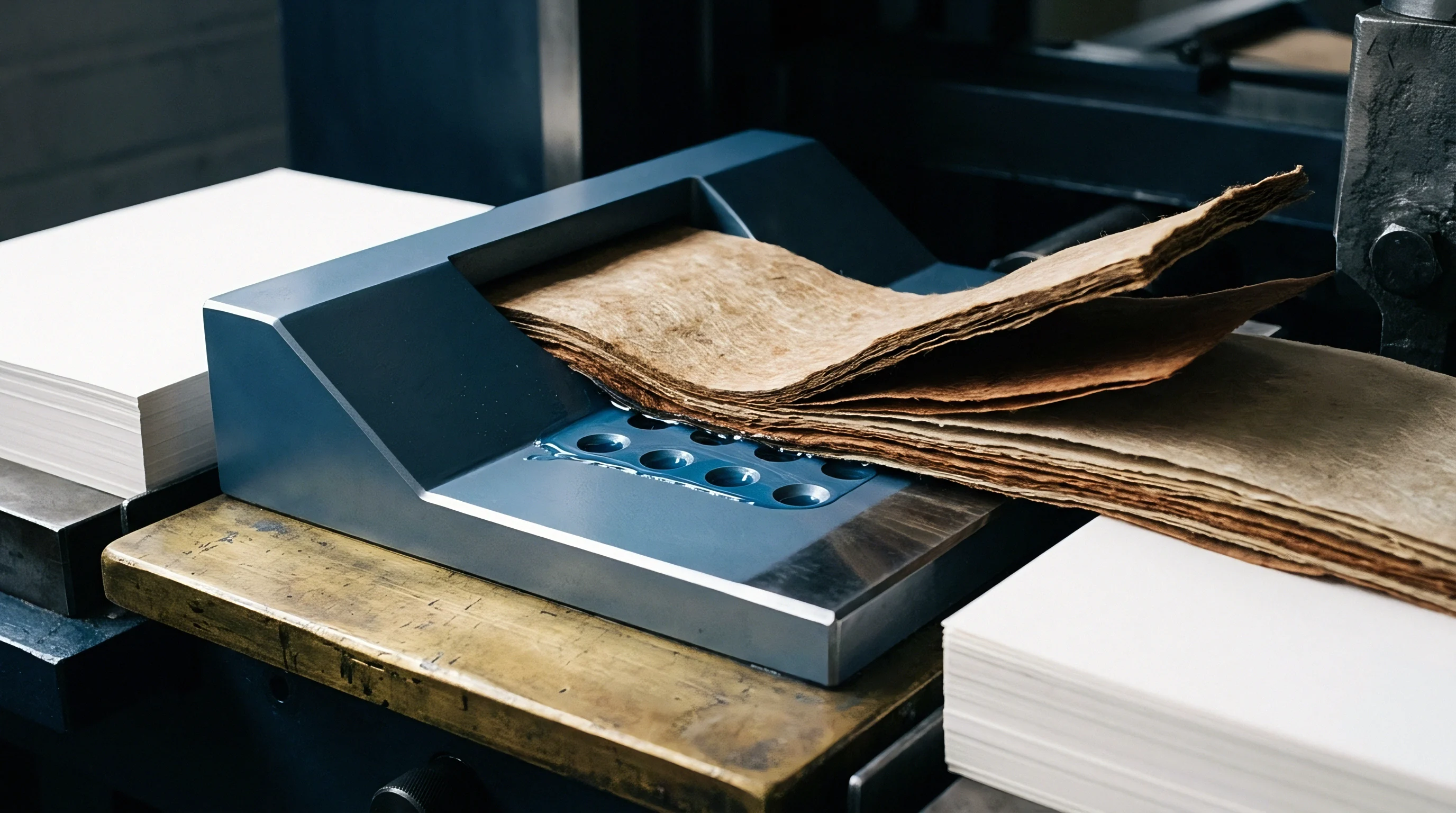
Vacuum Response and Permeability
When the wet web approaches the low-vacuum and high-vacuum suction boxes, differential air and water pressure compacts the structure. Long unrefined fibres, retaining their cylindrical cross-section due to lack of internal fibrillar softening, maintain high void fractions under pressure. The permeability of the wet cake stays elevated, which permits rapid water exit but limits wet-web consolidation.
The air permeance of a dry sheet made from this furnish, tested according to ISO 5636-3 (Bendtsen method), frequently exceeds 1,200 mL/min when unrefined and unpressed.
The shorter hybrid fibres collapse into smaller flow channels, lowering overall permeability and raising vacuum levels across the flatboxes. The machine operator balances this vacuum profile to prevent wire marking. High localized vacuum on an unrefined, free-draining mat drives the fibres deep into the weave of the forming fabric, creating significant two-sidedness in roughness and surface porosity.
Can adjusted slice geometry compensate for rapid drainage when running long-fibre eucalyptus?
The adjustment of slice opening and jet impingement angle offers modest mitigation. Increasing jet velocity relative to wire velocity introduces shear along the fabric, but without the hydration associated with mechanical refining, this shear tears the unformed sheet rather than shearing individual flocs, leaving a streak-dominated mass distribution.
A standard procurement agreement based on raw tensile index fails to protect the buyer against structural mass variations across the web width.
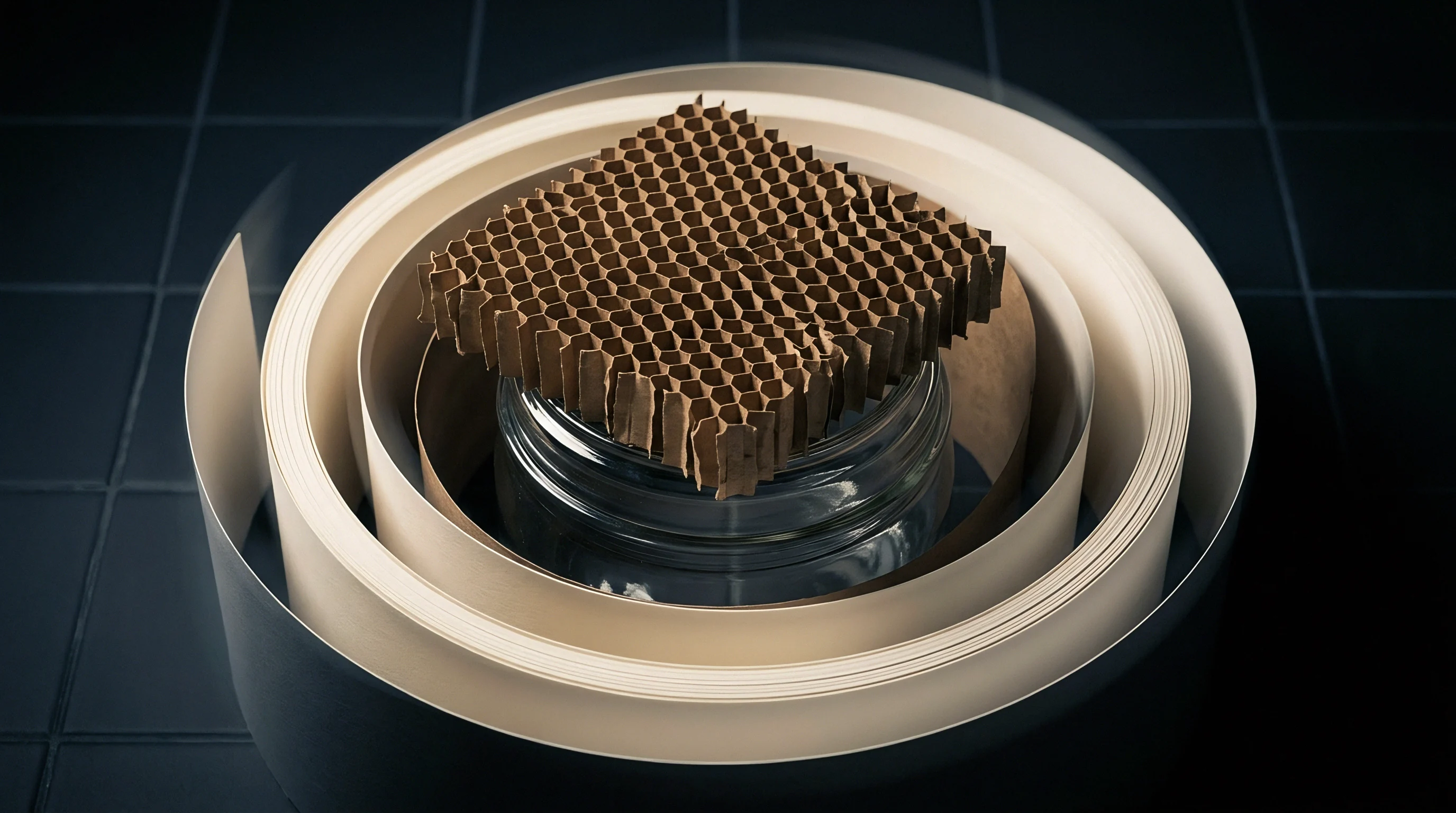
Sheet

Formation Index and Mass Distribution
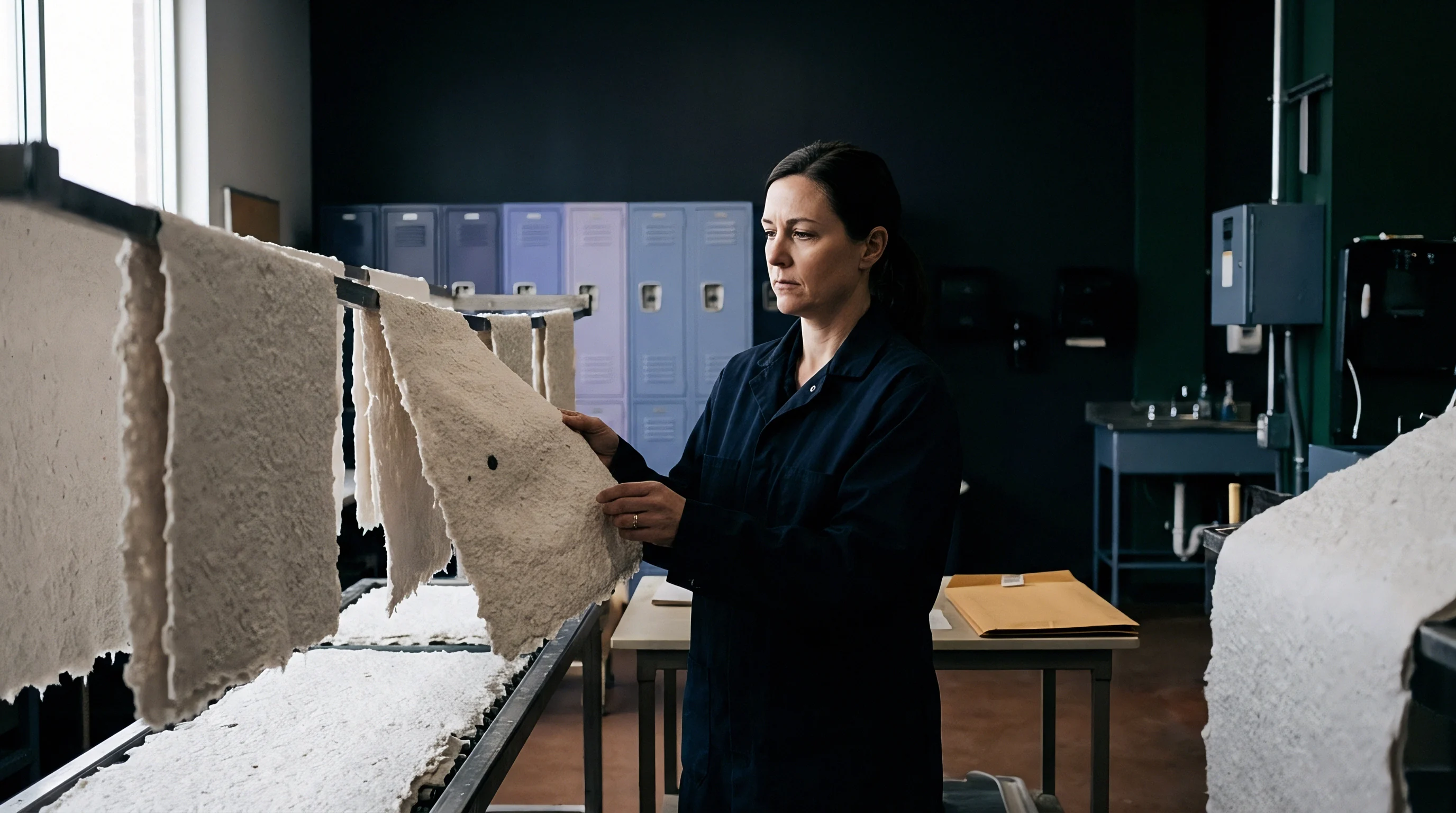
Physical measurement of mass uniformity in unrefined eucalyptus sheets highlights the structural consequences of morphological variance. Formation indices, whether determined via 2D beta-radiography, amber light transmission, or high-resolution optical scanning under TAPPI T 271, describe the standard deviation of local basis weight across micro-apertures ranging from 0.1 mm to 1.0 mm. For a nominal 80 g/m² unrefined sheet, the local mass variation of a hybrid eucalyptus furnish (0.68 mm length) exhibits an amber-light formation index between 110 and 125.
The identical mass produced from a 0.85 mm globulus furnish regularly yields an index between 85 and 95, reflecting larger optical light-and-dark patches corresponding to persistent flocs.
These mass fluctuations yield significant variations in local density and caliper. Caliper, measured under ISO 534 at 100 kPa pressure, reveals wide local spreads. An unrefined sheet containing longer hardwood fibres presents high specific volume, often exceeding 1.45 cm³/g to 1.60 cm³/g.
The peaks of these flocs carry the compressive load during calender or reel winding, while the lower-weight valleys remain untouched by machine nips.
The structural arithmetic of this mass divergence demonstrates the problem. Consider an unrefined 80 g/m² eucalyptus paper produced for base packaging substrate applications, evaluated on a cross-machine profile basis:
- Nominal target grammage ~ 80.0 g/m² across a 200 mm sample strip.
- High-mass floc regions ~ peak local mass measures 94.2 g/m² over a 1.2 mm aperture.
- Low-mass void regions ~ minimum local mass measures 66.8 g/m² over the same aperture.
- Local grammage deviation ~ a 27.4 g/m² spread between structural domains.
At an average bulk of 1.50 cm³/g, the nominal caliper sits at 120.0 µm. In the floc centers, compressed under wet pressing, the caliper expands to 135.0 µm, while the void spaces drop to 102.0 µm. This micro-structural variation undermines the uniformity of contact during subsequent converting operations.
Pore Architecture and Optical Properties
The dry sheet matrix consists of fibre walls surrounding air-filled pores. In an unrefined eucalyptus sheet, the pore size distribution, characterized by mercury intrusion porosimetry, displays a bimodal distribution. Inter-fibre pores dominate the 2.0 µm to 8.0 µm range, while intra-fibre lumen pores cluster around 0.5 µm to 1.2 µm.
The longer eucalyptus fibres produce a broader inter-fibre pore distribution due to bridging effects, which scatters light efficiently. ISO 2471 opacity for an unrefined 80 g/m² sheet of this type reaches 86 to 89 percent without mineral fillers, driven entirely by the high volume of unbonded fibre-air interfaces.
| Fibre Source | Apparent Density (g/cm³) | Bendtsen Roughness (mL/min) | Tensile Index (N·m/g) | Tear Index (mN·m²/g) | ISO Opacity (%) |
|---|---|---|---|---|---|
| Eucalyptus globulus (0.84 mm) | 0.62 | 820 | 24.5 | 4.8 | 88.2 |
| Eucalyptus nitens (0.78 mm) | 0.65 | 740 | 27.8 | 4.4 | 87.4 |
| E. grandis x urophylla (0.69 mm) | 0.69 | 580 | 31.2 | 3.8 | 85.9 |
| Eucalyptus dunnii (0.74 mm) | 0.66 | 690 | 28.1 | 4.1 | 86.8 |
As detailed above, the longer fibres yield lower apparent density and higher surface roughness. The unrefined sheet displays higher Bendtsen roughness (ISO 8791-2) because the stiffer, longer cells resist mechanical smoothing across the wire. Tensile strength remains low across all unrefined options, yet the shorter hybrid fibres consistently register higher unrefined tensile index values (31.2 N·m/g against 24.5 N·m/g).
This disparity arises directly from the higher number of inter-fibre contact points available per unit area in the short-fibre matrix, proving that sheer fibre length without mechanical activation does not confer tensile resistance.
Higher initial bulk comes at the direct expense of sheet smoothness and structural integrity.


Converting
Coating Holdout and Liquid Penetration
When an unrefined eucalyptus sheet enters an off-machine coater or a flexographic printing station, the structural irregularities created by fibre length variation govern liquid pickup. Coating formulations applied via blade or metering size press depend on uniform capillary pressure to regulate water and binder movement into the base sheet. The Lucas-Washburn equation describes the penetration distance (L) of a liquid into a porous structure:
L = √
In this relationship, r represents pore radius, γ represents surface tension, θ represents contact angle, t represents penetration time, and η represents liquid dynamic viscosity. Where unrefined longer fibres cause bridging, the effective pore radius r expands substantially. High-porosity zones absorb water rapidly from the coating colour, causing premature immobilization of the solid phase at the surface of the flocs while starving the valleys.
Under gravure or flexographic ink deposition, this uneven penetration produces optical mottling, visible as a blotchy, irregular ink film across solid coverage blocks.
Cobb60 water absorption (ISO 535) on unrefined eucalyptus base sheets commonly exceeds 80 g/m² without surface sizing. When length variations create localized variations in pore size, water absorption across the web deviates by up to 35 percent between the floc centers and the open inter-floc zones. This micro-porosity gradient produces blistering during high-temperature thermal drying of coatings, as trapped water vapor inside large pores ruptures thin mineral layers before the binder cross-links.
A surface roughness differential across adjacent sheet zones produces ink starvation in the low-mass micro-valleys during low-pressure impression.

Mechanical Calendering and Runnability
Converting operations involving creasing, folding, and die-cutting expose the structural limits of unrefined eucalyptus networks. Because inter-fibre hydrogen bonding is limited without refining, bending stiffness depends entirely on sheet thickness according to the cubic relationship:
S_b = (E h³) / 12
The elastic modulus (E) remains intrinsically low in an unrefined furnish, yet the high caliper (h) generated by long, stiff globulus fibres compensates, preserving bending resistance. However, under scoring and creasing operations, these sheets experience internal delamination. The absence of fibrillar entanglement prevents the sheet from hinging cleanly.
The outer liner ruptures along the score line when subjected to a 180-degree fold test, exposing raw fibres and cracking any surface treatment.
- Rotary die-cutting units experience accelerated tooling wear when compressive loads are elevated to shear unrefined, bulky flocs cleanly.
- Web breaks increase at slitter-rewinders where localized low-mass areas fail under line tension spikes exceeding 0.45 kN/m.
- Adhesive absorption rates during cold-set PVA lamination swing unpredictably, causing open-time failures along carton glue laps.
- Registration drift occurs across multi-station presses as non-uniform water absorption alters the dimensional stability of the cross-direction sheet web.
Failure to specify the exact eucalyptus morphological profile results in persistent print mottle, unexpected adhesive starvation, and brittle fold lines that disrupt high-speed finishing operations.

Trade
The Economics of Furnish Selection and Machine Speed
The financial ledger balances wood pulp market prices against machine productivity and yield. On the global pulp market, Northern Bleached Hardwood Kraft (NBHK) made from birch or aspen trades at a baseline differential against Southern Hardwood Kraft and Bleached Eucalyptus Kraft (BEK). Within the BEK category itself, Iberian globulus pulps traditionally carry a market premium of $20 to $45 per air-dry metric tonne over Latin American mixed hybrid pulps.
This premium is justified in refined applications by the high bulk and opacity delivered at lower refining energy inputs. For an unrefined sheet application, however, paying this premium incurs functional penalties on the converting floor.
Consider a papermaking line producing 120,000 tonnes annually of unrefined base sheet for laminate backing or bulky packaging grades. Deploying a longer-fibre globulus pulp requires lowering the headbox consistency by 0.15 percent to suppress the crowding factor and preserve acceptable sheet formation. This dilution demands higher water volume through the fan pump and limits wire dewatering capacity.
Consequently, the paper machine must decelerate from 950 m/min to 870 m/min to accommodate the hydraulic load on the forming section. That speed reduction costs 8.4 operating hours per week in lost output, destroying the commercial margin of the asset.
The following economic model illustrates the direct financial consequence of running an unsuitable eucalyptus morphology in an unrefined grade across a single calendar quarter:
- Production asset baseline ~ 30,000 tonnes per quarter capacity at 950 m/min machine speed.
- Raw material cost premium ~ $30 per tonne differential for high-coarseness globulus pulp ($900,000 gross).
- Speed reduction penalty ~ 8.4 percent throughput drop to manage formation, reducing delivered volume to 27,480 tonnes.
- Fixed operational cost absorption ~ $280 fixed cost per tonne expands to $305.68 per tonne on lower volume.
- Converting reject rates ~ customer reject allowances due to flexo mottle rise from 0.8 percent to 2.4 percent.
The total net margin erosion across the production quarter reaches $1,421,000 when accounting for raw material price differentials, fixed cost misallocation, and converted scrap penalties. Operating unrefined grades requires maximizing fibre populations per gram to secure sheet closure without relying on energy-intensive mechanical processing.

Procurement Specifications for Substrate Buyers
Substrate specifications must move beyond generic BEK labels to protect commercial conversions. A purchase order that specifies merely bleached eucalyptus kraft leaves the converter vulnerable to species-level substitution by the pulp mill. Pulp mills adjust woodchip balances between forest compartments based on seasonal harvesting logistics, blending globulus, dunnii, nitens, and urograndis without altering the commercial grade name.
Contracts for unrefined paper grades must explicitly govern the morphological boundaries of the delivered stock. The buyer defines bounds for length-weighted fibre length, coarseness, and fine content measured under ISO 16065-2. Imposing an upper limit on fibre length ensures that the crowding factor in the customer’s approach flow remains within stable parameters, avoiding unmanageable flocculation on older or slower paper machines.
Paragraph 7.2 of the standard substrate delivery contract specifies that shipments displaying formation index variances exceeding eight percent against the benchmark master reel will be rejected without right of cure.