Cellulose Fiber Thermal Expansion Mechanics in Sheetfed Packaging Printing Operations
Inter-deck thermal radiation drives anisotropic sheet expansion, causing tail-end register drift that requires precise substrate grain alignment and lamp modulation.
Swell
Water enters cellulose fiber walls primarily through the amorphous regions of hemicellulose and non-crystalline polymers, swelling the cross-section far more than the length. This anisotropy originates in tree growth and survives mechanical refining on the paper machine. In the dominant S2 cell-wall layer, microfibrils spiral at an angle to the fiber axis; because of this geometry, water intake increases fiber diameter by fifteen to twenty percent while length changes by only one to two percent across the full saturation range.
On the forming wire, headbox shear and web tension comb a majority of fibers into alignment with the machine direction, fixing the directional grain of the finished board. Hygroexpansion tracks this orientation closely. For commercial folding boxboard grades, cross-direction hygroexpansion coefficients run between 0.015 percent and 0.035 percent per one percent change in relative humidity.
Along the machine direction, where aligned fiber backbones resist movement, the coefficient drops to between 0.003 percent and 0.008 percent per one percent change in relative humidity.
A standard 350 gsm solid bleached sulfate board expands by 0.18 millimeters across a 1020 millimeter sheet width for every five percent increase in equilibrium moisture content under standard temperature.
Heat acts alongside moisture rather than in isolation. As board temperature rises, thermal agitation expands the cellulose matrix at rates dictated by fiber orientation: the linear coefficient of thermal expansion for dry microfibrils is only 3 to 6 microstrain per Kelvin along the axis, but reaches 25 to 35 microstrain per Kelvin across it. In a press unit, thermal expansion and hygroexpansion run together.
Heating the web raises internal vapor pressure and forces bound moisture out of the fiber walls, shrinking the matrix even as thermal excitation pushes the polymer lattice outward.
How far microfibrils can adjust under repeated inter-deck heat cycles without taking on permanent set is still poorly quantified in substrate physics.
Heat
A sheetfed press delivers intense heat through multiple curing and drying stages ~ traditional UV cassettes, LED-UV arrays, infrared panels, and hot-air knives all dump thermal energy into the running sheet. Even narrow-band LED units at 365-nanometer or 395-nanometer wavelengths pump significant parasitic heat into the board unless backed by dichroic cold mirrors and chilled quartz plates. Under a standard medium-pressure mercury lamp, sheet surface temperature jumps from 22 degrees Celsius to over 70 degrees Celsius in less than fifty milliseconds of dwell time.
That thermal shock unbalances the board’s internal moisture equilibrium. Bound water molecules pick up kinetic energy, break free of cell-wall bonding sites, and flash into the void spaces between fibers. The structural lattice responds instantaneously by expanding, lengthening the sheet.
Evaporation immediately pulls in the opposite direction: as vapor vents into the pressroom air, the drying fiber network contracts. What the sheet actually does over a ten-thousandth of a second exposure is the net outcome of immediate thermal expansion offset by slower evaporative shrinkage.
Higher temperatures also lower the viscosity and surface tension of residual pore water, accelerating capillary migration through open recycled boards far faster than through dense virgin SBS. Coated boards present an additional complication. Mineral coatings of calcium carbonate or kaolin bound with styrene-butadiene latex have thermal expansion coefficients between 8 to 14 microstrain per Kelvin ~ well out of step with the raw fiber plies underneath.
Sudden surface heating creates a steep expansion gradient through the caliper, driving curl toward or away from the lamps depending on coat weight and local moisture balance.
Sheet distortion beyond line tolerances is frequently attributed to pressroom humidity variations, though thermal loading from curing cassettes generates comparable dimensional error.
Register
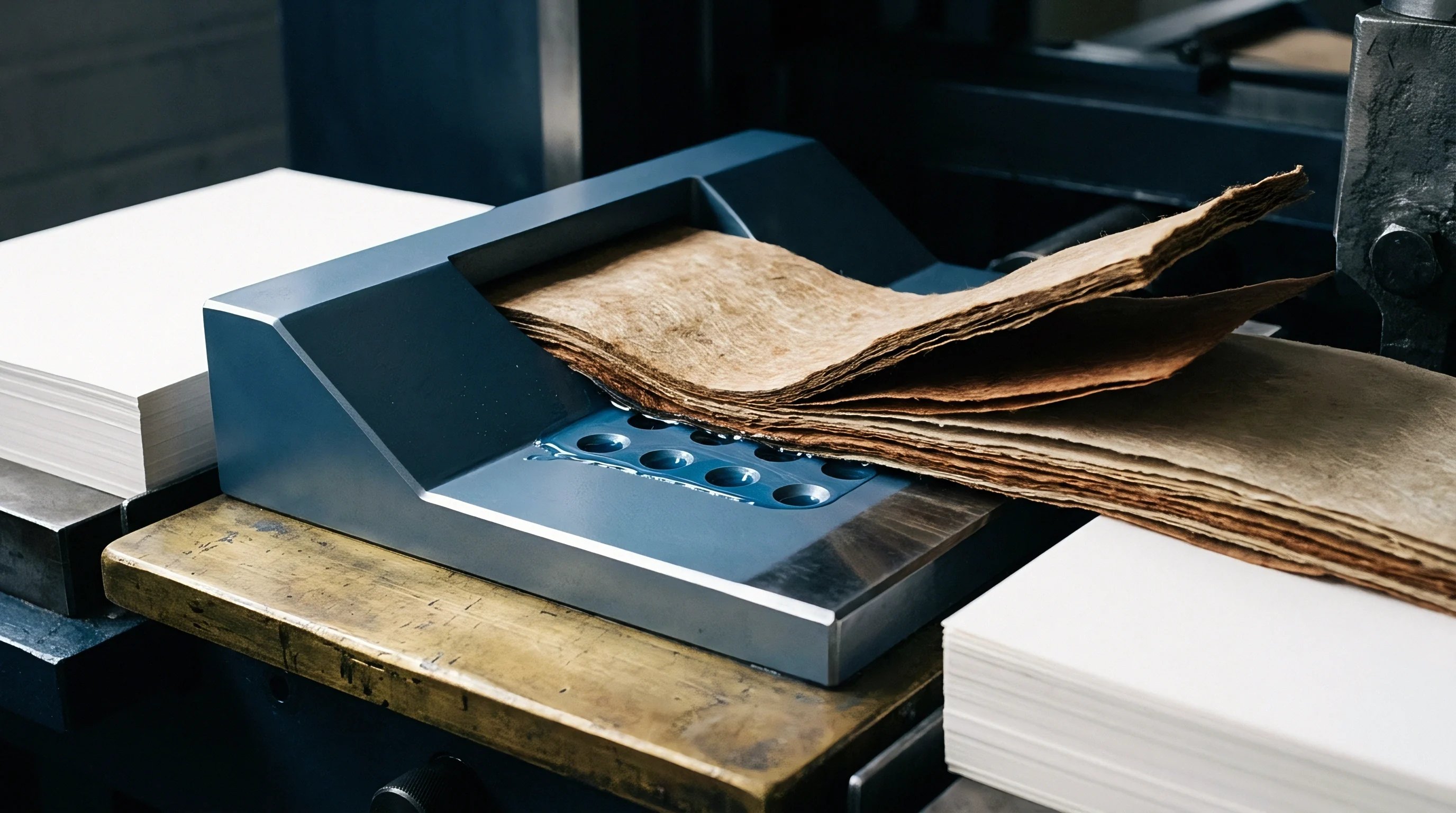
Holding color register across a packaging run demands sub-millimeter dimensional control from gripper to tail. Front lays and side guides pin the lead edge at the feeder to set mechanical zero. From there, each litho unit applies between 0.2 and 0.6 grams of fountain solution per square meter to non-image areas while inter-deck dryers apply heat, creating simultaneous moisture and thermal loads on stock locked between impression nips and gripper bars.
Is Tail End Misregister Driven by Thermal Expansion?
Thermal growth works with fountain-solution uptake to distort sheet corners. As radiant heat broadens the sheet sideways and impression nips squeeze the softened structure, the tail sweeps outward into classic fan-out. Because the lead edge remains pinned in the grippers, this spread accumulates toward the back of the form.
On a B1 sheet measuring 720 millimeters by 1020 millimeters, a lateral expansion of just 0.02 percent widens the tail by 0.204 millimeters ~ well beyond the 0.08 millimeters trapping margin typical for fine packaging type and foil-embossing borders.
| Substrate Grade | Caliper (µm) | Thermal Expansion Alpha (µm/m/K) | Hygro-Expansion Beta (% Delta RH) | Tail-End Fan-Out at 15K Rise (mm) |
|---|---|---|---|---|
| Solid Bleached Sulfate (SBS) | 350 | 12.4 | 0.018 | 0.14 |
| Folding Boxboard (FBB) | 400 | 15.8 | 0.024 | 0.19 |
| Coated Recycled Board (CRB) | 450 | 21.2 | 0.032 | 0.28 |
| Uncoated Kraft Back (CUK) | 380 | 14.1 | 0.021 | 0.17 |
Diagnosing misregister across multi-pass work means separating thermal growth from blanket tack pull and mechanical play in the press drive.
- Tail-End Fan-Out ~ Lateral spread along the trailing edge caused by thermal growth and dampening fluid, pushing print past die-cut allowances.
- Diagonal Skewing ~ Uneven lateral growth across the cylinder width, usually traced to hot spots or mismatched UV cassette outputs.
- Blistering at Inter-Deck Curing ~ Flash steam buildup within dense, double-coated boards that splits internal plies under peak dryer heat.
- Embossing Mismatch ~ Sheet shrinkage as the stack cools after printing, pulling pre-printed borders out of register with offline foil dies.
ISO 12647-2 specifies a color-to-color alignment tolerance of plus or minus 0.05 millimeters across the full image area for high-precision packaging runs.
When sheet growth gets out of hand on multi-pass packaging, press crews usually have to drop press speed by thirty percent to hold register, driving up make-ready waste and eroding margin.
Chamber
Baseline hygro- and thermal expansion values are determined under strict laboratory bench conditions. Under ISO 187, specimens equilibrate at 23 degrees Celsius, plus or minus one degree, and 50 percent relative humidity, plus or minus two percent, until sample weight stabilizes. Optical dilatometers inside climate chambers then track dimensional drift as air temperature ramps from 20 degrees Celsius to 80 degrees Celsius while holding absolute moisture steady.
| Parameter | ISO 187 Standard Chamber | Sheetfed Inter-Deck Zone | Delivery Stack Interior |
|---|---|---|---|
| Temperature Range (°C) | 23.0 ± 1.0 | 45.0 to 85.0 | 38.0 to 52.0 |
| Relative Humidity (%) | 50.0 ± 2.0 | 15.0 to 35.0 (Transient) | 60.0 to 85.0 (Vapor Trap) |
| Exposure Time | 24 to 48 Hours | 10 to 50 Milliseconds | 4 to 24 Hours |
| Dominant Strain Mode | Isotropic Equilibrium | Dynamic Anisotropic Thermal Shift | Trapped Thermal-Hygro Creep |
Dynamic mechanical analysis illustrates why heated board yields so readily: both storage and loss moduli drop sharply as polymers pass their glass transition thresholds. Amorphous lignin softens between 90 degrees Celsius and 140 degrees Celsius depending on moisture level, but moist hemicelluloses begin transitioning between 60 degrees Celsius and 90 degrees Celsius. When curing lamps push local sheet temperatures into that window, stiffness collapses, the sheet stretches under minimal nip tension, and the distortion sets permanently as the board chills in the delivery pile.
Placing unconditioned board pallets directly into a heated pressroom creates an immediate perimeter moisture gradient that yields permanent edge-wave deformation within two hours.
Standard supply contracts cite ISO 287 moisture provisions and require mills to replace stock at their own expense if sheets exceed stability tolerances within agreed ambient limits.
Yield
Yield estimates and spoilage budgets need to account directly for heat movement between printing units. Take a job running 50,000 sheets of 400-micron folding boxboard on a six-color sheetfed press with inter-deck UV lamps, sized at 720 millimeters by 1020 millimeters, on board priced at 1.20 Euros per sheet, with a planned offline foil stamping pass. Estimators typically allocate a standard four percent spoilage allowance based on single-pass cold running.
Inter-deck curing upsets that calculation completely.
Under the lamps, the board heats to 55 degrees Celsius, expanding cross-grain until tail-end die marks spread by 0.22 millimeters. Three hours later at the offline foil stamper, the stack has cooled to 22 degrees Celsius and lost moisture to the pressroom, contracting the total sheet width to 1019.78 millimeters. The stamping die, cut to 1020.00 millimeters from nominal CAD dimensions, lands inboard of the printed image on outer cartons.
Centering the sheet in the stamper only splits the misregister between both flanks, pushing peripheral cartons past the 0.15 millimeter tolerance limit and scrapping 12 percent of the finished run.
Holding down thermal waste comes down to adjusting press parameters and material handling before stock ever reaches the feeder.
- Pre-Conditioning Acclimatization ~ Leaving moisture wraps intact until pallet cores match room temperature prevents edge-wave distortion from ambient air exchange.
- Inter-Deck Power Modulation ~ Running UV cassettes at the lowest output that achieves cure reduces heat transfer and limits sheet distortion between printing units.
- Grip-to-Tail Sheet Formatting ~ Running grain direction parallel to cylinder axes places the board’s most stable dimension across the register width.
Standard line setup follows an established stabilization routine before running production speed.
- Measure ambient pressroom temperature and relative humidity at thirty-minute intervals using a calibrated hygrometer.
- Verify internal pallet temperatures with an insertion probe before stripping off protective moisture wrappers.
- Run an optical register check on first-off pull sheets after the third UV curing pass before committing to full speed.
- Compensate for measured lateral growth by adjusting tail-end draw wheels or cylinder register software.
Aligning board grain with the press cylinders ultimately provides far more register control than chasing expansion with press adjustments during the run.