Dynamic Surface Tension Effects on Barrier Coating Void Formation
Dynamic surface tension exceeding 38 mN/m at 10 ms causes air entrainment and pinholes in high-speed barrier coatings, ruining water and grease resistance.
Nip
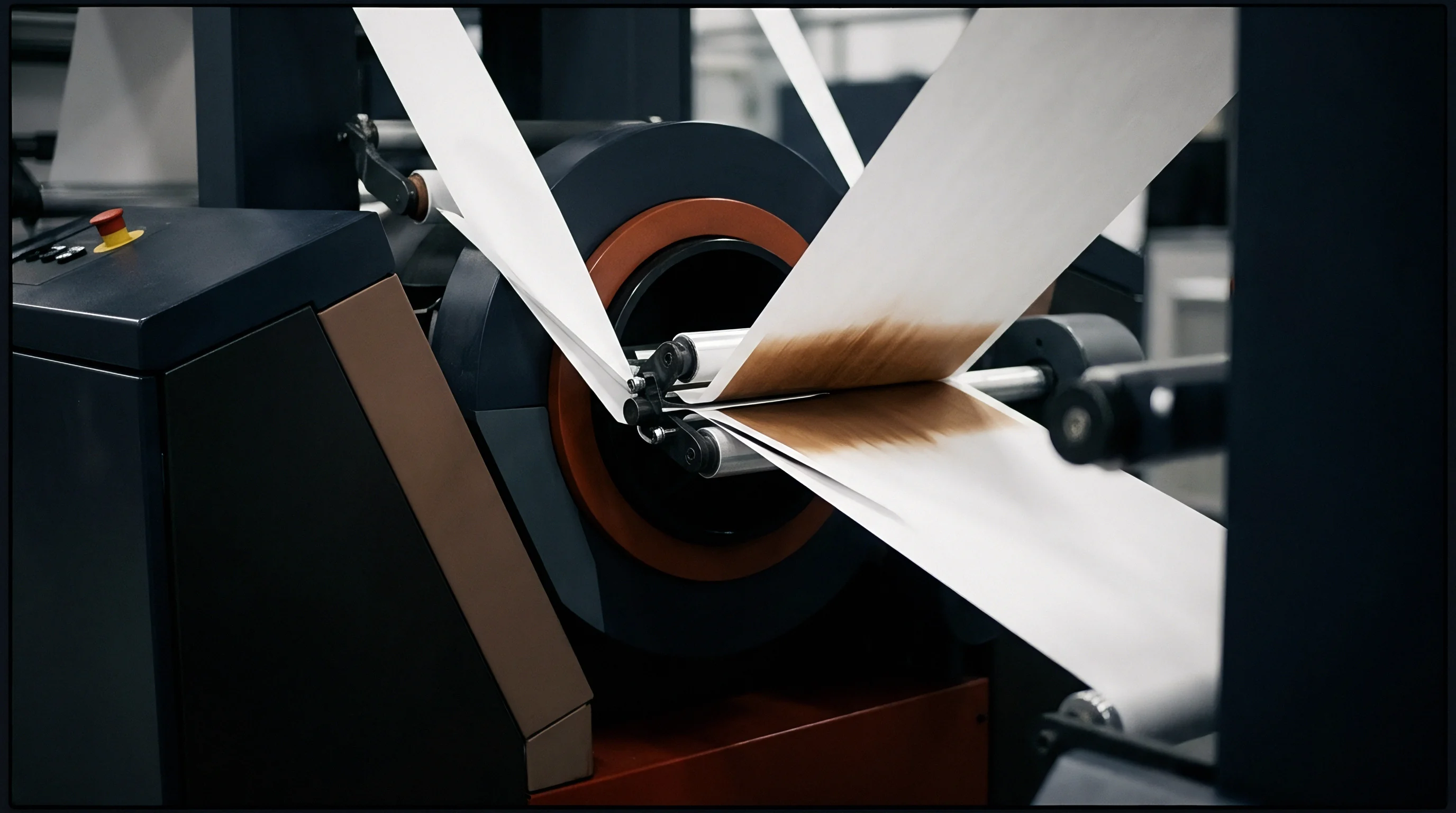
Coating heads running waterborne dispersions at seven hundred meters per minute expose fresh liquid interfaces within two to five milliseconds. When an aqueous polymer dispersion meets raw paperboard at the applicator roll or blade tip, air film displacement depends on how rapidly liquid surface energy drops during that initial contact interval. Liquid formulations possessing low static surface tension frequently fail at this junction because surfactant molecules remain trapped in the bulk liquid phase, unable to migrate to the newly created boundary before the wetting line advances.
Pinhole leaks cause line rejects.
The moving paperboard web drags a boundary layer of ambient air directly into the metering zone. If the transient surface tension of the coating remains high during the millisecond contact window, the dynamic contact angle widens past one hundred and twenty degrees. The incoming air film breaks into microscopic bubbles rather than displacing cleanly across the cellulosic fiber peaks.
These entrained micro-bubbles lodge within surface pores and valleys of the base sheet. Subsequent drying shrinks the polymer film around these trapped air pockets, puncturing the barrier layer and leaving open pinholes that ruin grease resistance and water vapor holdout.
Coatings traveling across metering blades above eight hundred meters per minute demand liquid surface re-equilibration faster than bulk surfactant diffusion can resupply the dynamic wetting line.
Air entrainment breaks film continuity. The mechanical setup of the coater blade exacerbates this vulnerability when run speeds climb. Blade geometry, tip angle, and backing roll hardness establish hydrodynamic pressures reaching two to five bar directly under the nip.
Under this transient squeeze, high transient surface tension prevents the aqueous phase from spontaneously wetting hydrophobic fiber patches or sizing deposits on the base board. Instead of spreading smoothly, the wet film cavitates behind the blade heel, forming micro-filaments that split and snap. Each snapped filament snaps back into the wet layer, dragging an air core that solidifies into a void during convection drying.
- Hydrodynamic Cavitation generates negative pressure troughs immediately behind the blade tip, pulling ambient air into micro-cavities across the wet layer.
- Contact Line Instability forces the advancing wetting meniscus to scallop, trapping air pockets along uncalendered fiber ridges.
- Capillary Resistance inhibits spontaneous penetration into board pores when liquid surface tension stays above substrate surface energy during the initial three milliseconds.
- Filament Cleavage occurs in the nip exit zone, where stretching liquid bridges rupture into mist and entrain micro-bubbles upon collapse.
Converters operating high-speed curtain coaters face an identical physical barrier when the falling liquid curtain touches the rapid board substrate. If the curtain surface tension at two milliseconds exceeds thirty-eight millinewtons per meter, the curtain heels backward and pulls air underneath the falling sheet. The liquid film ruptures.
Increasing wet coat weight does not eliminate these flaws, because additional volume merely buries the air voids deeper within the layer without resolving the interface mismatch. Run waste accumulates rapidly, producing rejection across subsequent converting operations whenever grease or moisture vapor penetrates the defective barrier layer.


Kinetics
Surfactant migration velocity dictates whether an aqueous formulation achieves wetting before the drying phase locks defects into place. Conventional ethoxylated surfactants lower equilibrium surface tension to twenty-eight millinewtons per meter over static timescales of ten to thirty seconds. At the coater nip, where interface ages range from one to twenty milliseconds, those same molecules remain motionless within the bulk dispersion.
The effective surface tension at the contact line reflects the unadulterated water phase, hovering near sixty to seventy millinewtons per meter. Surfactants require time to diffuse.

How Fast Do Surfactants Populate Fresh Interfaces?
Molecular weight, hydrophobic chain branching, and critical micelle concentration govern the diffusion rate of surface-active agents toward a newly generated interface. Small, symmetrical molecules move through the aqueous dispersion medium far faster than bulky polymeric stabilizers. Acetylenic diol chemistry demonstrates rapid migration, depressing transient surface tension below thirty-six millinewtons per meter within five milliseconds.
Sodium dioctyl sulfosuccinate provides comparable short-time kinetics, though its ionic structure introduces severe water sensitivity in dry barrier films. Bubble pressure tensiometers establish transient baselines.
Dynamic surface tension exceeding forty-two millinewtons per meter at ten milliseconds induces microscopic air entrapment on unsized bleached kraft board running at six hundred meters per minute.
The threshold value of thirty-eight millinewtons per meter at ten milliseconds rests on bubble pressure determinations conducted on solid bleached sulfate board at four hundred meters per minute. This baseline moves upward to forty-four millinewtons per meter if smooth rod metering replaces sharp blade geometry, because the extended pressure profile under a rotating rod grants surfactant molecules six to eight additional milliseconds to reach the fresh meniscus. Coater operators running fast gravure or reverse roll coaters lack this dwell buffer.
On these lines, interface creation occurs within three milliseconds, requiring chemical additions that depress short-timescale tension without generating foam.
| Surfactant Chemistry | Tension At 1 ms (mN/m) | Tension At 10 ms (mN/m) | Tension At 100 ms (mN/m) | Static Tension (mN/m) |
|---|---|---|---|---|
| Unformulated Acrylic Dispersion | 71.4 | 68.2 | 61.5 | 46.2 |
| Linear Alcohol Ethoxylate (Non-ionic) | 66.8 | 54.3 | 38.1 | 29.5 |
| Branched Polyether Siloxane | 58.2 | 46.7 | 32.0 | 24.8 |
| Symmetrical Acetylenic Diol | 44.1 | 34.6 | 31.2 | 28.4 |
| Sodium Dioctyl Sulfosuccinate | 41.8 | 32.4 | 28.5 | 26.1 |
Formulators often compensate for sluggish diffusion by elevating surfactant concentrations well above the critical micelle concentration. This practice generates massive micelle reserves in the bulk fluid, but micelle breakdown kinetics introduce another rate-limiting delay. Micelles must disassociate into individual unimers before those unimers can migrate and adsorb onto the expanding air-water boundary.
Chemical suppliers frequently assert that total surface tension reduction in the coating pan guarantees defect-free wetting across all line speeds, overlooking the reality that static laboratory measurements convey zero information regarding millisecond performance.

Crater
Pinhole voids frequently originate from surface tension differentials that develop during water evaporation rather than purely mechanical air entrainment. As the wet barrier film enters the drying tunnel, local evaporation gradients produce regions of varying surfactant concentration across the liquid surface. High evaporation rates at the boundaries of paper fibers create dry islands where surface tension spikes.
Liquid coating immediately flows away from low-tension zones toward adjacent high-tension zones, driven by Marangoni stress. This lateral mass transport pulls the wet film thin over surface asperities, creating circular crater voids that expose bare cellulose fibers.
This thin-film instability follows identical fluid-transport relations seen in naval hydrodynamics, where surfactant gradients tear apart thin surface layers on open water. On a coated paperboard sheet, the liquid film measures only eight to fifteen micrometers in thickness. A surface tension differential as small as two millinewtons per millimeter generates sufficient shear stress to drain the liquid layer completely down to the substrate within fifty milliseconds.
The presence of insoluble defoamer droplets accelerates this rupture. When a silicone or mineral oil droplet migrates to the drying surface, its low surface tension forces the surrounding aqueous dispersion to pull back aggressively, forming an open fish-eye void.
Substrate roughness exacerbates crater formation. Uncoated board absorbs water rapidly. Raw paperboard presents an uneven surface profile consisting of hydrophilic cellulosic fibers interwoven with hydrophobic sizing agents and microscopic air pockets.
When the aqueous dispersion touches this topography, rapid capillary suction drains water into the fiber matrix, raising the solids concentration of the remaining coating layer. If the transient surface tension remains elevated, the liquid meniscus cannot conform to the steep angles of the surface fibers. The coating bridges over microscopic valleys, leaving unsupported air cushions beneath the film that rupture outward as dryer temperatures vaporize the trapped air.
- Marangoni Thinning pulls fluid away from low-tension surfactant patches, leaving micro-craters directly over underlying fiber crowns.
- Defoamer Incompatibility deposits insoluble hydrophobic cores that induce severe dewetting rings across the leveling barrier layer.
- Capillary Liquid Depletion starves the surface layer of solvent, freezing partially formed craters into permanent pinhole defects before leveling completes.
- Vapor Eruption occurs when trapped sub-surface moisture boils through a skinning dispersion layer, leaving open volcano-shaped channels.
Coat weight cannot mask dewetting. Raising dry coat weight from ten grams per square meter to sixteen grams per square meter often fails to seal pinholes because the thicker film retains solvent longer, allowing Marangoni convection cells more time to circulate and rupture. The fundamental challenge remains unresolved whether dynamic surface tension must be matched strictly to initial web contact or continuously balanced against drying rates across every heating zone in the drying tunnel.

Assay
Standard laboratory evaluations of barrier coatings rely on static methods that disguise dynamic wetting failures. Conventional contact angle goniometry deposits a sessile drop on the substrate and records equilibrium contact angles after several seconds of rest. In commercial coating lines, the wetting process concludes in under twenty milliseconds.
Testing formulations strictly via static Wilhelmy plate or du Noüy ring instruments yields misleading data, approving formulations that foam or dewet violently under actual production conditions.
Maximum bubble pressure tensiometry serves as the primary verification tool for quantifying surface tension at millisecond surface ages. By bubbling nitrogen gas through a calibrated capillary submerged in the coating dispersion, the instrument records the maximum pressure required to produce a bubble across varying bubble lifetimes. Translating these lifetime measurements into surface age allows technicians to construct dynamic tension decay curves from one millisecond to ten seconds.
Formulations displaying tension curves that remain flat above fifty millinewtons per meter up to fifty milliseconds inevitably generate pinhole defects on high-speed coater blades.
- Calibrate the tensiometer capillary using pure deionized water at twenty-three degrees Celsius to confirm capillary radius and hydrostatic offset.
- Submerge the capillary exactly ten millimeters into the agitated barrier dispersion, ensuring uniform temperature control within half a degree Celsius.
- Measure bubble pressure across a frequency range spanning one bubble per second to eighty bubbles per second, corresponding to surface ages between one millisecond and one thousand milliseconds.
- Record the transient surface tension decay curve, noting the specific tension reading at five, ten, and fifty milliseconds.
- Reject coating batches where the five-millisecond surface tension exceeds forty millinewtons per meter for blade lines running over six hundred meters per minute.
Specification clauses referencing ASTM F1249 water vapor transmission thresholds penalize converters when unconditioned board samples display micro-pinholes invisible under standard light tables.
Post-coating void detection requires rigorous physical and chemical challenge testing. Visual inspection under normal lighting reveals large craters but overlooks microscopic pinholes measuring under five micrometers. Dye penetration testing under TAPPI T 431 using oil-soluble nigrosine dye or ethyl acetate dye solutions reveals capillary pinholes within thirty seconds of surface contact.
Solvent rub tests expose pinholes. Similarly, measuring water absorption via the Cobb test under TAPPI T 441 exposes barrier breakdown where water wicks through unsealed fibers. A sixty-second Cobb value jumping from two grams per square meter to fifteen grams per square meter indicates severe pinhole voiding even when the coating appears uniformly glossy.
| Tension At 10 ms (mN/m) | Visual Defect Count (per m2) | Dye Stain Pinholes (per m2) | WVTR (g/m2/day at 38 C, 90% RH) | Heptane Vapor Holdout (minutes) |
|---|---|---|---|---|
| 32.5 | 0 | 1 | 4.2 | 1800 |
| 36.8 | 0 | 3 | 5.8 | 1800 |
| 41.2 | 2 | 18 | 22.4 | 420 |
| 46.5 | 14 | 145 | 88.6 | 45 |
| 54.0 | 62 | 820 | 310.0 | 3 |
The pinhole limit of fifteen defects per square meter rests on cross-examinations conducted under ISO 5636-5 Gurley porosity guidelines across twenty-four paperboard production lots. This threshold shifts downward if ambient relative humidity during converting falls below forty percent, because dry air accelerates electrostatic charging, pulling airborne dust particles into open micro-voids and widening the defect aperture. Purchase agreements that incorporate European Standard EN 13676 for pinhole detection in plastic-coated paperboard impose financial chargebacks whenever a single stain penetration occurs across five tested sheets, forcing converters to verify millisecond wetting properties before shipping printed lots.
Penalty
Eliminating micro-voids carries steep commercial consequences across formulation cost, running yield, and finished pack compliance. Symmetrical acetylenic diol surfactants that depress millisecond surface tension cost between nine and fourteen euros per kilogram, compared to two to four euros per kilogram for standard non-ionic ethoxylates. Formulating an aqueous barrier dispersion with one percent active acetylenic diol adds approximately eighteen to twenty-five euros per wet metric ton of coating.
For a coater consuming twenty metric tons of dispersion daily, raw chemistry premiums exceed four hundred euros per shift.
Surfactant loading alters the entire processing chain. When operators increase surfactant concentrations to suppress transient surface tension voids, the coating dispersion exhibits a heightened tendency to generate persistent micro-foam under blade shear. Formulators respond by dosing mineral oil or silicone defoamers.
These defoamers act by creating localized surface tension depressions, which immediately re-introduces the identical dewetting crater defects the surfactant was intended to solve. Balancing wetting agents against defoamers narrows the operational make-ready window to razor-thin tolerances.
| Line Velocity (m/min) | Surfactant Dosing (% dry) | Defoamer Loading (% dry) | Make-Ready Waste (%) | Defect Scrap Rate (%) | Added Finish Cost per 1000 m2 (EUR) |
|---|---|---|---|---|---|
| 400 | 0.35 | 0.05 | 2.1 | 0.8 | 1.45 |
| 600 | 0.60 | 0.12 | 3.4 | 1.9 | 2.80 |
| 800 | 0.95 | 0.22 | 5.2 | 4.1 | 4.65 |
| 1000 | 1.40 | 0.35 | 8.6 | 7.8 | 7.20 |
Industry estimates attribute an unverified scrap rate of 4.2 percent to sub-surface micro-voids across wide-web curtain coating lines. Converting facilities cannot continuously audit micro-pinholes at web speeds exceeding eight hundred meters per minute without specialized online optical scatter cameras. Buyers protect their margins by holding retainage fees until offline dye testing confirms barrier continuity.
Mill trials burn expensive paperboard. Beyond direct scrap, surplus surfactant migration to the finished board surface lowers the coefficient of friction, inducing telescope roll defects during slitting and causing carton jams in high-speed folder-gluers.
Surfactant overdosing to suppress dynamic voids inevitably compromises hot-block resistance and invites repulping wash-water foaming penalties.
Environmental and food safety regulations further restrict the chemistries available to control millisecond surface tension. High surfactant loadings compromise water-repellent barrier grades under European Packaging and Packaging Waste Regulation mandates, as water-soluble surfactants extract into repulping wash water and trigger biological oxygen demand surcharges at wastewater treatment plants. In food contact packaging, low-molecular-weight surfactants face strict specific migration limits under EU Regulation 10/2011 and German BfR Recommendation XXXVI.
Sourcing teams balancing defect-free barrier integrity against compliance find that every chemical addition designed to mend interfacial voids risks failing migration certification at the brand audit. Higher line speeds widen voids. Controlling dynamic wetting without creating foam or regulatory exposure remains the single most reliable method for protecting converting margins.