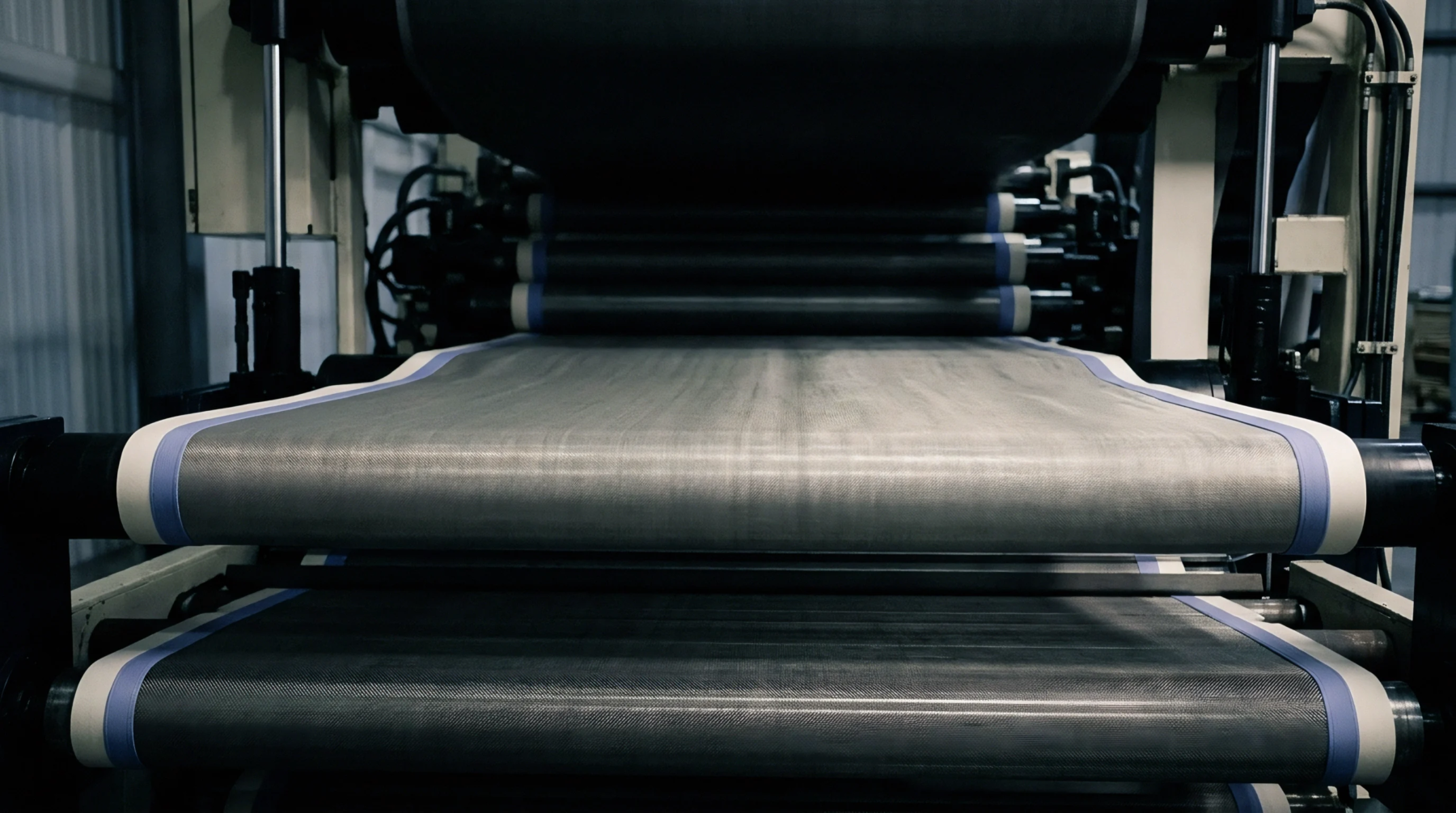
Topographic Limit
Compressive plateau conditions occur when increasing nip pressure fails to yield further micro-deviations on a paper surface. Described as surface roughness saturation, this physical ceiling marks the threshold where additional calender line load produces negligible gains in surface smoothness. Measurements of this boundary rely on Parker Print-Surf or Sheffield airflow methods under standard clamping loads.
The metric ceases to apply once nip pressure exceeds the ultimate failure point of the bulk fiber matrix.
Densification Asymptote
Progressive line loading crushes sheet bulk rapidly during the initial passes through a calender stack. As internal voids collapse, the fibrous sheet stiffens against further vertical deformation, causing the rate of roughness reduction to flatten along an asymptote. Elevating roller temperature softens surface fibers, shifting the surface roughness saturation threshold toward lower micro-inch values without requiring excessive line loads.
Beyond this threshold, additional mechanical force expends itself entirely on structural densification rather than leveling surface peaks.
Printability Plateau
Calendering past the leveling limit degrades final converting performance while providing zero gain in ink transfer fidelity. Board processors encounter fiber brittleness and micro-cracking at folding carton scores when stocks are calendered deep into the saturated zone. Caliper reduction reduces sheet stiffness, producing cartons that bow under top-to-bottom compression.
Operators halt load escalation once Parker Print-Surf readings stabilize, preserving vital substrate bulk and puncture resistance.