Quantifying Surface Energy Decay Profiles in Corona Treated Polypropylene Films
Corona discharge elevates polypropylene surface tension to forty-eight dynes per centimeter before hydrophobic recovery drops wetting below forty within days.
Oxidation
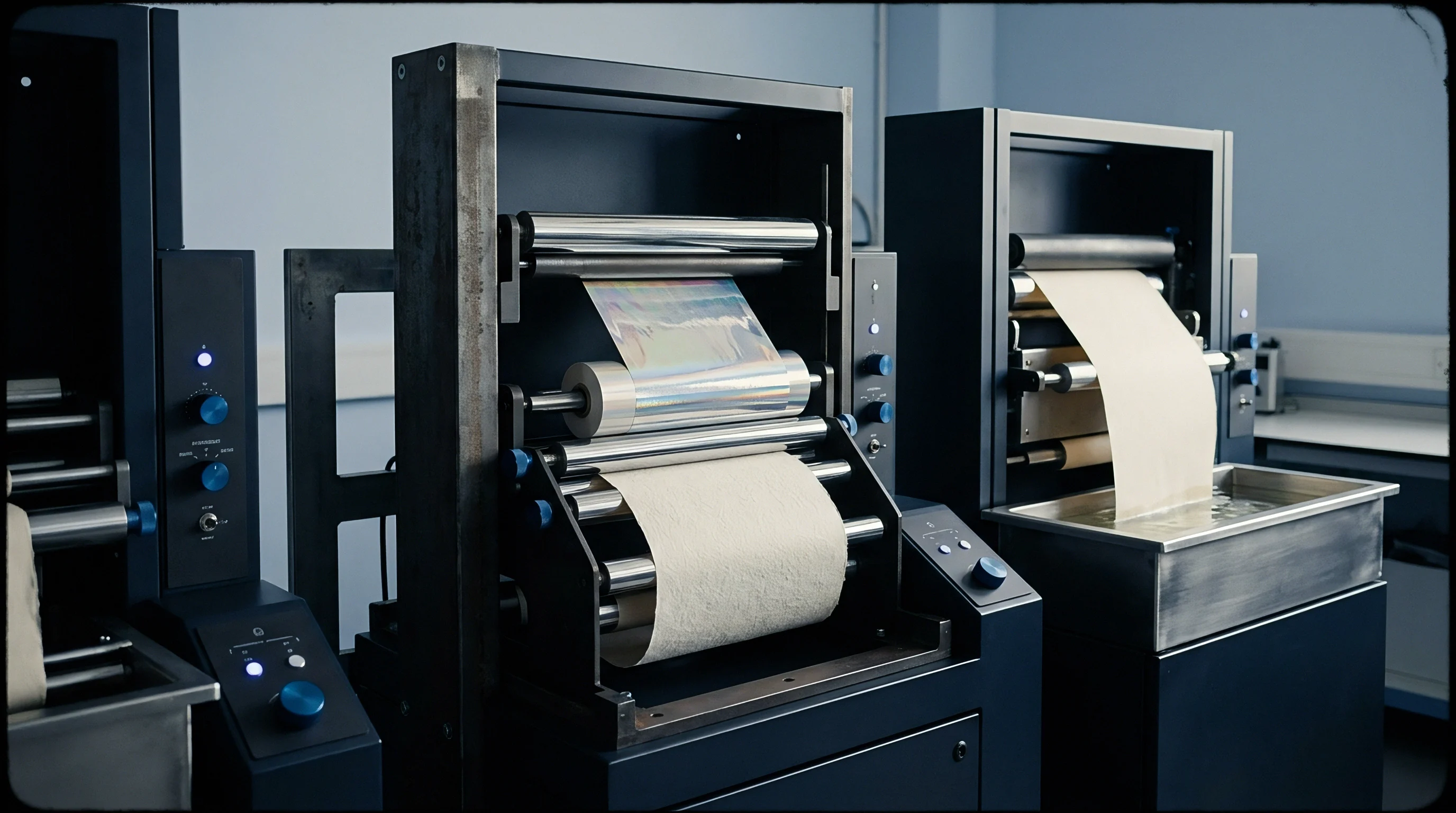
Dielectric barrier discharge generates ozone and free radicals within the air gap between a high-voltage electrode and a grounded dielectric roll. Passing biaxially oriented polypropylene through this ionized plasma fractures carbon-carbon and carbon-hydrogen bonds along the polymer backbone. Ambient oxygen couples with these surface free radicals, creating functional polar groups that elevate surface tension from an inert baseline of 29 mN/m to values between 44 and 48 mN/m.
The resulting chemical landscape determines whether water-based inks, solventless polyurethane laminating adhesives, or vacuum-deposited aluminum layers adhere to the moving web.
Fresh corona produces carboxyl groups. Hydroxyl and carbonyl groups form simultaneously across the skin layer. These oxygen-bearing species dramatically elevate the polar component of surface energy while leaving the dispersive Lifshitz-van der Waals component essentially unchanged at 28 to 30 mN/m.
Without this electrical treatment, printing inks bead into distinct droplets under the influence of liquid cohesion.
Untreated homopolymer polyolefin films reject water-based coating fluids through thermodynamic incompatibility between nonpolar polymer chains and polar liquid molecules.
Uncoated web exhibits low polarity. Industrial treaters operate at specific power densities between 15 and 45 Watts per square meter per minute to overcome this native resistance. Excessive power causes pinholing and generates low-molecular-weight oxidized material that shears off under tape peel testing, destroying interfacial bonding.
Converting lines run at speeds between 200 and 600 meters per minute, demanding continuous monitoring of discharge power to maintain consistent initial surface oxidation across the full web width.
Polar Group Generation on Polypropylene Surfaces
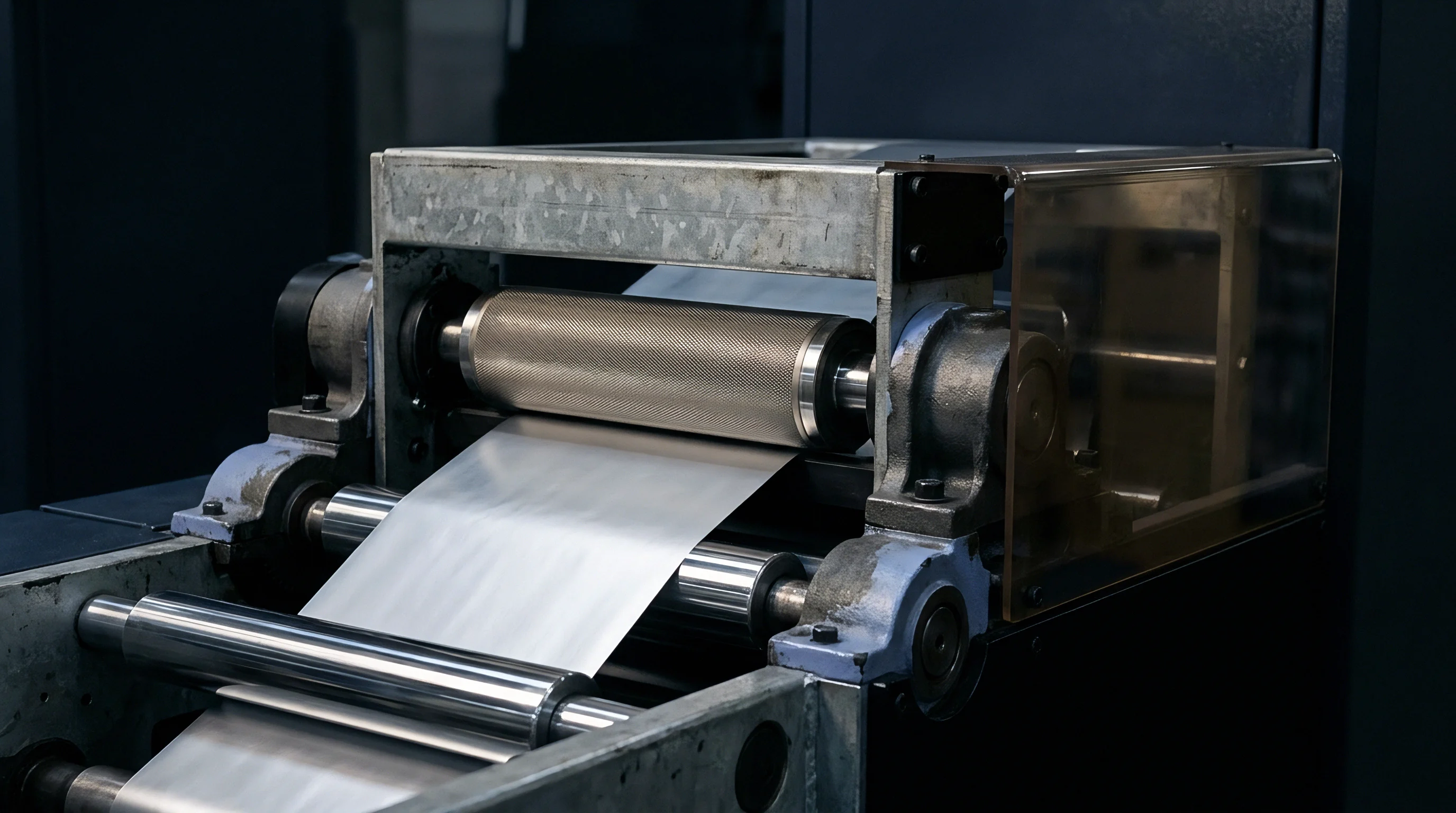
Electric fields ionizing ambient air deposit reactive chemical species onto the moving web. Ozone decomposes into molecular and atomic oxygen, attacking tertiary carbon sites in the polypropylene chain. Fourier-transform infrared spectroscopy reveals distinct absorption bands at 1715 cm⁻¹ for carbonyl stretching and 3400 cm⁻¹ for hydroxyl vibration immediately downstream of the discharge roll.
X-ray photoelectron spectroscopy quantifies an increase in surface oxygen-to-carbon atomic ratios from less than 0.01 on raw film to values exceeding 0.12 on fully treated stock.
Polar groups rotate inward. Thermal motion drives these freshly created hydrophilic sites beneath the surface plane during subsequent storage. The rate of this chemical rearrangement depends directly on ambient temperature, film orientation draw ratios, and polymer morphology.
Highly crystalline homopolymer skins resist chain relaxation longer than ethylene-propylene random copolymer heat-sealable skins. Copolymers possess higher chain mobility, allowing polar segments to submerge into the nonpolar bulk within days of processing.

Contact Angle Evolution across Film Aging Intervals
Liquid droplets placed on freshly discharged web yield baseline wetting values under optical goniometers. Deionized water contact angles drop from 102 degrees on untreated polypropylene down to 58 degrees immediately following electrical discharge. This wetting angle climbs progressively during storage, returning toward 82 degrees over a twelve-week period.
Diiodomethane contact angles remain stable between 50 and 54 degrees over the same timeframe, demonstrating that dispersive forces do not participate in surface energy decay.
Water droplets bead immediately. Surface energy quantification relies on tracking how these angles change across predefined storage intervals. Film tested immediately off the primary slitter shows high polarity, but rolls sampled thirty days later exhibit marked wetting resistance.
| Film Substrate Type | Treatment State | Water Angle (deg) | Diiodomethane Angle (deg) | Polar Energy (mN/m) | Total Energy (mN/m) |
|---|---|---|---|---|---|
| BOPP Homopolymer | Untreated Base | 101.8 | 52.4 | 1.2 | 31.4 |
| BOPP Homopolymer | Fresh Corona (1 hr) | 58.2 | 50.1 | 15.8 | 46.2 |
| BOPP Homopolymer | Aged (30 Days at 20°C) | 76.4 | 51.3 | 6.4 | 36.8 |
| EP Random Copolymer | Untreated Base | 103.5 | 53.1 | 0.8 | 30.1 |
| EP Random Copolymer | Fresh Corona (1 hr) | 61.4 | 50.8 | 14.1 | 44.5 |
| EP Random Copolymer | Aged (30 Days at 20°C) | 84.1 | 52.0 | 3.2 | 33.1 |
Film producers explain that low surface dyne readings on delivered rolls reflect inevitable atmospheric conditioning and seasonal humidity shifts during transit rather than deficient generator output during extrusion.

Reel
Winding treated polyolefin web under mechanical draw traps residual atmospheric oxygen between tightly compressed layers. Internal package pressures within a jumbo roll reach 1.5 to 3.5 MPa near the core, pressing the treated front side directly against the untreated reverse face. This intimate surface contact encourages cross-transfer of low-molecular-weight species and migratory additives across the boundary layer.
Temperature accumulation inside palletized reels acts as an environmental incubator, speeding up both chain relaxation and additive diffusion.
Tension traps air within wraps. Roll geometry influences how quickly the web loses its surface charge. Outer laps interact directly with ambient air and fluctuating warehouse humidity, whereas inner wraps experience sustained mechanical pressure and elevated winding heat.
Converters unwinding the first three hundred meters of a master roll frequently observe wetting tension three dynes per centimeter higher than readings taken near the fiber core.

How Rapidly Does Polar Concentration Dissipate?
Thermodynamic driving forces compel mobile functional chains to rotate away from the exposed boundary toward the bulk polymer matrix. Polypropylene chains maintain high segmental mobility above the glass transition temperature of 0°C. Stored at room temperature, the amorphous segments wiggle continuously, seeking thermodynamic equilibrium by burying high-energy polar groups beneath low-energy methyl pendants. Hydrophobic recovery proceeds rapidly in the initial seventy-two hours before stabilizing into an asymptotic decay trajectory.
Surface energy drops rapidly. Measurements taken at six-hour intervals demonstrate that freshly treated BOPP loses between two and four dynes per centimeter within the first day of slitting. The rate of loss drops by half during the second day and plateaus into a slow linear degradation after seven days.
Heat accelerates chain mobility. Storing slit reels in unconditioned warehouses during summer months accelerates this molecular inversion dramatically.
Biaxially oriented polypropylene held at thirty-five degrees Celsius loses five dynes per centimeter of wetting tension within the initial seventy-two hours following corona exposure.
Additive Blooming within the Wound Package
Erucamide and oleamide slip formulations migrate down thermal gradients toward the film interface. Resin compounders add primary fatty acid amides at loadings between 500 and 2000 parts per million to reduce film-to-metal friction during high-speed packaging converting. These molecules possess limited solubility within the semi-crystalline polypropylene matrix.
Extrusion chills the web rapidly, trapping slip additives in a supersaturated solid solution.
Slip packets concentrate on surfaces. Over days and weeks, these linear amide molecules diffuse to the surface where they precipitate as a microscopic waxy layer. This blooming layer blankets the corona-generated carboxyl and hydroxyl sites, causing an abrupt drop in measurable wetting tension.
In extreme formulations, slip migration masks surface energy completely, dropping readings from 44 mN/m to 32 mN/m within three weeks of production.
- Slitting inspection verifies web tension control across differential rewind shafts to prevent high winding pressures that accelerate slip additive transfer to untreated backing layers.
- Thermal quarantine isolates master rolls in climate-controlled staging bays held strictly below 25°C to limit macromolecular chain rotation.
- Preshipment sampling pulls outer-wrap and core-adjacent swatches to establish the exact decay margin before dispatching inventory to printing lines.
- Inline qualification confirms that incoming rolls retain sufficient polar functionality to bond with solventless laminating adhesives without edge-flagging defects.
Cool, dry storage slows additive migration and preserves functional surface wetting longer than heated warehouse holding.
Probe
Standardized wetting solutions evaluate polyolefin wettability through calibrated liquid mixtures and optical droplet shape analysis. Converters rely on liquid spreading behavior to predict how gravure inks and solventless adhesives will wet the substrate during production runs. Accurate measurement separates actual chemical degradation from optical measurement artifacts caused by film surface roughness, haze, or airborne contamination.
Dyne pens deposit liquid film. These disposable applicator pens deliver rapid binary feedback on press lines, indicating whether wetting tension exceeds a specific calibrated threshold. Quantitative engineering studies, however, demand laboratory goniometry and standardized test mixtures applied under controlled atmospheric conditions.
ASTM D2578 Wetting Tension Testing Mechanics
Formamide and ethylene glycol monoethyl ether mixtures spread across plastic films reveal interfacial wetting boundaries. ASTM D2578 outlines the standardized procedure for applying liquid mixtures of increasing surface tension across the test specimen using a cotton-tipped swab. The operator brushes the fluid across approximately 6.5 square centimeters of film and observes the continuous liquid film over a two-second interval under diffuse lighting.
Testing demands rigorous environmental control. If the continuous liquid film holds for two seconds before breaking into individual droplets, the wetting tension matches or exceeds the test fluid rating. If the liquid film ruptures in less than two seconds, the operator selects a lower-rated mixture and repeats the trial on an untouched web area.
The fluid volume deposited by manual swabs varies with operator technique, introducing up to two dynes per centimeter of operator variability between independent laboratories.
Purchase contracts referencing ASTM D2578 allow converters to reject incoming film shipments exhibiting wetting tension values below thirty-eight dynes per centimeter upon arrival.
Owens Wendt Rabel Kaelble Surface Energy Partitioning
Two-component liquid contact angle measurements isolate dispersive London interactions from polar acid-base forces. The Owens-Wendt-Rabel-Kaelble model relates measured equilibrium contact angles to substrate and liquid surface energy components. Deionized water acts as the polar probe fluid with a total surface tension of 72.8 mN/m, divided into a polar component of 51.0 mN/m and a dispersive component of 21.8 mN/m.
Pure diiodomethane serves as the nonpolar probe fluid, featuring a total surface tension of 50.8 mN/m composed entirely of dispersive forces.
Contact angles rise over time. The Owens-Wendt linear equation plots the relationship between the normalized polar and dispersive terms, generating a straight line whose slope yields the square root of the substrate polar component and whose intercept yields the square root of the dispersive component. As polypropylene ages, the calculated polar component contracts toward zero while the dispersive component holds rock steady.
| Aging Interval | Water Contact Angle (deg) | Diiodomethane Angle (deg) | Dispersive Energy (mN/m) | Polar Energy (mN/m) | ASTM D2578 Value (dynes/cm) |
|---|---|---|---|---|---|
| Fresh (0 Hours) | 57.4 | 49.8 | 29.8 | 16.5 | 48.0 |
| 24 Hours | 64.1 | 50.2 | 29.5 | 12.8 | 44.0 |
| 72 Hours | 70.3 | 50.6 | 29.3 | 9.6 | 41.0 |
| 7 Days | 74.8 | 50.9 | 29.2 | 7.2 | 38.0 |
| 30 Days | 78.2 | 51.2 | 29.0 | 5.5 | 36.0 |
| 90 Days | 82.6 | 51.5 | 28.9 | 3.8 | 34.0 |
| Contact angles measured via sessile drop method under ISO 187 conditioning standards using automated optical goniometry with drop volumes held at 3.0 microliters. | |||||
Testing protocols established under ISO 187 dictate sample conditioning at 23°C and 50% relative humidity for a minimum of twenty-four hours before baseline verification measurements are taken. Failure to observe this atmospheric stabilization period skews contact angle results by up to four degrees, distorting the calculated polar surface fraction.
- Fluid mixture expiration dates invalidate test results when formamide solutions exceed ninety days of shelf life due to atmospheric water absorption.
- Solvent vapor concentration within unventilated testing enclosures depresses measured dyne values through boundary-layer evaporation effects.
- Substrate handling contamination transfers fatty skin lipids to the web plane, masking localized corona treatment fields.
- Apparatus calibration logs demonstrate compliance with certified reference tile angles before daily lot release drawdowns begin.
Standard purchase specifications specifying a minimum delivery threshold of forty dynes per centimeter shift the financial liability for adhesion failures from the converter back to the film manufacturer.

Kinetics
Mathematical decay functions formalize wettability loss through multi-exponential relaxation curves. The loss of functional surface tension cannot be modeled as a single reaction pathway because two distinct physical mechanisms drive the decay. An initial rapid decay occurs as high-energy functional groups rotate into the amorphous polymer phase.
A secondary, slower decay regime reflects additive diffusion, atmospheric neutralization, and surface rearrangement.
Polymer relaxation mirrors the structural reorganization observed across silicate glass annealing and aerospace matrix curing, where strained nonequilibrium networks collapse toward thermodynamic ground states over time. In polypropylene films, this rearrangement reflects localized segmental rotations occurring along the first ten nanometers of the surface boundary.
Does Film Crystallinity Govern Hydrophobic Recovery?
Spherulite packing within the polyolefin skin layer dictates how rapidly modified molecular fragments bury themselves into amorphous regions. Biaxial stretching aligns polypropylene molecules along longitudinal and transverse directions, creating rigid crystalline lamellae flanked by flexible amorphous regions. Highly crystalline homopolymer grades exhibit dense lamellar boundaries that physically impede chain rotation, locking polar groups at the surface for extended periods.
Random ethylene-propylene copolymers incorporate ethylene disruptions into the chain architecture. This structural irregularity lowers overall crystallinity from 65% down to 48%, increasing the fractional volume of mobile amorphous domains. In these softer copolymer matrices, polar segments pivot inward with minimal resistance, cutting the functional shelf life of corona treatment in half compared to homopolymer grades.
Worked Mathematical Profiling of Decay Constants
Empirical calculations quantify surface tension dissipation over two thousand hours of ambient storage. Modeling this behavior utilizes a bi-exponential relaxation function describing total surface energy as a function of time:
γ(t) = γ_inf + Δγ_1 exp(-t / τ_1) + Δγ_2 exp(-t / τ_2)
Take a 20-micron biaxially oriented polypropylene film leaving the converting line corona treater with an initial surface tension of 48.0 mN/m. The steady-state asymptotic limit γ_inf sits at 34.0 mN/m, matching the permanently stabilized baseline of aged treated film. The fast relaxation amplitude Δγ_1 equals 8.0 mN/m, governed by a fast relaxation time constant τ_1 of 1.8 days.
The slow relaxation amplitude Δγ_2 accounts for 6.0 mN/m, driven by a diffusion time constant τ_2 of 24.0 days.
At day one (t = 1.0 day):
γ(1) = 34.0 + 8.0 exp(-1.0 / 1.8) + 6.0 exp(-1.0 / 24.0)
γ(1) = 34.0 + 8.0 0.5738 + 6.0 0.9592 = 34.0 + 4.59 + 5.76 = 44.35 mN/m
At day seven (t = 7.0 days):
γ(7) = 34.0 + 8.0 exp(-7.0 / 1.8) + 6.0 exp(-7.0 / 24.0)
γ(7) = 34.0 + 8.0 0.0205 + 6.0 0.7470 = 34.0 + 0.16 + 4.48 = 38.64 mN/m
At day thirty (t = 30.0 days):
γ(30) = 34.0 + 8.0 exp(-30.0 / 1.8) + 6.0 exp(-30.0 / 24.0)
γ(30) = 34.0 + 8.0 (5.9 10⁻⁸) + 6.0 0.2865 = 34.0 + 0.00 + 1.72 = 35.72 mN/m
The mathematical projection illustrates that the fast relaxation mechanism dominates during the first seventy-two hours, causing a drop of 5.5 mN/m. After seven days, the fast mechanism exhausts itself entirely, and ongoing decay depends exclusively on slow additive diffusion and ambient oxidation balance.
| Storage Time (Days) | Surface Tension at 20°C (mN/m) | Surface Tension at 40°C (mN/m) | Fast Component Retention (%) | Slow Component Retention (%) |
|---|---|---|---|---|
| 0 | 48.0 | 48.0 | 100.0 | 100.0 |
| 1 | 44.4 | 41.2 | 57.4 | 95.9 |
| 3 | 40.8 | 37.1 | 18.9 | 88.2 |
| 7 | 38.6 | 35.2 | 2.1 | 74.7 |
| 14 | 37.3 | 34.4 | 0.0 | 55.8 |
| 30 | 35.7 | 34.1 | 0.0 | 28.6 |
| 60 | 34.5 | 34.0 | 0.0 | 8.2 |
| 90 | 34.0 | 34.0 | 0.0 | 2.4 |
This empirical kinetic framework rests on a study of fifty standard 20-micron homopolymer lots produced under controlled 35 W/m²/min discharge rates. The constants shift upward when processing resin blends featuring over 800 ppm erucamide or when storing material above 30°C. Estimating decay trajectories on specialty high-barrier metallizable skin layers introduces unquantified boundary errors because vacuum metallizers apply proprietary chemical primers that modify baseline relaxation kinetics. Under these conditions, converters run weekly dyne tests rather than relying strictly on theoretical decay curves.
- Rotational chain relaxation buries oxygen-containing functional groups beneath nonpolar methyl groups in the amorphous phase.
- Amide slip blooming generates a physical wax barrier over the active corona-treated interface within weeks of extrusion.
- Thermal acceleration elevates polymer chain mobility, shortening the half-life of surface charges during hot warehouse storage.
- Atmospheric humidity adsorption neutralizes active free radicals and polar charges through ambient moisture condensation.
The exact chemical threshold where thermodynamic chain entombment permanently supersedes corona rejuvenation remains undetermined across high-speed packaging converting lines.


Outlay
Financial exposure on converted flexible packaging manifests as delamination scrap, ink flaking, and customer press downtime. Printing water-based inks onto polypropylene whose surface energy has dropped below 38 dynes per centimeter leads to immediate adhesive failure under cross-hatch tape testing. In laminating operations, inadequate wetting prevents polyurethane adhesive systems from spreading smoothly, resulting in optical haze, voids, and peel strengths falling below 1.0 N/15mm.
Adhesion fails at the score. Laminated snack food structures fold and score across automated packaging machines, concentrating mechanical peel stresses on the inner film interface. Ink adhesion collapses under shear.
When surface tension drops below critical thresholds, ink layers delaminate from the polypropylene backing, resulting in total rejection of delivered pouches.
Inline corona re-treatment restores wetting tension to forty-four dynes per centimeter without requiring chemical primer coats on standard flexible packaging webs.
Economic Impact of Primer and Corona Passes
Secondary inline discharge stations require capital investment for ceramic electrodes and ozone exhaust ducting. Integrating an inline corona treater onto a flexographic press or solventless laminator demands an installed outlay between $25,000 and $65,000, accompanied by continuous electrical consumption between 5 and 15 kW per operating hour. Ceramic dielectric sleeves also wear down, demanding replacement every eighteen months at $1,800 per roll.
Secondary corona treatment restores wettability. Chemical primer units deliver an alternative method for reclaiming aged film. Applying a water-borne polyethyleneimine or polyurethane primer pass adds between $0.003 and $0.007 per square meter in wet chemical costs, plus drying tunnel energy.
For a high-volume converter running twenty million square meters annually, inline electrical corona re-treatment amortizes in less than eight months compared to the ongoing chemical and drying costs of applied primer coats.
Run Spoilage Arithmetic on Degraded Rolls
Processing twenty thousand linear meters of aged web risks total adhesive bond failure during pouch conversion. Assume an unprinted 20-micron BOPP web width of 1,200 millimeters, yielding 24,000 square meters of material at an incoming raw material cost of $0.18 per square meter, representing $4,320 in substrate value. Running this job across a flexographic press with four process colors adds $0.08 per square meter in ink, mounting tape, and press hourly burden, bringing work-in-progress value to $6,240.
Lamination bonds peel apart cleanly. Solventless polyurethane lamination introduces a second 15-micron cast polypropylene sealing web at $0.14 per square meter, plus $0.04 per square meter for two-part polyurethane adhesive and lamination run charges. The finished laminated roll stock accumulates a total manufacturing cost of $0.44 per square meter, representing an inventory investment of $10,560.
Delamination destroys carton structural integrity. If this run proceeds on aged film whose wetting tension has decayed to 35 dynes per centimeter, adhesive anchorage fails completely over the subsequent forty-eight hours of room-temperature adhesive curing. The entire production lot converts to landfill scrap.
Discarding twenty thousand meters wastes $10,560 in direct materials and machine time, while remaking the customer order on emergency scheduling generates press make-ready waste of $1,200 and expedited freight surcharges exceeding $2,400.
Ignoring decay curves forces converters to absorb thousands of dollars in delaminated stock and unrecoverable press time on customer reprints.