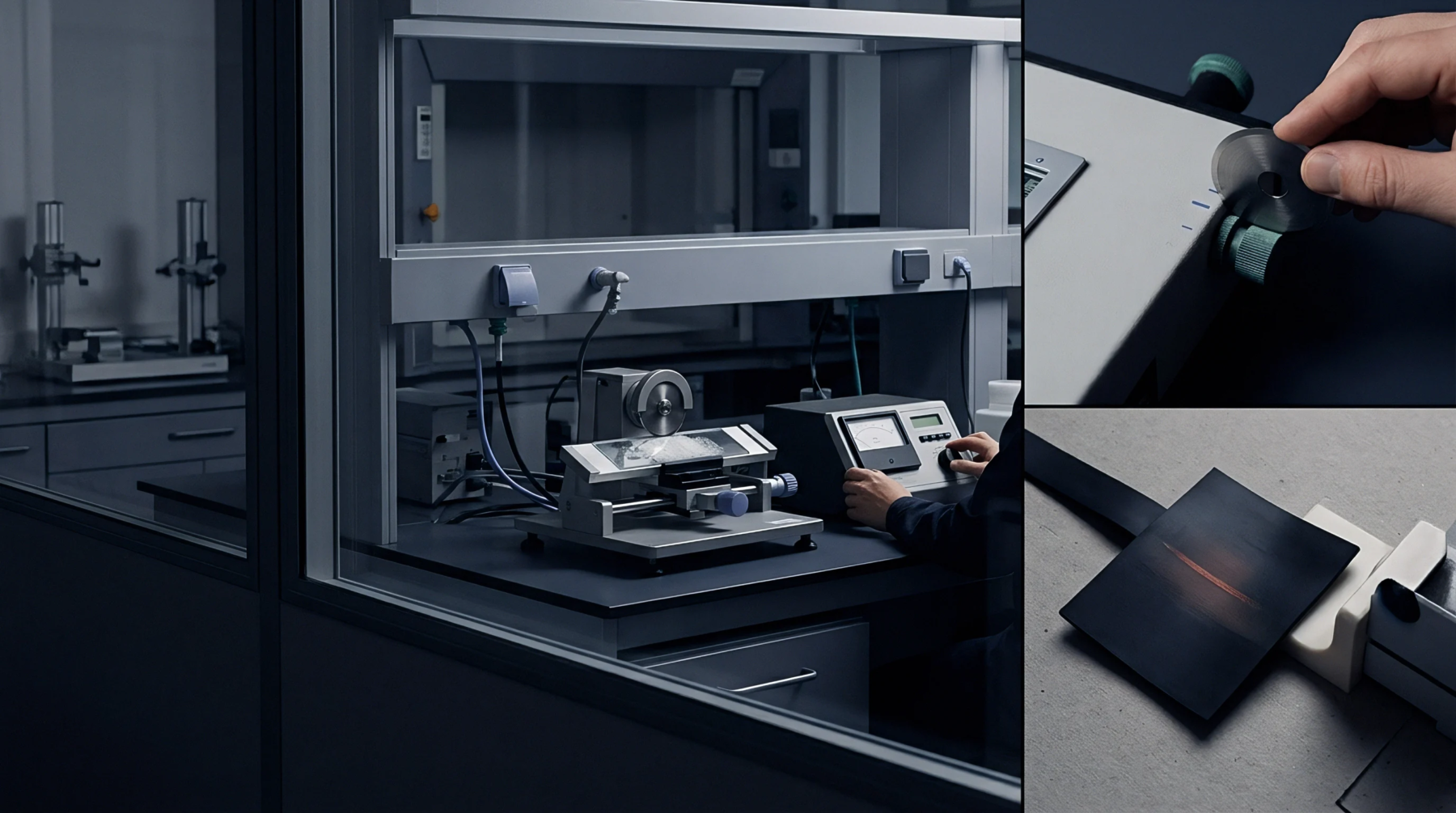
Laboratory Laminator
Specialized laboratory heating equipment designed to deliver precise contact pressure and uniform thermal energy transfers tacky polymeric particles from filter paper onto contrastive carrier membranes for optical inspection. Industrial pulp testing stations utilize a thermal transfer press to activate latent adhesive stickies isolated from recycled paper slurries during laboratory screening. The machine features electrically heated, ground-steel platens coupled to mechanical or pneumatic loading mechanisms that maintain parallel contact under constant force.
Applying controlled heat melts the surface of thermoplastic and pressure-sensitive fragments, causing them to adhere securely to coated backing sheets while non-tacky cellulosic fibers remain unbound. The mechanical scope encompasses heated flat-bed lamination units used in pulp quality analysis, excluding high-tonnage forming presses and continuous industrial web laminators.
Pressing Dynamics
Precise thermal activation requires close regulation of platen temperature, mechanical dwell time and clamping force across the test sandwich. The operator places a filter paper carrying screened pulp retentate between a black or white polyester receiver sheet and release paper, inserting the assembly into the open press cavity. Closing the platens subjects the layered sample to temperatures typically maintained between 100 and 120 degrees Celsius, paired with platen pressures ranging from two to ten kilopascals for periods between two and five minutes.
Controlled heating softens elastomeric polymers and hot melts without reaching the degradation temperature of the synthetic adhesives. If the thermal transfer press applies excessive temperature, adhesive particles undergo lateral flow, spreading outward into artificial footprints that inflate downstream optical dirt readings. Conversely, insufficient temperature leaves adhesive surfaces rigid, preventing them from transferring onto the carrier membrane and escaping visual detection.
Automated digital timers and calibrated proportional-integral-derivative controllers prevent thermal drift across consecutive testing cycles.
Purity Verification
High-precision thermal preparation prepares standardized test sheets that enable automated scanners to measure pulp contamination without manual sorting errors. Once the pressing cycle concludes and the sample cools, operators peel the carrier membrane away, revealing bonded adhesive particles anchored against a high-contrast background while residual cellulosic fibers rinse away cleanly with cold water. High-speed containerboard manufacturing depends on this reliable specimen preparation to spot aggressive adhesive loads before furnish enters the stock preparation line.
Converting facilities converting recycled board into retail packaging require clean sheets free of tacky specks that provoke web breaks on corrugators and print flaws on flexographic units. A calibrated thermal transfer press ensures repeatable physical preparation, establishing a uniform baseline for sticky quantification across testing laboratories.