Non Linear Hydrocarbon Permeation Dynamics across Mechanical Micro Microcracks in Aqueous Emulsion Coated Boards
Mechanical creasing fractures waterborne barrier coatings, causing non-linear hydrocarbon vapor migration through micro-channel networks.

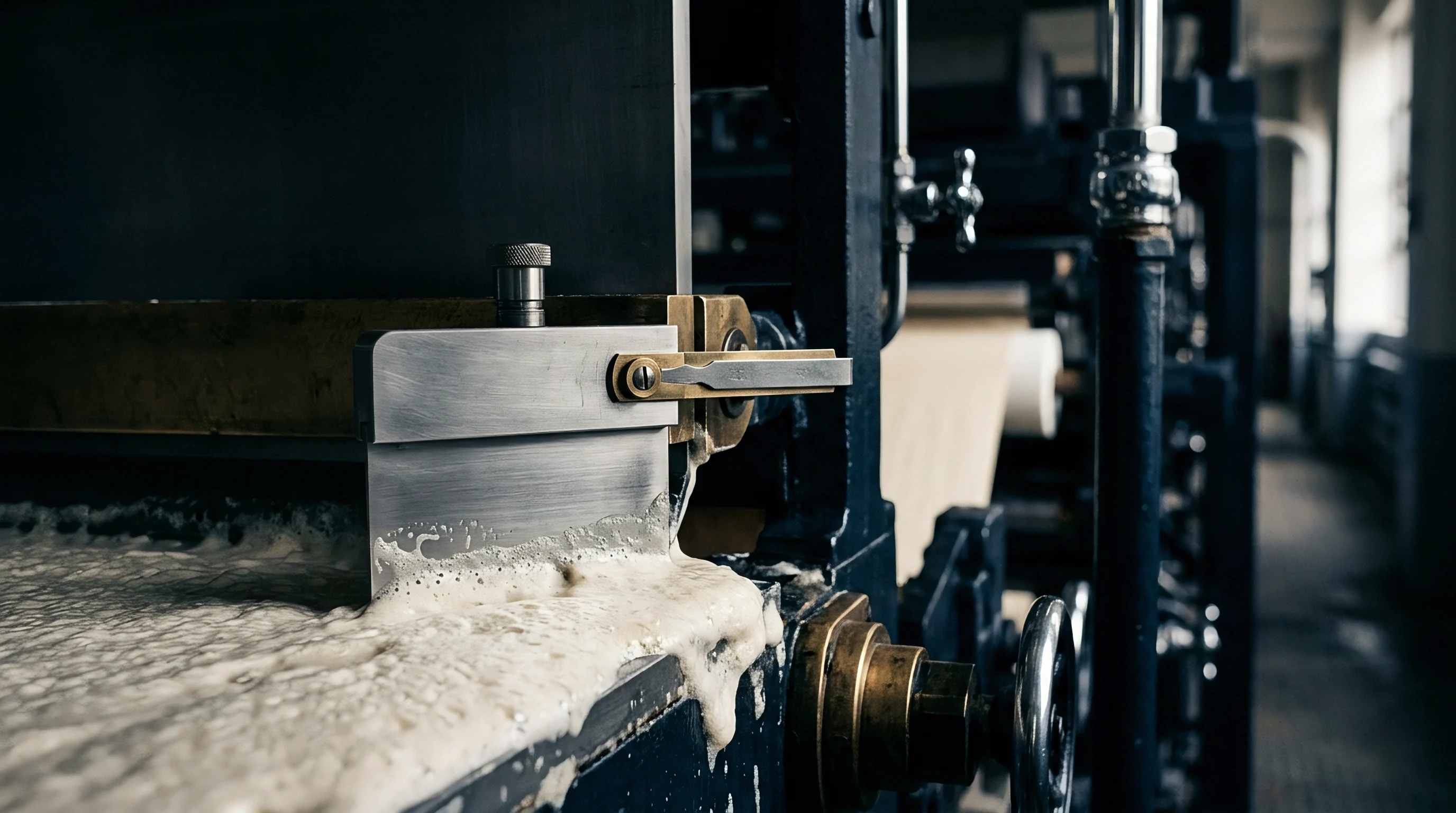
Fissure
Converting transforms flat barrier paperboard into three-dimensional packaging through localized compression and tensile strain. Scoring and creasing subject the top emulsion layer to intense elongation along the outer radius of the bend. Waterborne dispersion coatings use synthetic polymer matrices ~ such as styrene-butadiene latex, polyacrylates, or ethylene vinyl acetate copolymers ~ to form a continuous film over the cellulose fibers.
When tensile strain at the outer crease surpasses the elongation limit of the dry polymer matrix, micro-scale ruptures form across the surface. These breaches expose the underlying porous substrate to volatile organic compounds, mineral oil saturated hydrocarbons, and mineral oil aromatic hydrocarbons from inks, secondary packaging, or transport environments.
Score line geometry determines the distribution and severity of these structural breaks. On flat board, waterborne coatings show low steady-state Fickian diffusion coefficients for non-polar molecules, but mechanical scoring concentrates deformation into narrow channels. Substrate variables ~ including grammage, caliper, internal bond strength, and moisture content ~ dictate the strain profile experienced by the polymer skin.
High-density paperboard grades concentrate flexural stress into narrow hinge regions, creating higher micro-crack density than low-density recycled boards.
| Coating Polymer Base | Dry Coating Weight (g/m²) | Crease Angle (Degrees) | Mean Tensile Strain (%) | Observed Crack Width (µm) | Microcrack Surface Density (cracks/mm) |
|---|---|---|---|---|---|
| Styrene-Acrylic Dispersion | 8.0 | 90 | 4.2 | 0.15 to 0.40 | 3.1 |
| Styrene-Acrylic Dispersion | 8.0 | 180 | 9.8 | 1.20 to 3.50 | 12.4 |
| Ethylene Vinyl Acetate Dispersion | 10.5 | 90 | 3.8 | 0.00 to 0.10 | 0.4 |
| Ethylene Vinyl Acetate Dispersion | 10.5 | 180 | 8.9 | 0.45 to 1.10 | 4.8 |
| Plasticized Bio-Based Polyester | 12.0 | 180 | 11.4 | 2.80 to 6.20 | 18.9 |
Micro-cracking scales directly with coating thickness and pigment loading. Thick single-pass applications have higher flexural rigidity, making them vulnerable to brittle fracture under dynamic scoring rules. Multi-layer coating, by contrast, distributes flexural stress across discrete interfaces, lowering the incidence of fractures through the full coating thickness.
While inorganic fillers like plate-like kaolin clay or talc extend the diffusion path in intact films, they act as stress concentration points during converting, initiating local micro-fractures when tensile limits are exceeded. On high-speed carton lines, a miscalibration in score rule depth of just fifty micrometers causes immediate barrier degradation.
Temperature during folding dictates polymer chain mobility and controls how dry emulsion films fracture. Converting below the glass transition temperature of the latex matrix yields sharp, linear fractures with low tortuosity. Operations above the glass transition temperature permit localized plastic flow, preventing total matrix cleavage while creating sub-micron voids.
When high-speed converting lines run without thermal conditioning, mechanical micro-cracking breaches the continuous film and exposes the underlying paperboard core to rapid hydrocarbon penetration.

Dispersion
Formulation parameters govern both film formation and the mechanical resilience of waterborne barrier coatings. Surfactant selection, particle size distribution, glass transition temperature, and cross-linking density dictate how polymer particles coalesce during drying. Incomplete coalescence leaves interstitial boundaries within the film ~ micro-void networks that act as fault lines during creasing or embossing.
Surfactants that migrate to the film surface during drying further weaken cohesive strength, lowering resistance to micro-cracking under flexural strain.
Mineral oil saturated hydrocarbon vapor migration through micro-cracked score lines increases by two orders of magnitude compared to uncreased flat sheet controls under identical conditioning at forty degrees Celsius.
Pigment volume concentration directly drives micro-crack propagation. Platy minerals enhance barrier performance in unformed flat sheets by creating a tortuous path for migrating hydrocarbons. Exceeding the critical pigment volume concentration, however, leaves insufficient binder to encapsulate the inorganic particles, embrittling the matrix.
During converting, brittle fractures propagate along inorganic-organic phase boundaries, converting what was a continuous barrier into a dense network of open micro-fissures.
- Coalescence Deficiencies cause incomplete film formation, leaving microscopic pinholes that expand into continuous structural gaps during score line bending.
- High Glass Transition Temperature creates rigid, glassy polymer structures at room temperature that undergo brittle fracture under low bending strain.
- Excessive Pigment Volume Concentration reduces matrix elongation, accelerating stress-crack initiation across converting folds.
- Surfactant Aggregations form weak interfacial boundaries that reduce internal cohesive strength and facilitate inter-particle fracture.
- Thermal Shock During Drying induces skinning, trapping solvent moisture and forming internal stress voids within the dried barrier coat.
Converter technical datasheets frequently cite high elongation figures derived from free-standing films tested under static tensile conditions. These figures rarely reflect real performance once the coating is bonded to a heterogeneous cellulose substrate. Fiber movement, surface roughness, and differential expansion between film and paperboard concentrate strain inside the coating layer.
Barrier failures at score lines are often attributed to improper scoring tool geometry or incorrect creasing matrix selection rather than low matrix toughness or inadequate binder elongation in dispersion formulations.


Pathway
Hydrocarbon permeation through intact polymer films follows Fickian diffusion, with solute molecules dissolving into the polymer matrix and moving down a concentration gradient. Mechanical micro-cracking introduces convective mass transport and Knudsen diffusion through physical micro-channels. When crack widths approach the mean free path of vaporized hydrocarbon molecules, Knudsen diffusion governs transport kinetics; molecular collisions with channel walls occur far more frequently than collisions between molecules, yielding transport rates well above standard polymeric diffusion coefficients.

Capillary Convection and Non-Linear Flux Kinetics
Liquid hydrocarbons ~ such as vegetable oils, synthetic lubricants, and low-viscosity fractions ~ experience strong capillary suction upon contact with micro-fractured surfaces. Capillary pressure within a narrow slit crack scales inversely with crack width. Micro-cracks measuring between 0.1 and 2.0 micrometers generate enough capillary pressure to draw liquid hydrocarbons through the coating thickness into the porous fiber matrix within milliseconds.
Once inside the cellulosic matrix, liquid spreads via wetting along fiber surfaces, bypassing the barrier coating entirely.
Vapor-phase migration of mineral oil hydrocarbons ~ specifically MOSH and MOAH compounds in the C10 to C35 range ~ exhibits non-linear dynamics across micro-cracked zones. Total vapor flux equals residual Fickian diffusion through intact polymer regions plus hydrodynamic convective flow through open fractures. Under total pressure gradients, the hydrodynamic flux scales with the fourth power of crack width per Hagen-Poiseuille relations; under pure partial pressure gradients, it scales linearly with crack surface area.
| Substrate Barrier State | Effective Permeation Mode | Mean Micro-Crack Width (µm) | Calculated Tortuosity Factor | Steady-State Hydrocarbon Flux (mg/m²·day) | Barrier Efficiency Retention (%) |
|---|---|---|---|---|---|
| Uncreased Flat Sheet | Fickian Bulk Polymer Diffusion | 0.00 | 14.8 | 0.12 | 100.0 |
| Creased (Light Strain) | Knudsen Gas Diffusion | 0.25 | 2.1 | 4.85 | 2.5 |
| Creased (Moderate Strain) | Transition / Slip Flow | 0.85 | 1.3 | 28.40 | 0.4 |
| Creased (Severe Strain) | Hydrodynamic Poiseuille Flow | 2.50 | 1.0 | 195.00 | 0.06 |
| Delaminated Crease Hinge | Unrestricted Vapor Convection | 8.00 | 1.0 | 1420.00 | 0.01 |
Quantifying overall vapor transport requires calculating effective diffusivity across the fractured zone. Consider a barrier board with a ten-micrometer coating subjected to score line creasing that produces five cracks per millimeter at an average width of 0.5 micrometers. Assuming a gas-phase diffusion coefficient for a representative MOSH compound like eicosane (C20H42) in air of 0.05 square centimeters per second, compared to a bulk solubility-diffusion coefficient in the intact polymer matrix of 1.2 x 10^-10 square centimeters per second, an open crack area ratio of just 0.25 percent of the crease area increases effective transport across the micro-cracked zone by more than four thousand times, showing how completely micro-fractures dominate total mass transport.
A compliance certificate issued solely on flat board test reports provides zero warranty coverage for converted cartons carrying mechanical score lines.
- Mount the pre-conditioned board sample into a temperature-controlled dual-chamber permeation cell with the barrier coating facing the donor chamber.
- Introduce a calibrated hydrocarbon gas mixture containing specific MOSH and MOAH markers into the donor chamber at a constant flow rate.
- Maintain a sweep gas of ultra-high purity nitrogen in the acceptor chamber at atmospheric pressure to capture migrating vapor species.
- Direct the acceptor chamber effluent to a gas chromatograph equipped with a flame ionization detector or mass spectrometer for continuous quantification.
- Calculate the transient permeation curve to determine the lag time, steady-state flux, and effective barrier breakthrough dynamics across flat and folded samples.
Micro-crack morphology evolves during storage as environmental thermal cycling and internal stress relaxation take effect. Paperboard fibers absorb and desorb ambient moisture, driving localized swelling and contraction around score lines. This hygro-expansion dynamically opens and closes micro-crack apertures, altering Knudsen transport rates over time.
Meanwhile, plasticizers migrating from adjacent adhesives or printing inks into exposed crack edges can swell the coating matrix, partially closing micro-voids while softening the binder. Short-term laboratory acceleration models struggle to predict the long-term equilibrium of these dynamic micro-channel networks.
Measurement
Evaluating hydrocarbon migration across aqueous emulsion coated paperboard requires testing protocols that account for converted pack geometry. Standard European food contact testing uses modified polyphenylene oxide (Tenax) as a solid simulant for dry fatty foods under EN 14338. Testing flat, unformed board yields low migration figures that overstate barrier performance; when identical boards undergo standard 180-degree folding prior to exposure, analytical results regularly show a surge in detected MOSH and MOAH fractions.

Standard Test Protocols and Analytical Limitations
Quantifying mineral oil hydrocarbons requires high-performance liquid chromatography coupled with gas chromatography and flame ionization detection (HPLC-GC-FID). This technique separates MOSH from MOAH fractions prior to thermal desorption and chromatographic separation. Standard gas chromatography methods struggle to differentiate between natural plant waxes, synthetic oligomers from the board binder, and petroleum-based mineral oil contaminants.
Sample preparation requires online epoxidation to remove interfering olefins like squalene or carpet terpenes, which would otherwise generate false-positive MOAH readings.
| Test Standard | Food Simulant Used | Contact Condition | Sample Geometry | MOSH C10-C35 Recovery (mg/kg food) | MOAH C10-C35 Recovery (mg/kg food) |
|---|---|---|---|---|---|
| EN 14338 (Tenax) | Modified Polyphenylene Oxide | 10 days at 40°C | Flat Sheet | 0.08 | < 0.01 |
| EN 14338 (Tenax) | Modified Polyphenylene Oxide | 10 days at 40°C | Creased (DIN 53121) | 3.45 | 0.62 |
| EN 1186-5 (Solvent) | Iso-octane Total Immersion | 2 days at 20°C | Flat Sheet | 0.42 | 0.05 |
| EN 1186-5 (Solvent) | Iso-octane Total Immersion | 2 days at 20°C | Edge-Sealed Pack | 12.80 | 2.10 |
| BfR Recommendation XXXVI | Solvent Extraction (Ethanol 95%) | 4 hours at 60°C | Folded Edge Joints | 18.90 | 3.40 |
Solvent extraction with iso-octane or ethanol can induce artificial swelling in the emulsion matrix, altering crack dimensions during testing. Solvents penetrate micro-voids and dissolve low molecular weight binder components, creating migration pathways that do not exist during dry food contact. By contrast, gas-phase transport testing using volatile surrogates like heptane or toluene offers a rapid screening method for micro-crack integrity without altering polymer morphology.
Strong correlation between solvent vapor transmission rates and HPLC-GC-FID mineral oil values allows converting plants to run inline quality checks on creased board.
Test reports using flat uncreased sheets offer zero defense against food safety compliance failure once converted cartons land on retail shelves.
Establishing defensible compliance files requires rigorous sample verification before testing. Quality managers must ensure test specimens reflect worst-case converting conditions, including maximum scoring rule depth, minimum bend radii, and high-speed folder-gluer execution.
- Verification of Sample Creasing Parameters requires confirming that test specimens carry standard cross-direction and machine-direction score lines produced under nominal production pressures.
- Analytical Simulant Selection relies on solid Tenax for dry food contact testing to isolate gas-phase migration without inducing matrix swelling.
- Chromatographic Fractionation Verification ensures operational epoxidation steps eliminate natural plant interferences to prevent false MOAH readings.
- Temperature Acceleration Limits cap thermal exposure at forty degrees Celsius during migration testing to prevent unrepresentative glass transition softening of the emulsion film.
Selecting appropriate test conditions prevents false passes that lead to product recalls and border rejections. Standard protocols that omit mechanical creasing systematically underestimate real-world hydrocarbon transport across converted packaging. While some practitioners apply safety factors to flat-sheet test data to estimate score line migration, physical testing of formed packaging remains the only defensible validation method.

Recourse
Commercial contracts for barrier packaging board frequently leave legal liability gaps between paper mills, converters, and brand owners. Board manufacturers test and certify aqueous emulsion coated grades as flat sheets, issuing compliance declarations under ideal laboratory conditions. When converters form those boards into folding cartons, score line creasing fractures the coating skin, undermining the mill’s initial barrier claims.
If migration audits subsequently reveal mineral oil contamination above actionable thresholds, disputes arise over whether liability sits with the coating supplier, the paperboard mill, or the converter.
European regulatory frameworks are tightening structural standards for mineral oil migration limits in food contact materials. European Union Regulation 1935/2004 mandates that packaging materials must not transfer constituents to food in quantities that endanger human health. Draft national regulations, like the German Mineral Oil Ordinance, propose a maximum MOAH migration limit of 0.1 milligrams per kilogram of food for paper and board.
Simultaneously, the EU Packaging and Packaging Waste Regulation restricts chemical barriers that impede mechanical recycling, placing aqueous dispersion coatings under dual scrutiny for both barrier integrity and repulpability compliance.
Customs authorities and market surveillance bodies halt shipments based on converted pack migration findings rather than mill flat-sheet certificates.
Cost exposure extends well beyond packaging replacement when hydrocarbon migration breaches regulatory thresholds. Retaining non-compliant inventory on retail shelves risks product recalls, brand damage, administrative fines, and mandatory customs impoundment of imported packaged goods. Importers of record bear sole legal responsibility for compliance at the border, leaving them vulnerable when supplier documentation relies exclusively on flat-sheet test certificates.
Procurement agreements must incorporate warranty clauses that explicitly cover converted barrier performance under operational conditions. A standard supply contract clause shifting technical responsibility reads: The seller warrants that the supplied aqueous emulsion coated paperboard retains its specified mineral oil barrier efficiency, achieving a MOSH migration limit below 0.5 mg/kg and MOAH below detection limits (0.1 mg/kg) under EN 14338 test conditions, when creased and folded according to standard converting specifications set forth in Schedule B.