Nonlinear Finite Element Formulations for Moisture Gradient Driven Microstructural Flute Instability under Variable Climate Distribution
Nonlinear shell formulations integrating hygro-expansion and mechano-sorptive creep predict humidity-driven flute buckling to prevent packaging transit collapse.

Deflection
Box compression performance decays during sea transport when ambient humidity swings between sixty and ninety percent. Standard McKee equations predict top-to-bottom compressive capacity from ambient edge crush test values, flexural stiffness, and box perimeter. Those formulations assume stationary equilibrium moisture content throughout the liners and the fluting medium.
In maritime intermodal shipping containers, relative humidity fluctuations generate transient through-thickness moisture gradients before the paperboard reaches hygroscopic equilibrium. Corrugated board loses rigidity rapidly. The outermost fibers of the linerboard take up moisture within minutes, while the fluting core lags by hours.
This asymmetric swelling introduces internal bending moments, eccentric compressive loading, and premature out-of-plane bifurcation long before the container reaches steady-state conditioning.
Under cyclic humidity between fifty and ninety percent at twenty-three degrees Celsius, edge crush resistance drops forty-two percent within four hours of sorption.
Finite element models relying solely on linear elasticity fail to forecast this collapse mechanism. Compressive failure of corrugated boxes under climate distribution stems from localized geometric bifurcation inside the flute tips and flanks. As water molecules disrupt hydrogen bonding between cellulose microfibrils in the amorphous hemicellulose matrix, the longitudinal tangent modulus of the paperboard degrades nonlinearly.
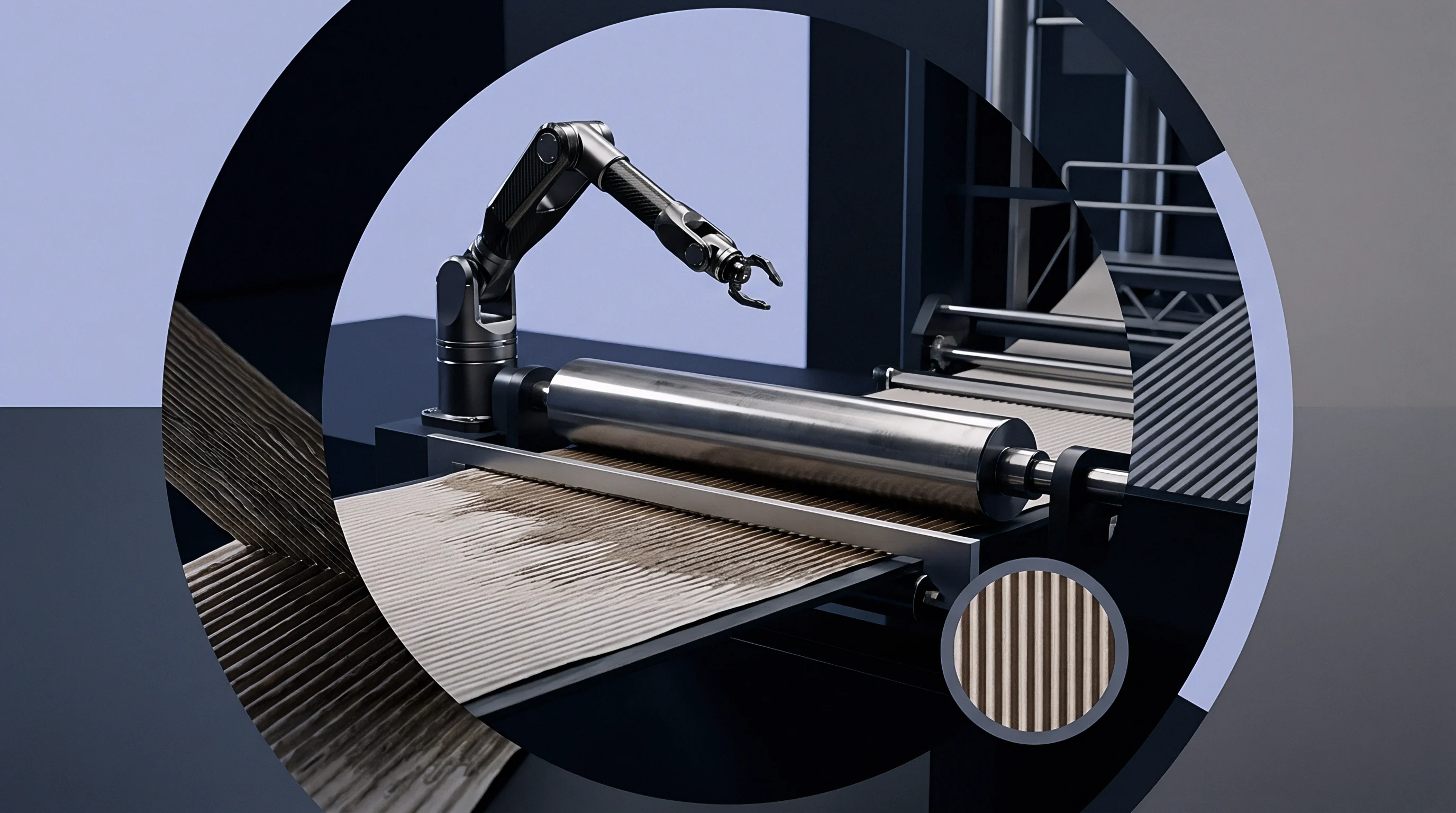
The fluting medium, formed under residual plastic strain during the corrugating rolls corrugation process, possesses an asymmetric initial stress state. Coupled moisture transport and mechanical equilibrium equations reveal that the crest-to-liner adhesive interface experiences extreme peeling and shear stresses under moisture gradients, inducing microstructural instabilities that trigger box collapse under nominal static loads.
McKee Equation Shortfalls under Nonisothermal Humidity
Static engineering formulas treat corrugated structures as equivalent homogeneous plates with constant flexural rigidity. When ambient relative humidity cycles between day and night, the moisture sorption front penetrates the outer liner, crosses the starch bond, and travels into the flute arch. Linear models fail here.
The diffusion coefficient along the cross direction ranges from 1.2 × 10⁻¹¹ to 4.8 × 10⁻¹¹ square meters per second, depending on the furnish composition and refining degree. Because the diffusion rate through the thickness is roughly two orders of magnitude lower than along the in-plane fiber direction, significant moisture differentials develop across the 180-micrometer wall of a fluting medium. This localized gradient generates hygro-expansion strains that oppose or magnify the external stacking load, warping the flute wall into a secondary curvature.
| Paperboard Grade | Basis Weight (g/m²) | Sorption State (RH %) | Elastic Modulus MD (MPa) | Elastic Modulus CD (MPa) | Geometric Mean SCT (kN/m) |
|---|---|---|---|---|---|
| Virgin Kraftliner | 175 | 50 | 7420 | 3180 | 3.85 |
| Virgin Kraftliner | 175 | 90 | 3680 | 1490 | 1.92 |
| High-Performance Testliner | 160 | 50 | 5850 | 2410 | 2.95 |
| High-Performance Testliner | 160 | 90 | 2510 | 980 | 1.31 |
| Semi-Chemical Fluting | 127 | 50 | 6100 | 2650 | 3.10 |
| Semi-Chemical Fluting | 127 | 90 | 2890 | 1120 | 1.44 |
| Recycled Medium | 120 | 50 | 4200 | 1750 | 2.15 |
| Recycled Medium | 120 | 90 | 1650 | 640 | 0.88 |
When design teams rely on static McKee calculations calibrated at standard laboratory atmospheres of twenty-three degrees Celsius and fifty percent relative humidity, their safety margins vanish during transport through equatorial corridors. Pallets stacked three units high lean, the bottom corrugated tiers crease along the horizontal scorelines, and entire container shipments crush into the dunnage, generating structural cargo claims that average thirty-five thousand euros per ocean container.
Web
Cellulose networks behave as orthotropic layered media whose principal stiffness directions coincide with the machine direction and cross direction of the paper machine. The machine direction exhibits higher fiber orientation, conferring an elastic modulus typically two to three times greater than that in the cross direction. In corrugated board fabrication, the fluting medium runs with its machine direction oriented along the axis of the flute corrugations, placing the lower cross direction modulus in line with the vertical compressive load of a stacked shipping carton.
Moisture softens the web. Because the transverse hygro-expansion coefficient in the cross direction exceeds the machine direction value by up to a factor of five, humidity intake expands the paperboard predominantly in the direction bearing the primary structural burden.
Furnish selection determines how aggressively moisture degrades the cell wall matrix. Virgin unbleached kraft pulp produced via the sulphate process retains intact, long softwood fibers that maintain hydrogen bond networks under modest hydration. In contrast, recovered post-consumer furnish contains shortened, hornified fibers with elevated ash fractions and residual sizing agents that destabilize upon wetting.
Recycled fibers absorb water faster. When moisture content rises from eight to eighteen percent dry basis, hornified recycled fibers exhibit accelerated inter-fiber sliding. The bonded area between adjacent fibers contracts as water molecules form multi-layer hydration shells around exposed hydroxyl groups, driving rapid reduction of the shear modulus across the transverse plane.
- Furnish Hornification Index dictates the irreversible loss of swelling capacity following multiple drying cycles, reducing inter-fiber bonding strength by twenty to thirty-five percent compared to virgin unbleached kraft pulps.
- Starch Adhesive Penetration Depth establishes whether the glue line reinforces the flute crest or creates a brittle, moisture-sensitive boundary where stress concentrations initiate delamination under cyclic humidity.
- Contact Angle Wettability governs how liquid condensate from container rain migrates across the calendered surface of the exterior linerboard into the interstitial flute cavities.
- Residual Aluminum Sulfate Chemistry accelerates acid hydrolysis of hemicellulose chains under elevated temperature and humidity during transit, degrading fiber wall tensile capacity over thirty-day shipping windows.
Adhesive joints linking the fluting tips to the linerboards introduce complex micro-mechanical boundaries. Traditional corrugating adhesives rely on modified native corn or wheat starch suspended in an alkaline borax carrier. Starch adhesive lines resist shear.
When the adhesive cures, it forms a dry starch film with high elastic modulus but notable moisture susceptibility. As surrounding air exceeds eighty percent relative humidity, the starch absorbs moisture, undergoing plasticization that drops its shear yield limit from twelve megapascals down to less than two megapascals. The fluting tip loses rotational restraint, converting a clamped-clamped plate boundary condition into a pinned or elastomeric hinge that slashes the critical buckling load of the flute flank by more than half.
Adhesive shear yield values falling below two megapascals convert rigid flute tip fixity into pinned connections that cut structural compressive thresholds by fifty-five percent.
Mills frequently claim that surface water-repellent sizing additives compensate for low virgin fiber content, asserting that a Cobb sixty value below twenty-five grams per square meter guarantees mechanical survivability across maritime trade lanes.


Formulation
Mathematical modeling of moisture-induced structural failure demands a continuum mechanics framework capable of handling finite rotations, large displacements, and coupled hygro-mechanical kinematics. Classical linear Kirchhoff plate theories cannot represent the out-of-plane distortion of curved fluting geometry under transverse shear. A fully nonlinear formulation implements a co-rotational or updated Lagrangian shell element framework incorporating seven degrees of freedom per node to account for through-thickness strain and thickness stretching.
Transverse shear strains trigger buckling. The total Green-Lagrange strain tensor partitions into elastic, plastic, hygro-expansive, and mechano-sorptive creep components.
The constitutive relation couples moisture concentration fields directly to the tangent stiffness tensor. Let theta represent the normalized moisture concentration across the shell thickness coordinate zeta. The total strain rate tensor decomposes into:
d_epsilon = d_epsilon_e + d_epsilon_p + d_epsilon_beta + d_epsilon_ms
The hygro-expansive strain rate increment relates directly to the moisture increment through the second-order hygro-expansion tensor beta:
d_epsilon_beta = beta(theta) d_theta
Because paperboard exhibits anisotropic hygro-expansion, beta contains distinct components along the machine direction, cross direction, and thickness direction, with values approximately 0.05, 0.25, and 1.20 percent strain per percentage point moisture content gain. The tangent stiffness degrades. As moisture accumulates, the elastic stiffness tensor C(theta) scales according to an exponential degradation function derived from experimental ultrasonic stiffness determinations.
The softening rate accelerates once localized moisture exceeds fourteen percent dry basis.
Does Nonlinear Kinematics Capture Localized Web Crushing?
Numerical simulations demonstrate that geometric imperfections govern the bifurcation path of the sinusoidal fluting core. In standard C-flute geometry, with a pitch of 7.9 millimeters and a flute height of 3.6 millimeters, small variations in flute tip radius generate eccentric bending moments during vertical compression. Applying a small-strain formulation understates localized transverse deflection by forty to sixty percent when relative humidity exceeds seventy-five percent.
A nonlinear co-rotational formulation captures the secondary buckling modes that emerge along the flute flanks between adjacent glue lines.
| Kinematic Element Type | Degrees of Freedom per Node | Constitutive Plasticity Model | Bifurcation Load at 50% RH (N/mm) | Bifurcation Load at 90% RH (N/mm) | Post-Buckling Convergence Stability |
|---|---|---|---|---|---|
| Linear Mindlin Shell (S4R) | 6 | Isotropic J2 Flow | 14.8 | 9.2 | Bifurcation missed; premature divergence |
| Continuum Solid Shell (SC8R) | 3 | Orthotropic Hill-48 | 12.6 | 6.4 | Stable through snap-through |
| Co-rotational Layered Shell | 7 | Anisotropic Xia Model | 11.9 | 4.7 | Captures flank micro-buckling cleanly |
| Solid-Shell with Cohesive Interface | 7 | Bilinear Traction-Separation | 11.2 | 3.9 | Predicts joint debonding and localized crush |
| Evaluated on a 50 mm x 50 mm single-wall C-flute domain subjected to 1.0 mm/min vertical edge compression under transient moisture diffusion. | |||||
To capture the localized debonding of the flute crests from the liners, zero-thickness cohesive interface elements are inserted along the adhesive strip. The traction-separation behavior follows a bilinear softening law where the critical fracture energy release rates in normal opening Mode I and tangential sliding Mode II decay exponentially as a function of interfacial moisture concentration. When moisture softens the starch bridge, interfacial shear stresses induce microscopic delamination, eliminating structural continuity between the outer liner and the inner arch.
- Initialize geometry and orientation vectors by mapping orthogonal material axes across the curved flute profile using local curvilinear coordinate transformations.
- Execute transient moisture diffusion step applying ambient boundary conditions to determine the nodal moisture concentration field theta through Fickian or non-Fickian kinetics.
- Evaluate degraded orthotropic constitutive tensors at every integration point across the layered shell thickness using updated moisture values.
- Formulate internal force vector and tangent stiffness matrix incorporating geometric non-linearities via Green-Lagrange strain formulations.
- Solve equilibrium iterations via Newton-Raphson scheme checking displacement and residual force tolerances against convergence limits.
- Detect bifurcation points through eigenvalue extraction or arc-length continuation routines to trace stable post-buckling equilibrium paths.
Consider a standard C-flute single-wall corrugated panel with an initial dry basis weight of 175 grams per square meter for both liners and 127 grams per square meter for the semi-chemical fluting medium. Take a 100-millimeter wide test strip subjected to an ambient step-change from fifty percent to ninety percent relative humidity under a constant top load of five hundred newtons. Numerical integration of the coupled field equations indicates that moisture accumulates non-uniformly through the outer liner within twelve minutes, while the internal fluting core remains at eight percent moisture.
The resulting hygro-expansive strain mismatch generates an initial out-of-plane deflection of 0.42 millimeters along the central flute arch. Linerboard delamination finishes the box. As the outer liner yields under combined axial compression and bending, the internal load shifts entirely into the fluting tips, exceeding the degraded critical bifurcation capacity and precipitating total section collapse within seventy-eight minutes.
The exact micro-mechanical mechanism by which lignin redistribution inside semi-chemical fibers alters the irreversible dislocation density during sorption cycling remains an active topic of investigation across pulp and paper physics laboratories.

Climate
Marine logistics routes expose freight containers to diurnal thermal and hygrometric oscillations that trigger violent moisture exchange between the interior air space and packaged goods. When ambient temperatures plunge during nightfall on open ocean vessels, air inside the shipping container reaches saturation, driving condensation events termed container rain. Equilibrium moisture content lags behind.
Containerboard does not absorb or desorb water along a singular thermodynamic curve; sorption isotherms exhibit marked hysteresis between adsorption and desorption branches.
Dynamic sorption loops alter the stress state of paperboard via the mechano-sorptive effect. Mechano-sorptive creep represents an accelerated rate of inelastic deformation occurring exclusively during transient moisture movement through a loaded fibrous structure. Sorption hysteresis alters local strain.
Under steady-state conditioning at ninety percent relative humidity, a corrugated structure deforms under creep at a rate proportional to its baseline viscoelastic compliance. When the relative humidity cycles dynamically between fifty and ninety percent every twelve hours, the observed creep deformation rate increases by a factor of three to five relative to the stationary high-humidity benchmark.
Do Flute Microstructures Buckle under Cyclic Humidity?
Microstructural examination reveals that mechano-sorptive acceleration originates within the transient swelling and contraction of hemicellulose chains bonding adjacent cellulose microfibrils. Under external compression, moisture ingress temporarily unlocks interfiber crosslinks, allowing microfibrils to slip into lower energy configurations before water molecules stabilize. Mechano-sorptive creep accelerates collapse.
As drying initiates during the subsequent cycle, internal stresses cannot revert to their initial state, locking in permanent plastic dislocations along the flute flanks. Each climate cycle acts as an irreversible ratcheting mechanism that amplifies the out-of-plane amplitude of the flute walls.
| Environmental Regime | Cycle Duration | Equilibrium Moisture Content Range (%) | Transient Creep Acceleration Factor | Flute Buckling Inception Time (Hours) |
|---|---|---|---|---|
| Isothermal Steady State (23°C / 50% RH) | None | 7.5 – 7.8 | 1.0 | No collapse observed at 500 hours |
| Isothermal Steady State (23°C / 90% RH) | None | 17.2 – 17.6 | 2.4 | 280 |
| Diurnal Cycling (15°C-35°C / 50%-90% RH) | 24 Hours | 8.2 – 16.9 | 6.8 | 46 |
| Rapid Marine Transit (20°C / 60%-95% RH) | 6 Hours | 9.5 – 18.1 | 9.2 | 18 |
| Cold Chain Condensation (4°C-25°C / 85%-98% RH) | 12 Hours | 14.0 – 22.5 | 14.5 | 6 |
Finite element simulations of cyclic moisture regimes incorporate an internal state variable representing cumulative transient moisture flux. The mechano-sorptive constitutive tensor couples the deviatoric stress state to the absolute time derivative of the moisture concentration. Pallet loads crush suddenly.
The resulting localized strain concentrations localize along the inner radius of the flute crests, where stress triaxiality is highest. Within three moisture cycles, the transverse flexural stiffness of the corrugated medium degrades past the critical threshold required to prevent secondary buckling, precipitating a catastrophic loss of top-to-bottom package rigidity.
- Equilibrium Adsorption Offset denotes the lag between atmospheric humidity shifts and core paperboard fiber moisture, generating through-thickness hygro-expansion gradients that induce out-of-plane twisting.
- Lignin Matrix Glass Transition drops into the ambient temperature operating envelope as moisture plasticization lowers the thermal softening boundary of unbleached kraft papers.
- Transverse Shear Delamination propagates along low-density core interfaces when localized hygro-expansion strains exceed the Mode II shear capability of recycled fiber networks.
Paperboard structures subjected to fluctuating humidity fail at load levels that remain perfectly secure under constant atmospheric moisture.
Exposure
Regulatory frameworks governing packaging waste and environmental claims enforce severe commercial penalties for structural packaging over-design or catastrophic cargo collapse. The European Packaging and Packaging Waste Regulation mandates significant source reduction, requiring converters to minimize packaging weight and headspace without sacrificing transport safety. Converting companies that down-gauge containerboard to satisfy regulatory weight targets without verifying nonlinear flute instability under climate cycling risk catastrophic transit failures.
Customs inspectors seize warped cartons. When secondary packaging collapses during customs inspection or port handling, border authorities hold entire consignments under non-compliant cargo provisions.
Chain-of-custody documentation under certification schemes like the Forest Stewardship Council and the Programme for the Endorsement of Forest Certification establishes fiber origin but does not verify physical batch performance. Importers frequently present an FSC Mix or PEFC certified claim on a bill of lading, assuming the paperwork confirms structural integrity. Unsupported environmental claims invite fines.
Chain-of-custody certificates track input-output volume reconciliation across credit or percentage accounting mechanisms. They provide zero proof regarding fiber hornification, moisture sorption coefficients, or interfacial starch bond durability under maritime transit.
Purchasing teams negotiating supply agreements must anchor technical specifications to verified performance standards under controlled cyclic conditioning rather than nominal basis weight. Box failure cancels carrier coverage. When containers collapse due to humidity-induced flute buckling, marine cargo underwriters routinely deny insurance claims by citing inadequate packaging under standard Institute Cargo Clauses.
The financial liability flows upstream directly to the brand owner or importer of record who signed the packaging specification sheet.
International maritime carriage contracts exclude cargo loss where structural packaging failures originate from predictable humidity fluctuations along the transit corridor.
Specifications that replace static edge crush guarantees with mandatory ASTM D685 conditioning at ninety percent relative humidity and cyclic ISTA 3E protocols shift structural liability back to the corrugated converter.