Short Span Compressive Strength Degradation in Recycled Testliner under Moisture
Recycled testliner loses up to 50 percent of ISO 9895 short span compressive strength at 85 percent RH, requiring elevated BCT safety factors for transit.
Matrix

Hydrogen Bond Network Disruption
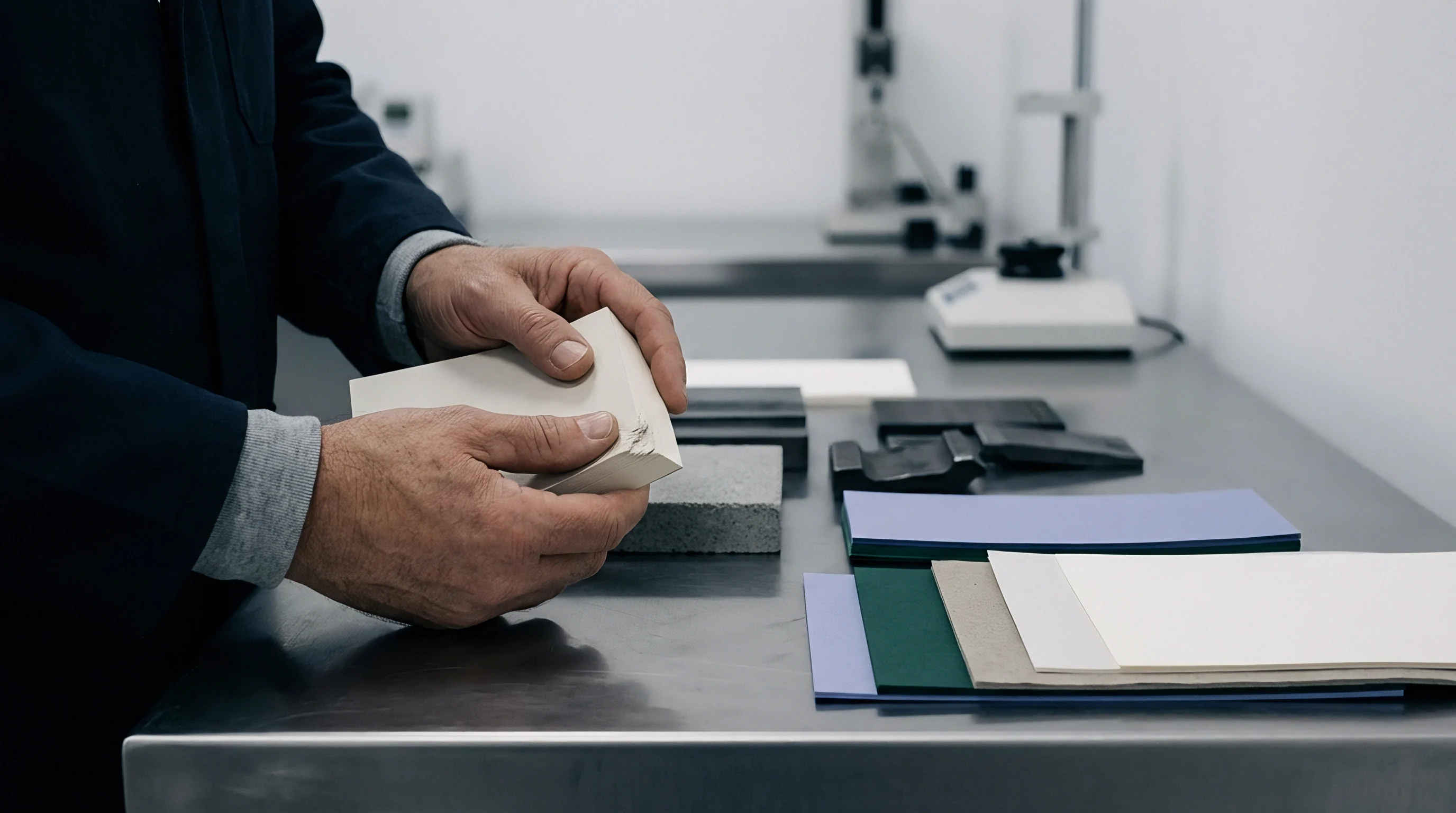
Axial compression resistance in paperboard depends on individual cellulose fibers carrying load within a constrained web geometry. Standard short span compressive strength testing under ISO 9895 clamps a 15-millimeter wide test strip between two pneumatic jaws separated by a narrow gauge gap of 0.70 millimeters. This micro-gap prevents global Euler buckling across the sheet, forcing failure into localized axial compression of the fiber cell walls.
In recycled testliner, secondary pulp fibers undergo repeated wetting, pressing, drying, and repulping cycles that permanently alter their physical structure. Hornification during previous drying collapses internal pores within the cell wall, reducing swelling capacity and flexibility so that recycled fibers form fewer and weaker inter-fiber hydrogen bonds per unit area than virgin unbleached kraft fibers.
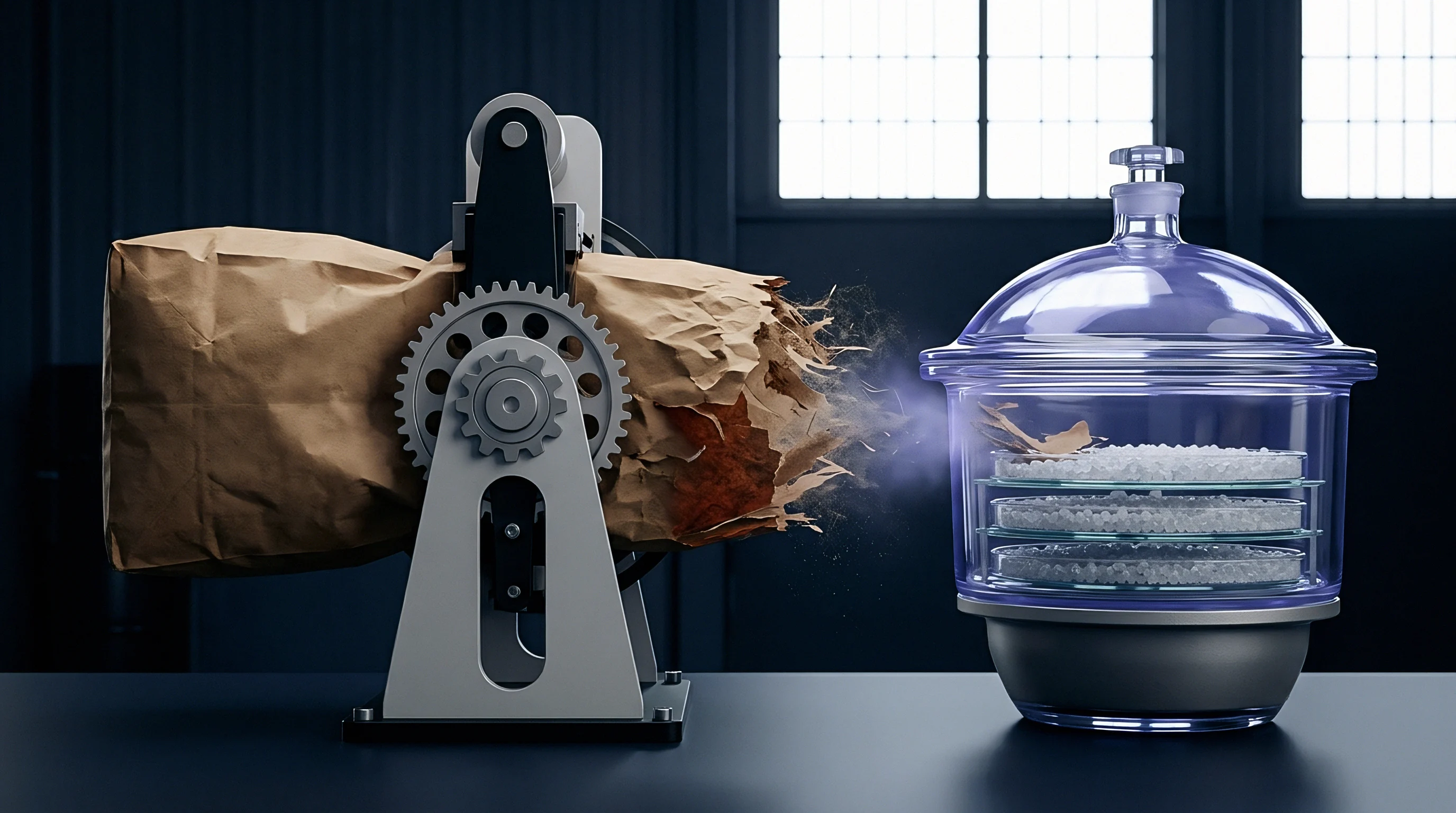
Water entering the sheet interacts immediately with exposed hydroxyl groups along amorphous regions of cellulose and hemicellulose, acting as a molecular plasticizer within inter-fiber bonding regions. Rising ambient relative humidity increases the equilibrium moisture content of the paperboard, displacing hydrogen bonds between neighboring cellulose chains. As water molecules insert themselves between adjacent polymer chains, intermolecular spacing grows and the glass transition temperature of hemicellulose and amorphous cellulose drops from over 100 degrees Celsius down to ambient levels.
The structural network loses shear modulus, allowing individual fibers to slip past one another under lower compressive loads.

Cell Wall Softening Mechanics
Fiber cell wall geometry governs ultimate load capacity under pure axial compression. Recycled testliner contains high proportions of short hardwood fibers, damaged softwood fibers, and mechanical fines. Fines absorb water rapidly due to their high specific surface area, creating localized wet zones across the fiber web.
When external axial load applies across the 0.70-millimeter test span, stress concentrations accumulate around fiber-to-fiber joints where plasticization is highest.
Compressive load bearing capacity decreases non-linearly as moisture content rises. At moisture levels below five percent, fiber cell walls stay rigid, yielding high compressive stiffness. As moisture approaches eight to ten percent, micro-delamination occurs within the secondary S2 cell wall layer, which carries the primary longitudinal load in wood fibers.
Softened hemicellulose matrix material fails to transfer shear stresses between longitudinal cellulose microfibrils, triggering localized plastic micro-buckling long before the ultimate tensile or shear strength of the solid fiber wall reaches its limit.
Recycled testliner exhibits distinct structural vulnerabilities compared to virgin linerboard grades due to fiber shortening and residual kontaminants. The degree to which specific non-fibrous additives or mechanical refining actions restore lost dry strength remains constrained by water molecule mobility inside amorphous fiber regions. It remains unclear whether modifying hemicellulose distribution during repulping can permanently stabilize the S2 cell wall layer against moisture-induced plasticization without compromising recyclability in standard paper repulping systems.
Sorption
Isotherm Behavior in Secondary Fibers
Moisture exchange between paperboard and surrounding air follows a sigmoidal Type II sorption isotherm characteristic of hydrophilic porous materials. Recycled testliner demonstrates higher equilibrium moisture content at given relative humidity setpoints than virgin kraftliner, driven by exposed hemicellulose, residual starch fragments from former surface sizings, and fine particles. During adsorption, dry fibers take up moisture until reaching equilibrium with ambient relative humidity.
During desorption, moisture leaves the fiber matrix, but residual water molecules stay trapped within cell wall micro-cavities due to hysteretic effects.
At 85 percent relative humidity and 23 degrees Celsius, recycled testliner achieves an equilibrium moisture content of 12.8 percent while losing 46 percent of its dry short span compressive strength.
Hysteresis causes paperboard arriving at a given moisture content via drying to exhibit lower compressive strength than paperboard reaching that same moisture content via wetting. Fiber network orientation generated during web formation creates anisotropic sorption behavior: machine direction fibers align parallel to web travel and display lower swelling strain than cross direction fibers. Cross direction compressive strength degrades faster under moisture exposure because perpendicular fiber expansion weakens cross-link joints that resist lateral expansion during compression.
Equilibrium Moisture Disparities
Comparing virgin unbleached kraftliner to recycled testliner highlights clear differences in moisture uptake dynamics. Kraftliner retains hydrophobic wood extractives and a longer average fiber length, slowing vapor diffusion into the fiber core. Recycled testliner, composed of mixed packaging waste, contains hydrophilic fillers such as calcium carbonate alongside damaged fiber fragments that speed up moisture diffusion.
| Relative Humidity (%) | Kraftliner EMC (%) | Kraftliner SCT Index (Nm/g) | Recycled Testliner EMC (%) | Recycled Testliner SCT Index (Nm/g) | Testliner Strength Loss (%) |
|---|---|---|---|---|---|
| 30 | 4.8 | 31.2 | 5.4 | 26.8 | 0.0 |
| 50 | 7.2 | 28.5 | 8.1 | 23.5 | 12.3 |
| 70 | 9.8 | 23.1 | 10.6 | 17.8 | 33.6 |
| 85 | 12.1 | 17.4 | 13.4 | 12.5 | 53.4 |
| 90 | 14.5 | 13.8 | 16.2 | 8.9 | 66.8 |
Structural and compositional parameters accelerate moisture vapor uptake within secondary fiber webs:
- High hemicellulose content exposes extra hydroxyl sites for water molecule attachment along recycled pulp fibers.
- Presence of papermaking fines increases capillary sorption channels throughout the sheet cross-section.
- Pores created by hornification trap liquid water via capillary condensation at elevated relative humidity levels.
- Residual starch deposits from converting operations absorb ambient moisture rapidly, acting as localized plasticizing hubs.
Nominal grammage standards are satisfied at mill gate shipment regardless of downstream ambient humidity shifts, as post-shipment moisture uptake reflects environmental exposure rather than manufacturing non-conformance.

Buckling
Compressive Failure Modes at High Relative Humidity
Short span compressive failure modes transition from brittle material fracture to ductile plastic micro-buckling as internal moisture levels rise. Under dry standard conditions of 50 percent relative humidity and 23 degrees Celsius, testliner specimens exhibit clean transverse shear failures across the 0.70-millimeter test span, showing clean cell wall shearing without extensive fiber separation. As plasticization lowers structural rigidity and moisture content exceeds ten percent, the failure zone broadens into a visibly kinked shear band characterized by extensive inter-fiber delamination.
Kink band formation initiates at micro-voids and local grammage fluctuations within the recycled sheet. Fibers located on the concave side of an initiating micro-buckle undergo localized axial compression, while adjacent fibers experience secondary transverse tension. Because wet hemicellulose exhibits poor transverse tensile strength, neighboring fibers separate.
Local micro-buckling cascades laterally across the width of the specimen, terminating load capacity at significantly lower force thresholds than predicted by linear elasticity.

How Do Cyclic Ambient Humidity Fluctuations Accelerate Compressive Strength Loss?
Cyclic humidity environments induce mechano-sorptive creep, a structural degradation phenomenon where simultaneous mechanical loading and moisture variation cause deformation rates far exceeding those measured under static high-humidity conditions. Freight containers moving through day-night temperature and humidity transitions present ideal conditions for mechano-sorptive degradation. As relative humidity cycles between 50 percent and 90 percent, paperboard fibers absorb and desorb water continuously under sustained stacking loads.
ISO 187 conditioning protocols specify standard testing environments at 50 percent relative humidity and 23 degrees Celsius, creating a blind spot for containers exposed to unconditioned tropical maritime transit.
During the absorption phase of a humidity cycle, water molecules entering the stressed cell wall allow microfibrils to slip under load. When the environment dries during desorption, new hydrogen bonds form in the deformed geometry, locking in permanent plastic strain. Repeating this cycle, cumulative structural damage weakens short span compressive resistance faster than static storage at 90 percent relative humidity.
| Conditioning State | Equilibrium RH (%) | SCT Value (kN/m) | Compressive Index (Nm/g) | Failure Strain (%) |
|---|---|---|---|---|
| Standard Isothermal | 50 | 3.29 | 23.5 | 1.85 |
| High Static RH | 85 | 1.75 | 12.5 | 3.10 |
| Cyclic RH (50% to 85% 3 cycles) | 85 equivalent | 1.26 | 9.0 | 4.45 |
| Cyclic RH (50% to 95% 5 cycles) | 90 equivalent | 0.84 | 6.0 | 5.80 |
Sizing treatments and chemical additives moderate water vapor absorption speed, but given sufficient duration, moisture migration into the cell wall matrix reaches equilibrium regardless of surface hydrophobicity.
Retention

Wet Strength Resins and Hydrophobic Sizing
Preventing short span compressive strength decay requires wet-end chemical treatments and surface modifications at the paper machine. Hydrophobic sizing agents, including Alkyl Keten Dimer and Alkenyl Succinic Anhydride, alter fiber surface energy, raising contact angles to impede liquid water wetting while internal sizing retards liquid penetration into macro-pores. Because water vapor bypasses hydrophobic sizing, it diffuses directly through air voids into interior fiber cell walls, plasticizing hemicellulose despite high liquid contact angles.
Polyamidoamine-epichlorohydrin wet-strength resins form covalent cross-linked networks that enclose fiber-to-fiber contact areas, protecting inter-fiber bonds from total dissolution when exposed to moisture. In recycled furnishes, high ionic charge, residual surfactants, anionic trash, and high fine concentrations consume wet-end chemicals, lowering retention efficiency. Excess fines adsorb cationic wet-strength resins prematurely, preventing uniform chemical distribution across long structural fibers.
Chemical Additive Boundary Conditions
Surface application of native or chemically modified starch at the size press improves dry compressive strength by increasing sheet density and adding hydrogen bonding sites. Because moisture weakens starch bonds, unmodified starches dissolve or soften at elevated relative humidity, losing structural contribution. Cross-linked or hydrophobic surface starches mitigate moisture sensitivity, but raise processing challenges during subsequent boxboard recycling.
Chemical additives applied to containerboard must align with international compliance frameworks for food contact, recyclability, and chemical safety:
- Wet strength resin additions must comply with BfR Recommendation XXXVI limits, restricting 1,3-dichloro-2-propanol and 3-monochloro-1,2-propanediol residuals in food-contact papers.
- Recyclability qualification rules under EN 13430 limit non-paper additives to ensure rapid repulpability without generating insoluble sticky particles.
- Per- and polyfluoroalkyl substances bans restrict hydrophobic surface treatments, mandating non-fluorinated sizing chemistries for grease and water resistance.
- Eco-modulation fee structures under national Extended Producer Responsibility schemes penalize packaging materials containing non-separable synthetic resin coatings.
Internal sizing delays liquid water penetration into testliner pores but offers no barrier against vapor-phase moisture equilibrium.
According to standard commercial sales terms under EN 10810, containerboard deliverable specifications bind the seller only to properties measured under standard ISO 187 laboratory conditioning unless explicit high-humidity performance clauses are executed within the master supply agreement.
Margin
Box Compression Engineering and McKee Derating
Translating sheet-level short span compressive strength values into finished box compression performance relies on empirical structural relationships. The classic McKee equation links container compression strength to short span compressive strength, flexural stiffness, and box perimeter:
BCT = 5.87 × SCT0.74 × (D × BW)0.26 × P0.49
In this relationship, SCT represents the cross-direction short span compressive strength in kilonewtons per meter, D represents the bending stiffness of the combined corrugated board, BW represents the box perimeter in millimeters, and P represents the box perimeter parameter. Because short span strength carries an exponent of 0.74, degradation in sheet-level compression impacts total box compression non-linearly.
Because stacking loads crush humid boxes, packaging engineers apply environmental derating factors to dry BCT predictions to calculate allowable field load capacity under humid transit conditions.

Transit Stress Worked Sensitivity Analysis
Evaluating an ocean freight container transport route illustrates the mathematical consequences of moisture degradation on recycled testliner performance. Consider a standard regular slotted container manufactured from a single-wall corrugated board profile using 140 gsm recycled testliner outer and inner facings with a 120 gsm recycled fluting medium. Box dimensions are 400 mm length, 300 mm width, and 300 mm height, yielding a box perimeter of 1400 mm.
Stacking safety requirements demand supporting a static load over a 30-day storage period at 85 percent relative humidity.
- Determine dry short span compressive strength of 140 gsm recycled testliner at 50 percent relative humidity, yielding 3.29 kN/m.
- Calculate dry BCT using combined board flexural stiffness values, producing a baseline static compression strength of 3.42 kilonewtons.
- Apply relative humidity derating factor derived from ISO 9895 high-humidity testing, reducing testliner SCT to 1.75 kN/m at 85 percent relative humidity, a 46.8 percent strength loss.
- Recalculate combined board compressive capacity under moist conditions, yielding a derated BCT of 2.14 kilonewtons.
- Apply mechano-sorptive fatigue factor of 0.60 to account for cyclic ambient temperature and humidity shifts inside shipping containers, reducing total allowable static load capacity to 1.28 kilonewtons.
- Establish required safety factor by dividing baseline dry BCT by allowable field load capacity, demonstrating that a safety margin of 2.67 must apply to dry bench test results to prevent field stacking failure.
Safety margins offset moisture loss, whereas standard bench figures mislead buyers who omit environmental factors.
| Outer/Inner Liner Specification | Conditioning RH (%) | Sheet SCT (kN/m) | Calculated BCT (kN) | Allowable Stacking Load (kg) | Required Safety Multiplier |
|---|---|---|---|---|---|
| 120 gsm Recycled Testliner | 50 | 2.70 | 2.85 | 290 | 1.00 |
| 120 gsm Recycled Testliner | 85 | 1.38 | 1.72 | 105 | 2.76 |
| 140 gsm Recycled Testliner | 50 | 3.29 | 3.42 | 348 | 1.00 |
| 140 gsm Recycled Testliner | 85 | 1.75 | 2.14 | 130 | 2.67 |
| 175 gsm Recycled Testliner | 50 | 4.20 | 4.18 | 426 | 1.00 |
| 175 gsm Recycled Testliner | 85 | 2.28 | 2.68 | 164 | 2.60 |
| 140 gsm Virgin Kraftliner | 85 | 2.43 | 2.78 | 198 | 1.75 |
Containerboard specifications based solely on dry ISO 9895 bench tests systematically under-specifies paper weight requirements for humid supply chain routes.
Specifying recycled testliner without adjusting grammage or safety margins for high-humidity transit leads directly to compressive collapse in bottom-tier pallets, triggering carrier freight damage claims and total product rejections at destination docks.

Proof
Laboratory Conditioning Protocols and ISO 9895 Compliance
Verifying paperboard quality requires strict adherence to international test standards and conditioning procedures. ISO 187 governs atmosphere conditioning for paper, board, and pulps. Standard conditioning mandates exposure to 50 percent relative humidity plus or minus two percent, and 23 degrees Celsius plus or minus one degree, for a minimum of 24 hours prior to structural testing.
Specimen pre-conditioning requires exposure to low relative humidity environments between 20 percent and 35 percent at temperatures below 40 degrees Celsius to ensure samples reach equilibrium via adsorption rather than desorption.
Short span compressive testing following ISO 9895 or TAPPI T 826 specifies pneumatic clamping force settings to prevent testpiece slippage without crushing fiber cell walls before testing starts. Clamping pressure must remain calibrated between 2300 plus or minus 500 kilopascals. Insufficient clamping pressure leads to specimen slippage inside the jaws, resulting in artificially low compression readings.
Excessive clamping pressure damages the fiber network within the gauge gap zone, triggering premature micro-buckling failure.
Certificate Scopes, FSC Claims, and Regulatory Audits
Commercial claims regarding recycled testliner rely on chain of custody certification schemes to establish fiber origin and environmental credentials. Forest Stewardship Council standards FSC-STD-40-004 and Programme for the Endorsement of Forest Certification standard PEFC ST 2002 govern chain of custody tracking across paperboard manufacturing and converting operations. Buyers inspecting compliance dossiers verify scope certificates against public scheme databases to confirm that specific manufacturing facilities hold active verification for recycled containerboard grades.
Certificates cover claims of fiber origin, distinguishing FSC Recycled 100 percent, FSC Recycled Credit, or FSC Mix Credit outputs. An FSC scope certificate held by a paper converter confirms organizational traceability protocols, but does not guarantee the physical or mechanical properties of the underlying paperboard. Short span compressive strength performance remains entirely a technical specification governed by bilateral purchase orders and material specifications.
Border authorities inspect physical declarations under emerging packaging environmental rules, including the European Union Packaging and Packaging Waste Regulation. Recyclability grading mandates evaluating containerboard packaging against standardized repulpability criteria under EN 13430. Higher chemical additions, synthetic sizing agents, or wet-strength resins introduced to combat moisture degradation must remain within statutory concentration thresholds to maintain full recyclability classification and avoid financial penalties under national eco-modulation fee systems.
Technical compliance files require paired presentation of certified chain of custody documentation alongside accredited laboratory test reports showing ISO 9895 compressive values measured under both standard ISO 187 conditioning and high-humidity test profiles.