Downgauging Folding Boxboard without Losing Compression Strength
Downgauging folding boxboard demands increasing core bulk and outer ply elastic modulus to preserve caliper and bending stiffness under McKee formula laws.

Mechanics
A digital micrometer closing on a sample of 280 grams per square metre Folding Boxboard displays a caliper of 365 micrometres. That single measurement determines whether a pallet of stacked cartons survives three months in cold storage or collapses under top-to-bottom compression. Box Compression Test values correlate directly with bending stiffness rather than pure sheet grammage, and caliper governs bending stiffness.
Paperboard flexural rigidity follows classical plate theory. Bending stiffness per unit width, expressed in millinewton-metres or micronewton-metres depending on the test protocol, scales with the elastic modulus of the substrate and the cube of sheet thickness. Because stiffness equals elastic modulus times caliper cubed divided by twelve, even small reductions in sheet thickness knock out structural performance.
A ten percent drop in caliper cuts bending stiffness by twenty-seven percent if the elastic modulus stays constant. Preserving box compression strength while reducing grammage requires paperboard manufacturers to increase structural bulk or elevate the elastic modulus of the outer plies.
At standard conditioning of 23 degrees Celsius and 50 percent relative humidity, a ten percent reduction in board caliper decreases structural bending stiffness by twenty-seven percent unless the elastic modulus of the outer plies is increased proportionally.
Box compression resistance in converted folding cartons depends on cross-direction short-span compression strength combined with machine-direction and cross-direction bending stiffness. Packaging engineers evaluate box performance using modified McKee formulations, which originally linked ultimate box compression strength to edge crush strength, caliper, and carton perimeter. For folding boxboard, swapping simple edge crush values for the geometric mean of machine-direction and cross-direction flexural stiffness gives far more accurate predictions of vertical load capacity.
Stacking loads, in particular, demand cross-direction strength.
Cross-direction bending resistance is usually the limiting factor in corner post compression failure. Under vertical load, the panel faces bow outward while the vertical corners carry most of the weight. That outward flexing transfers stress toward the score lines.
If cross-direction flexural stiffness falls below the critical buckling threshold, panel deflection speeds up, stress concentrates at the vertical corners, and the panel creases. Downgauging strategies that sacrifice cross-direction stiffness to protect machine-direction values tend to fail on the packing line.

Plate Theory and Flexural Mechanics
Layered paperboard functions much like a composite structural beam. Tensile loads during bending concentrate almost entirely in the outer fibre layers, while the central core sees minimal axial stress and mainly carries shear forces. High-density bleached chemical pulp on the top and back surfaces provides high elastic modulus values, while low-density mechanical pulp in the middle keeps those outer skins separated.
The layout mirrors a steel I-beam, maximizing the moment of inertia per unit of basis weight.
Short-span compression testing under ISO 9895 measures the axial load capacity of individual fibres across a 0.7 millimetre clamp gap. Where bending stiffness dictates when panel buckling starts, short-span compression strength determines the load at which the fibre matrix wall suffers micro-compressive yield. Cutting sheet grammage hits both properties at once: less total fibre mass means fewer load-bearing fibres per unit area.
Offsetting that loss requires stronger inter-fibre bonding, achieved through refined chemical pulps or wet-end strength additives.
| Grade Variant | Grammage (g/m²) | Caliper (µm) | Bulk (cm³/g) | MD Stiffness (mN·m) | CD Stiffness (mN·m) | SCT CD (kN/m) |
|---|---|---|---|---|---|---|
| Standard GC1 | 300 | 390 | 1.30 | 24.5 | 11.8 | 4.60 |
| Downgauged High-Bulk GC1 | 270 | 392 | 1.45 | 24.1 | 11.5 | 4.45 |
| Ultra-Bulk GC2 Variant | 245 | 385 | 1.57 | 22.8 | 10.9 | 4.15 |
| Sub-Calibrated Standard | 270 | 350 | 1.30 | 17.2 | 8.2 | 4.38 |
Bending resistance is measured using a 15-degree optical encoder gauge operating under ISO 2493-1 conditioning protocols. Mill trial data shows that sub-calibrated standard boards ~ where grammage is reduced without altering core density ~ take a heavy hit in bending resistance. A 270 gsm standard board calendered down to 350 micrometres loses thirty percent of its cross-direction bending stiffness compared to a 300 gsm standard board.
By contrast, engineered high-bulk variants that maintain a 392 micrometre caliper at 270 gsm keep ninety-seven percent of their baseline cross-direction bending strength.
Adjusting the elastic modulus offers another way to protect performance at lower weights. Heavy refining of hardwood and softwood chemical pulps increases specific surface area and hydrogen bonding. That extra inter-fibre bonding raises the elastic modulus of the outer layers, offsetting some of the lost caliper.
But because refining increases overall sheet density, applying it across the whole furnish crushes core volume. Mills have to isolate refining to the outer chemical plies while leaving the mechanical core unrefined and bulky.
Moisture absorption complicates how lab numbers translate to real-world performance. Standard testing happens at 50 percent relative humidity, but transit environments often reach 85 percent. High-lignin mechanical pulps absorb water quickly, plasticizing the fibre walls and driving down the elastic modulus.
Chemically treated outer skins slow down moisture intake and help preserve the moment of inertia in humid conditions, keeping sheet thickness intact.
Long-term creep strain under static loads reveals weaknesses in downgauged materials that short tests miss. Over time, paperboard undergoes viscoelastic deformation, and creep speeds up as the stress-to-strength ratio rises. Lowering grammage while keeping caliper constant preserves initial bending stiffness, but it forces individual pulp fibres to carry higher static stress.
As a result, long-term stacking performance remains vulnerable to moisture spikes during extended storage.
It remains unclear how road vibration during transit interacts with the reduced fibre mass of downgauged carton walls. Standard lab compression tests press down on empty cartons with static hydraulic force, ignoring the cyclic fatigue caused by internal contents sloshing or shifting on long hauls. Transport stress often triggers micro-buckling well below static laboratory limits, raising questions about how road vibration profiles should shift safety margins for low-grammage designs.
Furnish
Multi-ply paperboard divides mechanical duties across distinct web layers formed at the wet end. Modern Folding Boxboard relies on three structural zones: a fully bleached chemical pulp top layer for print smoothness and tensile strength, a bulky middle layer engineered for volume, and a chemical pulp back layer (bleached or unbleached). Tuning the composition of each layer lets mills strip mass from the sheet without sacrificing its flexural stiffness.
Chemi-Thermomechanical Pulp (CTMP) forms the core of high-bulk middle layers. Pre-treating wood chips chemically before mechanical defibration preserves long, stiff fibres while retaining high lignin levels. That lignin keeps individual fibre walls rigid so they don’t collapse during drying.
The resulting network achieves a specific volume of 1.5 to 2.2 cubic centimetres per gram, compared to 1.1 cubic centimetres per gram for fully bleached sulphate chemical pulps, keeping the outer skins well separated.
Preserving top-to-bottom compression strength while reducing overall sheet grammage demands that the mechanical core maintain maximum bulk while the chemical outer plies absorb all tensile loads.
Hardwood and softwood pulps serve different roles in the outer plies. Northern Softwood Bleached Kraft brings long fibres (2.5 to 3.3 millimetres) for tensile strength and tear resistance. Bleached Hardwood Kraft, mostly Eucalyptus, uses shorter fibres (0.7 to 1.2 millimetres) to fill surface gaps and create a smooth print surface.
Adding long softwood fibres to the outer skins forms a tough web capable of taking heavy flexural loads when panels bend.
While the outer plies handle tension, the mechanical core’s compression behavior sets the buckling limits under vertical load. The middle layer has to resist both z-direction compression and the internal shear stresses created as the board flexes. If the core lacks internal bond strength (measured via Scott Bond under TAPPI T 541), outer ply bending will split the core apart, causing the carton panel to collapse instantly.
| Parameter | Standard FBB (300 g/m²) | High-Bulk FBB (270 g/m²) | Ultra-High Bulk FBB (240 g/m²) |
|---|---|---|---|
| Top Ply Furnish | 100% Bleached Hardwood/Softwood Kraft (65 g/m²) | 100% Bleached Hardwood/Softwood Kraft (55 g/m²) | 100% Bleached Hardwood/Softwood Kraft (48 g/m²) |
| Middle Ply Furnish | Standard CTMP / GW (170 g/m²) | High-Yield Coarse CTMP (160 g/m²) | Engineered Ultra-Bulk CTMP (144 g/m²) |
| Back Ply Furnish | 100% Bleached Hardwood/Softwood Kraft (65 g/m²) | 100% Bleached Hardwood/Softwood Kraft (55 g/m²) | 100% Bleached Hardwood/Softwood Kraft (48 g/m²) |
| Core Bulk (cm³/g) | 1.55 | 1.85 | 2.10 |
| Overall Sheet Density (g/cm³) | 0.77 | 0.69 | 0.62 |
Calendering is the trickiest compromise on the paper machine. Raw sheet formation leaves micro-roughness that ruins high-resolution printing. Traditional hard-nip calendering runs dry paperboard between rigid steel rolls under high nip pressure, crushing surface peaks smooth ~ but it also destroys core bulk, flattening mechanical fibres and cutting bending stiffness.
Modern mills use heated soft-nip or extended-belt shoe calenders instead. Thermal soft calendering smooths the outer coating and chemical fibres right at the surface while leaving the inner mechanical core uncompressed.
Stock preparation choices determine outer layer performance limits. Softwood pulps for the top and back plies undergo low-consistency disc refining to fibrillate the fibre walls without cutting fibre length too short. Higher fibrillation increases hydrogen bonding sites, lifting the tensile stiffness index of the outer layers.
Refining the mechanical pulp in the middle layer, however, is a mistake; core pulp needs raw stiffness and bulk rather than bonding density.
Pushing core bulk too far creates distinct risks during converting and handling:
- Low z-direction tensile strength occurs when core density drops too low, causing plies to split during high-speed offset printing tack pulls.
- Surface dusting and linting increases when mechanical pulp is left too unrefined, shedding loose short fibres onto printing blankets and disrupting ink transfer.
- Increased moisture sensitivity occurs because high-bulk CTMP absorbs ambient water vapor faster than dense chemical plies, accelerating stiffness loss in humid storage.
- Reduced score crack resistance happens when outer chemical skins are thinned past their limits, causing the liner to rupture along fold lines.
Micro-particle retention systems added at the wet end help distribute fine fibres and mineral fillers evenly without disrupting formation. Clay and calcium carbonate boost surface brightness and opacity, but carry zero load. Adding too much filler to outer plies weakens inter-fibre hydrogen bonding, hurting both elastic modulus and flexural rigidity.
Keeping filler below eight percent by weight in the outer skins maintains tensile performance.
Coating formulations add sheet weight without contributing flexural strength. Double or triple pigment coatings applied via blade or curtain coaters put 20 to 40 grams per square metre of mineral content onto the top surface. While those coatings improve print gloss and ink holdout, they represent dead weight.
Swapping in synthetic hollow-sphere polymeric pigments or fine tabular clay cuts coating mass while maintaining opacity and smoothness.
A simple rule of thumb guides machine adjustments: double the core bulk before thinning the outer chemical skins.

Score
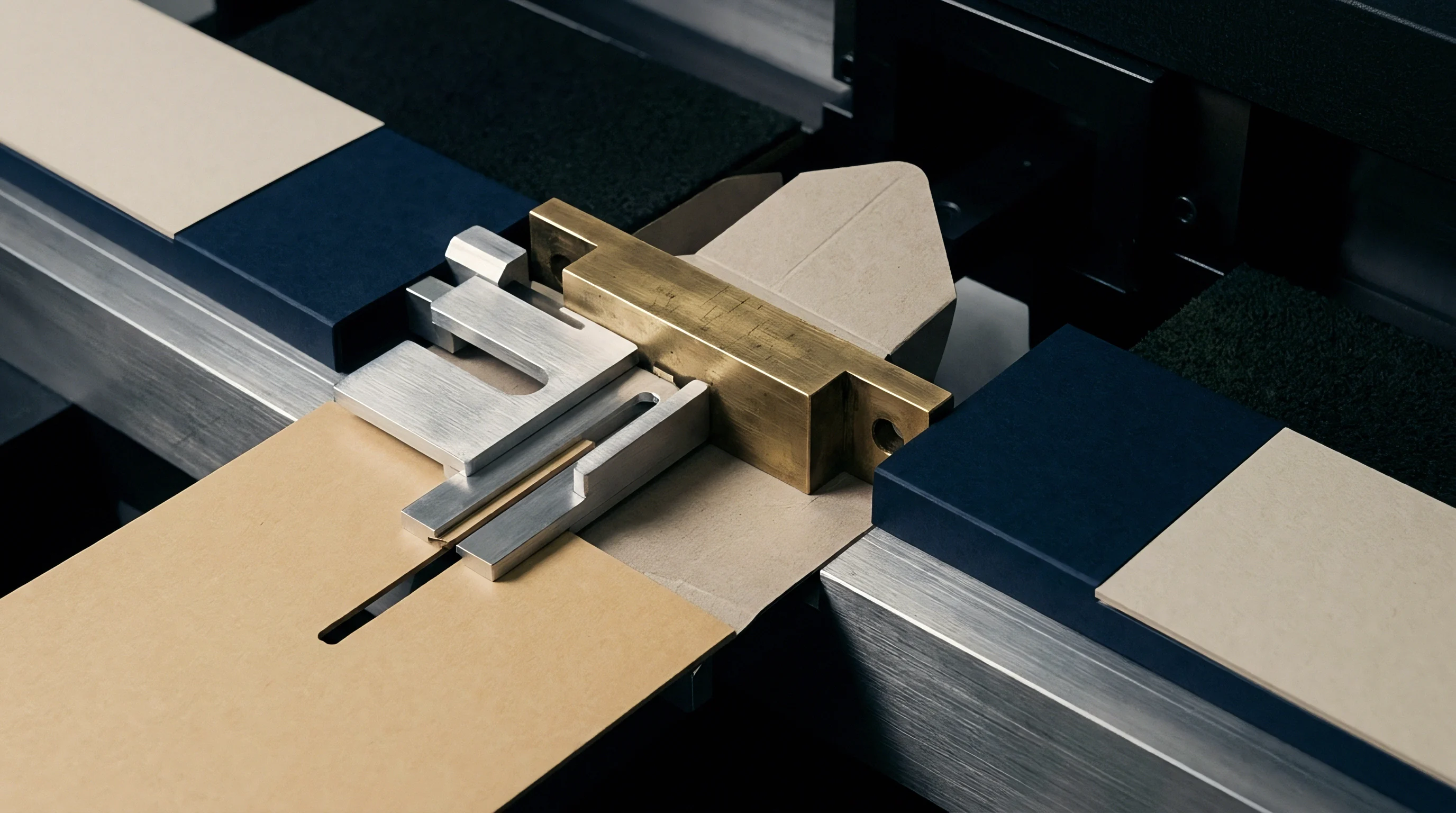
Converting flat paperboard into structural cartons requires precise mechanical creasing. A steel scoring rule presses the board into a matrix channel, creating a controlled internal fracture line along the fold axis. This micro-delamination allows the board to bend 90 or 180 degrees without cracking the printed outer liner.
Downgauged board absorbs less energy during scoring, narrowing the window for acceptable tooling tolerances.
Crease depth directly alters score stiffness. The crease stiffness ratio ~ the bending resistance of a folded crease relative to the uncreased flat sheet, measured under ISO 2493-2 ~ should ideally sit between thirty and fifty percent. Above sixty percent, the adjacent flat walls bow outward during folding, creating residual stress that weakens vertical corner columns.
Below twenty-five percent, internal plies have ruptured severely, leaving the score line floppy and prone to corner twist.
Controlled delamination keeps the surface from tearing during folding. As a creased score folds, the outer chemical skin stretches under tension while the inner skin compresses. The mechanical core has to shear internally, forming overlapping slip-planes that relieve flexural stress.
High-bulk downgauged boards have lower internal bond strength in the CTMP core, making them prone to shear splits that run past the crease and into the flat panel walls.
When Does Crease Geometry Compromise Stacking Strength?
Adjusting die-cutting parameters is mandatory when moving from standard to downgauged high-bulk board. Because high-bulk grades match the thickness of heavier standard boards with less total fibre mass, standard scoring rule widths and matrix depths crush the low-density core. Over-penetration by the male rule fractures outer linerboard fibres at the crease line, undermining the load-bearing capacity of folded carton edges.
Matrix channel widths depend on sheet thickness and rule dimensions. Standard female channel width equals male rule width plus 1.5 to 1.7 times board caliper, with channel depth matching sheet thickness. For lower-density high-bulk boards, female channel width needs to shrink slightly ~ to male rule width plus 1.3 to 1.4 times caliper ~ to prevent sloppy fold geometry that ruins stack alignment on packaging lines.
A high-speed converting line running 240 gsm ultra-bulk GC2 board through a platen die-cutter demonstrated this failure mode. Standard 2-point (0.71 millimetre) scoring rules paired with 1.40 millimetre wide female matrix channels caused micro-fracturing along the main vertical corners. Vertical compression testing showed a twenty-two percent drop in load capacity compared to flat sheet calculations.
Narrowing the female channels to 1.15 millimetres and backing off male rule penetration restored score integrity, bringing box compression back within three percent of theoretical strength.
Excessive male rule penetration during die-cutting fractures the linerboard fibres at the crease line and collapses the vertical load-bearing capacity of the folded carton edge.
Corner column alignment dictates real-world pallet stacking performance. When cartons stack vertically, weight transfers directly down the four corner score lines. If score stiffness varies across panels, the box tilts under load, shifting stress from the rigid corners onto the flat side panels.
Misaligned stacks can lose up to forty percent of their design compression capacity, leading to leaning stacks and pallet collapse during transit.
Converting setups for downgauged high-bulk substrates require careful tooling adjustments across production runs:
- Scoring rule width selection demands matching male rule thickness to the reduced basis weight to prevent skin shear.
- Matrix channel depth calibration requires setting channel floors equal to compressed sheet caliper to ensure clean bead definition.
- Counter-die hardness specifications involve using high-density phenolic or brass counters to maintain crisp crease edges over long runs.
- Nicking tool size control requires narrow laser-cut nicks to keep from tearing thinned outer skins during blank separation.
- Ejection rubber durometer matching requires soft, medium-rebound elastomers near score lines to avoid crushing bulky mechanical cores.
Humidity changes in carton storage areas alter score mechanics significantly. Below 35 percent relative humidity, mechanical pulp cores turn brittle, causing outer liner cracking along score lines during high-speed folding. Above 70 percent relative humidity, moisture plasticizes core fibres, lowering score stiffness and causing fold bulge.
Converting plants without climate control face seasonal score drift when running low-grammage high-bulk board.
A fifteen thousand euro commercial claim resulted when a production run of downgauged frozen food packaging suffered side-seam pops and score fractures on high-speed cartoning lines. The failure traced back to uncalibrated creasing dies that severed the thin top chemical fibres of a 250 gsm high-bulk sheet. Downgauging without tooling adjustments turns theoretical material savings into real floor losses.
Freight
Paperboard is bought by weight, billed per metric tonne, but converted packaging sells by the unit ~ per thousand printed cartons. That yield arithmetic makes or breaks downgauging projects. Switching a specification from 300 gsm standard FBB to 260 gsm high-bulk FBB yields thirteen point3 percent more printable sheet area per tonne of raw material, directly lowering unit material cost.
Yield dictates landed cost, and cutting overall shipping weight yields real transport savings. When consumer goods are packed in heavy board, ocean containers and trucks hit weight limits long before they run out of volume. Stripping ten to fifteen percent of fibre weight out of outer cartons lets shipments carry more net product units, reducing freight cost per item sold.
Extended Producer Responsibility rules and packaging waste fees in Europe and North America tax brand owners on the total packaging weight they put on the market. Eco-modulation rate structures penalize heavy materials and reward lightweight designs. Reducing carton basis weight cuts producer responsibility fees proportionally, delivering savings on top of raw material cost reductions.
| Evaluation Metric | Baseline 300 g/m² Standard | Option A: 270 g/m² High-Bulk | Option B: 245 g/m² Ultra-Bulk |
|---|---|---|---|
| Sheet Yield per Metric Tonne (800x1000mm) | 4,166 sheets | 4,629 sheets | 5,102 sheets |
| Raw Substrate Cost per 1,000 Sheets (€1,400/t) | €336.00 | €302.40 | €274.40 |
| Carton Weight per 10,000 Units (kg) | 1,050 kg | 945 kg | 857 kg |
| Box Compression Strength Retained (%) | 100% (Baseline) | 97.5% | 93.0% |
| EPR Packaging Fee per 100,000 Units (€220/t) | €2,310.00 | €2,079.00 | €1,885.40 |
| Net Annual Material + EPR Savings (1M units) | Baseline (€0.00) | €35,910.00 | €65,846.00 |
Financial models have to account for converting waste. High-bulk boards show slightly more caliper variation across parent reels due to core bulk dynamics. If that variation leads to press misfeeds, die-cutting drift, or failed glue lines, make-ready spoilage will quickly wipe out theoretical tonnage savings.
Line-side waste tracking is essential to confirm true savings.
- Quantify baseline carton weight, annual unit consumption, landed board price per tonne, and freight rates across target SKU families.
- Audit mill technical datasheets to identify high-bulk alternatives that match original caliper and cross-direction bending resistance limits.
- Calculate theoretical sheet yield increases per metric tonne and project gross material cost reductions.
- Model Extended Producer Responsibility fee reductions using regional eco-modulation rate tables based on net mass savings.
- Run controlled press and converting trials to track make-ready spoilage, glue adhesion speeds, and tooling wear.
- Reconcile net landed cost per thousand finished cartons by weighing yield gains, freight cuts, and EPR savings against trial scrap rates.
Specifying substrate compliance under ISO 1924-3 tensile stiffness index rather than nominal basis weight protects the buyer against unannounced furnish changes by the paper mill.
Scope 3 carbon reporting places a heavy emphasis on reducing raw material mass. Paperboard production generates embedded emissions during pulping, drying, and chemical recovery. Replacing standard grammage board with downgauged high-bulk variants cuts embedded carbon per packaging unit, supporting corporate reduction targets without requiring changes to outer transit boxes.
Freight costs follow mass. Fuel consumption and carbon emissions track vehicle weight directly over long hauls. Trimming forty kilograms off each pallet cuts fuel use per tonne-kilometre, generating measurable carbon credits under international logistics auditing schemes.
Mill pricing structures often attach a premium to high-bulk grades. Paper mills know that high-bulk CTMP increases buyer sheet yield per tonne, which cuts overall tonnage demand. Sales managers offset that volume loss by charging a ten to fifteen percent price premium per metric tonne for high-bulk engineered grades over standard GC1 or GC2.
Commercial yield models must include these surcharges to ensure net savings remain positive.
High-bulk board sells on square metres of performance, and expecting additional sheet area at standard tonnage prices ignores the capital required to operate low-density mechanical pulp formers.

Dossier
Technical substrate specifications in procurement contracts anchor commercial quality enforcement. Historic agreements relying only on nominal basis weight and burst strength gave paper mills wide latitude to shift furnish blends, calender down caliper, or tweak refining intensity without violating supply terms. Contracts for downgauged paperboard require parameter-based technical specifications tied directly to standard test methods.
Specifying minimum flexural bending resistance under ISO 2493-1 replaces basis weight as the main acceptance criterion. Contracts should set explicit cross-direction and machine-direction bending resistance values in millinewton-metres at a 15-degree deflection angle. Ordering a 270 gsm board requires setting a cross-direction bending stiffness floor (such as 11.5 mN·m) alongside tight caliper tolerance bands ~ typically nominal caliper plus or minus three percent across parent reels.
Laboratory hand sheets always flatter production runs.
Conditioning protocols during goods-in quality audits cause frequent vendor disputes. Samples tested right after unsealing wrapped pallets show artificial stiffness if they are dry, or artificially low values if exposed to humidity in transit. Standard contract terms must mandate that verification testing happens only after 24 hours of pre-conditioning at ISO 187 standard atmosphere (23 degrees Celsius, plus or minus one degree, at 50 percent relative humidity, plus or minus two percent).
Goods-in verification sampling follows ISO 2859-1 statistical acceptance criteria. Sampling plans require full-width web strips across parent reels at designated roll depths. Lab technicians measure cross-direction caliper drift, short-span compression strength under ISO 9895, surface roughness under ISO 8791-2, and z-direction tensile bond strength under TAPPI T 541.
Acceptance Quality Limits (AQL) for structural stiffness parameters should be set to 1.0 Normal Inspection, with optical brightness parameters set to 4.0 AQL.
Mill certificates require independent verification. Accepting roll documentation without lab testing leaves converting plants open to unannounced furnish changes. When pulp prices fluctuate, mills may adjust outer ply refining or shift mechanical core proportions to lower input costs.
Testing cross-direction short-span compression strength catches these furnish modifications before reels ever reach the press.
Tropical testing protocols must supplement standard ISO conditioning for packaging bound for hot, humid export markets. Testing downgauged high-bulk board solely under ISO 187 flatters material performance. Re-testing samples at 38 degrees Celsius and 90 percent relative humidity shows how quickly mechanical pulp cores lose flexural stiffness as lignin plasticizes under moisture.
Specifications for tropical supply chains need higher baseline cross-direction stiffness safety margins to withstand humidity-induced creep.
The specification dossier closes with a binding compliance clause: The delivered paperboard shall maintain a minimum cross-direction bending resistance of 11.5 millinewton-metres under ISO 2493-1 and a minimum cross-direction short-span compression resistance of 4.4 kilonewtons per metre under ISO 9895, conditioned to ISO 187 standards; any delivered lot falling below these flexural floors by more than three percent shall be subject to immediate rejection at the mill’s sole financial expense.