Optimizing Folding Boxboard Grain Orientation for High Speed Gluer Conversion
Aligning folding boxboard grain parallel to gluer travel maximizes line speed and squareness, over-riding minor paper savings from cross-grain imposition layouts.

Kinematics
At 650 metres per minute, an incoming blank hits air resistance and abrupt momentum changes almost instantly. Folding boxboard (FBB) carries significant inertia at that pace as the suction belts pull sheets off the bottom of the stack and drive them into the breaker section. How the board responds to those transport forces depends largely on fibre alignment.
With the machine direction (MD) running parallel to carton travel, the blank retains its maximum longitudinal stiffness, keeping the leading edge flat as it meets the timed feed gauge and enters the folding section.
Running the grain perpendicular to the feed axis reduces transverse stiffness. In this cross-direction (CD) orientation, downward pull from lateral transport belts tends to bow the blank upward across its width. That centre-line deflection shifts the score lines away from their intended track against the folding plows; even a 1.5 millimetres vertical rise at the fold point causes noticeable lateral wander along the main crease.
Tightening the upper guide rollers is a common floor response, but it usually scuffs the double-coated top layer of bleach chemical pulp.
| Grain Alignment to Feed Axis | Line Velocity Threshold | Primary Mechanical Defect Mode | Physical Root Cause | Yield Impact |
|---|---|---|---|---|
| Machine Direction Parallel | 650 m/min | Trailing flap distortion | Insufficient CD bending resistance across wide panels | 0.3 percent spoilage |
| Cross Direction Parallel | 420 m/min | Fishtailing at folding plows | Low longitudinal E-modulus allowing blank buckling | 3.8 percent spoilage |
| Machine Direction Parallel | 700 m/min | Glue seam skew | Excessive torsional flex under asymmetric belt tension | 0.8 percent spoilage |
| Cross Direction Parallel | 380 m/min | Blank jam at feed nip | Leading edge deflection under vacuum suction pull | 5.2 percent spoilage |
Synchronized belt transfers fold panels through 90 and 180 degrees along the line. If the sheet travels with its grain across the direction of travel, the score line itself folds easily enough, but belt friction causes the surrounding panel to bow. That deflection alters the contact angle between the glue flap and the mating panel, pulling the carton out of square and throwing the glue seam off line.
Getting the box square again often forces an operator to dial back line speed by up to 35 percent, which quickly erodes margins on high-volume runs.
Bending resistance measured under ISO 2493-1 at a 15-degree deflection angle drops by 50 to 60 percent when testing cross-direction samples compared to machine-direction samples from the same FBB batch.
Rotary tracking cannot compensate once improper grain alignment distorts the blank in motion. When the MD to CD stiffness ratio climbs past 2.2:1, structural imbalance turns into a primary cause of downtime. High-frequency vibration down the line sets off fluttering across open, unguided stretches of the transport bed, and any unsupported panel span over 300 millimetres needs longitudinal fibre stiffness to stay stable.
At 700 metres per minute, the point where hydrodynamic drag finally overcomes sheet stiffness varies considerably across multi-ply FBB boards with different mechanical pulp fractions.
Stiffness
Substrate Morphology and Bending Moments
Folding boxboard uses a multi-ply construction to yield the highest possible bending stiffness per unit of grammage. Smoothness on the print side comes from a bleached chemical pulp top layer, while the middle plies rely on mechanical pulp ~ typically stone groundwood or chemi-thermomechanical pulp ~ to build bulk. A bleached or unbleached chemical pulp back liner balances internal stresses.
Most of the sheet’s longitudinal stiffness is established on the forming wire, where fibres line up along the web path, leaving a noticeable difference in elastic modulus between axes.
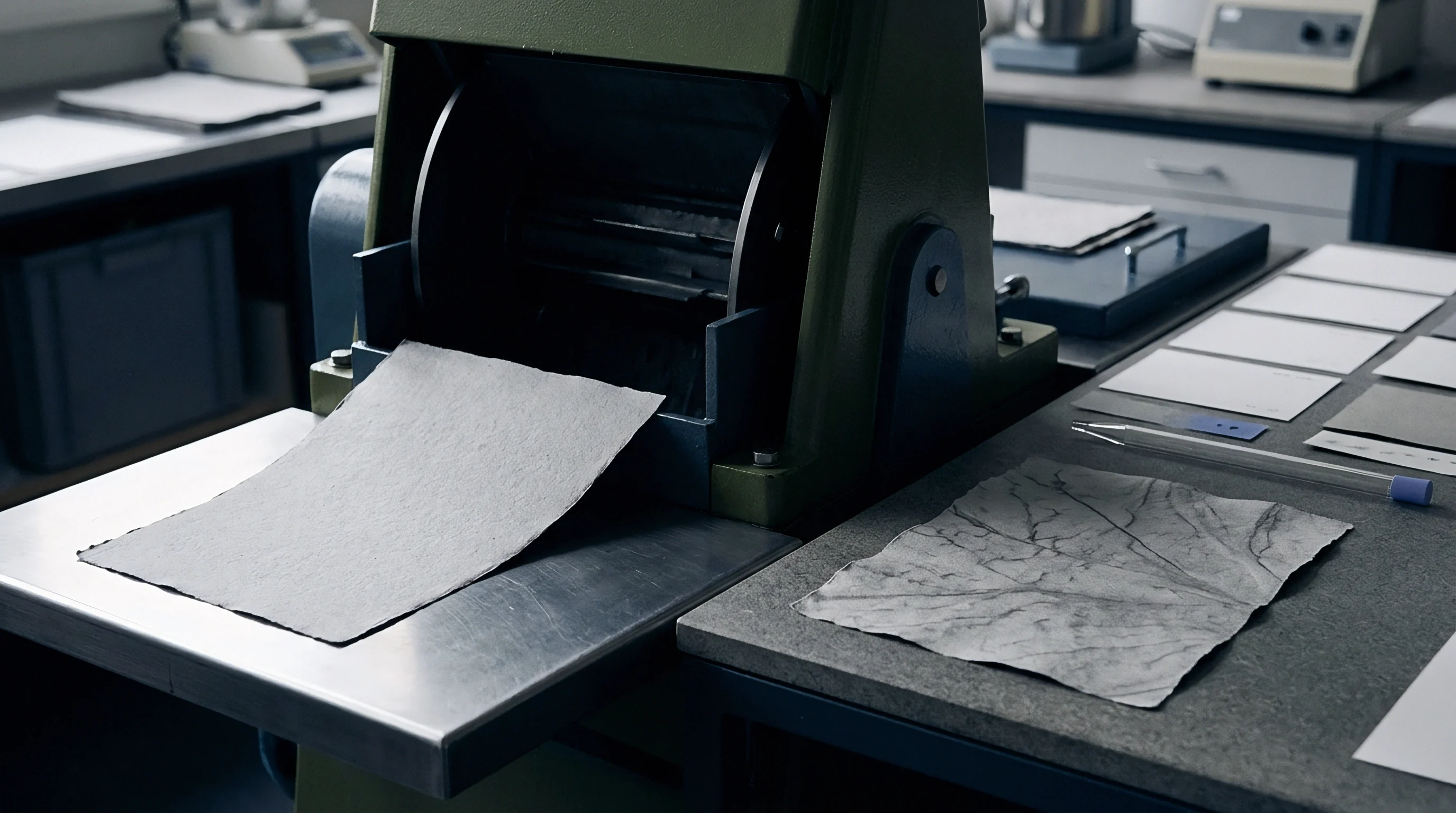
Taber versus ISO Bending Resistance
Stiffness values depend heavily on the test method in play. ISO 2493-1 records the force needed to bend a 38-millimetre wide strip through a 15-degree angle across a 50-millimetre span. TAPPI T 489, by contrast, uses a Taber-style instrument that expresses stiffness in units of g-cm at 15-degree deflection.
Converting from one scale to the other is rarely linear, relying on caliper as well as internal bond strength (determined via TAPPI T 569 Scott Bond). In typical FBB grades, the MD/CD stiffness ratio runs between 1.8 and 2.5, governed by wire speed, jet-to-wire ratios, and refining in the mechanical pulp.
| Grammage (g/m²) | Caliper (µm) | ISO Bending MD (mN) | ISO Bending CD (mN) | Taber Stiffness MD (g·cm) | Taber Stiffness CD (g·cm) |
|---|---|---|---|---|---|
| 230 | 350 | 17.5 | 8.2 | 8.9 | 4.2 |
| 275 | 430 | 31.0 | 14.5 | 15.8 | 7.4 |
| 300 | 490 | 45.0 | 21.0 | 22.9 | 10.7 |
| 350 | 580 | 72.0 | 33.0 | 36.7 | 16.8 |
Running FBB through a gluer comes down to the balance between panel stiffness and crease resistance. Stiff panels along the travel axis keep the carton body from dishing while the flaps fold inwards. When a crease runs parallel to the machine direction, folding forces must bend across aligned fibres, raising the force required to initiate the fold.
Scoring across the machine direction breaks those longitudinal fibres cleanly, producing a hinge with far less residual spring-back.
A standard specification clause requires substrate conditioning at 23 degrees Celsius and 50 percent relative humidity for 24 hours prior to stiffness verification under ISO 187.
As a rule, maintaining longitudinal stiffness across the main body panel while routing major structural creases perpendicular to the machine direction prevents the panel from bowing under belt compression.
Feed
Friction and Suction Separation Dynamics
Feeders pull single blanks from the bottom of the pile using timed vacuum pulses over rubber friction belts. How that bottom blank shears away from the stack depends heavily on grain direction. With the grain aligned to the feed direction, the board resists pulling down into the vacuum ports, keeping the leading edge flat as it enters the gate.
Cross-grain blanks, by contrast, tend to sag into the suction holes, which produces uneven drag against the belts and leads to double feeds or missed cycles.
Squaring and Breaker Section Physics
From the feed belts, blanks move directly into the pre-breaker, where scores are folded up to 180 degrees to break internal fibres before glue application. Pre-breaking score line 1 and score line 3 softens the fold memory so cartons open without resistance on automated packaging lines. How cleanly those creases break depends on their orientation relative to the direction of travel.
- Feeder gate clearance set to 1.5 times the nominal board caliper under static stack load to prevent top-coat scratching.
- Vacuum timing synchronized with friction belt acceleration cycles to eliminate slippage on the bottom sheet.
- Pre-breaker belts engaged between 90 and 180 degrees on crease 1, breaking internal fibre bonds in the mechanical pulp core.
- Final squaring guides aligned within 0.2 millimetre tolerance along the carrier rails prior to adhesive application.
Skewing almost always traces back to grain alignment in the feeder. A blank that enters the pre-breaker just 1-degree off can drift several millimetres out of square by the glue station. Corrective edge guides then have to shove the carton sideways back into position.
When cross-direction fibres meet that lateral load, the edge buckles under compression, leaving crushed side walls and loose fibre debris that fouls the glue nozzles.
A flat panel surface entering the glue application section maintains a constant distance of 1.0 millimetre from the non-contact cold glue nozzle tips.
Feeding blanks with the wrong grain orientation reliably triggers feeder jams, edge crushing, clogged nozzles, and speed reductions that wipe out converting margins.
Crease
Good creasing in FBB hinges on delaminating the mechanical core internally without splitting the chemical pulp liners on either face. As the creasing rule pushes the board into the matrix channel, it forms a bead on the reverse side. Folding the crease to 90 or 180 degrees then shears the middle plies so the liners roll into a clean hinge.
Whether that crease holds together or cracks comes down to how the score sits against the sheet grain.

Score Matrix Selection Parameters
When creasing parallel to the machine direction (an MD score), the rule pushes between fibres aligned along the score line. Because those fibres resist spreading sideways, channel width has to be selected carefully. Creasing across the machine direction (a CD score) shears across longitudinal fibres instead, promoting easier delamination in the mechanical plies.
Standard calculations for matrix width and depth account for this difference directly alongside board caliper.
For a standard FBB with caliper t = 450 micrometres (0.45 mm), the standard matrix channel width W and matrix depth D are calculated using the following operational formulas:
For Cross-Direction Scores (CD):
W = (1.5 × t) + trule
D = t
For Machine-Direction Scores (MD):
W = (1.7 × t) + trule
D = t
Where trule is the creasing rule thickness (typically 2-pt or 0.71 mm). The wider matrix channel width required for MD scores accounts for the higher lateral resistance of machine-aligned fibres during rule indentation.
Top-Coat Cracking Mechanics
Surface cracking down a crease ruins printing and lets moisture into the raw board. When an MD score folds through 180 degrees, outer tensile stress pulls across the cross-direction fibres. Cross-direction stretch at break (ISO 1924-2) is relatively high, allowing the liner to yield without breaking.
A CD score, however, pulls directly along the longitudinal fibres. Because machine-direction elongation is quite low ~ typically 1.5 to 2.5 percent versus 3.5 to 5.0 percent in CD ~ creasing across the grain leaves the outer ply vulnerable to cracking if matrix depth or width is even slightly tight.
Surface cracking on score lines stems either from low ambient moisture content in the converter warehouse or from improper crease channel dimensions and misaligned sheet grain.
Adhesion
Adhesive Wetting and Compression Dynamics
High-speed lines typically run PVA (polyvinyl acetate) emulsions through non-contact extrusion heads, reserving hot melts for barrier-coated cartons. Bond formation relies on a tight interaction between adhesive open time, green tack, and compression dwell. As PVA contacts the flap, water from the emulsion has to wick into the board before the polymer chains can lock together, a process governed largely by Cobb sizing values (ISO 535) and porosity in the fibre matrix.
Spring-Back Force against Glue Joint Integrity
Carton spring-back presents the main physical threat to a green glue seam. Right after folding, folded panels push outward against the curing adhesive line, and how hard they fight the joint depends directly on grain orientation along the crease.
- MD Fold Line (Grain Parallel to Glue Seam) ~ Transverse panel stiffness forces the carton open against the wet seam during transfer through the compression section.
- CD Fold Line (Grain Perpendicular to Glue Seam) ~ Lower transverse stiffness exerts minimal spring-back, letting tack build reliably even under short compression belt runs.
- High Grammage Substrates (Over 350 g/m²) ~ Board stiffness easily overpowers green tack if belt pressure drops, resulting in open-joint defects downstream.
- Coated Glue Flaps ~ Glue tabs must remain unprinted and uncoated; stray coating cuts bond shear strength by up to 70 percent under ISO 6383 tear testing conditions.
Total dwell time is strictly a function of compression apron length. At 500 metres per minute, a 4-metre belt gives the joint just 0.48 seconds under pressure. When the grain runs parallel to the seam, spring-back on heavy-caliper FBB often overpowers the green tack built within that 0.48-second window.
Blanks spring open the moment they leave the belts, jamming packing stations and triggering mass rejections.
Quality standards generally require a 90-degree fiber-tear test 10 minutes after application to show 100 percent fiber tear across the entire contact pattern.

Imposition
Prepress planning balances sheet yield on press against running speed on the finishing floor. Layout software naturally seeks maximum sheet utilization down to fractions of a percent, but turning blanks 90 degrees to squeeze on an extra row often forces cartons cross-grain through the gluer. The resulting speed drops and scrap spikes on the converting line can quickly outstrip any board savings gained on the press.
Take a run of 500,000 retail cartons on 300 g/m² FBB (caliper 490 µm, priced at 1,450 EUR per metric tonne), comparing two impositions on a standard 720 x 1020 mm sheet:
Option A maximizes press yield by running the grain parallel to the glue seam (CD feed). Packing 12 blanks per sheet requires 41,667 sheets. Factoring in 2 percent press makeready waste, total substrate comes to 9.42 metric tonnes, or 13,659 EUR.
Option B turns the blank layout 90 degrees so the grain runs perpendicular to the glue seam (MD feed), trading press density for line stability. Yield falls to 10 blanks per sheet, pushing sheet consumption to 50,000 sheets. Board requirements rise to 11.30 metric tonnes, raising board expenditure to 16,385 EUR ~ an extra 2,726 EUR upfront.
On the converting floor, however, performance differences reverse the financial picture:
| Performance Metric | Option A (Cross-Grain Feed) | Option B (Grain-Correct Feed) | Variance Impact |
|---|---|---|---|
| Folder-Gluer Line Speed | 350 m/min | 620 m/min | +77 percent velocity |
| Total Gluer Operating Hours | 23.8 hours | 13.4 hours | -10.4 machine hours |
| Hourly Gluer Machine Rate | 180 EUR/hour | 180 EUR/hour | -1,872 EUR labor/overhead |
| Converting Spoilage Rate | 4.5 percent | 0.5 percent | -20,000 rejected cartons |
| Spoilage Cost (Board + Print) | 1,420 EUR | 160 EUR | -1,260 EUR waste reduction |
| Net Conversion Cost Impact | Base Cost | -3,132 EUR Savings | +406 EUR Net Profit Shift |
Paying 2,726 EUR more for paper in Option B generates 3,132 EUR in reduced gluer hours and lower waste, leaving a net operational gain of 406 EUR. More significantly, reclaiming 10.4 machine hours frees up gluer capacity for subsequent jobs.
Evaluating actual packaging costs requires folding substrate stiffness, score line mechanics, and gluer kinematics straight into early prepress imposition decisions.