Multilayer Folding Boxboard Density Tuning for Converting Line Feed Reliability
Tuning middle-ply CTMP density between 0.45 and 0.55 g/cm³ balances board flexural rigidity against vacuum porosity to prevent converting feeder misfeeds.
Stack
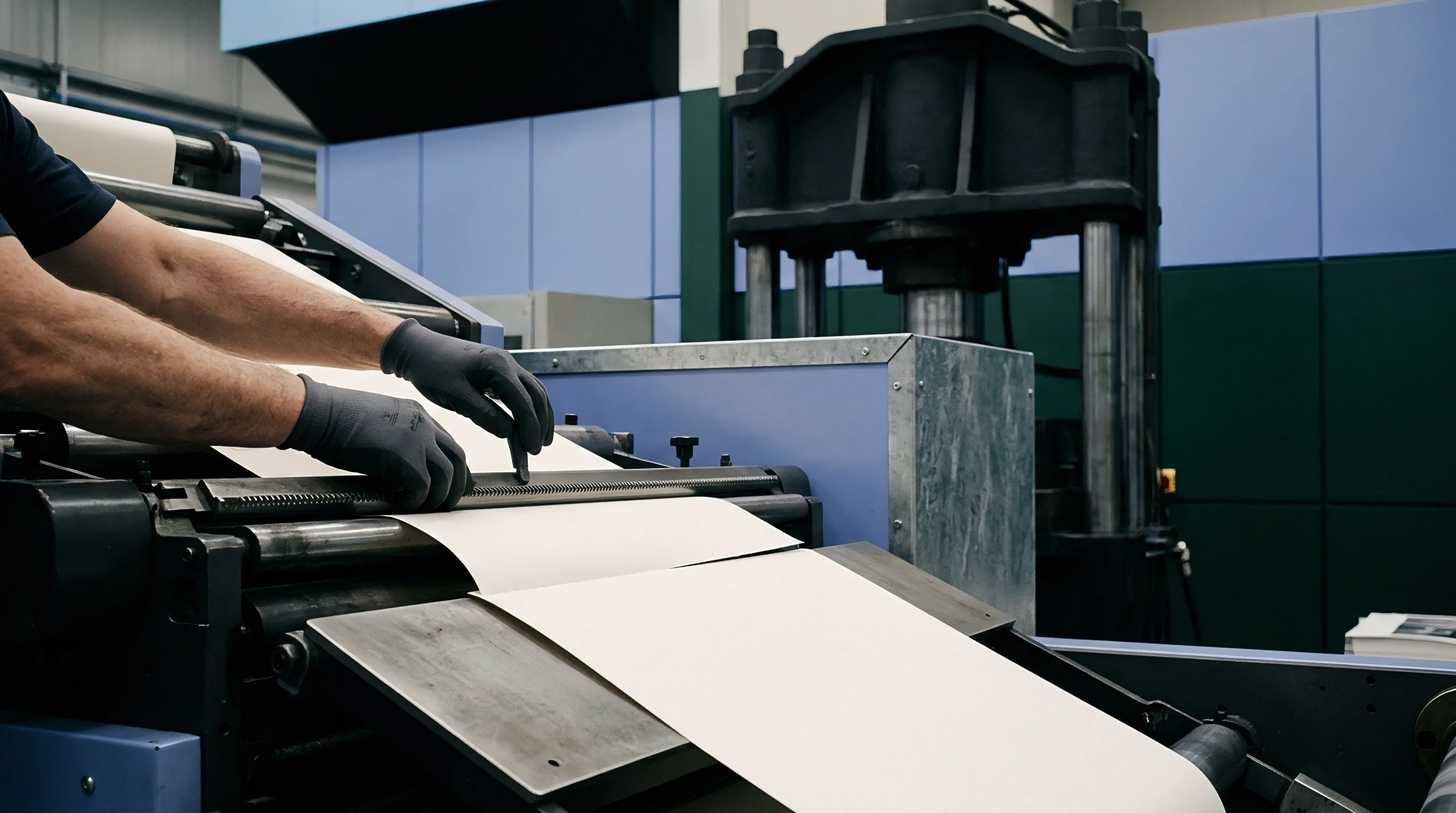
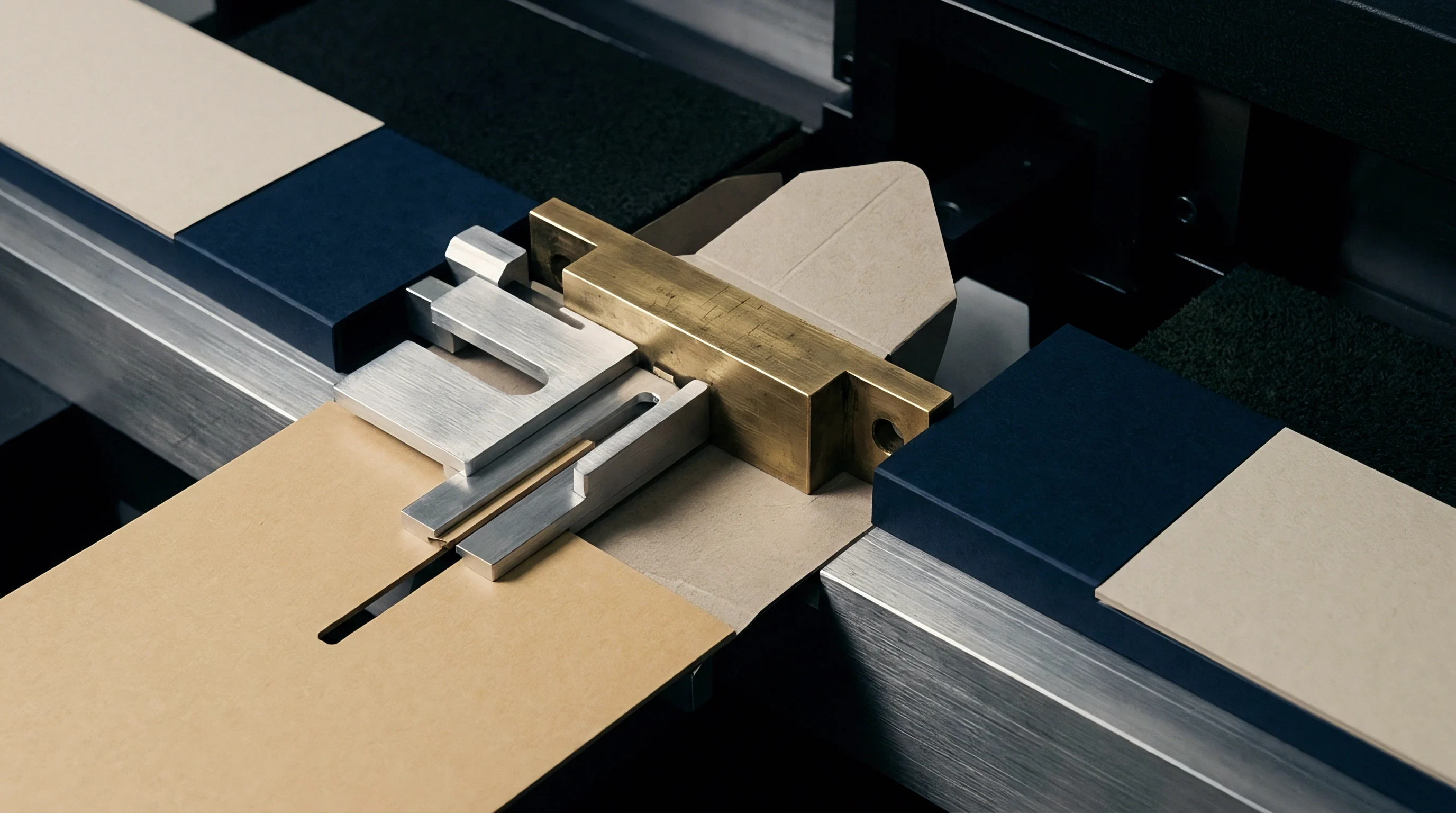
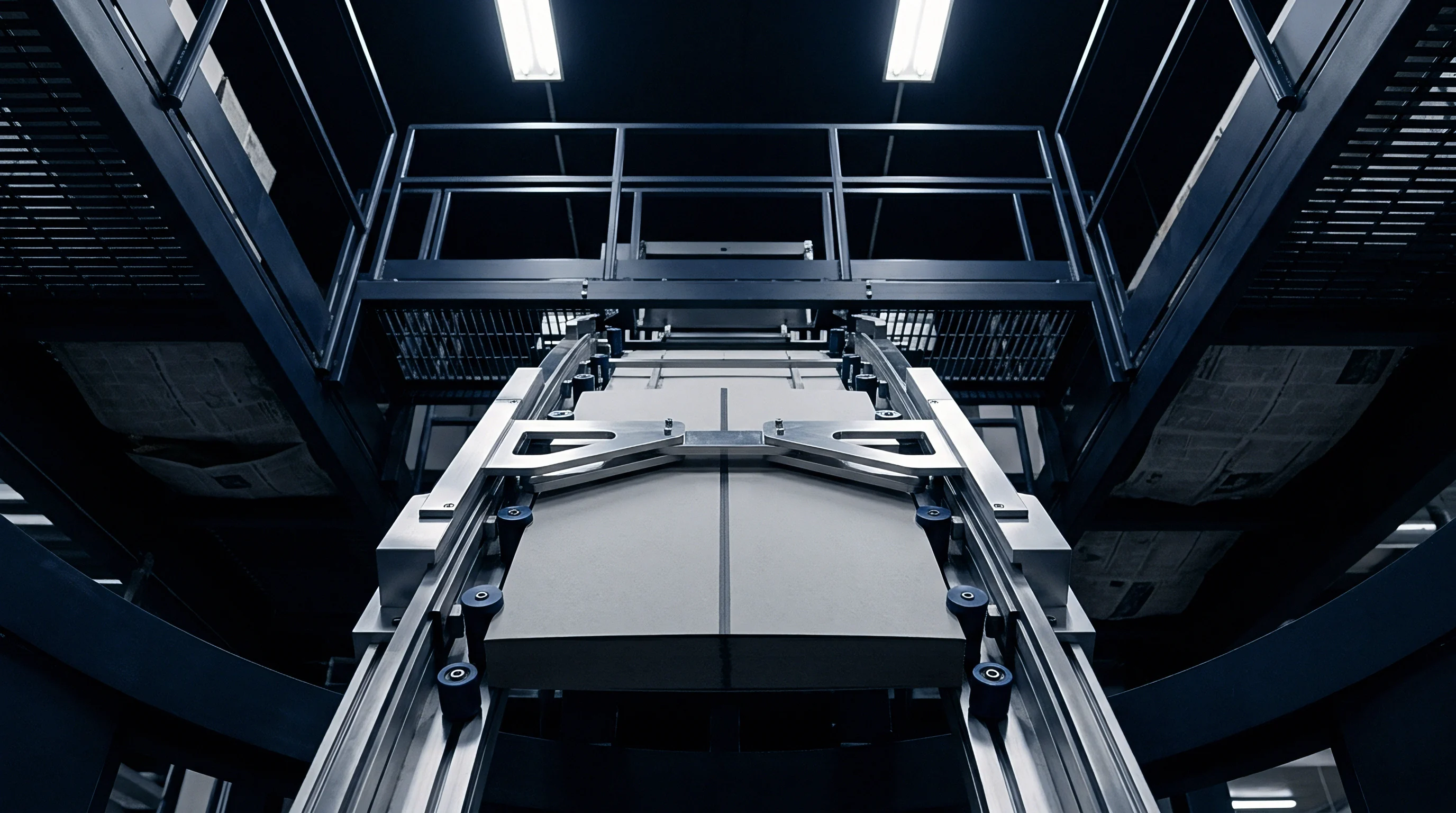
High-speed folding carton convertors run automated suction feeder heads at speeds exceeding 15,000 blank passes per hour. Board blanks enter the feed table from a rear-supported pallet elevator, where suction cups seize the lead edge while air knives blast pressurized streams through the top six sheets. Mechanical separators isolate the primary board, allowing the vacuum bar to advance a single blank onto the transfer belts without dragging the underlying substrate.
Feeder Inlet Kinematics and Sheet Lift Mechanics
Suction pressure within the pickup nozzles creates a pressure differential between the upper surface and the atmospheric gap beneath. When board stiffness drops below specified thresholds, the lead edge deforms into the suction cup orifice, altering the engagement angle. This localized deformation narrows the air gap necessary for the separator jets to break inter-sheet vacuum.
Board blanks exhibiting elevated flexural rigidity resist the parabolic deflection forced by the suction cups. Pneumatic lift cylinders draw higher vacuum currents to compensate, pulling the second blank upward through friction engagement along the back coating layer. Feeder stops drop hourly output.
Specifying a maximum cross-direction caliper variation under ISO 534 of plus or minus 3 percent prevents feed table skewing and vacuum pressure drops during continuous feeder elevation.
Feeder Separation Failure Categories
Converting equipment disruptions fall into four discrete operational modes when substrate properties deviate from mill tolerances:
- Double Sheet Pickups occur when static sliding friction between the top coating and bottom liner exceeds the vacuum separation force generated by the feeder air blasts.
- Blank Hesitation Incidents surface when low Z-direction flexural rigidity permits the lead edge to droop before reaching the feed table registration grippers.
- Vacuum Pressure Loss manifests when surface air permeance allows ambient air draw through the sheet thickness, diminishing sucker holding power.
- Feed Table Jamming arises from cross-direction caliper variation, which tilts the board pile and misaligns the lead edge against the front lay gauges.
Misaligned feeder boards force press stops. Operators clear jams manually while the feeder head recalibrates its suction height. Unplanned feed interruptions consume six to twelve minutes per clearance cycle, dropping net press output by as much as 1,200 printed sheets per hour.
Density
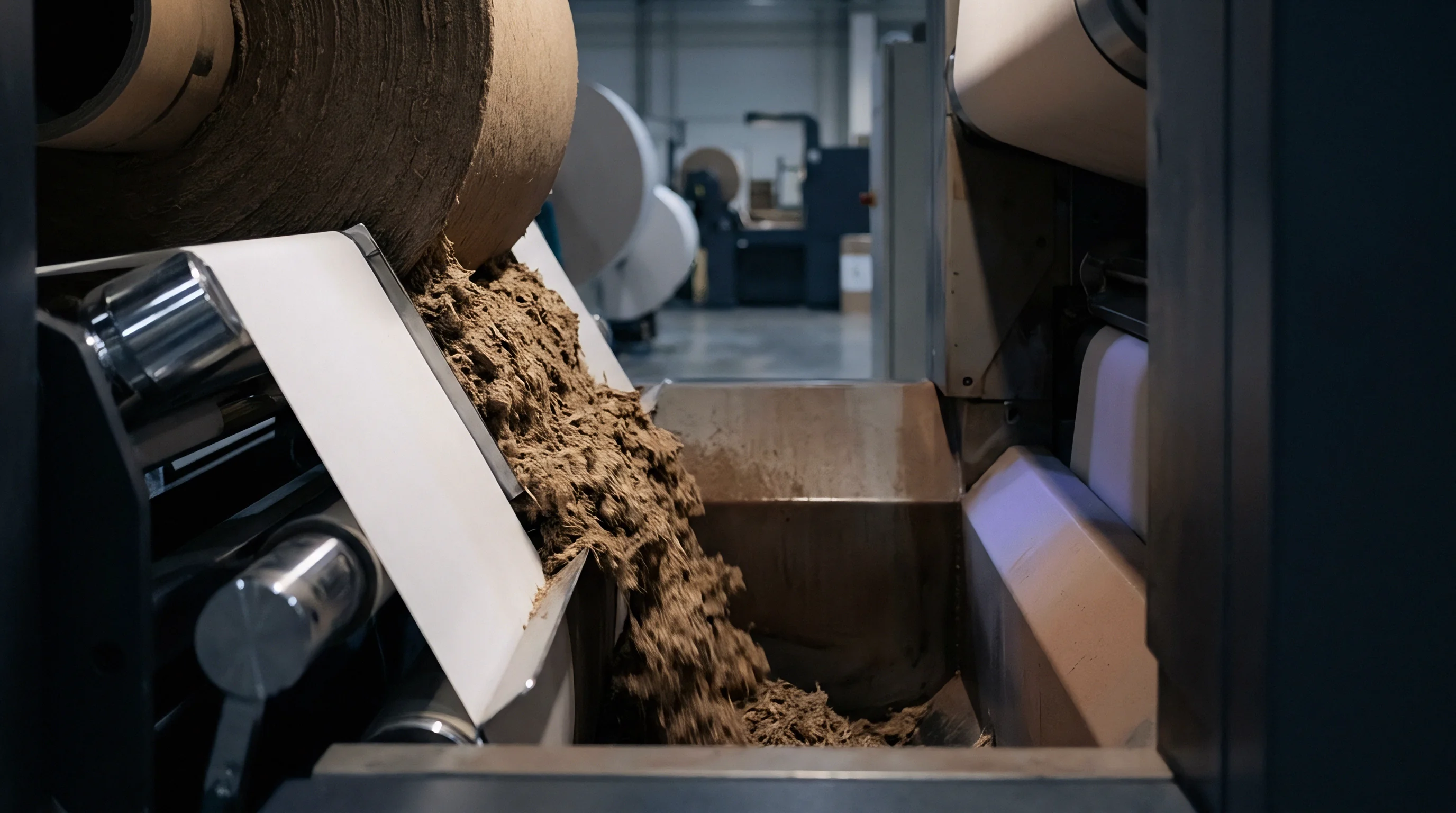
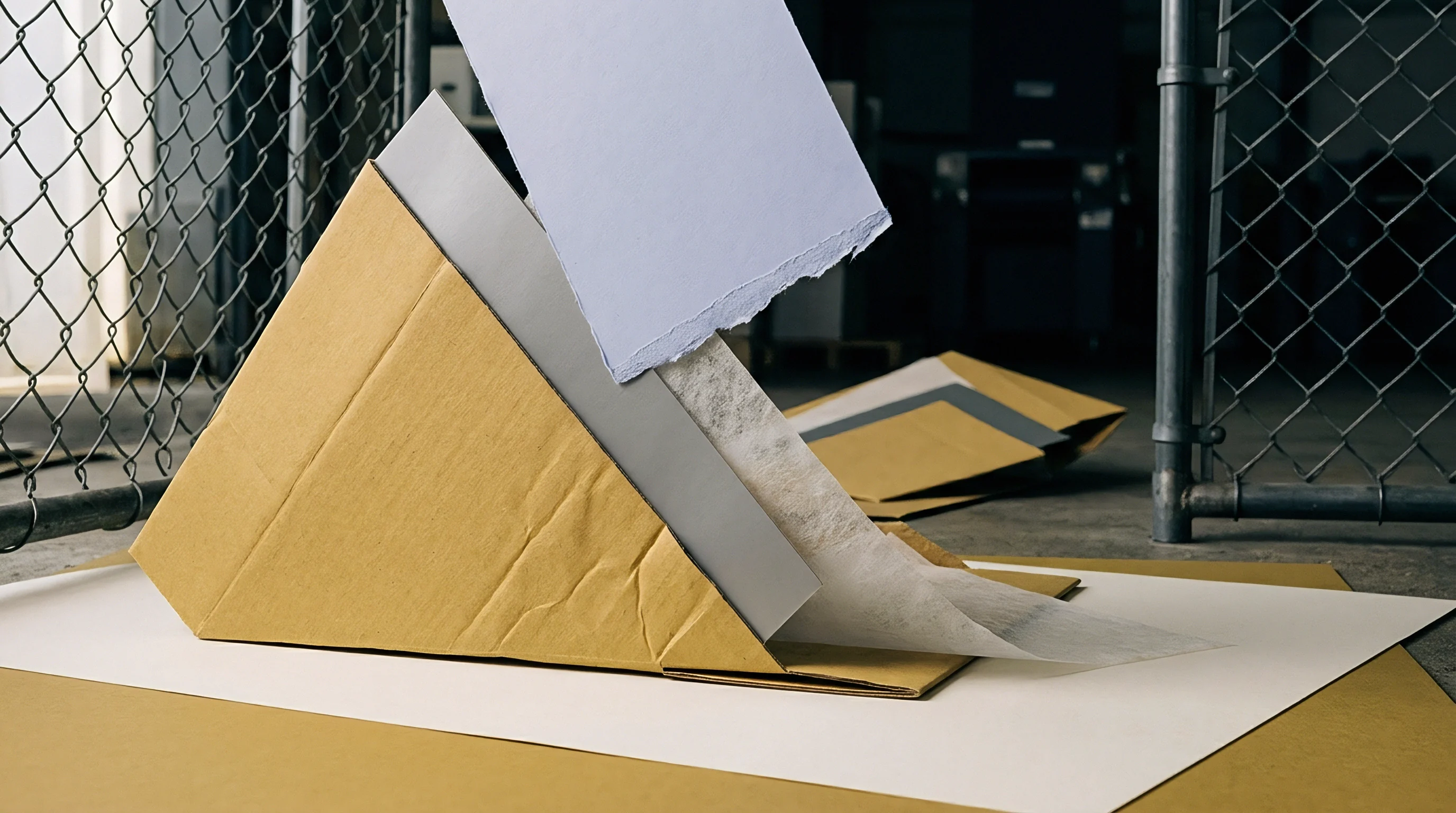
Multilayer folding boxboard relies on an engineered structural gradient across its thickness profile. Bleached chemical pulp forms the outer top and back layers to deliver smooth printing surfaces and tensile strength. Chemi-thermomechanical pulp (CTMP) or pressurized groundwood occupies the bulky middle layer, maximizing moment of inertia while conserving raw material mass.
Mechanical Fiber Stratification in Triple Ply Board
Refining intensity applied to the middle ply furnishes governs the trade-off between sheet compactness and flexural stiffness. High-yield CTMP fibers preserve intact lumen geometry, creating a porous network that provides structural bulk per unit basis weight. Chemical pulps in the outer plies undergo intensive refining to boost hydrogen bonding.
Dense outer plies absorb stress. Low bulk reduces flexural stiffness. Refining boosts outer ply bonding.
CTMP plies maintain structural bulk.
Bending resistance under ISO 2493-1 follows a cubic relationship with board thickness. Equation calculations demonstrate that multiplying caliper by a factor of two increases flexural rigidity eightfold at equivalent mass, provided the outer layers maintain high tensile moduli. Lowering central layer compacting during press section water removal preserves this caliper advantage.
A density decrease from 0.82 g/cm³ to 0.65 g/cm³ at constant 350 g/m² grammage increases L&W bending resistance by 48 percent under ISO 2493-1 conditioning at 23 C and 50 percent relative humidity.
Mill trial adjustments for establishing middle-layer furnish structure follow a strict technical sequence:
- Set CTMP freeness levels between 450 and 520 ml CSF in the middle stock preparation line to preserve fiber length.
- Adjust wet press roll nip pressures on the board machine to achieve target caliper prior to the yankee drying cylinder.
- Apply mild calender nip loading at the finishing stack, maintaining bulk above 1.45 cm³/g for standard folding boxboard grades.
- Verify cross-machine basis weight uniformity using inline beta-gauge attenuation sensors before reel spool winding.
- Measure Z-direction bond strength according to ISO 16260 to confirm internal ply adhesion exceeds 160 J/m².
Bulk Range Tolerances for Converting Headroom
Standard commercial grades balance volumetric weight against mechanical stiffness to match specific carton performance categories. The table below outlines technical properties across three distinct boxboard structural profiles evaluated at 300 g/m² nominal basis weight.
| Grade Classification | Grammage ISO 536 (g/m²) | Caliper ISO 534 (µm) | Bulk ISO 534 (cm³/g) | Density ISO 534 (g/cm³) | Taber Bending 15° ISO 2493 (mN·m) |
|---|---|---|---|---|---|
| High-Bulk FBB (CTMP Core) | 300 ± 3% | 480 ± 4% | 1.60 | 0.625 | 24.5 |
| Medium-Density FBB | 300 ± 3% | 405 ± 4% | 1.35 | 0.740 | 18.2 |
| Compact Heavy-Calendered FBB | 300 ± 3% | 345 ± 4% | 1.15 | 0.870 | 12.8 |
| Data measured under ISO 187 standard atmosphere (23°C, 50% RH). Bending stiffness measured in machine direction. | |||||
Calendering the middle layer increases surface smoothness while reducing the distance between the stiff outer plies. Linear bulk adjustments alter caliper. Preserving fiber bulk in the central layer delivers higher flexural stiffness than adding chemical pulp mass to the outer plies.

Porosity
Pneumatic sheet transport relies on controlled air resistance through the paperboard matrix. When vacuum cups grip the top sheet on a feeder pile, suction pumps draw air from the interface between nozzle rubber and the coated board surface. Open substrate structures permit ambient air to flow through the sheet thickness, dropping line vacuum pressures below operational holding thresholds.
Air Permeance Interactions with Suction Cup Vacuum Draw
Gas flow measurements conducted under ISO 5636-3 using Bendtsen instruments quantify fluid volume passing through a defined surface area at 1.47 kPa test pressure. Gas flow governs vacuum hold. High-bulk boards containing uncalendered CTMP layers show higher air permeance values than compact chemical pulp grades.
Excessive permeability allows feeder vacuum suction to draw the underlying sheet upward, causing double feeds.
Uncoated back plies require sufficient internal sizing to prevent moisture pickup from wet press blankets without increasing static sliding friction at the feeder stack.
Triple-ply structures mitigate through-sheet vacuum loss through double-pigment coating application on the top ply and starch sizing on the back ply. Top coatings fill surface voids. Sizing seals the back liner.
Which Vacuum Level Prevents Double Sheet Lifting?
Pneumatic operators adjust manifold air valves to balance suction force against inter-blank separation requirements. Vacuum levels match paperboard density. Operating at excessive negative pressure induces air flow across low-density board structures, creating a suction lock that pulls secondary blanks off the pile.
Lowering manifold vacuum from negative 80 kPa to negative 55 kPa reduces through-sheet suction while preserving sufficient grip for forward acceleration.
| Board Structure Type | Bendtsen Permeance ISO 5636-3 (ml/min) | Gurley Air Resistance ISO 5636-5 (s/100 ml) | Optimal Feeder Vacuum Pressure (kPa) | Separator Air Blast Pressure (bar) |
|---|---|---|---|---|
| Sealed Coated FBB | 15 ~ 45 | 120 ~ 350 | -75 to -85 | 1.2 ~ 1.5 |
| Standard Medium-Bulk FBB | 80 ~ 180 | 30 ~ 80 | -60 to -70 | 1.8 ~ 2.2 |
| Ultra-High-Bulk Open Layer FBB | 250 ~ 550 | 8 ~ 25 | -45 to -55 | 2.5 ~ 3.0 |
High air permeability board lots force convertors to adjust feeder timing curves to prevent double sheet lift. Paperboard mills often argue that feeder misfeeds stem entirely from worn rubber suction cups or incorrect blower nozzle positioning, side-stepping board permeability variations across production lots.

Friction
Inter-sheet shear forces govern the sliding motion between adjacent blanks during high-speed feed table removal. When the top suction bar lifts a blank, the back liner of that blank slides across the coated top surface of the board resting immediately beneath. Slippage behavior depends on surface chemistry, roughness profiles, and ambient climate conditioning.
Static and Dynamic Coefficients on Coated Surfaces
Slide angle testing performed in accordance with ISO 8295 establishes the force necessary to initiate motion between contact surfaces. Static friction controls sheet lifting. Static values between coated topsides and uncoated backsides typically range from 0.35 to 0.50.
Higher values indicate elevated tack. Increased resistance demands higher separator air pressure to dislodge the top sheet from the stack.
Conditioning board stock at 23 C and 50 percent relative humidity under ISO 187 prevents dimensional warp and stabilizes static coefficient of friction within target operating limits.
Dynamic resistance measures force requirements once motion has commenced. Elevated dynamic resistance causes sheet drag along the feeder registration table, delaying arrival at the front lay stops. Printing press registration systems trip fault sensors when blank arrival delays exceed three milliseconds.
Feeder Surface Inspection Protocol
Verifying sheet drag characteristics prior to press loading requires systematically testing board surface properties:
- Static Coefficient Measurement using a horizontal plane device under ISO 8295 ensures contact forces remain within the 0.38 to 0.44 target range.
- Backside Smoothness Testing via Parker Print-Surf under ISO 8791-4 verifies that roughness exceeds 4.5 µm to prevent vacuum contact welding between sheets.
- Surface Electrical Resistance Evaluation per IEC 61340-2-1 confirms static charge decay times remain under 0.5 seconds at ambient room humidity.
- Inter-Ply Wax Pick Determination following TAPPI T 459 guarantees coating binder strength resists pick forces generated by high-tack feeder suction pads.
Supply agreements routinely incorporate standard purchase specifications stating that substrate deliveries failing to meet ISO 8295 friction limits between 0.35 and 0.48 entitle convertors to reject non-conforming pallets without incurring restocking penalties.

Stiffness
Bending resistance controls structural stability as blanks accelerate from the feeder stack onto the press conveyor belts. As the vacuum bar releases the lead edge, momentum carries the blank forward across an open gap onto moving drive belts. Insufficient mechanical resistance causes the unsupported lead edge to sag under gravity, striking the lay gauge fingers and causing registration failure.
Flexural Rigidity Arithmetic and Feeder Trajectory
Bending resistance measured with L&W instruments at a 15-degree deflection angle under ISO 2493-1 defines the force required to flex a 50 mm wide specimen over a 10 mm bending distance. Cross direction resistance dictates stability. Machine direction orientation exhibits significantly higher modulus values than cross direction orientation due to fiber alignment on the paper machine wire.
Cross direction resistance dictates lead-edge stability when feeding sheets wide-edge first.
Lead-edge deflection follows cantilever beam physical equations where sag distance varies inversely with flexural rigidity. A 10 percent drop in board bending resistance increases lead-edge downward deflection by more than 15 percent at high feeder head acceleration rates. This geometric droop alters the angle of contact with front lay alignment stops.
Worked Yield Sensitivity Analysis across Bulk Grades
Consider an operational order for producing 1,000,000 folding cartons with blank dimensions of 700 mm by 1,000 mm (0.7 m² per sheet). The converting line target demands a minimum cross-direction L&W 15-degree bending resistance of 12.0 mN to prevent lead-edge feed crashes at 14,000 sheets per hour. Three structural boxboard options meet this mechanical requirement through different caliper and density combinations.
Option A utilizes a Compact Heavy-Calendered FBB at 350 g/m² grammage (0.875 g/cm³ density, 400 µm caliper), delivering 12.5 mN CD bending resistance at a board price of $1,200 per metric tonne. Option B utilizes a Medium-Density FBB at 310 g/m² grammage (0.738 g/cm³ density, 420 µm caliper), delivering 12.2 mN CD bending resistance at $1,280 per metric tonne. Option C utilizes a High-Bulk CTMP-layer FBB at 270 g/m² grammage (0.600 g/cm³ density, 450 µm caliper), delivering 12.1 mN CD bending resistance at $1,380 per metric tonne.
| Parameter | Option A (Compact FBB) | Option B (Medium-Density FBB) | Option C (High-Bulk CTMP FBB) |
|---|---|---|---|
| Basis Weight ISO 536 (g/m²) | 350 | 310 | 270 |
| Caliper ISO 534 (µm) | 400 | 420 | 450 |
| CD Bending Resistance ISO 2493 (mN) | 12.5 | 12.2 | 12.1 |
| Total Mass Required (Tonnes) | 245.0 | 217.0 | 189.0 |
| Price Per Metric Tonne ($) | 1,200 | 1,280 | 1,380 |
| Total Material Landed Cost ($) | 294,000 | 277,760 | 260,820 |
| Cost Per 1,000 Delivered Sheets ($) | 294.00 | 277.76 | 260.82 |
Calculating overall raw material outlay proves that Option C saves $33,180 compared to Option A despite carrying a $180 per tonne premium in raw price. Downgauging basis weight while maintaining flexural rigidity via low-density CTMP plies lowers total fiber mass required by 56 metric tonnes over the production run.
How far paperboard mills can reduce central ply density before Z-direction internal bond strength degrades under creasing and die-cutting forces remains an open industry challenge.