Dynamic Strain Rate Modeling for Multi Ply Boxboard under Rapid Compression
Dynamic strain rate modeling predicts multi-ply boxboard Z-direction compression and interlayer shear collapse during high-speed converting and package drops.


Dynamics
During high-speed converting or drop impacts, paperboard experiences rapid loading with strain rates exceeding several hundred units per second. At standard test speeds of one millimeter per minute, wood fibers and starch bonds have time to undergo plastic flow. But when deformation takes place in milliseconds, stress relaxation cannot dissipate the mechanical energy.
Viscoelastic dissipation freezes, driving up out-of-plane stiffness while ultimate compressive strain drops sharply. Evaluating boxboard for automated packaging lines therefore requires testing across the entire span from static stacking to dynamic compression.
The fibrous network of multi-ply paperboard pairs stiff chemical-cellulose outer layers with bulky mechanical or recycled middle plies, and strain rate sensitivity differs markedly between these zones. Outer plies with refined kraft fibers stiffen through intra-fiber polymeric constraint. Middle plies containing groundwood or thermo-mechanical pulp respond by displacing interstitial air and bending fibers rapidly.
Under fast loading, air cannot escape the pore structure quickly enough, generating transient internal pneumatic pressure that temporarily boosts bulk resistance before the core collapses.
Static crush metrics like short-span compressive strength or ring crush resistance fail to capture these dynamics. Dynamic compression alters load distribution across folding boxboard layers during creasing matrix engagement and rotary die cutting. A board formulation tuned strictly for static compression often turns brittle under rapid die strikes, where lower dynamic energy absorption leads to score line cracking, internal delamination, and outer liner fracture on high-speed cartoning lines.
A 350 g/m² folding boxboard shows a 42 percent increase in peak out-of-plane compression resistance when the strain rate rises from 0.01 per second to 500 per second at 23 degrees Celsius and 50 percent relative humidity.
Strain rate sensitivity factors depend on board construction and mechanical fiber treatment. Empirical compression metrics across loading velocities illustrate these shifts for standard commercial packaging substrates.
| Substrate Grade | Grammage (g/m²) | Quasi-Static Modulus (MPa) | Dynamic Modulus at 500 s⁻¹ (MPa) | Peak ZD Yield Stress (MPa) | Energy Absorption Shift (%) |
|---|---|---|---|---|---|
| Solid Bleached Board (SBB) | 300 | 18.5 | 31.2 | 4.8 | +28 |
| Folding Boxboard (FBB) | 350 | 11.2 | 22.4 | 2.9 | +45 |
| Coated White Lined Chip (WLC) | 400 | 8.7 | 15.1 | 1.8 | +18 |
| Unbleached Kraft Board (SUB) | 330 | 15.8 | 27.9 | 4.1 | +36 |

Strain Rate Dependent Constitutive Responses
Stress-strain curves for cellulose networks shift in shape as deformation speeds up. In quasi-static tests, the curve features an elastic region, a smooth yield plateau, and a densification zone. High-speed impact steepens the initial elastic slope and elevates the yield stress threshold, which is then followed by a sudden load drop as fiber wall micro-buckling spreads through the core.
This localized collapse caps the total work-to-fracture during sudden impacts.
Temperature and moisture levels modulate rate sensitivity across every ply. Under slow shear or compression, hydrogen bonds between fibers continuously reform. High strain rates break those bonds faster than their natural relaxation rate allows.
Higher equilibrium moisture softens the amorphous hemicellulose matrix, counteracting dynamic stiffening and shifting failure back toward shear-induced cell wall yield.
Higher impact velocities shift failure in the fiber network from ductile yielding to brittle shear slipping along internal interfaces.


Substrate
Multi-ply paperboard lays down specific fiber types through the sheet thickness to maximize bending stiffness per unit weight. Dense, tightly bonded chemical pulp in the outer plies resists tensile and compressive forces during bending, while coarse mechanical pulps or recycled fibers in the middle form a bulky core separating the outer skins. Dynamic response under fast compression depends directly on how these individual layers deform and interact across their interfaces.
Density profiles through the thickness govern how compression waves travel through the board. High-density outer layers transmit kinetic energy quickly into the structure, whereas lower-density core layers compress at lower stress levels, functioning as energy-absorbing collapse zones. When a high-velocity impact hits the surface, the compressive wave decelerates abruptly at the soft middle ply, creating intense out-of-plane shear along the ply boundaries.
In-plane structural variations create localized density differences that distort dynamic stress distribution. Formation flaws or fiber flocs concentrate compressive loads into high-density islands. Under rapid impact, these dense spots resist deformation while surrounding low-density areas collapse early, triggering delamination before the bulk material reaches its overall yield limit.

Out-of-Plane Compression Modulus Calculations
Analyzing multi-layer dynamic response requires calculating the composite out-of-plane compression modulus across the layer stack, where each ply contributes based on its thickness fraction and strain-rate-dependent modulus. Take a typical 450 micrometer folding boxboard under rapid impact. The top chemical ply measures 80 micrometers with a dynamic modulus of 32 MPa, the mechanical core measures 290 micrometers at 14 MPa, and the back chemical ply measures 80 micrometers at 28 MPa.
Effective out-of-plane dynamic compliance equals the weighted sum of individual ply compliances divided by total caliper. Dividing layer thickness by dynamic modulus gives a top ply compliance of 2.5 times 10⁻⁶ m/MPa, core compliance of 20.71 times 10⁻⁶ m/MPa, and back ply compliance of 2.86 times 10⁻⁶ m/MPa, for a total stack compliance of 26.07 times 10⁻⁶ m/MPa. Dividing the 450 micrometer total thickness by this compliance produces an effective composite dynamic out-of-plane modulus of 17.26 MPa under high strain rates.
Under static conditions, the same construction yields an effective static modulus near 9.8 MPa. This 76 percent jump in dynamic composite stiffness highlights how strongly the mechanical core behaves during rapid loading. Middle-ply fiber density and cell wall collapse thresholds determine whether the structure absorbs kinetic energy or transmits peak shock loads directly to the packaged contents.
Elevated starch spraying compensates for reduced middle-ply grammage during high-speed crease formation.


Crush
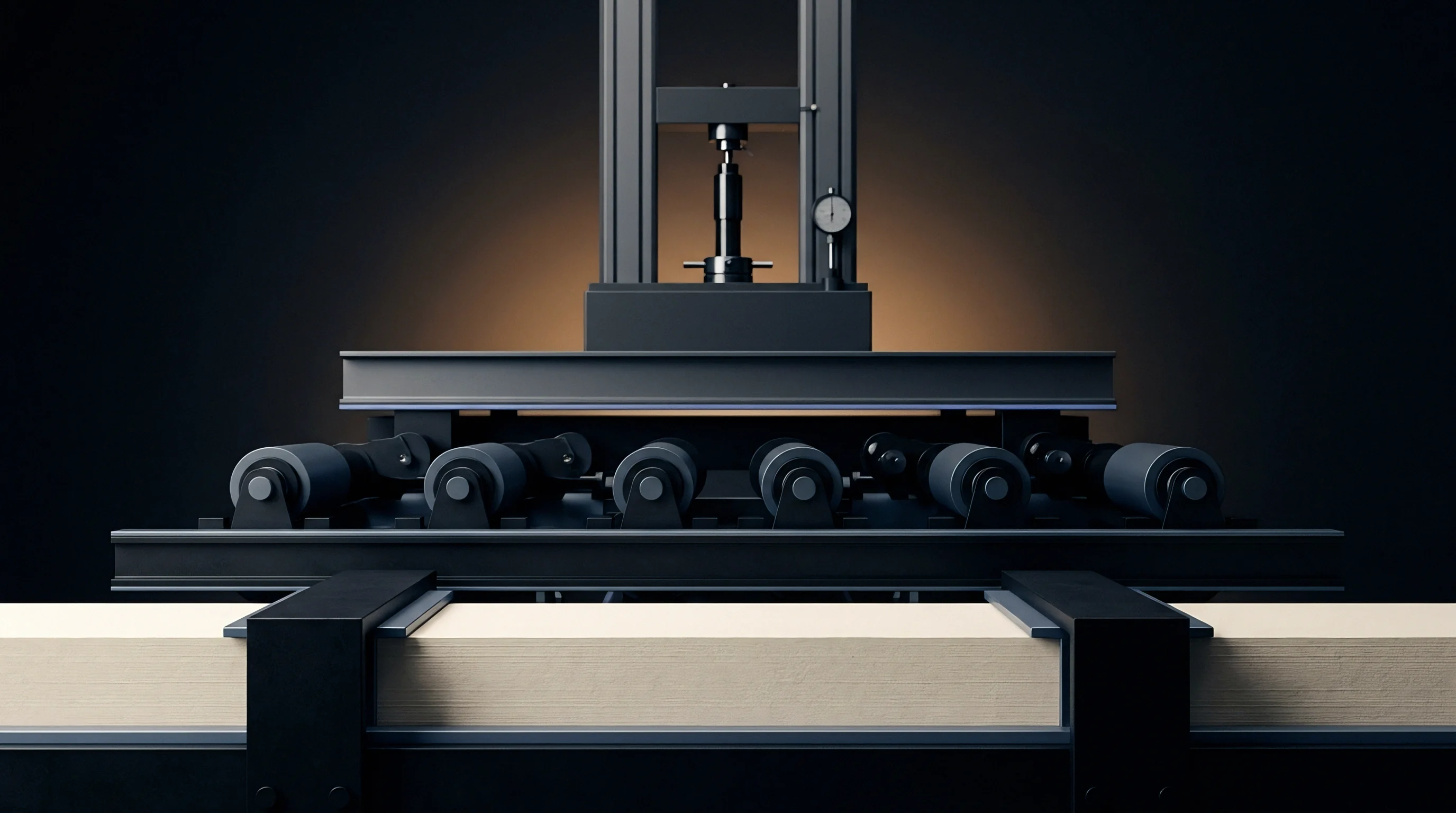
Validating dynamic strain rate models experimentally requires test equipment capable of applying uniform compression above 100 per second. Standard tensile and compression frames fail at high speeds from frame inertia and transducer ringing. Characterizing material response instead relies on modified Split-Hopkinson Pressure Bar setups, drop-weight impact towers, and high-speed servo-hydraulic systems with laser Doppler vibrometry.
Split-Hopkinson Pressure Bar systems adapted for soft cellulosic media use low-impedance polymeric or hollow aluminum bars to match paperboard acoustic impedance. A striker bar impacts the input bar, launching a compressive stress wave toward the thin paperboard sample. Part of the wave reflects into the input bar while part transmits through the specimen into the output bar.
High-speed strain gauges on both bars capture wave profiles, allowing direct calculation of strain rate, specimen deformation, and axial stress history without inertial artifacts.
Drop towers produce the controlled, low-velocity, high-energy impacts typical of package drop events. Transducers beneath the anvil record transient loads while high-speed digital imaging tracks caliper reduction and lateral expansion. Combining optical speckle tracking with force data reveals localized strain fields across individual plies during millisecond impacts.
What Mechanics Governs Z-Direction Collapse at High Strain Rates?
Out-of-plane collapse starts with micro-buckling of unsupported fiber segments within middle-ply voids. Under slow deformation, fibers rotate and slip past adjacent bonds, gradually consolidating the network. Rapid impact forces cell walls to buckle instantly between inter-fiber bonding nodes.
This cell wall crushing begins at the interface between the top chemical layer and mechanical core, where stiffness mismatches concentrate stress.
Pore air compression adds substantial transient resistance during sudden impacts. While paperboard porosity permits air permeation under static loads, rapid volume reduction creates localized hydraulic resistance within narrow fiber capillaries. Trapped air pressure elevates overall compressive resistance until it escapes laterally along fiber alignments.
This pneumatic cushioning causes dynamic compression resistance to scale non-linearly with impact velocity.
ISO 187 conditioning mandates standard laboratory atmospheres because a two percent shift in equilibrium moisture content alters dynamic strain rate sensitivity factors by up to eighteen percent.
Standard test methodologies specify strict conditioning parameters to isolate strain rate effects from atmospheric variations. Key dynamic compression test protocols and their operating ranges apply to multi-ply board evaluation in distinct ways.
| Test Method Framework | Strain Rate Range (s⁻¹) | Primary Deformation Axis | Core Measurement Target | Transducer System |
|---|---|---|---|---|
| Servo-Hydraulic High-Speed | 0.1 to 100 | Out-of-Plane (ZD) | Yield point, modulus shift | Piezoelectric load cell |
| Split-Hopkinson Bar (Polymer) | 200 to 1500 | Out-of-Plane (ZD) | High-rate flow stress | Semiconductor strain gauge |
| Drop-Weight Impact Anvil | 10 to 300 | In-Plane & ZD | Total energy absorption | Laser optical extensometer |
| Rotary Matrix Simulator | 50 to 500 | Crease Punch Shear | Rule penetration force | Quartz force washer array |
ASTM D642 section 8.2 alters pass requirements by allowing dynamic package impact values to override static BCT ratings when high-speed palletizing is specified.

Rheology
Modeling dynamic strain rate behavior requires non-linear viscoelastic-viscoplastic formulations that capture rate-dependent hardening, thermal softening, and damage accumulation. Standard linear viscoelastic models break down because permanent consolidation in paperboard involves fiber wall crushing and intra-ply bond failure. Advanced finite element models combine phenomenological yield surfaces with rate sensitivity functions calibrated against dynamic test data.
Cowper-Symonds strain rate hardening equations adjust classical yield stress values based on plastic strain rate. Dynamic yield stress equals static yield stress multiplied by a rate factor ~ specifically, plastic strain rate divided by a material parameter, raised to an empirical exponent. For mechanical pulp middle plies, the rate parameter ranges between 400 and 800 per second with an exponent near 0.25.
Chemical pulp outer layers exhibit higher rate parameters near 1200 per second, reflecting lower rate sensitivity at moderate speeds.
Cohesive zone modeling captures interlayer bond strength between adjacent plies. Interface stiffness and critical energy release rates in mode I compression and mode II transverse shear are defined as rate-dependent parameters. As punch velocity increases during die scoring, higher interface penalty stiffness shifts stress concentrations from the outer liner surface deeper into the fiber core.
Calibrating a rate-dependent material model for commercial FEA solvers requires a structured sequence of steps.
- Gather quasi-static out-of-plane compression data across standard conditioning levels to define base yield stress and initial modulus.
- Run high-speed servo-hydraulic compression trials at strain rates from 1 to 500 per second to map yield elevation slopes.
- Extract Cowper-Symonds or Johnson-Cook strain rate hardening parameters by curve-fitting stress-strain plateaus.
- Measure dynamic shear response to isolate mode II rate sensitivity across internal ply bonding layers.
- Enter layer-specific strain rate parameters into multi-ply shell or 3D solid continuum elements in the finite element solver.
- Validate full model predictions against drop-weight impact force-displacement curves recorded on physical carton samples.
Interlayer shear modulus scales faster with strain rate than out-of-plane compressive stiffness across all mechanical pulp middle plies.
It remains unclear how micro-void consolidation inside mechanical pulp cores alters localized thermal energy dissipation during millisecond nip compression events.
Delamination
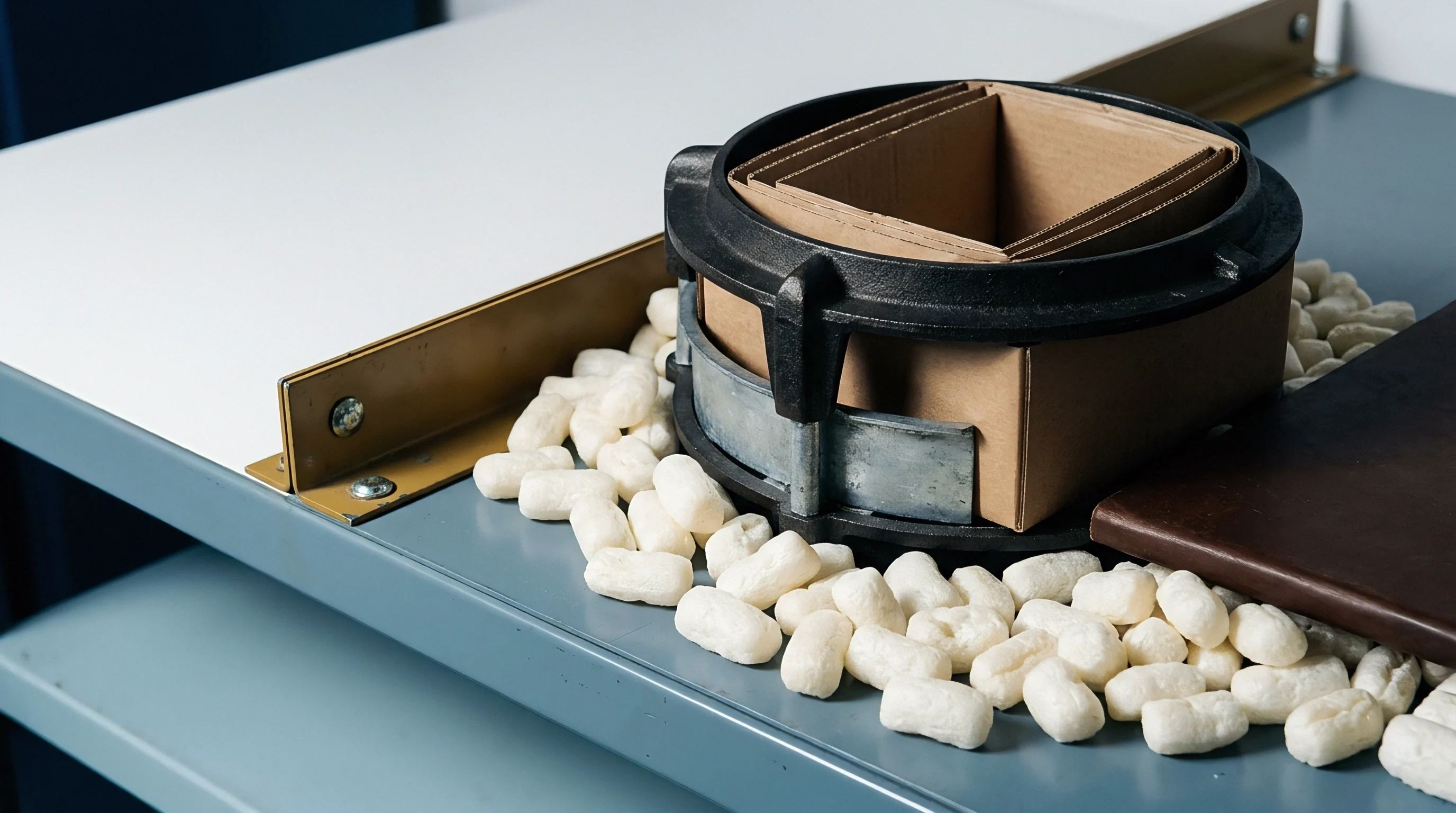
Rapid compressive loading triggers failure mechanisms that differ sharply from static failure. In high-speed creasing and blanking, punches enter the board surface at speeds above two meters per second. This rapid displacement drives out-of-plane compression while inducing intense transverse shear along ply interfaces.
When internal shear stress exceeds local bond strength, delamination propagates quickly ahead of the tool.
Controlled delamination during creasing allows outer plies to bend outward without cracking when the box is folded. Uncontrolled delamination, however, destroys bending stiffness and compromises stacking strength. As converting line speeds rise, the shear zone narrows, concentrating deformation into thin bands within the groundwood core and causing score lines to split prematurely.
Dynamic compression failures in multi-ply boxboard manifest as distinct physical defects during high-speed converting.
- Crease Root Splitting occurs when high punch velocities generate excessive transverse tensile stress beneath the female die matrix, fracturing the back chemical liner before controlled delamination initiates.
- Core Ply Crushing results from sudden micro-buckling of coarse mechanical fibers, causing permanent bulk loss and reduced bending stiffness along crease shoulders.
- Top Liner Peeling develops when high shear strain rates exceed cohesive bond strength at the interface between the top chemical layer and middle groundwood core.
- Corner Edge Bursting arises during rapid drop impacts, where dynamic hydraulic air pressure in core voids combines with out-of-plane shear to blow out folded carton corners.
Rapid creasing punch velocities above two meters per second shift the shear strain accumulation into the central groundwood layer before the top liner can deform elastically.
Ignoring high-velocity strain hardening during die setup causes severe score line splitting, pushing scrap rates above six percent on high-speed folder-gluer lines.

Economics
Selecting multi-ply board grades based solely on static spec sheets creates real financial risk on modern packaging lines. A grade specified for static compression strength often underperforms during dynamic converting, forcing operators to slow equipment to prevent scoring fractures. Dropping folder-gluer speeds from 400 meters per minute to 280 meters per minute increases hourly unit conversion costs by up to 30 percent, wiping out any savings from buying lower-grammage board.
Lightweighting initiatives often reduce grammage by cutting middle-ply bulk and adding chemical pulp to preserve static stiffness. This substitution alters dynamic strain rate behavior: chemical pulp plies show steeper dynamic hardening, increasing penetration resistance during die-cutting. That extra resistance requires greater impression force, accelerating rule wear and forcing frequent machine stops for recalibration.
Optimizing multi-ply boxboard specifications requires balancing raw material yield against high-speed converting reliability and dynamic shock resistance. Key yield, cost, and operational tradeoffs apply across three distinct 350 g/m² equivalent board formulations.
| Board Formulation Strategy | Raw Material Cost Ratio | Relative Bulk (cm³/g) | Max Converting Speed (m/min) | Die-Cut Tool Life Shift (%) | Dynamic BCT Retention (%) |
|---|---|---|---|---|---|
| High-Bulk FBB (Groundwood Core) | 1.00 | 1.55 | 420 | Baseline | 88 |
| Dense Premium SBB (100% Chemical) | 1.28 | 1.22 | 310 | -22 | 94 |
| Recycled WLC (Deinked/TMP Core) | 0.86 | 1.38 | 350 | -12 | 76 |
Factoring dynamic strain rate behavior into material sourcing reduces production waste and eliminates overly conservative safety margins. Accurate modeling allows converting plants to optimize creasing matrix geometry and nip clearances for specific line speeds before paying for die tooling. Converting lines can then run at full speed while finished cartons retain structural integrity under real-world shock and drop conditions.