Calculating Bending Stiffness and Compression Resistance in Multi-Ply Board Specifications
Multi-ply board stiffness and compression depend on z-direction modulus distribution, where cubic caliper scaling governs flexure and cross-direction short-span compression dictates box stacking strength.


Ply
The mechanical behavior of paperboard comes down to how individual fiber layers are distributed through its thickness. Under bending loads, a homogeneous single-ply sheet develops a linear strain gradient, where stress scales directly with distance from the neutral axis. Multi-ply constructions exploit this profile by placing dense, high-modulus chemical fibers at the outer surfaces and lighter, lower-cost mechanical or recycled fibers in the core.
Predicting structural performance for these layered structures depends on accurate figures for each ply’s thickness, density, and elastic modulus.
Four primary multi-ply grades dominate industrial packaging. Solid Bleached Board is made entirely from bleached chemical pulp, giving it uniform density and high mechanical strength through its z-direction. Folding Box Board places a mechanical pulp core between bleached chemical outer plies, gaining bulk and bending stiffness at a lower grammage.
White Lined Chipboard is built mostly from recycled fibers, using a bleached pulp top liner over a grey recycled core and back liner. Solid Unbleached Board relies on unbleached chemical kraft pulp ~ frequently topped with a thin bleached surface ~ to supply the tensile and compressive strength needed for heavy carrier packaging.
The z-direction elastic modulus profile determines how the sheet responds to flexural stress. When bent under load, the outer plies sustain the peak tensile and compressive stresses, whereas the core experiences little bending stress but must withstand shear to keep the layers from separating. A thin, high-modulus outer ply adds far more flexural resistance than a much thicker layer positioned near the center plane.
Because distance from the neutral axis scales stiffness by a squared factor, the properties of the outer plies dominate composite bending behavior.
Performance drops quickly when the ply arrangement fails to match the demands of converting equipment or warehouse stacking.
- Interlayer delamination occurs when shear forces overcome internal bond strength during high-speed folding, ruining structural continuity through the core.
- Face cracking appears on the tension side of a score line when outer chemical plies lack sufficient elongation or moisture.
- Compression failure develops on the inner bending surface as low-density mechanical core plies yield under localized buckling strain.
- Caliper collapse occurs under heavy press nip pressure when soft recycled core furnishes suffer permanent thickness loss.
The modulus distribution across layers also governs crease formation and reverse bending. Clean creasing depends on controlled, localized delamination within the central mechanical core while the outer chemical plies stretch without breaking. Excessively dense cores resist this internal shear, causing the score line to crack outer coatings during folding.
Mechanical pulps such as thermomechanical pulp or groundwood preserve high bulk and low shear modulus, providing the ideal core matrix for sharp hinges on carton blanks. Chemical kraft pulps on the outer faces supply the tensile energy absorption needed to maintain joint integrity under dynamic loads.
Virgin chemical fibers preserve longer average lengths ~ typically 2.2 to 3.2 millimeters for softwoods and 0.8 to 1.6 millimeters for hardwoods. Recycled furnishes undergo fiber shortening during repulping, which drops average lengths below 0.6 millimeters in unsorted chipboard. These shorter fibers reduce inter-fiber bonding, lowering both face tensile modulus and core shear strength.
Matching fiber morphology to the stress state of each individual ply ensures efficient material use during board specification.
| Board Classification | Furnish Layout (Top / Core / Back) | Density Range (g/cm³) | Top Ply Modulus (GPa) | Core Ply Modulus (GPa) |
|---|---|---|---|---|
| Folding Box Board (FBB) | Bleached Chemical / Mechanical / Chemical | 0.60 – 0.75 | 6.5 – 8.5 | 1.8 – 2.8 |
| Solid Bleached Board (SBS) | Bleached Chemical throughout | 0.80 – 0.95 | 6.0 – 7.5 | 5.5 – 7.0 |
| White Lined Chipboard (WLC) | Bleached Chemical / Recycled Core / Recycled | 0.70 – 0.85 | 4.5 – 6.0 | 1.2 – 2.2 |
| Solid Unbleached Board (SUB) | Bleached Surface / Unbleached Kraft Core | 0.75 – 0.88 | 7.5 – 9.5 | 3.5 – 5.0 |
Discrepancies in face-layer modulus and tensile stress lead to unexpected panel flex, bulging carton walls, and frequent jams on automatic packaging lines.

Flexure
Bending stiffness measures how effectively paperboard resists deformation under flexural load. Analyzing flexural behavior in multi-ply board relies on composite beam theory, where overall resistance represents the integral of elastic moduli through the sheet thickness. Standard homogeneous equations fail here because the elastic modulus varies along the z-direction profile.
Bending stiffness per unit width, denoted as Sb, comes from the flexural rigidity equation for layered composites:
Sb = sumi=1n Ei · Ii
Where Ei is the elastic modulus of ply i, and Ii is its area moment of inertia relative to the composite neutral axis. For a sheet divided into n layers, the neutral axis location z0 from the bottom surface equals:
z0 = fracsumi=1n Ei · ti · barzisumi=1n Ei · ti
Here ti represents layer thickness and barzi is the distance from the bottom reference plane to the midpoint of layer i. Evaluating the moment of inertia for each layer yields:
Ii = fracti312 + ti · left( barzi – z0 right)2
Substituting Ii back into the stiffness summation highlights the critical influence of distance from the neutral axis. The squared term left( barzi – z0 right)2 ensures that outer plies contribute far more to total stiffness than the core. Effective multi-ply design maximizes stiffness by positioning high-modulus material as far from z0 as practical.
Bending stiffness scales with the cube of total board thickness when layer elastic moduli remain constant.
Doubling sheet caliper increases bending stiffness eightfold, assuming elastic modulus stays constant. In multi-ply manufacturing, preserving caliper with a bulky core gives equivalent stiffness at much lower total grammage. FBB mills exploit this cubic relationship by running low-density mechanical pulp cores down to 0.45 g/cm³.
Fiber alignment in the machine direction creates marked structural anisotropy in multi-ply board. Preferential orientation along the web direction produces a machine-direction elastic modulus typically two to three times higher than in the cross direction. Bending stiffness follows this same ratio, meaning packaging calculations must account for whether bending moments act along or across the manufacturing axis.
Composite modulus is calculated by weighting individual layer contributions against total sheet caliper. Consider a three-ply board 400 micrometers thick, constructed from two 50-micrometer chemical pulp surface plies (elastic modulus 8.0 GPa) and a 300-micrometer mechanical pulp core (elastic modulus 2.0 GPa). Calculating layer contributions through the parallel axis theorem yields a bending stiffness that a single-ply sheet of identical basis weight cannot achieve.
Although core elastic modulus plays a minor role in flexural moment capacity, it governs transverse shear stiffness. Under severe bending loads, a low shear modulus permits internal sliding between core fibers, leading to premature warping. Refining levels for mechanical pulp must therefore be tightly controlled on the mill floor to maintain inter-fiber bonding without sacrificing core bulk.
When comparing substrates, calculating the stiffness index eliminates weight bias. This index divides measured bending stiffness by the third power of basis weight. Higher values indicate superior structural efficiency, permitting grammage reductions without sacrificing package stability.
A minor loss in core bulk reduces flexural stiffness far more severely than a comparable drop in surface-ply tensile modulus.

Buckling
Compression resistance governs the maximum vertical load a finished carton or container can sustain before wall collapse. Stacking strength depends primarily on two mechanical properties: the material’s edgewise compressive strength and the panel’s resistance to global wall buckling. While bending stiffness prevents wide panels from bowing outward, edgewise compression strength resists failure along vertical crease lines and load-bearing corners.
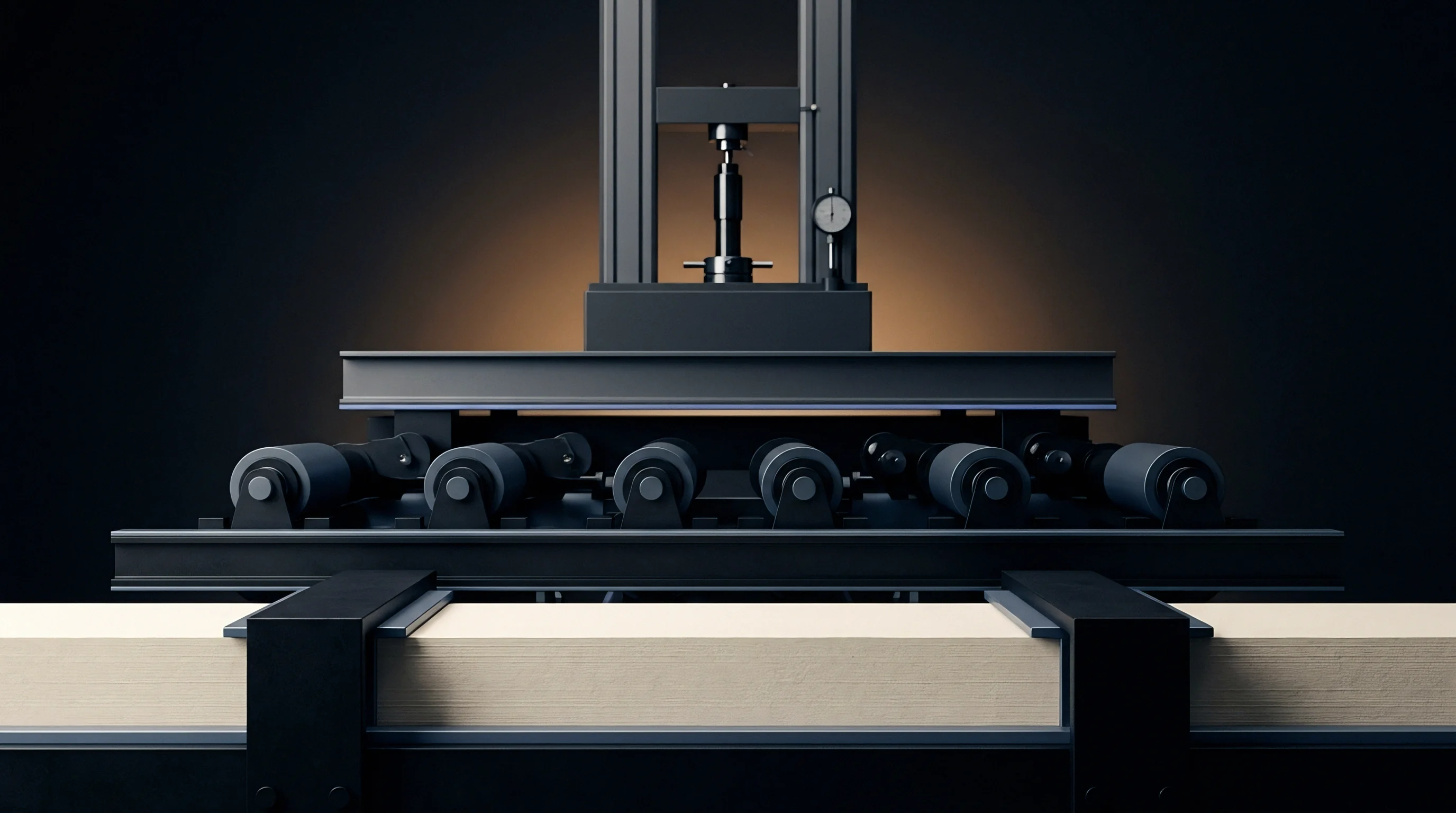
Edgewise compression strength is evaluated mainly using the Short-Span Compression Test (ISO 9895 and TAPPI T 826). Older protocols such as the Ring Crush Test frequently yield inaccurate figures for thin board because specimens buckle within the holder before reaching pure compressive failure. In short-span testing, pneumatic clamps secure a 15-millimeter-wide strip across a gap of exactly 0.7 millimeters.
This narrow span suppresses flexural instability, forcing pure compressive yield.

How Does Ply Bond Strength Affect Short Span Compression?
Ply bond strength establishes the upper limit for short-span compressive yield in multi-ply sheets. Under compressive loads, fiber walls buckle locally through micro-instabilities. If interlayer adhesion is insufficient, localized microbuckling propagates along ply boundaries and splits adjacent layers apart.
High ply bond strength provides ongoing lateral support to the outer plies, forcing fibers to yield in axial compression rather than delaminating.
Predicting finished box performance from sheet properties relies on modified compression models. Although the classic McKee equation was derived for corrugated board, adapted formulations work directly for multi-ply folding cartons. Top-to-bottom compression strength (BCT) links edgewise compression strength to bending stiffness:
BCT = 2.028 · SCT0.75 · left( sqrtSb,MD · Sb,CD right)0.25 · Z0.5
Where SCT represents cross-direction short-span compression resistance in kilonewtons per meter, Sb,MD and Sb,CD are machine- and cross-direction bending stiffness in millinewton-meters, and Z is the internal carton perimeter in meters. The relative exponents indicate that short-span compression influences top-to-bottom load capacity three times as strongly as bending stiffness.
Cross-direction compression strength plays the leading role in stacking performance. Because cartons are typically folded so cross-direction fibers align vertically along load lines, cross-direction short-span strength acts as the primary defense against wall collapse. Mills that adjust jet-to-wire speed ratios to increase cross-direction fiber alignment yield higher stacking strength per unit basis weight.
Evaluating compression in the field follows a set sequence to separate raw material defects from converting damage.
- Cut undamaged samples from unprinted sheet margins with a dual-blade precision cutter to avoid edge distortion.
- Condition test strips at 23 degrees Celsius and 50 percent relative humidity for 24 hours.
- Run short-span compression tests on ten machine-direction and ten cross-direction specimens with the standard 0.7-millimeter gap.
- Perform parallel tests on printed, creased carton walls to isolate strength losses introduced during converting.
- Calculate strength retention ratios by comparing values from printed carton walls against baseline figures from the unprinted parent sheet.
Losses in compressive strength frequently stem from excessive nip pressure on printing press impression cylinders. Over-pressing crushes low-density mechanical cores, permanently reducing caliper and panel stiffness without altering raw short-span values. Quality audits must differentiate between raw fiber deficits and mechanical damage inflicted during printing.
Incorporating precise test standards into purchasing contracts prevents disputes regarding delivered stock performance. A standard clause might specify: Short-span compression resistance in the cross-direction shall be tested in accordance with ISO 9895 under standard conditions of 23 degrees Celsius and 50 percent relative humidity, maintaining a minimum individual roll mean of 4.2 kilonewtons per meter across any delivered batch.

Measurement
Evaluating mechanical properties in multi-ply board demands rigorous control over environmental conditions. Standard testing atmospheres (ISO 187 and TAPPI T 402) specify 23 degrees Celsius and 50 percent relative humidity. Because cellulose fibers are hygroscopic, they exchange moisture with surrounding air until equilibrium is reached.
Absorbed water disrupts hydrogen bonding within the fiber network, reducing elastic modulus and short-span compression strength while slightly increasing strain-to-break.
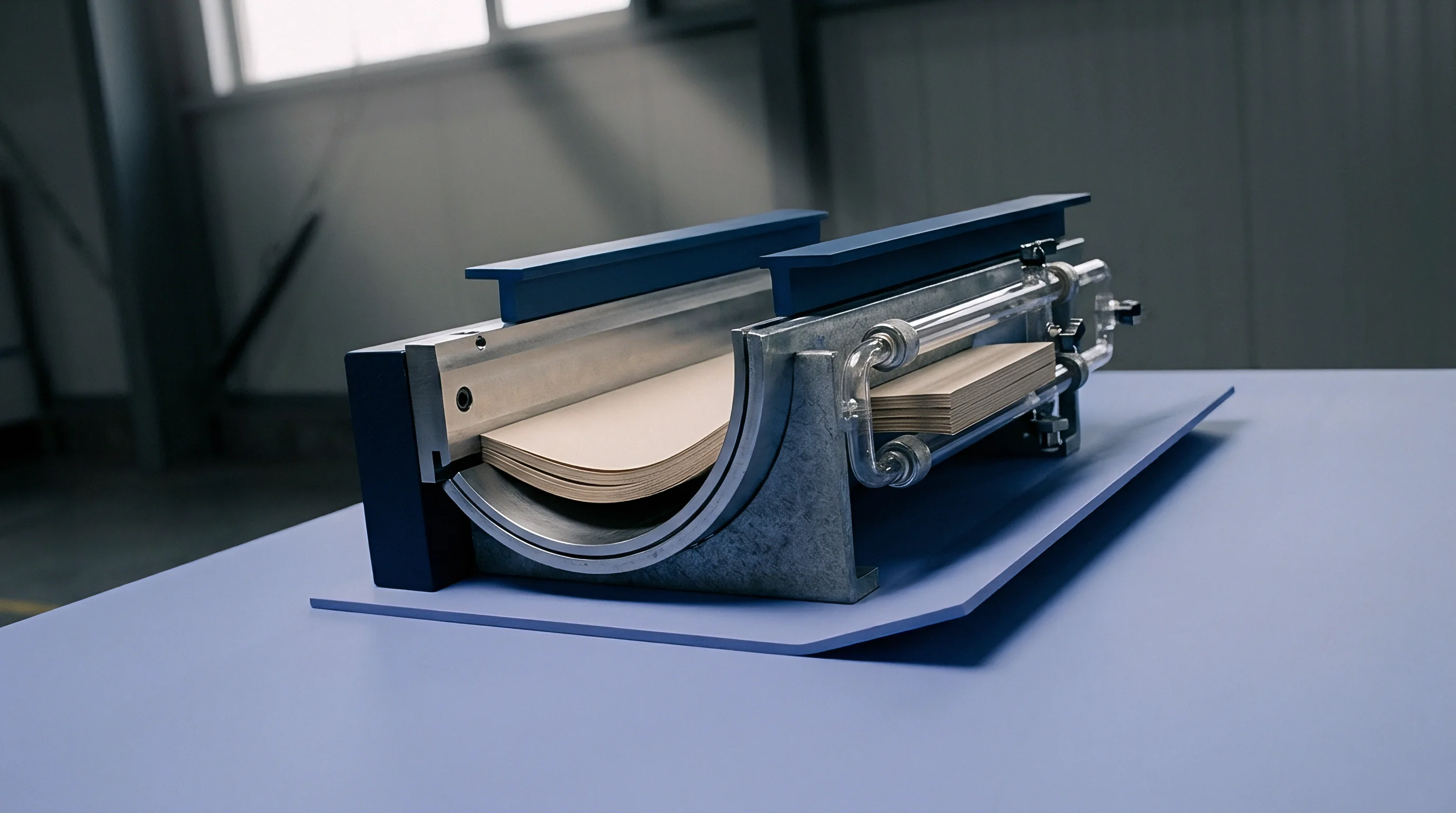
Bending stiffness testing relies primarily on two setups: two-point bending and three- or four-point flexural methods. An L&W two-point tester clamps a 38-millimeter-wide specimen at one end, applying force 50 millimeters from the fixture to achieve a 15-degree deflection. Taber instruments apply equivalent two-point torque, measuring resistance at 15 degrees across a 50-millimeter test length.
Results are reported in millinewton-meters or Taber units.
All flexural stiffness measurements require precise specimen alignment to prevent torsional force contamination.
Short-span compression testing under ISO 9895 applies a clamping force of 2300 ± 500 Newtons across a 15-millimeter strip. Clamping pressure must be sufficient to prevent slip within the jaws without crushing fibers along the grip line. Improper jaw pressure skews test values, masking underlying pulp deficits or structural flaws.
| Property Target | Standard Protocol | Sample Geometry | Primary Test Parameters | Reporting Units |
|---|---|---|---|---|
| Bending Resistance (2-Point) | ISO 2493-1 / TAPPI T 556 | 38 mm wide x 50 mm span | 15 degree deflection, 5 seconds | mN or mNm |
| Taber Stiffness (2-Point) | TAPPI T 489 / ISO 2493-2 | 38 mm wide x 38.1 mm span | 15 degree deflection angle | Taber Units or mNm |
| Bending Stiffness (4-Point) | ISO 2493-2 | 50 mm wide x 100 mm span | Four-point load line flexure | mNm |
| Short-Span Compression (SCT) | ISO 9895 / TAPPI T 826 | 15 mm wide x 0.7 mm gap | Compression rate 1 mm/min | kN/m |
Converting between stiffness units requires care. Taber values convert to bending moment in millinewton-meters when multiplied by 0.0981. Translating two-point L&W stiffness (15 degrees over a 50-millimeter span) into four-point pure bending stiffness requires adjusting for shear along the cantilever span, as two-point testing introduces transverse shear stress that slightly underestimates pure flexural stiffness.
Substrate anisotropy requires separate reporting for machine-direction and cross-direction properties. Geometric mean stiffness gives an overall measure of structural capability:
Sb,geom = sqrtSb,MD · Sb,CD
The anisotropy ratio Sb,MD / Sb,CD tracks the balance of fiber orientation. Target ratios for multi-ply folding boxboard typically range between 1.8 and 2.5. Values above 3.0 indicate excessive machine-direction orientation, leading to weak cross-direction panel walls and cracking along parallel crease lines.
Sample preparation is a frequent source of scatter in test results. Dull cutting blades produce burred edges that introduce micro-cracks along specimen borders. These defects propagate early during short-span compression testing, artificially depressing measured values by up to 12 percent relative to true sheet potential.
Because a mill’s certificate of analysis reflects controlled testing under ISO 187, fluctuations in ambient warehouse humidity can noticeably alter actual board stiffness during converting.
Derivation
Evaluating substrate substitution options calls for systematic calculations. Consider replacing a 350 gsm White Lined Chipboard with a lighter Folding Box Board while maintaining or exceeding cross-direction bending stiffness. The baseline 350 gsm WLC features a caliper of 420 micrometers, a cross-direction elastic modulus of 1.8 GPa, and a cross-direction bending stiffness of 11.2 mNm.
The proposed FBB option achieves an effective cross-direction modulus of 3.2 GPa thanks to high-modulus chemical outer plies and a bulky mechanical core. Setting up the flexural equivalence relationship gives the minimum FBB thickness needed to hit the 11.2 mNm baseline:
Sb,target = EFBB,eff · fractFBB312
Solving for minimum caliper tFBB yields:
tFBB = left( frac12 · Sb,targetEFBB,eff right)frac13 = left( frac12 · 0.0112 N m3.2 × 109 N/m2 right)frac13 = 348 × 10-6 m = 348 μm
At an FBB bulk density of 0.68 g/cm³, a thickness of 348 micrometers corresponds to a basis weight of 236 gsm. Replacing 350 gsm WLC with 240 gsm FBB maintains panel stiffness while cutting sheet mass by 110 gsm ~ a 31.4 percent weight reduction.
Replacing recycled board with virgin folding boxboard cut unit weight by 31.4 percent while preserving flexural stiffness.
Next, evaluate how this substitution affects top-to-bottom compression resistance. The 350 gsm WLC baseline has a cross-direction short-span compression strength of 4.8 kN/m. The 240 gsm FBB drops to 3.6 kN/m because of its lower total fiber content.
Applying the adapted McKee equation for a carton with perimeter Z = 0.60 meters:
For original WLC stock:
BCTWLC = 2.028 · (4.8)0.75 · (11.2)0.25 · (0.60)0.5 = 2.028 · 3.243 · 1.828 · 0.775 = 9.32 kN
For substitute FBB stock:
BCTFBB = 2.028 · (3.6)0.75 · (11.2)0.25 · (0.60)0.5 = 2.028 · 2.616 · 1.828 · 0.775 = 7.51 kN
While bending stiffness remains unchanged, carton compression strength drops by 19.4 percent. To recover this compressive performance without reinstating the original basis weight, mills can boost core short-span strength using surface starch applications or targeted refining adjustments.
| Grade Option | Grammage (g/m²) | Caliper (µm) | CD Bending Stiffness (mNm) | CD SCT (kN/m) | Calculated BCT (kN) |
|---|---|---|---|---|---|
| Baseline Recycled (WLC) | 350 | 420 | 11.2 | 4.8 | 9.32 |
| Substitute Virgin (FBB) | 240 | 348 | 11.2 | 3.6 | 7.51 |
| Engineered FBB (High SCT) | 265 | 380 | 14.5 | 4.4 | 9.35 |
Reviewing grade alternatives requires clear performance criteria before committing purchasing volume.
- Flexural equivalence must be verified through cross-direction two-point or four-point bending stiffness calculations.
- Compressive capacity should be checked by applying cross-direction short-span values to carton geometry models.
- Score line integrity requires verifying outer ply tensile absorption against planned folding radii.
- Crease depth tolerance must match matrix channel dimensions to ensure clean bead formation on high-speed folder-gluers.
Calculated yield savings must account for landed substrate costs, freight volume shifts, and regional extended producer responsibility fees.
Does the lower freight mass offset higher per-tonne virgin pulp prices when total landed carton counts stay the same?

Specification
Translating calculated properties into commercial contracts demands enforceable mill specifications. Standard target values are statistical batch averages that vary across production runs. A robust purchasing specification establishes target means alongside clear lower specification limits to ensure delivered stock performs reliably on automated converting equipment.
Commercial board specifications establish standard tolerance windows around key physical properties. Basis weight typically allows a variance of ±3 percent, whereas caliper requires ±4 percent from target. Bending stiffness is commonly specified as a floor 10 percent below the target batch mean, while short-span compression resistance usually requires a minimum 8 percent below target mean to safeguard stacking performance.
Ream-to-ream variability frequently rises during receiving inspections when mills transition between recycled furnishes without adjusting headbox chemistry. In addition, unit economics shift depending on whether board is bought by mass or surface yield. Purchasing by the metric tonne yields fewer total sheets whenever grammage drifts toward the upper limit, making surface-area ordering or strict basis-weight clauses essential for protecting converter margins.
Verification protocols at receiving require systematic sampling from delivered shipments. Quality inspectors draw six sheets per pallet across five randomly selected pallets per batch. These samples undergo 24 hours of conditioning under standard atmospheric conditions before testing.
If average test values drop below the defined lower limit, the lot enters formal quality dispute procedures.
Commercial paperboard specifications must define property minimums rather than target averages to prevent line jams.
Substrate cost should be evaluated per thousand cartons rather than solely by price per tonne. High-bulk FBB at 1,400 Euros per tonne yields significantly more sheets per unit mass than a WLC grade at 1,000 Euros per tonne. Calculating landed material cost per unit area reflects the true commercial balance, frequently proving that lighter, higher-grade substrates lower total carton cost despite a higher purchase price per tonne.
Final technical documentation supplied to mills should consolidate target grammage, minimum cross-direction stiffness, minimum short-span compression resistance, and acceptable moisture ranges into a single binding specification. Clear parameters eliminate ambiguity and establish predictable performance expectations for both mill and converter.