Recycled Containerboard Compression Loss under Constant Atmospheric Humidity
Recycled containerboard loses up to 45% compression strength under constant 85% RH; specify ISO 2233 derated SCT metrics to prevent static stack collapse.
Stack
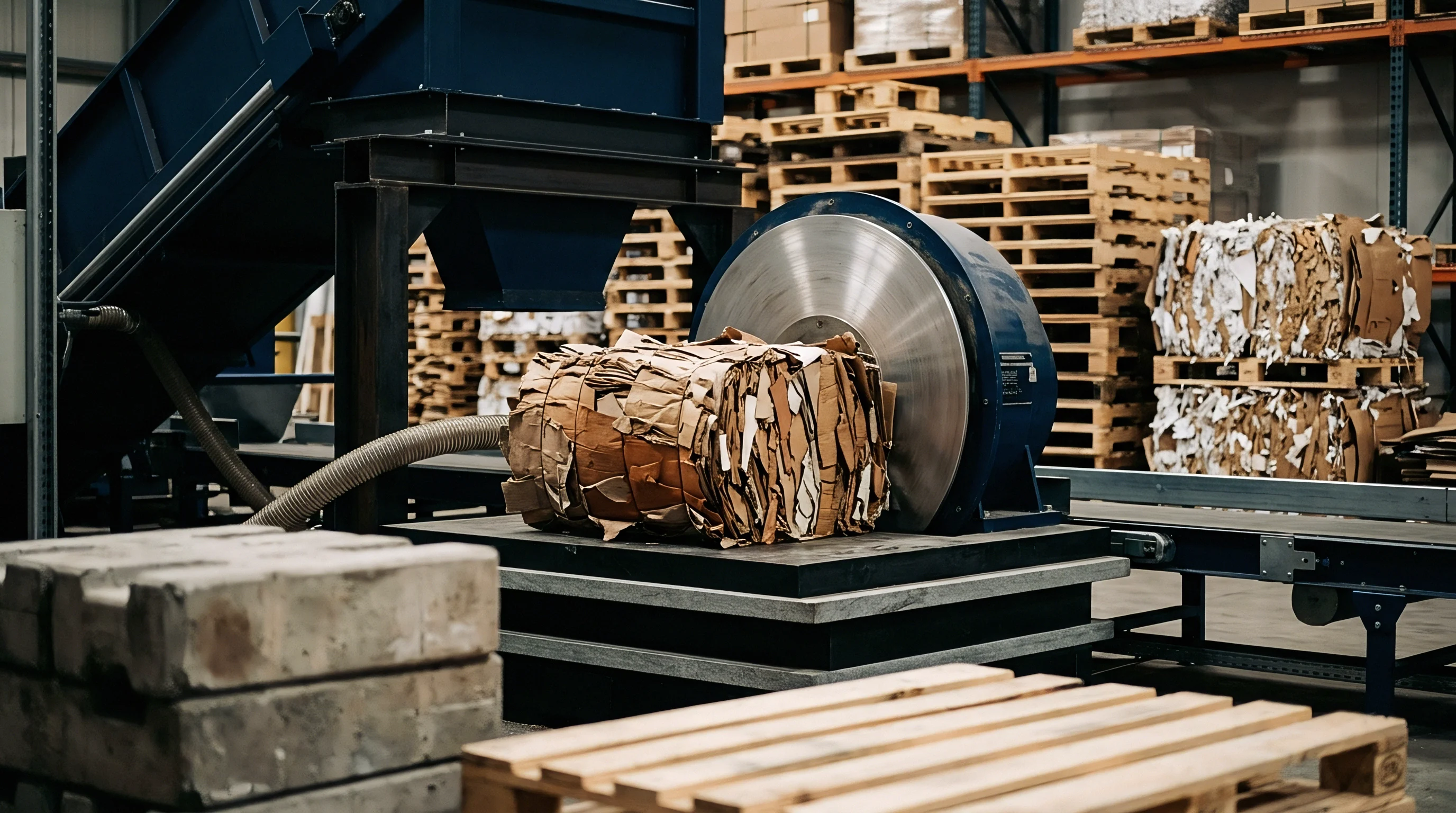
Top-load resistance in recycled corrugated containers drops continuously under static mass, even if ambient moisture levels stay perfectly constant. While standard box compression tests measure peak force during rapid strain applications over just a few seconds, actual warehouse storage subjects loaded boxes to deadweights for weeks or months. Under this static loading, the fiber network undergoes viscoelastic relaxation ~ reorganizing internal stress distributions while external dimensions appear unchanged ~ which steadily erodes load-bearing capacity over time.
As paper absorbs ambient water vapor, water molecules act as plasticizers within the amorphous regions of cellulose and hemicellulose, weakening inter-fiber hydrogen bonds and increasing segment mobility inside cell walls. At elevated relative humidity, secondary fibers reach a higher equilibrium moisture content than virgin fibers, causing recycled liners to soften more rapidly. The combination of sustained deadload pressure and high moisture content triggers moisture creep, driving structural degradation even without fluctuations in temperature or humidity.
Mechanics of Static Fatigue
Static fatigue occurs when a material fails under continuous stress well below its short-term ultimate strength. In recycled containerboard, this appears as progressive compression loss: hydrogen bonds within the fiber matrix yield at local stress points and reform in relaxed configurations. Repeated repulping leaves secondary fibers shorter, higher in fines content, and structurally damaged, restricting the sheet’s ability to transfer localized loads to adjacent fibers.
Moisture destabilizes the fiber wall directly. In an atmosphere of 80 percent relative humidity, moisture content in recycled board stabilizes near 10.5 percent on a dry-weight basis. This drops the elastic modulus of recycled testliner by up to 35 percent compared to its dry baseline, directly reducing panel bending stiffness.
Deflection starts immediately upon loading, building geometric instability long before total column collapse.
Secondary fibers absorb atmospheric moisture faster than virgin softwood fibers during the initial equilibrating hours.
Time Dependent Compression Decay
Long-term deadload strength follows a logarithmic decay curve. Within the first 24 hours under static load at 75 percent relative humidity, a recycled containerboard box loses 20 to 25 percent of its original laboratory compression strength. After 30 days under the same conditions, cumulative loss often exceeds 45 percent.
Decay rates depend on fiber composition, starch dosage, and flute geometry.
Converting plants that calculate required box compression strength from short-term test values without accounting for moisture creep risk catastrophic pallet collapse in humid storage. Specifying board grades strictly on short-duration laboratory compression figures leads directly to panel creasing, box tilting, and product damage over extended warehouse storage.
Lignin
Chemical composition dictates how containerboard responds to moisture. Native softwood kraft fibers consist mostly of crystalline cellulose with few non-cellulosic impurities. In contrast, recycled testliner and fluting medium contain variable amounts of residual non-cellulosic materials, short hardwood fibers, surface starches, and inorganic fillers.
These non-cellulosic polymers are highly amorphous and rich in hydroxyl groups that bind water, increasing total moisture absorption at higher relative humidity.
Repeated papermaking and drying cycles cause hornification, which stiffens individual fiber walls and reduces swelling capacity while creating micro-voids in the secondary cell wall. In humid air, these voids trap moisture, plasticizing surrounding amorphous cellulose and lowering the axial compressive yield stress of individual fibers.
Microstructural Softening Mechanisms
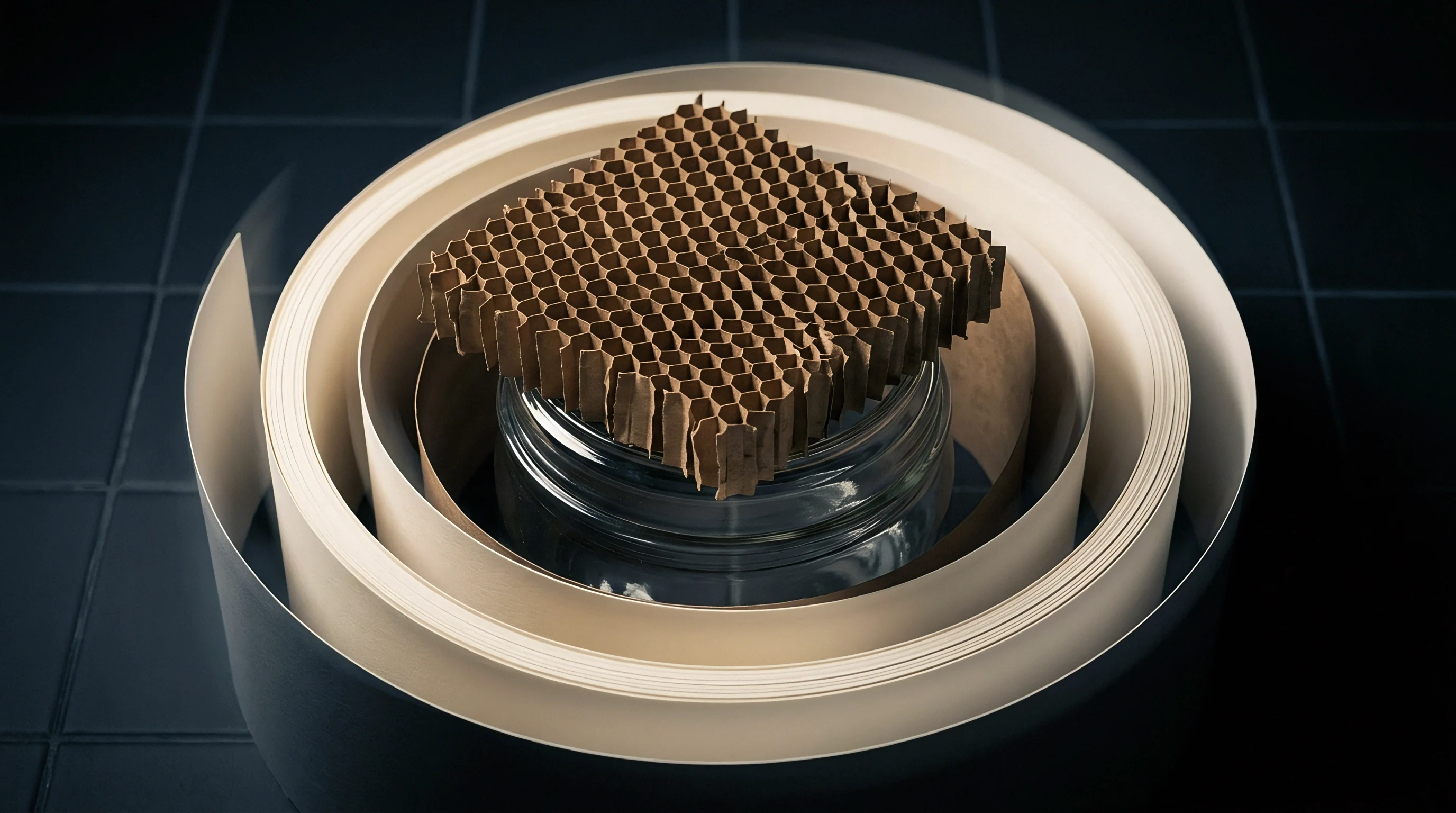
Compressive strength in containerboard relies on individual fiber rigidity and inter-fiber bond shear strength. As ambient humidity rises, water penetrates the fiber wall, swelling the amorphous matrix and spreading adjacent microfibrils apart. This expansion reduces axial compressive resistance across the sheet.
Recycled liners lose more strength than virgin kraftliners because they rely heavily on added starch to meet strength targets, and starch films soften rapidly above 70 percent relative humidity.
With mean fiber lengths in recycled testliner ranging from 1.1 to 1.4 millimeters ~ compared to 2.5 to 3.2 millimeters for unbleached softwood kraftliner ~ shorter segments buckle earlier under load. Under continuous compressive stress, shorter fibers transfer loads across more bond nodes per unit distance. Each node is a potential site for moisture-induced shear failure, and as humidity weakens these bonds, the sheet’s compressive load paths break down.
Fiber Recycled History and Swelling
Processing history governs how secondary fibers expand when exposed to moisture. Fibers recycled through multiple cycles suffer irreversible cell wall collapse and lose surface fibrillation. Paper mills compensate for lost structural strength by adding cationic wet-end starches and surface sizing.
While starch boosts dry short-span compressive strength (SCT ISO 9895), it is highly sensitive to water: at 85 percent relative humidity, starch-rich recycled testliners lose up to 40 percent of dry compressive strength, compared to roughly 25 percent for low-starch virgin liners.
| Containerboard Grade | Grammage (g/m²) | Conditioning Atmosphere | SCT Index (Nm/g) | EMC (%) | BCT Retained (%) |
|---|---|---|---|---|---|
| Unbleached Softwood Kraftliner | 140 | 23°C / 50% RH | 34.2 | 7.2 | 100.0 |
| Unbleached Softwood Kraftliner | 140 | 23°C / 85% RH | 25.6 | 10.8 | 74.8 |
| Recycled Testliner Grade 2 | 140 | 23°C / 50% RH | 28.5 | 7.8 | 100.0 |
| Recycled Testliner Grade 2 | 140 | 23°C / 85% RH | 16.5 | 11.9 | 57.8 |
| Recycled Testliner Grade 3 | 140 | 23°C / 50% RH | 24.1 | 8.2 | 100.0 |
| Recycled Testliner Grade 3 | 140 | 23°C / 85% RH | 13.0 | 12.6 | 53.9 |
| Semi-Chemical Fluting Medium | 127 | 23°C / 50% RH | 31.0 | 7.0 | 100.0 |
| Recycled Fluting Medium | 127 | 23°C / 85% RH | 15.2 | 12.1 | 49.0 |
| Data measured following 72-hour equilibrium conditioning. EMC represents Equilibrium Moisture Content. BCT Retained calculated relative to 50% RH baseline under ISO 12048 conditions. | |||||
Increasing grammage is often expected to offset the performance penalties of secondary fiber in humid environments, yet testing demonstrates that adding recycled mass without modifying fiber quality fails to prevent moisture creep, merely delaying structural failure by minor margins.
Buckling
Compressive failure in corrugated packaging follows specific collapse modes dictated by board geometry and material properties. Under top-load stress, vertical walls experience combined axial compression and bending moments, with failure starting either as global panel buckling or localized edge compression along the corners. In recycled boxes kept at high humidity, local edge failure dominates because short-span compressive strength degrades faster than overall panel bending stiffness.
Panel corners carry up to 70 percent of total vertical load in stacked boxes. Corner strength depends directly on edge crush resistance (ECT ISO 3037), which relies on the combined compressive stiffness of the outer liners, inner liner, and corrugating medium. When elevated humidity softens the fluting, it fails to maintain fixed spacing between the inner and outer liners, leaving them to buckle individually under lower loads.
Can Static Compression Models Predict Recycled Liner Performance under Humid Conditions?
Standard static compression models assume linear elastic behavior right up to failure, but high humidity introduces non-linear viscoelastic creep that renders these models inaccurate for long-term projections. At a constant 80 percent relative humidity, recycled testliner exhibits time-dependent strain at loads well below short-term yield stress. Strain accumulation accelerates non-linearly under load, leading to premature panel collapse.
Short-span compressive strength testing (SCT ISO 9895) indicates moisture-induced strength loss far better than traditional ring crush testing (RCT ISO 12192). By measuring compressive resistance across a 0.7-millimeter span, SCT minimizes specimen buckling during testing. At high humidity, SCT values drop sharply as inter-fiber bonds weaken, correlating closely with long-term box failure under static deadweight.
Flute Shear Modulus Degradation
The fluted medium holds linerboards at a fixed distance, establishing the section moment of inertia for the combined board. Under humid conditions, recycled fluting medium loses shear modulus faster than linerboards do. This loss of shear rigidity allows relative lateral movement between inner and outer liners during compression, driving panel tilt; as flute tips deform, localized bending stresses concentrate along scorelines and trigger wall instability.
- Creep Buckling progresss gradually under continuous load as moisture-softened fibers yield across the load-bearing panels.
- Flute Rollover occurs when the corrugating medium loses transverse compressive stiffness, causing the flutes to flatten sideways.
- Scoreline Fracture develops along horizontal creases where bending stresses concentrate in weakened, high-moisture linerboard.
- Corner Creasing initiates at top and bottom box corners when short-span compressive strength falls below localized vertical deadload stresses.
A recycled corrugated box operating at 80 percent relative humidity requires nearly twice the initial safety factor of a virgin kraft box to guarantee the same survival time under static stack loading.
Shed
Laboratory evaluation relies on standardized climate protocols. ISO 187 specifies standard testing conditions of 23 degrees Celsius and 50 percent relative humidity, but figures obtained under these parameters reflect ideal conditions rarely found in supply chains. Actual storage environments routinely see relative humidity between 65 and 90 percent, especially in unconditioned warehouses, ocean containers, and cold-chain staging docks.
Equilibrium moisture content tracks ambient humidity directly as containerboard absorbs or desorbs water until internal vapor pressure matches the surrounding air. Following a sigmoidal hysteresis curve, a box moved into high humidity absorbs water rapidly, reaching 90 percent of its new equilibrium moisture content within 24 hours ~ with compressive strength falling right alongside it.
Bench Conditioning Standards versus Freight Realities
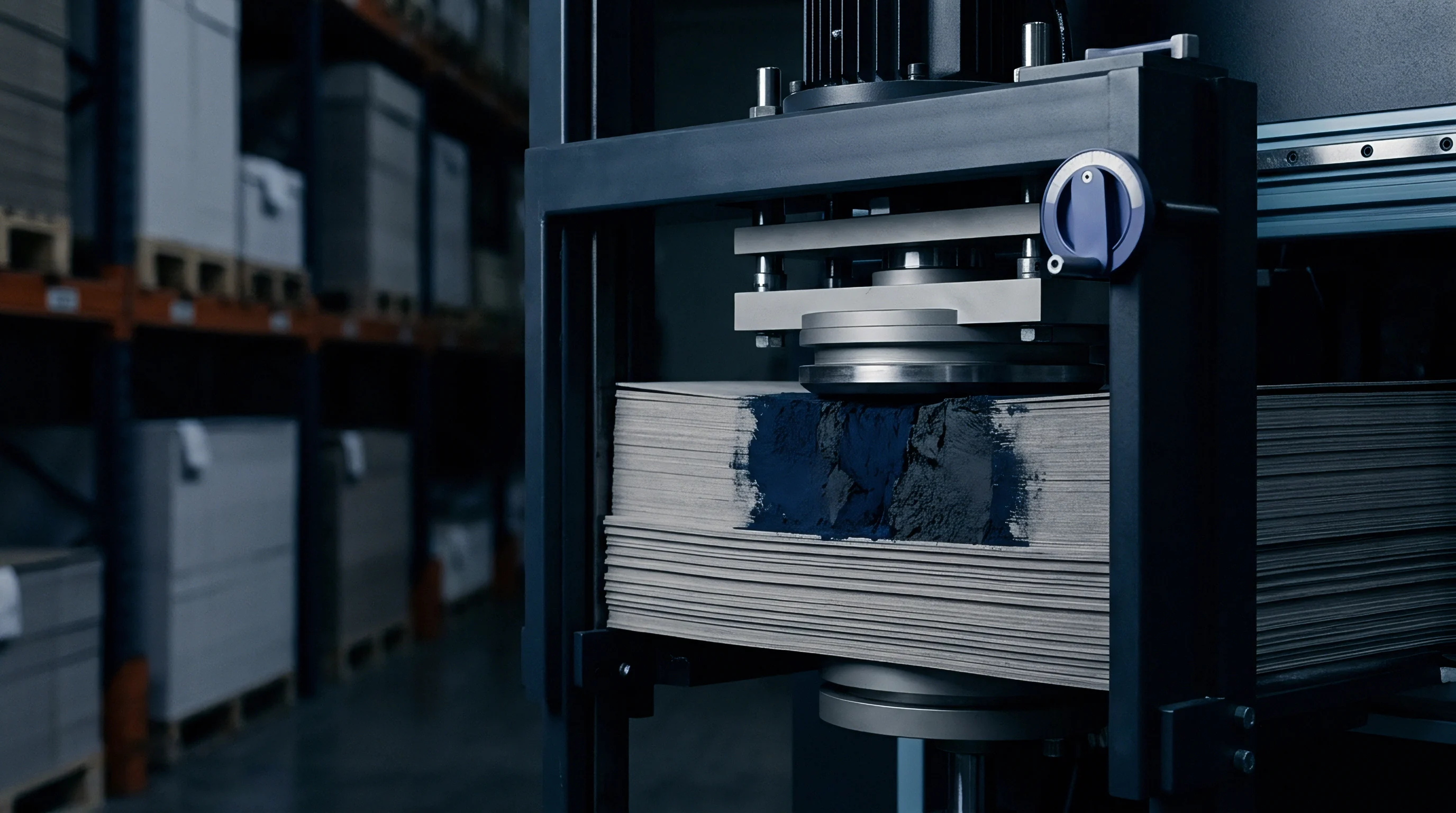
Short-duration laboratory tests under ISO 12048 apply top loads at a constant crosshead displacement of 10 millimeters per minute until failure, finishing in under 30 seconds. Resistance measured during rapid loading misses viscoelastic creep, stress relaxation, and long-term moisture plasticization entirely. Specifying board grammage for high-humidity routes based on ISO 187 rapid compression data results in field failure rates up to 15 percent.
Tropical conditioning under ISO 2233 (40 degrees Celsius and 90 percent relative humidity) simulates severe transit environments. Recycled testliner held under ISO 2233 loses up to 55 percent of its ISO 187 short-span compressive strength, whereas unbleached virgin softwood kraftliner loses roughly 35 percent under the same conditions. This performance gap only widens as conditions worsen.
Chamber Testing Methodologies
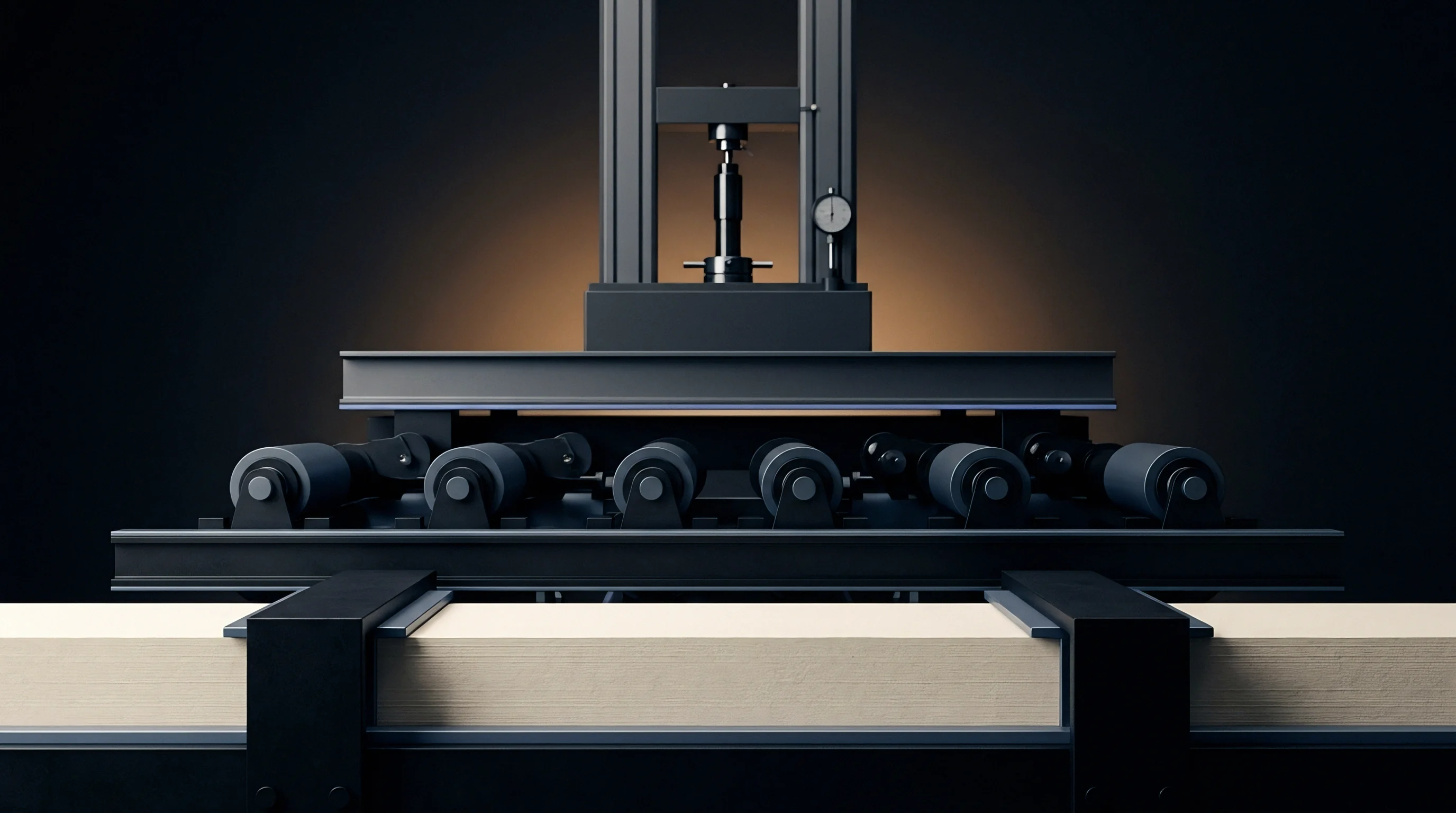
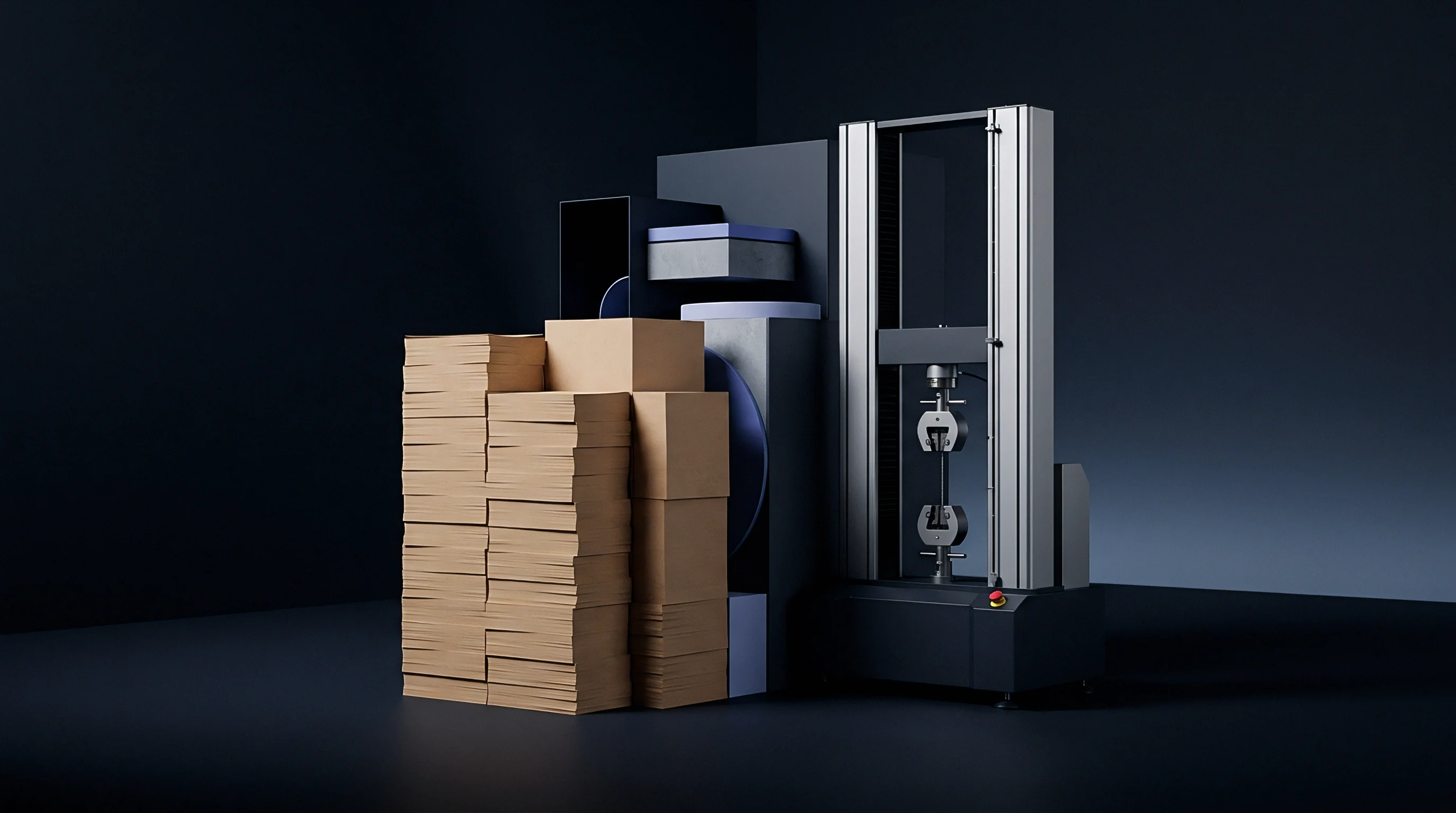
Predicting stack durability accurately requires continuous creep testing inside climate chambers. The testing apparatus applies a constant, non-destructive static load while maintaining tight environmental control, using deflection sensors to monitor height changes over 7 to 30 days. These trials yield creep strain curves that mark the onset of tertiary creep ~ the threshold where strain rates accelerate toward collapse.
- Conditioning Uniformity Check verifies that test samples achieve full weight equilibrium inside climate chambers prior to applying mechanical deadloads.
- Static Load Calibration ensures deadweights match intended warehouse stack masses without introducing dynamic shock during load placement.
- Deformation Tracking Precision records vertical displacement at sub-millimeter scales to identify micro-yield points in panel corners.
- Atmospheric Control Tolerance maintains relative humidity within plus or minus 2 percent to prevent cyclic sorption artifacts during long-term trials.
| Standard Code | Temperature (°C) | Relative Humidity (%) | Exposure Time | Recycled Board EMC (%) | Strength Reduction Factor |
|---|---|---|---|---|---|
| ISO 187 (Standard) | 23 ± 1 | 50 ± 2 | 24 hours | 7.5 – 8.0 | 1.00 |
| ISO 2233 (Condition G) | 20 ± 2 | 85 ± 2 | 72 hours | 11.5 – 12.5 | 0.58 |
| ISO 2233 (Condition Tropical) | 40 ± 2 | 90 ± 5 | 72 hours | 13.5 – 15.0 | 0.45 |
| Custom Warehousing Profile | 25 ± 2 | 80 ± 3 | 30 days | 11.0 – 12.0 | 0.52 |
Compliance with ISO 12048 at standard atmosphere fails to guarantee pallet integrity when transit humidity stays above 80 percent for more than 72 hours.
When procuring containerboard for international supply chains, buyers include explicit requirements in their specifications: Box Compression Strength must be validated under ISO 2233 Condition G (20°C / 85% RH) whenever specified secondary fiber content exceeds 50 percent.

Derivation
Calculating the required short-term box compression strength to prevent warehouse stack collapse involves applying multiplicative safety factors to baseline static loads. The traditional McKee formula models box compression strength (BCT) as a function of edge crush resistance (ECT), total panel perimeter (P), and combined flexural stiffness (D):
BCT = 5.87 × ECT × (P × sqrt(Dx × Dy))^(0.5)
To account for environmental degradation, moisture creep, and storage duration, engineers modify the calculated required BCT by applying an environmental loss factor (Fe) and a duration load factor (Fd). For recycled containerboard operating under constant 85 percent relative humidity for 90 days, these factors alter baseline requirements dramatically.
McKee Formula Compression Loss Factor Calculation
Consider a packaging scenario requiring a bottom box in a pallet stack to support a static deadload of 4,000 Newtons for 90 days in a non-air-conditioned warehouse averaging 85 percent relative humidity at 20 degrees Celsius. The starting point for calculation determines the individual derating coefficients based on verified material properties and environmental conditions.
- Determine the nominal static deadload force acting on the lowest box in the stack, set at 4,000 Newtons.
- Apply the load duration factor for recycled containerboard held under continuous load for 90 days, setting Fd equal to 1.85.
- Apply the environmental moisture reduction factor for 100 percent recycled testliner at 85 percent relative humidity, setting Fe equal to 1.72.
- Apply the pallet pattern factor to account for corner overhang and alignment imperfections, setting Fp equal to 1.25.
- Calculate the minimum required dry laboratory box compression strength: BCT_req = 4,000 N × 1.85 × 1.72 × 1.25 = 15,910 Newtons.
The total effective safety factor applied to the working load reaches 3.98. By comparison, an identical load housed in a standard atmosphere (23°C / 50% RH) requires an effective safety factor of just 2.10. Sustained high humidity almost doubles the structural mass or edge crush resistance needed to keep recycled stacks stable.
Recycled testliner under a constant 85 percent relative humidity at 23 degrees Celsius experiences a 42 percent reduction in short span compressive strength over 30 days.
Multi Factor Safety Margin Steps
Assigning a value to the environmental reduction factor Fe depends on short-span compressive strength (SCT) measured at different humidity levels. Tests on 140 g/m² recycled testliner show the SCT index dropping from 28.5 Nm/g at 50 percent relative humidity to 16.5 Nm/g at 85 percent relative humidity ~ a 42.1 percent loss. This drop yields the 1.72 environmental factor (1 / (1 – 0.421) = 1.727).
Structural wood engineering applies similar viscoelastic creep deratings to timber beams under permanent moisture loads, reflecting shared physical principles across cellulosic materials.
Uncertainty remains around how starch degradation interacts with micro-fluctuations in humidity inside stretch-wrapped pallets. When pallets are wrapped in high ambient humidity that traps moisture inside the corrugated structure, a conservative 1.15 film-entrapment multiplier is added to the base environmental factor.
Which microstructural modifications in starch cross-linking will allow recycled testliners to achieve moisture-creep performance equal to virgin kraftliner without sacrificing recyclability under current European packaging mandates?
Contract
Procuring recycled containerboard requires explicit specification limits connecting paper grades to verified physical performance. Purchase specs that state only dry grammage and bursting strength fail to protect against static fatigue failures in humid storage; effective supply contracts require minimum Short-Span Compressive Strength (SCT ISO 9895) and Edge Crush Resistance (ECT ISO 3037) values measured after full equilibrium conditioning at 85 percent relative humidity.
Under the European Packaging and Packaging Waste Regulation (PPWR), packaging must meet strict recyclability criteria while maintaining functional strength. Article 6 establishes recyclability performance classes that penalize designs using non-recyclable wet-strength resins or heavy wax coatings to withstand moisture. Importers and brand owners depend on high-performing recycled fiber structures and optimized starch application to preserve strength without sacrificing Class A recyclability.
Specification Clauses and Moisture Tolerances
Commercial purchase agreements require precise clauses covering fiber sourcing, recycled content claims, and moisture-derated compression limits. Certifications like FSC Recycled or PEFC Recycled confirm chain of custody, but offer no assurance of structural durability under load. Without an accompanying lab report, a certification claim creates real operational risk at border inspection points.
When specifying recycled containerboard for cross-border shipments, buyers build explicit technical conditions into supply terms: suppliers must guarantee that delivered testliner and fluting lots retain at least 55 percent of their ISO 187 SCT values after reaching equilibrium under ISO 2233 Condition G (20°C, 85% RH). Missing this threshold gives the buyer the right to reject non-conforming lots at the supplier’s expense.
Unverified recycled content claims expose buyers to regulatory delisting under current packaging waste mandates.
Regulatory Alignment under European Packaging Rules
European packaging regulations require clear documentation proving both material composition and structural fitness. Border inspections scrutinize technical dossiers for imported goods to ensure recycled packaging meets functional standards without adding excess volume or weight ~ a practice explicitly restricted under PPWR optimization rules.
Demonstrating compliance requires a complete technical dossier: certified mill test reports covering dry and wet SCT values, FSC or PEFC chain-of-custody documents tied to specific paper machines, and lab verification of recyclability under EN 13430. This documentation protects importers against fines for environmental claims and prevents logistical delays if packaging fails during customs inspection.