Contact Angle Analysis in Polyurethane Film Decay
Sessile drop contact angle analysis tracks polyurethane film degradation by measuring polar surface energy shifts before lamination adhesive failure occurs.
Scission
Polyurethane films break down structurally when exposed to atmospheric moisture, ultraviolet radiation, and elevated processing temperatures. Degradation runs mainly along two chemical pathways: hydrolytic scission of backbone ester or ether linkages and photo-oxidative cleavage of aromatic urethane segments. Chain scission leaves polar functional groups ~ carboxylic acids, free amines, and primary hydroxyls ~ at the film surface.
These polar chemical groups alter the thermodynamic equilibrium between the substrate surface and applied fluids, shifting total surface energy and rebalancing its polar and dispersive force fractions.
Hydrolysis drives chain cleavage, with the degradation rate depending heavily on the chemical structure of the polyol soft segment. Polyester-based polyurethanes carry ester carbonyl groups vulnerable to nucleophilic attack by ambient moisture; the resulting carboxylic acid end groups autocatalyze further chain breakdown. Polyether-based polyurethanes offer superior hydrolytic resistance because ether bonds maintain high stability in humid conditions.
However, polyether soft segments are susceptible to photo-oxidation, generating hydroperoxides that decompose into aldehyde and alcohol species.
Ester and Ether Linkage Hydrolysis Kinetics
In flexible film converting, chemical degradation kinetics dictate the operational shelf life of untreated web stock. High relative humidity at ambient temperatures initiates hydrolytic cleavage in polyester urethane grades long before visible physical defects manifest. As ester bonds cleave, the rising concentration of polar carboxyl and hydroxyl functional groups per unit area increases surface polarity, a transformation tracked directly by the decay in baseline water contact angle over exposure duration.
Aromatic and aliphatic hard segments exhibit contrasting stability profiles under ambient and UV exposure. Synthesized with diphenylmethane diisocyanate or toluene diisocyanate, aromatic polyurethanes contain quinoid structures that absorb solar radiation and trigger light-induced oxidation. This photo-Fries rearrangement ruptures urethane linkages to produce primary aromatic amines and quinone-imide photo-products that discolour the substrate and increase surface polarity.
Aliphatic polyurethanes based on isophorone diisocyanate or hexamethylene diisocyanate retain optical clarity and surface energy stability under identical weathering conditions.
Unsaturated carboxylic groups generated during ester bond hydrolysis accelerate secondary chain degradation by donating protons to adjacent urethane linkages.
The balance between polymer hard segments and soft segments governs the macro-scale degradation pattern. Hard segment domains act as physical crosslinks, restraining chain mobility and limiting water diffusion into the amorphous soft segment matrix. As chemical cleavage reduces molecular weight, micro-phase separation degrades, and low molecular weight oxidized species accumulate at the web boundary, forming a weak boundary layer that severely impairs subsequent lamination or coating passes.
| Resin Chemistry | Exposure Time (Hours) | Ester/Ether Scission Rate (mol/m³·s) | Carboxyl Generation (mmol/m²) | Water Contact Angle (Degrees) |
|---|---|---|---|---|
| Polyester Urethane (Aromatic MDI) | 0 | 0.00 | 0.02 | 84.2 |
| Polyester Urethane (Aromatic MDI) | 250 | 1.45 × 10⁻⁶ | 0.18 | 68.5 |
| Polyester Urethane (Aromatic MDI) | 500 | 3.82 × 10⁻⁶ | 0.45 | 51.3 |
| Polyether Urethane (Aliphatic IPDI) | 0 | 0.00 | 0.01 | 88.6 |
| Polyether Urethane (Aliphatic IPDI) | 250 | 0.12 × 10⁻⁶ | 0.03 | 86.1 |
| Polyether Urethane (Aliphatic IPDI) | 500 | 0.29 × 10⁻⁶ | 0.06 | 83.9 |
| Test parameters: ISO 4892-2 Method A, xenon arc irradiance 0.51 W/m² at 340 nm, black panel temperature 65°C, relative humidity 50%. | ||||
Photo-Oxidative Cleavage in Aromatic Isocyanate Formulations
Solar spectrum components below 380 nanometers break aromatic urethane linkages through homolytic carbon-nitrogen bond cleavage. The resulting free radicals react instantly with atmospheric oxygen, generating peroxy radicals that abstract hydrogen atoms from adjacent polyol chains. This autoxidation loop multiplies polar functional species on the exposed face while reducing the average molecular weight of the surface layer.
Degradation alters the surface energy profile of the film rapidly. Water contact angles drop quickly while polar components double during oxidation, causing unpredictable wet-out during solventless adhesive application. An unaged film possessing a total surface energy of 38 mN/m may experience an increase to 52 mN/m following solar radiation exposure, driven almost entirely by an expansion in the polar force component while the dispersive force component remains virtually static.
- Hydrolytic Cleavage breaks ester carbonyl linkages in polyester-based polyurethanes under high ambient humidity, generating free carboxylic acid groups that accelerate secondary resin breakdown.
- Photo-Oxidative Norrish Type I reactions rupture aliphatic and aromatic urethane nitrogen-carbon bonds upon exposure to ultraviolet wavelengths, creating free radical species on the polymer backbone.
- Norrish Type II Scission abstracts hydrogen atoms from adjacent soft polyol segments, yielding terminal vinyl groups and small-molecule aldehydes that volatilize or form boundary contaminants.
- Autoxidative Peroxidation converts tertiary carbon sites in polyether chains into hydroperoxides, expanding surface polarity and triggering micro-cracking across the high-strain web face.
Surface energy drops stem from polymer backbone chain cleavage rather than ambient humidity storage.
Drop
Sessile drop optical tensiometry provides the primary analytical framework for mapping surface energy shifts during film aging. Placing liquid probes of known polar and dispersive force components onto the polyurethane substrate allows precise calculation of solid surface free energy through the Young-Dupré relation combined with interfacial energy models. As film decay progresses, alterations in baseline liquid contact angles expose micro-chemical and micro-topographical transformations at the interface.
The Owens-Wendt-Rabel-Kaelble method divides total surface free energy into independent dispersive and polar contributions. Dispersive forces arise from London dispersion interactions, reflecting non-polar hydrophobic backbone density. Polar forces stem from dipole-dipole, induction, and hydrogen bonding interactions produced by urethane, urea, carboxyl, and hydroxyl groups.
Resolving these distinct components requires testing with at least two probe liquids, typically deionized water as the polar liquid and diiodomethane as the non-polar dispersive liquid.
Polar and Dispersive Surface Energy Dissection
A fresh aliphatic polyurethane film typically exhibits a total surface energy between 36 and 40 mN/m, dominated by dispersive forces with a polar component under 4 mN/m. As degradation proceeds, oxidation and hydrolysis generate polar functionality without significantly expanding the non-polar dispersive network. Measuring the contact angle of water alone yields incomplete insight into this mechanism because water responds to both polar and dispersive force shifts.
Exposure to 500 hours of accelerated weathering elevates the polar surface energy component of aromatic polyurethane from 3.2 mN/m to 18.7 mN/m while the dispersive component contracts by 2.1 mN/m.
Diiodomethane contact angles remain relatively stable across early and moderate decay stages because the non-polar carbon-hydrogen framework of the polymer matrix undergoes slower structural reorganization than polar functional group generation. Consequently, a sharp drop in water contact angle paired with a stable diiodomethane contact angle provides unambiguous diagnostic confirmation of chemical oxidation or hydrolytic scission rather than surface plasticizer accumulation.
| Exposure Duration (Hours) | Water Contact Angle (Degrees) | Diiodomethane Angle (Degrees) | Dispersive Energy (mN/m) | Polar Energy (mN/m) | Total Surface Free Energy (mN/m) |
|---|---|---|---|---|---|
| 0 | 86.4 ± 0.8 | 48.2 ± 0.6 | 35.4 | 2.8 | 38.2 |
| 100 | 78.1 ± 1.1 | 47.8 ± 0.7 | 35.6 | 6.4 | 42.0 |
| 250 | 67.3 ± 1.4 | 48.9 ± 0.9 | 35.0 | 11.8 | 46.8 |
| 500 | 52.6 ± 1.8 | 50.1 ± 1.2 | 34.3 | 19.1 | 53.4 |
| 750 | 41.2 ± 2.3 | 52.4 ± 1.5 | 33.0 | 25.6 | 58.6 |
Which Surface Energy Delta Triggers Lamination Delamination?
Lamination adhesives require matched surface energy profiles to achieve complete wetting and thermodynamic adhesion. Solvents or 100% solid polyurethane adhesives formulated for flexible packaging typically possess surface tensions between 32 and 38 mN/m. When substrate surface energy rises above 50 mN/m due to decay, the thermodynamic drive for spreading remains favorable, but excessive polarity difference at the interface induces localized stress during cure.
Advancing and receding contact angle dynamics reveal surface heterogeneity and chain mobility. The advancing contact angle measures the high-energy hydrophobic barrier presented by the film, whereas the receding angle reflects low-energy polar domains or swellable degraded zones. The hysteresis delta, calculated as advancing angle minus receding angle, widens significantly as degradation creates microscopic surface pits and localized oxidized pockets.
A hysteresis value exceeding 25 degrees indicates severe morphological disruption, warning the converter that physical adhesion will fail under dynamic shear stress.
When advancing contact angles drop while receding contact angles remain static, plasticizer migration dominates over backbone scission.

Peel
Interfacial bond performance in laminated web structures depends directly on the surface energy stability of the constituent films. When a polyurethane film degrades prior to or following lamination, changes in surface chemistry weaken physical and chemical bonds established with adhesives or extrusion coatings. Measuring peel strength in accordance with ASTM F904 or ISO 11339 exposes how contact angle alterations translate into operational failure modes on the converting floor.
Corona treatment applied to film webs increases surface energy temporarily by introducing carbonyl, carboxyl, and hydroxyl groups via high-voltage electrical discharge. Corona energy decays within weeks. Polyurethane films subject to decay exhibit accelerated treatment loss, known as hydrophobic recovery.
Low molecular weight oxidized species created by chain scission rotate into the bulk resin, while unreacted low-energy oligomers migrate to the surface. This migration masks active polar sites, causing the water contact angle to rebound from an engineered 55 degrees back to over 78 degrees within fourteen days of storage.
Interfacial Bond Rupture and Additive Bloom Dynamics
Weak boundary layers destroy lamination bond integrity. During polyurethane film decay, plasticizers, slip agents such as erucamide, and low molecular weight degraded polymer chains bleed out of the bulk matrix and gather at the film-adhesive interface. Plasticizer bloom lowers peel resistance.
Contact angle measurements on bloomed surfaces often display erratic readings, where initial contact angles appear hydrophobic, but decay rapidly within seconds as the probe liquid dissolves the superficial additive layer.
A surface energy mismatch greater than 8 mN/m between curing adhesive and decayed polyurethane film guarantees cohesive failure within the weak boundary layer during high-speed web rewinding.
Interfacial failure modes transition from cohesive adhesive failure to adhesive substrate delamination as surface decay deepens. In unaged laminates, 180-degree peel testing results in cohesive rupture within the adhesive layer or substrate yield, reflecting bond forces exceeding 4.5 N/15mm. In degraded films where polar surface energy has spiked or additive blooming has occurred, peel values collapse below 1.2 N/15mm, with failure occurring cleanly at the film surface interface.

Corona Treatment Decay Curve on Polyurethane Web Surface
Converters frequently attempt to reclaim aged or decayed film inventory by re-treating the web inline prior to adhesive coating. Re-treating degraded polyurethane yields diminishing returns. While fresh polyurethane responds to corona discharge with stable polar group expansion, degraded substrates containing high concentrations of short-chain cleavage products undergo rapid overtreatment.
Over-powering the discharge unit burns the degraded layer, generating excessive low molecular weight species that wash off upon contact with liquid adhesives.
Diagnostic verification on the converting line must precede laminator bring-up to avoid catastrophic job rejection. The operational test protocol below identifies web surface readiness using multi-liquid sessile drop metrology:
- Mount a 200 mm wide clean sample strip of polyurethane film onto the vacuum stage of an optical tensiometer, ensuring zero tension wrinkling or surface contamination.
- Dispense a 2.0 microliter droplet of HPLC-grade deionized water onto three distinct transverse web locations using a calibrated micro-syringe.
- Capture the baseline sessile drop profile within 500 milliseconds of liquid contact to measure the initial static contact angle before swelling occurs.
- Dispense a secondary 2.0 microliter droplet of diiodomethane (99% purity) on adjacent untreated sites and record the equilibrium contact angle.
- Calculate polar and dispersive surface energy fractions using the two-component Owens-Wendt model embedded in the tensiometer software.
- Verify whether the polar surface energy fraction resides within the process window of 4.0 to 10.0 mN/m for solventless adhesive lamination.
- Perform dynamic advancing and receding angle measurements by inflating and deflating the droplet volume by 1.5 microliters to determine hysteresis.
- Reject any roll lot exhibiting a contact angle hysteresis value greater than 22 degrees or a baseline water contact angle under 62 degrees.
Ignoring contact angle hysteresis decay prior to solventless lamination yields widespread web delamination across converting stacks within forty-eight hours of curing.
Bench
Accurate measurement of surface energy on degrading polyurethane films requires rigorous bench protocols. Polyurethane is an amorphous, flexible material susceptible to probe liquid absorption, surface swelling, and roughness changes during degradation. Tensiometric testing without taking physical corrections into account leads to erroneous polar surface energy values, confusing polymer chain degradation with surface topography effects.
Surface roughness alters apparent contact angles according to the Wenzel and Cassie-Baxter models. As degradation erodes the film surface, micro-cavities, pinholes, and cracks emerge. On a chemically hydrophobic surface where the true contact angle exceeds 90 degrees, Wenzel roughness increases the apparent contact angle.
Conversely, on a degraded polar surface where the true angle resides below 90 degrees, micro-roughness depresses the apparent angle further, artificially inflating calculated polar surface energy.
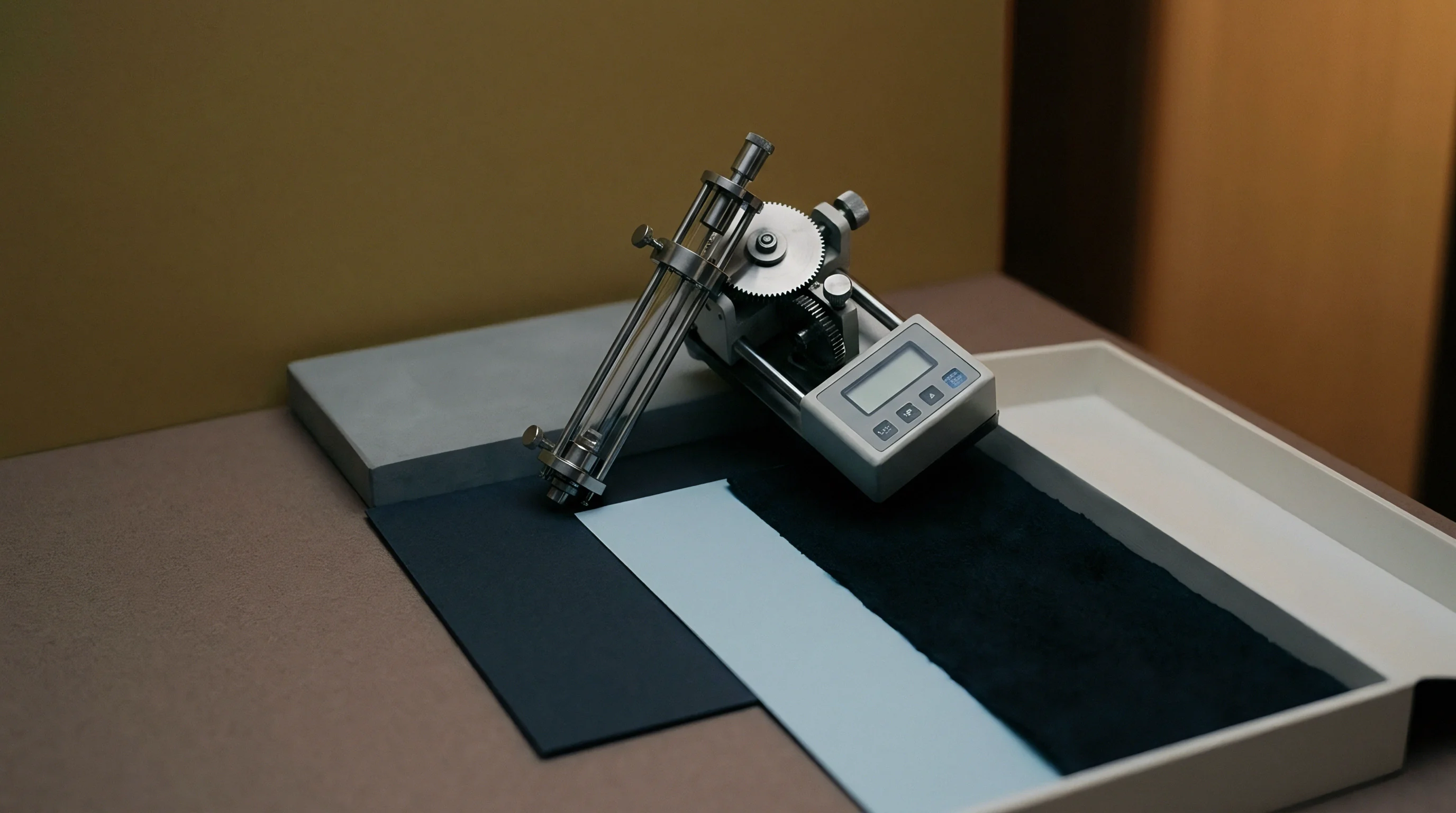
Optical Tensiometry and Wenzel Roughness Correction Factors
Quantifying true chemical surface energy requires decoupling surface topography from chemical functionality. Measuring the Wenzel roughness factor ~ the ratio of actual surface area to projected geometric area ~ via white-light interferometry or atomic force microscopy provides the necessary correction parameter. A degraded polyurethane film showing a surface roughness value of 1.35 will display a measured water contact angle of 58 degrees, whereas the true chemical contact angle corrected for roughness stands at 67 degrees.
Clause 4.2 of ASTM D7334 mandates liquid drop profile measurement within two seconds of surface contact to eliminate errors caused by probe liquid absorption into degraded polymer networks.
Probe liquid choice and purity dictate baseline accuracy. Diiodomethane decomposes when exposed to light, forming free iodine that turns the liquid reddish and drops its baseline surface tension from 50.8 mN/m to under 46 mN/m. Polar probe liquids like ethylene glycol or formamide penetrate micro-cracked degraded films, inducing localized swelling that distorts the drop baseline within three seconds of deposition.
Test protocols must specify optical drop capture within 500 to 1000 milliseconds of drop placement.
| Analytical Parameter | Standard Value | Degradation Error Vector | Operational Impact | Correction Method |
|---|---|---|---|---|
| Water Probe Volume | 2.0 ± 0.2 µL | Droplet weight compresses degraded soft matrix | Contact angle underreported by 2.5° to 4.1° | Reduce drop volume to 1.0 µL via automated dispenser |
| Drop Dwell Time | 500 ms | Liquid absorption into swellable oxidized zones | Polar energy artificially inflated by >6 mN/m | High-speed video capture at 120 fps baseline fitting |
| Surface Roughness (Ra) | Photo-erosion micro-pitting (Ra > 0.40 µm) | Wenzel amplification of surface wetting | Apply white-light interferometry correction factor | |
| Ambient Humidity | 50 ± 5% RH | Surface moisture absorption on polar sites | Baseline water angle reduced by 3.8° | Environmental chamber isolation at standard atmosphere |

Standard Testing Atmosphere Control and Drop Dynamics
Atmospheric conditioning before tensiometric evaluation remains mandatory under ISO 187. Polyurethane films absorb moisture rapidly once ester or ether scission creates free hydrophilic groups. Storage at 65% relative humidity compared to 50% relative humidity can depress initial water contact angles by up to 5 degrees solely through ambient water uptake, masking true polymer backbone changes.
Substrates must be conditioned for twenty-four hours at 23°C and 50% relative humidity prior to optical tensiometry.
Converting operations rely on systematic raw material qualification to prevent online production failures. The decision process outlined below governs incoming polyurethane roll acceptance based on surface energy criteria:
- Baseline Contact Angle Audit requires water contact angles between 82 and 88 degrees for unaged, untreated aliphatic film, confirming freedom from photo-oxidation.
- Polar Force Component Floor limits initial polar surface energy to a maximum of 3.5 mN/m, rejecting lots contaminated with hydrolytic cleavage products.
- Hysteresis Delta Limit caps advancing minus receding contact angle spread at 15 degrees, eliminating rolls exhibiting severe additive blooming or micro-voiding.
- Chemical Re-Treatment Response dictates that corona-treated substrates achieve a minimum 48 mN/m surface energy with a decay rate under 10% over seven days.
Interfacial tension drives dewetting behavior during liquid coating passes. In flexible barrier lamination, applying a high-solids adhesive onto a polyurethane web whose polar component has shifted beyond engineered limits results in reticulated coating patterns, micro-voids, and immediate bond destruction. Laboratory technicians verify tensiometers daily using calibrated ruby calibration standards to ensure drop profile fitting algorithms maintain spatial accuracy within 0.1 degrees.
Tensiometers require routine weekly purging of probe fluids.
Compliance with ISO 19403-2 clause 6.3 obliges the converter to purge probe liquids weekly, eliminating false polar component elevation from contamination.
Ledger
Selecting polyurethane film grades for packaging and industrial converting involves direct trade-offs between chemical durability, shelf life, and unit substrate cost. Aromatic polyurethanes offer lower initial resin pricing, but exhibit fast surface degradation under environmental exposure. Aliphatic polyurethanes cost significantly more at the raw material level, but preserve surface energy stability, contact angle profiles, and lamination performance across extended storage and service lifetimes.
Resin premiums reflect underlying chemical synthesis costs. Aliphatic isocyanates like IPDI require complex production pathways compared to aromatic MDI, driving up resin prices. A converter specifying a 50-micron aromatic polyurethane film pays approximately 3.20 USD per square meter, whereas an equivalent aliphatic film commands 5.80 USD per square meter.
However, factoring in a 15% scrap rate caused by surface decay and delamination on stored aromatic rolls narrows the effective cost gap substantially over a full production run.
Resin Specification Economics and Aliphatic Cost Premium
Yield loss from film decay impacts overall job profitability. When incoming roll stock sits in non-climate-controlled storage for ninety days, ester-based aromatic films frequently suffer surface hydrolysis. Water contact angles drop below acceptance limits, rendering the web uncoatable without extensive pre-treatment or surface priming passes.
A converter running 50,000 square meters of laminated film incurs a financial loss of 16,000 USD when surface degradation forces roll scrap due to interfacial bond failure.
Adding remedial pre-treatment passes increases converting expense. Running an inline corona or atmospheric plasma pass adds 0.08 USD per square meter in energy, equipment depreciation, and line speed reduction costs. If pre-treatment fails to restore bond integrity due to low molecular weight species accumulation, the entire laminated structure must be landfilled, incurring material disposal fees alongside lost machine time charged at typical rates of 450 USD per hour.
Yield Loss Calculations and Shelf-Life Inventory Spoilage
Managing financial risk requires establishing precise shelf-life cutoffs backed by contact angle lot testing. A batch of aromatic polyurethane stored past six months in humid ambient conditions loses its initial surface characteristics. Implementing mandatory contact angle qualification upon roll receipt and at thirty-day storage intervals ensures decayed inventory is identified before committing expensive adhesives, barrier foils, and press time to a flawed substrate.
Contractual specifications must bind material suppliers to surface energy decay thresholds rather than nominal tensile properties. Standard supply contracts stating tensile strength and elongation fail to protect the buyer against surface hydrolysis or photo-oxidation. Incorporating specific clauses defining minimum water contact angles, maximum polar energy components, and allowable hysteresis deltas shifts financial liability for degraded web stock back to the film manufacturer.
Quantifying aging mechanics through optical contact angle analysis allows converting operations to optimize stock rotation schedules, enforce vendor quality limits, and select cost-effective resin formulations for challenging operational environments.