Dynamic Contact Angle Testing Methods for Recycled Paperboard Grades
Time-resolved automated contact angle testing tracks millisecond liquid uptake on recycled board where static Cobb methods fail to predict adhesive bonding
Interface
A droplet of test liquid applied to a paperboard surface exhibits immediate volumetric and geometrical changes as the fibrous network interacts with the fluid. On recovered paperboard grades, such as coated recycled board, white lined chipboard, and multi-ply testliner, surface phenomena occur over millisecond intervals that dictate converting success. Traditional static contact angle measurements record a single value after several seconds or minutes, missing the rapid wetting, spreading, and penetration stages that determine glue adhesion and ink transfer.
Automated optical goniometers capture this progression by recording droplet profiles from the instant of liquid contact through subsequent absorption phases.
Base sheets react instantaneously. When aqueous fluids touch recycled fibers, the initial apparent contact angle reflects both the physical roughness of the sheet and the local distribution of internal sizing agents. Within the initial ten to fifty milliseconds, inertial forces from droplet deposition dissipate, leaving capillary forces and chemical interactions to govern fluid behavior.
Recovered fiber furnishes contain heterogeneous elements, including residual deinking chemistries, stickies, starch complexes, and mineral fillers like calcium carbonate. These constituents produce localized energy gradients across the board face, causing the contact angle to decay along variable trajectories depending on position and ply composition.
Per TAPPI T 558, automated contact angle readings taken at 0.1 seconds reveal sizing uniformity that standard sixty-second absorption tests fail to capture.
Liquid volume governs initial wetting. Automated goniometer systems track the droplet profile over intervals extending from 0.01 seconds to several seconds. The rate of contact angle decrease over time, known as wetting velocity or contact angle decay rate, provides the true analytical profile of sheet receptivity.
A steep slope indicates rapid liquid penetration and spreading, typical of unsized or poorly sized recycled medium. A flat profile reveals heavy sizing or hydrophobic surface treatments that delay fluid acceptance, which can lead to extended adhesive open times and bonding failures on converting equipment.
Automated Sessile Drop Wetting across Milliseconds
Standard liquid dispensers release droplets of deionized water or model fountain solutions onto conditioned board samples within enclosed test chambers. High-speed cameras record the droplet profile at capture rates between sixty and one thousand frames per second. Image analysis routines fit mathematical models, such as the Young-Laplace equation, polynomial fits, or sphere approximations, to the captured droplet boundary.
The software calculates left and right contact angles alongside droplet height, base width, and calculated volume as functions of elapsed time.
Calculations derived from the Young-Laplace model offer high precision on smooth, homogeneous substrates. Recycled board surfaces present irregular topographies, asymmetric droplet shapes, and rapid liquid absorption that test the limits of these algorithms. Automated testers address this by evaluating the advancing edge independently on both sides of the droplet.
Significant disparity between the left and right contact angles indicates localized surface contamination, uneven coating distribution, or rough fiber orientation along the machine direction.

Contact Angles Displace the Standard Cobb Test
Traditional liquid pickup protocols measure water absorption over thirty, sixty, or one hundred and eighty seconds. Method ISO 535 and TAPPI T 441 define the Cobb test, which quantifies the mass of water absorbed by one square meter of board over a specified time. While the Cobb value serves as a contract benchmark for bulk water resistance in corrugated packaging, it lacks the temporal resolution necessary to evaluate high-speed converting operations.
Surface roughness complicates droplet baselines. High-speed folder-gluers apply aqueous adhesives that must achieve initial wet tack and fiber tear within two hundred to eight hundred milliseconds. Modern flexographic printing presses transfer ink films that set in less than fifty milliseconds.
A board grade displaying an acceptable sixty-second Cobb value of thirty grams per square meter can exhibit either instant fluid strike-through or total fluid rejection during the initial quarter-second. Automated contact angle testing identifies these distinct early-stage wetting behaviors, allowing packaging buyers to evaluate runnability before mounting reels on converting lines.
| Grade Designation | Grammage (g/m²) | Initial Angle at 0.1s (deg) | Decay Angle at 1.0s (deg) | Rate of Change (deg/s) | Cobb 60 (g/m²) |
|---|---|---|---|---|---|
| Coated Recycled Board (CRB) | 350 | 94.2 | 86.1 | 8.1 | 28.5 |
| White Lined Chipboard (WLC) | 300 | 102.5 | 95.3 | 7.2 | 24.0 |
| Testliner 2 (Recycled Kraft) | 150 | 88.4 | 52.6 | 35.8 | 42.0 |
| Testliner 3 (Mixed Waste) | 140 | 76.1 | 31.4 | 44.7 | 58.2 |
| Recycled Fluting Medium | 125 | 62.0 | 18.5 | 43.5 | 85.0 |
Data recorded across these grades demonstrates that initial contact angles above ninety degrees do not guarantee prolonged water holdout. Testliner 2 maintains an initial contact angle near ninety degrees due to surface starch sizing, yet capillary action rapidly pulls the liquid into the interior web after five hundred milliseconds. Recycled fluting, engineered without synthetic sizing agents, exhibits immediate fluid drop and rapid spreading, confirming that short-interval contact angle tracking captures the dynamic fluid response across porous structures.
Probe
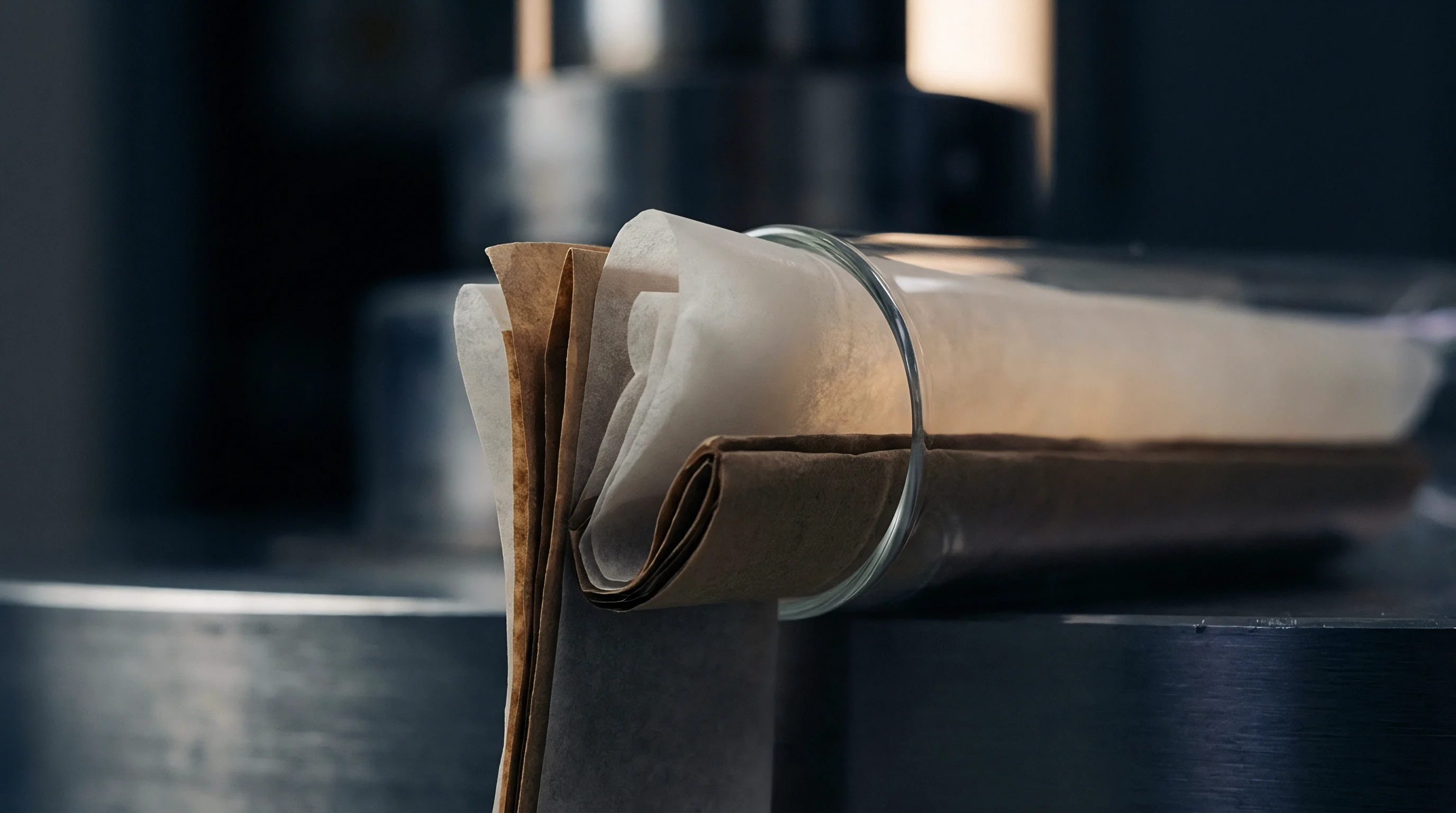
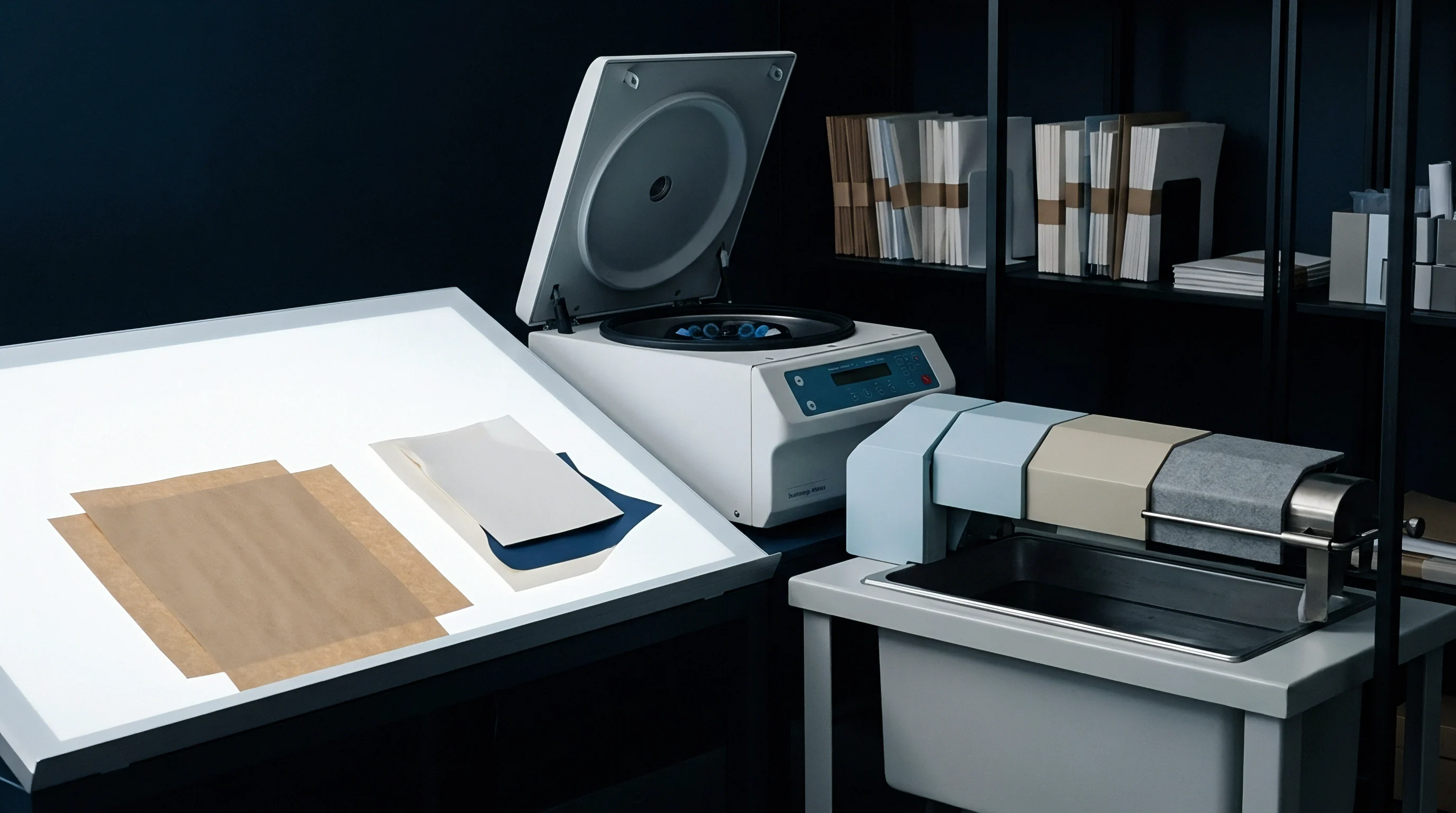
Automated goniometers employ charge-coupled device cameras paired with telecentric optical assemblies to image the liquid-air boundary at frame rates exceeding one thousand exposures per second. Standard instruments utilize a syringe pump coupled to a straight, PTFE-coated needle to produce calibrated micro-droplets. Mechanical vibrations, droplet detachment speeds, and baseline detection accuracy represent the primary sources of instrument variation during board evaluation.
Fast cameras prevent baseline drift. When testing rough, fibrous surfaces like uncoated recycled testliner, automated edge-detection algorithms struggle to distinguish between the actual liquid contact boundary and shadows cast by projecting cellulose fibers. Advanced optical instruments illuminate the sample using monochromatic light-emitting diode backlights and apply diffuse reflective surfaces beneath the specimen stage.
Telecentric optics eliminate magnification changes caused by slight sample warping or thickness variations across recycled sheets.
High Speed Image Capture and Baseline Algorithms
Modern testing hardware records the physical outline of the fluid bead immediately upon detachment from the dispensing tip. ASTM D5725 outlines the procedure for measuring surface wettability and absorbency of sheeted materials using automated contact angle testers. The instrument establishes time zero at the exact millisecond when the droplet contacts the paperboard plane.
In older manual goniometers, human operators introduced delays of up to three seconds before capturing the angle, invalidating data for rapid-adhesion converting processes.
Image processing algorithms apply edge-detection filters to locate the substrate plane. On coated white lined chipboard, the mineral pigment layer presents a relatively flat baseline, enabling straightforward circle-fitting or Young-Laplace calculations. On uncoated recycled liners, individual wood fibers project several micrometers above the mean plane, which distorts the detected boundary line.
Specialized algorithms employ baseline smoothing over a five-hundred-micrometer span, ignoring microscopic fiber fuzz to determine the macroscopic contact angle governing adhesive laydown.
A baseline shift of fifty micrometers on rough testliner introduces an error of eight degrees in calculated contact angles.
Which Dispenser Volume Prevents Droplet Kinetic Distortion?
Dispensing needles release liquid volumes calibrated between one and four microliters to prevent inertial bouncing during deposition. Excessive droplet volumes generate kinetic energy upon falling from the needle tip, which artificially drives the liquid outward into a forced wetting configuration. Insufficient volumes, below 0.5 microliters, cause rapid evaporation in dry testing rooms, distorting contact angle decay calculations within two seconds.
Automated micro-syringes advance the liquid meniscus slowly until gravitational or electrostatic detachment deposits the bead cleanly onto the test piece. The instrument maintains needle-to-board distances below two millimeters to suppress impact energy. Certain laboratories employ piezoelectric drop-on-demand dosing heads that fire sub-nanoliter droplets, mimicking the drop volumes found in industrial inkjet printing on packaging boards.
These micro-droplet systems evaluate single-fiber wetting dynamics, whereas two-microliter sessile drops average the combined response of fibers, fillers, and surface pores.
Specifying the test fluid chemistry remains equally critical. Pure water measures polar interaction capacity and internal sizing efficiency. Adding secondary probe liquids, such as diiodomethane or ethylene glycol, allows technicians to calculate the Lifshitz-van der Waals dispersive and Lewis acid-base polar surface energy components through the Owens-Wendt-Rabel-Kaelble method.
Technical uncertainty persists regarding whether calculated surface energy components from static multi-liquid probes accurately predict the high-shear wetting kinetics of starch and synthetic polymer adhesives during board lamination.

Felt
Top liner plies manufactured from recovered fiber exhibit pronounced chemical and physical divergence between their top and bottom faces. Papermaking machines deposit the slurry onto forming fabrics, creating a wire side characterized by lower fines content and marked wire-mark textures, alongside a felt side that retains higher concentrations of mineral fillers and sizing chemistry. In multi-ply boards, the top white liner receives intensive surface sizing and blade coating, while the underlying filler plies consist of unsorted mixed paper waste.
Deinked fibers absorb water unevenly. Recovered furnishes contain variable amounts of residual printing inks, silicone oils from release liners, and hot-melt adhesives known as stickies. These contaminants do not disperse homogeneously throughout the sheet.
Instead, they aggregate into hydrophobic domains across the board surface, creating localized patches where aqueous liquids bead up rather than penetrate. This spatial variability degrades test reproducibility, forcing laboratories to collect at least twenty individual droplet measurements per sample to achieve statistically valid data.

Wire Side Contrasts and Deinked Pulp Variance
Machine fabrics impart distinct topographical profiles during wet pressing, leaving suction patterns that alter local fluid absorption. The felt side of uncoated testliner generally presents a denser, smoother surface enriched with recycled starch, leading to higher initial contact angles and slower decay rates. The wire side displays open surface pores and exposed fibers that facilitate rapid liquid drainage into the sheet core.
- Mechanical pulps resist rapid penetration due to high residual lignin concentrations on recycled fiber walls, causing prolonged droplet retention on unbleached plies.
- Chemical pulps accelerate capillary movement because exposed hydrophilic hydroxyl groups readily form hydrogen bonds with penetrating water molecules.
- Recycled fibers collapse under pressure during sequential drying and re-pulping cycles, reducing internal lumen volume while increasing sheet density.
- Secondary fines increase surface area by packing between structural fibers, creating microscopic capillaries that pull liquids rapidly along the surface plane.
Variations in deinking efficiency further alter contact angle stability. In deinked pulp manufacturing, flotation deinking relies on fatty acid collectors and calcium soaps to remove hydrophobic ink particles. If residual collector chemistries carry over into the finished board web, they deposit hydrophobic organic films on fiber surfaces.
These residual soaps elevate the apparent water contact angle, leading converting plant managers to assume the board is adequately sized when it actually suffers from chemical contamination that interferes with cold-set adhesive bonding.

Chemical Sizing Reversion in Storage Environments
Alkyl ketene dimer and alkenyl succinic anhydride molecules migrate over prolonged warehousing periods. Paperboard mills add these internal sizing agents to the wet end to provide water holdout. In recycled board mills utilizing high amounts of calcium carbonate filler, alkyl ketene dimer represents the standard sizing chemistry.
Over weeks of storage in variable humidity, alkyl ketene dimer molecules undergo hydrolysis or reorient their hydrophobic hydrocarbon chains away from the air-board interface, causing sizing reversion.
| Storage Interval (Days) | Initial Contact Angle at 0.1s (deg) | Retained Angle at 1.0s (deg) | Cobb 60 Value (g/m²) | Folder-Gluer Fiber Tear (%) |
|---|---|---|---|---|
| 0 (Mill Baseline) | 108.4 | 102.1 | 22.1 | 100 |
| 15 | 104.2 | 96.5 | 24.8 | 98 |
| 30 | 97.8 | 84.3 | 29.2 | 85 |
| 60 | 89.1 | 68.7 | 38.5 | 60 |
| 90 | 78.3 | 42.1 | 54.0 | 35 |
Mill test certificates generated at the end of the paper machine reel record pristine sizing values, yet pallets stored across humid seasons exhibit substantial property drift. When converting plants process three-month-old white lined chipboard, the contact angle decay rate often increases threefold compared to newly manufactured stock. Glue lines applied to reverted board penetrate too rapidly, starving the interface and creating brittle, unbonded seams.
Mill representatives typically attribute bonding failures to excessive ambient humidity in the converting hall rather than sizing instability within the supplied furnish.

Swell
Cellulose networks expand upon exposure to polar fluids, changing the physical boundaries of the surface within twenty milliseconds. Recycled papermaking fibers undergo hornification during previous thermal drying cycles, which alters their pore structure and water-swelling capacity. When a droplet rests on a recycled sheet, liquid imbibition into the porous matrix occurs simultaneously with fiber wall swelling.
This dual action continuously modifies both the surface roughness and the thermodynamic contact angle.
Similar to unsaturated moisture migration through compacted clay soils in civil engineering, liquid movement through a recycled fibrous web follows non-linear capillary pressure gradients determined by pore tortuosity and pore radius distributions. The classical Lucas-Washburn equation describes fluid penetration into idealized cylindrical pores, yet actual paper pores consist of irregular, interconnected voids that deform as fiber walls swell. As water penetrates the cell walls, fibers expand primarily in cross-sectional diameter rather than length, closing smaller pores while opening micro-fissures in surface mineral coatings.

Wenzel Wetting States on Porous Recycled Topliners
Surface rugosity forces applied fluids to conform directly to peaks and valleys in the paper plane. Wetting behavior follows either the Wenzel model, where the liquid completely penetrates surface depressions, or the Cassie-Baxter model, where the liquid bridges across surface asperities, trapping air pockets beneath the droplet. Recycled paperboard surfaces transition rapidly between these states during initial contact.
Droplets deposited on rough, uncoated testliners initially sit in a metastable Cassie-Baxter configuration. Within ten to thirty milliseconds, capillary suction draws liquid into surface micro-pores, initiating a transition into the Wenzel state. The apparent contact angle drops abruptly during this shift, not due to chemical changes, but because the liquid now wets the true, enlarged surface area of the roughened fiber mat.
For water contact angles below ninety degrees, physical roughness accelerates apparent wetting; for intrinsic contact angles above ninety degrees, roughness initially increases water repellency.
A transition from Cassie-Baxter to Wenzel wetting drops the apparent contact angle by up to thirty degrees in less than fifty milliseconds without changing surface chemistry.

Advancing and Receding Angle Hysteresis
Discrepancies between the forward boundary of an expanding droplet and the trailing boundary of a retreating droplet quantify thermodynamic heterogeneity. Contact angle hysteresis equals the difference between the advancing angle and the receding angle. On recycled paperboard, hysteresis values frequently exceed forty degrees, driven by physical roughness, chemical heterogeneity from recycled contaminants, and localized fiber swelling.
- Surface rugosity pins the advancing liquid boundary at microscopic fiber edges, requiring higher local pressures before the liquid edge advances across the sheet.
- Patchy sizing deposition creates microscopic islands of high and low surface energy that trap retreating fluid edges, elevating measured hysteresis values.
- Fines migration alters porosity across the top surface plane, creating localized capillary funnels that disrupt droplet symmetry during automated testing.
- Coating binder migration pulls styrene-butadiene latex toward coating peaks during thermal drying, leaving pigment-rich, porous valleys that accelerate liquid pinning.
Evaluating both advancing and receding angles provides deeper operational clarity than tracking static angles alone. Dynamic tilting plate methods and automated pumping methods reveal whether low contact angles stem from genuine chemical receptivity or from capillary penetration into voids. Recycled board grades exhibiting extreme hysteresis values display unpredictable ink dot gain in flexographic printing, as ink droplets spread irregularly along rough fiber tracks rather than forming uniform circular deposits.
Smooth surfaces hold steady droplet boundaries while rough fibrous surfaces produce variable wetting lines.

Gluer
High-speed packaging machinery applies aqueous adhesive beads along carton flaps at web speeds reaching six hundred meters per minute. On folding carton lines, the time elapsed between adhesive extrusion and the compression belt typically falls between two hundred and six hundred milliseconds. If the paperboard surface fails to accept the adhesive vehicle within this window, the adhesive bead sits on top of the sheet without wetting the cellulose fibers, preventing mechanical interlocking.
Adhesive failure halts converting operations. Water-based emulsion adhesives, including plasticized ethylene-vinyl acetate and polyvinyl acetate dispersions, require controlled water migration into the board surface to initiate polymer coagulation and wet tack. On recycled boards with excessively high contact angles at five hundred milliseconds, the water remains trapped in the adhesive film, causing glue line slumping, slow set times, and carton pop-opens inside packing facilities.
What Governs Adhesive Open Time on Recycled Liners?
Setting speeds for aqueous vinyl acetate emulsions rely on controlled capillary uptake into the underlying fibrous web. The open time represents the maximum allowable interval between adhesive application and flap mating during which the glue successfully bonds. The closed time represents the duration under compression required to develop fiber-tearing bonds.
Both operational windows correlate directly with the contact angle decay curve of the substrate.
Consider a typical packaging converting operation running five hundred thousand folding cartons per shift using four-hundred-micrometer white lined chipboard. Assume a standard converting line speed of four hundred cartons per minute with an adhesive open time target of four hundred milliseconds. If a substituted mill lot of recycled board displays a 0.4-second water contact angle of one hundred and twelve degrees instead of the qualified target of eighty-eight degrees, the adhesive fails to wet the liner face.
Compression belts must be extended by fifty percent to prevent unbonding, forcing line speeds down to two hundred and sixty cartons per minute. This operational speed reduction represents a thirty-five percent drop in plant throughput, turning a profitable run into a substantial operating loss.
Specification Limits for Water Based Emulsions
Board converters establish purchase thresholds for contact angle progression at critical inspection intervals. Sourcing contracts that rely solely on Cobb 60 values leave converters exposed to severe machine downtime. Technical specifications should state contact angle windows at 0.1 seconds, 0.5 seconds, and 2.0 seconds under ISO 187 conditioning atmospheres (23 degrees Celsius, 50 percent relative humidity), testing with standardized water solutions and model adhesive vehicle formulations.
| Contact Angle at 0.1s | Contact Angle at 0.5s | Surface Wetting Status | Folder-Gluer Setting Response | Carton Joint Fiber Tear |
|---|---|---|---|---|
| > 110 deg | > 100 deg | Hydrophobic / Over-sized | Adhesive film slumps; setting delayed beyond 3 seconds | 0% to 20% (Adhesive failure) |
| 90 to 105 deg | 75 to 88 deg | Controlled Penetration | Optimum setting speed; full bond achieved in 400ms | 90% to 100% (Substrate failure) |
| 70 to 89 deg | 45 to 65 deg | Rapid Wetting | Accelerated tack development; risk of starved glue joint | 70% to 90% (Partial tear) |
| < 70 deg | < 40 deg | Porous / Under-sized | Instant water strike-through; starved bond; paper delamination | 10% to 40% (Brittle bond) |
When contact angles at 0.5 seconds exceed ninety degrees, converting operators must either apply mechanical scoring wheels to slice through the sized surface layer or switch to higher-solids, resin-modified adhesives that carry higher material costs. Conversely, when angles drop below forty degrees within half a second, the adhesive water phase drains prematurely into the board core, leaving dried polymer solids on the surface that fail to establish molecular contact with the opposing flap.
- Surface sizing thresholds specify a contact angle between eighty and ninety-five degrees at 0.5 seconds to balance wet tack development against glue starvation.
- Coating binder ratios dictate water retention values, where excessive styrene-butadiene latex concentrations suppress liquid penetration along glued joints.
- Surface tension calibration requires model test fluids to maintain seventy-two millinewtons per meter to simulate water-borne packaging adhesives accurately.
- Lot acceptance criteria mandate rejection of board shipments showing greater than fifteen degrees of contact angle variance across a single reel width.
Purchase contracts incorporating ASTM D5725 or TAPPI T 558 parameters permit buyers to reject board lots that deviate from agreed contact angle decay profiles, establishing direct commercial accountability for converting failures.