Evaluating Owens Wendt Polar Dispersive Ratios on Corona Treated Polypropylene Webs
Owens Wendt contact angle analysis isolates polar from dispersive surface energy, preventing lamination failure caused by unreliable single-value dyne pen readings.

Charge
Bare polyolefin films resist wetting because their nonpolar hydrocarbon chains lack functional sites for chemical bonding. An untreated biaxially oriented polypropylene web presents a baseline surface energy between 29 and 30 millinewtons per meter, consisting almost exclusively of Lifshitz-van der Waals dispersive forces. Atmospheric discharge breaks carbon-hydrogen bonds along the backbone, producing free radicals that react with ambient oxygen, ozone, and nitrous oxides.
This physical exposure incorporates oxygen-containing functionalities into the top five nanometers of the polymer interface.
The web advances. Atmospheric dielectric barrier equipment ionizes the process air within a narrow gap of one to two millimeters. The resulting electron bombardment strips electrons and cleaves aliphatic chains, generating an oxidized skin that accepts printing inks and solventless lamination adhesives.

Ionization Chemistry at the Polypropylene Interface
High voltage discharge across a grounded metal roller triggers rapid chemical substitution along the polypropylene repeat units. Secondary reactions with atmospheric gas mixtures yield distinct chemical groups on the surface plane:
- Hydroperoxide intermediates form within milliseconds of primary radical formation, serving as precursors to stable polar functions.
- Carbonyl groups generate dipole moments that interact with polar solvent molecules and polyurethane prepolymers.
- Carboxyl functions produce distinct acidic reaction points that promote hydrogen bonding with primer layers.
- Hydroxyl terminations raise polar wetting components and drive localized hydrogen bonding across the contact perimeter.
Oxygen radicals attack the backbone. The chemical distribution of these moieties determines whether an applied liquid will spread spontaneously or bead into disconnected droplets.
A surface energy increase that relies entirely on unstable low molecular weight fragments washes off during solvent coating.

Polar Group Generation across High Voltage Fields
Discharge power controls the rate of chemical grafting on the film face. When specific energy input rises above forty watt-minutes per square meter, the air gap plasma generates a high concentration of water-soluble oxidized oligomers alongside bound surface groups. These short-chain fragments cling loosely to the virgin polymer core.
Excessive ionization severs the polymer chains repeatedly, generating an over-oxidized, friable layer. Converting lines that pull high peel forces on laminated pouches strip this weak boundary layer directly from the web, causing interfacial failure despite elevated initial dyne readings.
Matching corona discharge density to line speed preserves the structural coherence of the base polymer while grafting the functional groups needed for subsequent coating passes.

Droplet
Sessile contact angle goniometry evaluates the force equilibrium where solid, liquid, and vapor phases meet. The Young equation balances interfacial tensions along the solid plane:
σs = σsl + σl cos θ
Here, σs is total solid surface energy, σsl is solid-liquid interfacial tension, σl is liquid surface tension, and θ is the measured contact angle. Owens, Wendt, Rabel, and Kaelble separated interfacial attractions into dispersive components, arising from London electron fluctuations, and polar components, stemming from dipole-dipole, induction, and hydrogen bonding. The geometric mean relationship governs the boundary:
σsl = σs + σl – 2(σsd σld)0.5 – 2(σsp σlp)0.5
Combining the Young and Owens-Wendt relationships yields a linear equation of the form y = mx + c:
/ = (σsp)0.5 + (σsd)0.5
Water probes the polar dipoles. Diiodomethane isolates London dispersion forces. Contact angles from two certified liquids permit direct regression solving for solid dispersive and polar components.

Why Do Dyne Solutions Mislead Lamination Teams?
Industrial testing often defaults to ASTM D2578 wetting tension mixtures of formamide and 2-ethoxyethanol. Dyne pens hide this variance. A fluid with a nominal rating of 38 millinewtons per meter spreads across a polypropylene web whenever the total surface energy exceeds that numeric threshold, regardless of whether the driving force is polar attraction or dispersive interaction.
Solvent components in dyne solutions swell the polyolefin web and dissolve low molecular weight oxidized material, producing false wetting indications. A surface reading 40 dynes per centimeter via ink pens frequently contains only 2 millinewtons per meter of polar energy, leaving water-based primers unable to anchor to the moving film.
At 23 degrees Celsius and 50 percent relative humidity, a water contact angle above 78 degrees indicates insufficient polar development for waterborne acrylic bonding.

Mathematical Separation of Energy Components
Accurate Owens-Wendt characterization demands precision dosing and optical calculation of the baseline drop diameter. Automated goniometer stages eliminate operator variation during drop placement.
- Deionized water deposition delivers a four-microliter droplet through a clean polytetrafluoroethylene needle to record initial contact angle at twenty seconds.
- Secondary fluid deposition introduces nonpolar diiodomethane onto an adjacent pristine web site, isolating dispersive contribution without triggering dipole interactions.
- Baseline edge detection fits a Young-Laplace contour around the liquid shadow to resolve contact angles within a tolerance of 0.2 degrees.
- Linear regression derivation plots the geometric mean ratios, assigning the square of the slope to polar energy and the square of the y-intercept to dispersive energy.
Interfacial tension drops immediately. Polypropylene webs tested immediately following discharge exhibit elevated polar values that shift substantially under roll winding pressure.
| Film Treatment State | Water Angle (deg) | Diiodomethane Angle (deg) | Dispersive Energy (mN/m) | Polar Energy (mN/m) | Total Energy (mN/m) | Polar Ratio (Xp) |
|---|---|---|---|---|---|---|
| Virgin Untreated | 104.2 | 53.1 | 31.8 | 0.3 | 32.1 | 0.01 |
| Fresh In-Line Corona | 68.4 | 46.2 | 33.2 | 10.4 | 43.6 | 0.24 |
| Stored 7 Days (Ambient) | 76.1 | 48.0 | 32.5 | 6.2 | 38.7 | 0.16 |
| Stored 30 Days (Ambient) | 83.5 | 50.4 | 32.0 | 3.1 | 35.1 | 0.09 |
| Over-Treated Degraded | 61.2 | 44.1 | 32.9 | 14.8 | 47.7 | 0.31 |
Film suppliers often state that incoming material satisfies dyne specifications at dispatch, leaving secondary adhesion loss to atmospheric variables outside the mill’s control.

Recovery
Corona-treated films lose surface energy over storage time through hydrophobic recovery. The film looks unchanged. The underlying mechanism involves polymer thermodynamics rather than evaporation of grafted species.
Amorphous chain segments possessing polar functionality rotate away from the air-film boundary toward the bulk interior to minimize interfacial free energy. Nonpolar methyl and methylene units turn toward the surface plane, driving water contact angles upward within hours of treatment.
Entropy drives this relaxation. Low molecular weight oxidized material migrates laterally into microscopic droplets, agglomerating across the surface and exposing virgin polyolefin domains beneath.

Thermodynamic Relaxation and Chain Migration
Polypropylene features a glass transition temperature between minus ten and zero degrees Celsius. At standard warehouse storage temperatures of twenty degrees Celsius, the amorphous chains maintain significant segmental mobility. Chain rotation occurs continuously.
Slip additives like erucamide and oleamide, formulated into the resin to reduce friction during web transport, accelerate this degradation. These fatty acid amides migrate rapidly through the amorphous matrix, blooming to the surface and masking the grafted carbonyl and carboxyl groups. The polar fraction drops, while the dispersive energy remains anchored near 32 millinewtons per meter.
A contract specification that records dyne level without stating elapsed storage days permits delivery of unbondable aged web stock.

Environmental Acceleration of Polar Decay
Ambient humidity accelerates the clustering of water-soluble oxidized oligomers. Water vapor plasticizes localized surface domains, facilitating molecular rearrangement. Elevated temperatures inside shipping containers produce rapid decay profiles.
A web holding 10 millinewtons per meter of polar energy at the slitter head drops to less than 4 millinewtons per meter after forty-eight hours at forty degrees Celsius.
This kinetic loss resembles the mechanical embrittlement observed when fluorosilicone seals experience secondary crosslinking during elevated temperature storage in pressurized aircraft hydraulic circuits, where surface morphology reorganizes independently of bulk properties. Once the polar energy drops below five millinewtons per meter, polyurethane laminating adhesives fail to spread across the micro-roughness peaks of the film.
The rate at which internal additives replace grafted surface groups remains difficult to predict without knowing the precise molecular weight distribution of the original polypropylene masterbatch.


Adhesion
Adhesive spreading and bond strength depend on thermodynamic work of adhesion rather than gross surface tension values. The Dupre equation defines the energy required to separate an adhesive from a solid substrate into two distinct interfaces:
Wa = σs + σa – σsa
Substituting the Owens-Wendt geometric mean formulation yields:
Wa = 2 (σsd σad)0.5 + 2 (σsp σap)0.5
Maximum adhesion occurs when both dispersive and polar surface components of the substrate closely match those of the liquid coating. When a polar polyurethane formulation touches a web with low polar energy, the second term drops near zero, limiting bond strength to dispersive physical forces. Adhesion tests reveal brittle bondlines.

Is Polar Fraction Sufficient for Thermal Lamination?
Thermal lamination processes demand distinct thermodynamic profiles compared to cold solventless adhesives. Extruded low-density polyethylene or ethylene acrylic acid tie layers arrive at the nip in a molten state between 280 and 320 degrees Celsius. Contact angles measured at room temperature do not fully describe the rheological wet-out occurring under hot nip compression.
While a high polar fraction promotes immediate covalent coupling with functional groups in carboxylic-modified ethylene copolymers, excessive surface oxidation creates weak boundary zones that split internally under mechanical peel tests. Operating teams must balance polar functional density against polymer chain integrity.
| Adhesive or Ink Formulation | Dispersive Component (mN/m) | Polar Component (mN/m) | Target Substrate Polar Ratio (Xp) | Work of Adhesion (mJ/m²) | Observed Failure Mode |
|---|---|---|---|---|---|
| Solventless 2K Polyurethane | 31.5 | 9.8 | 0.20 to 0.28 | 84.2 | Cohesive (Substrate Tear) |
| Waterborne Acrylic Primer | 28.4 | 16.5 | 0.25 to 0.35 | 87.9 | Cohesive (Primer Split) |
| Solvent-Based Nitrocellulose Ink | 27.2 | 5.4 | 0.12 to 0.18 | 70.1 | Substrate Yield |
| UV-Curable Radical Varnish | 32.0 | 7.2 | 0.18 to 0.24 | 79.4 | Interfacial Delamination |
| Hot Melt Ethylene Vinyl Acetate | 30.1 | 2.8 | 0.08 to 0.14 | 67.5 | Adhesive Peel |

Thermodynamic Matching in Polyurethane Adhesives
Solventless laminations fail silently. Consider a production run laminating 20-micron BOPP to 12-micron metallized polyester using a standard two-component solventless polyurethane adhesive. The adhesive supplier specifies a minimum web surface energy of 38 dynes per centimeter.
If this 38 millinewtons per meter consists of 35 dispersive and 3 polar units, the polar fraction sits at 0.08. Calculating the work of adhesion between this web and a polyurethane adhesive displaying 31.5 dispersive and 9.8 polar components yields:
Wa = 2 (35 × 31.5)0.5 + 2 (3 × 9.8)0.5 = 66.4 + 10.8 = 77.2 mJ/m²
A web treated to 42 millinewtons per meter containing 32 dispersive and 10 polar units generates:
Wa = 2 (32 × 31.5)0.5 + 2 (10 × 9.8)0.5 = 63.5 + 19.8 = 83.3 mJ/m²
The six millijoule increase in thermodynamic work represents an eighty percent increase in the polar anchoring component. This difference determines whether curing stresses delaminate the multi-layer barrier structure during pouch conversion. Converting floors that skip polar component verification face catastrophic tunnel delamination across finished roll stock during cure maturation.

Density
Corona treater power delivery must adapt dynamically to line velocity to maintain consistent polar-dispersive ratios across an entire production shift. Specific energy density, quantified in watt-minutes per square meter, dictates the quantity of ionized particles interacting with the passing web:
E = P / (v × w)
In this equation, P is generator power in watts, v is web line speed in meters per minute, and w is discharge electrode width in meters. Line speed dictates dwell time. Doubling speed cuts energy density by half unless generator output scales proportionally.

Specific Energy Calculations on High Speed Lines
Operating a slitter-rewinder or dedicated treatment line at four hundred meters per minute reduces exposure time in the plasma field to fractions of a millisecond. If the system fails to deliver sufficient power, the web passes through the gap with insufficient chain scission, preventing polar group formation. High-speed lines require bare-roll treaters with ceramic dielectric electrodes capable of dissipating thermal loads without thermal dielectric breakdown.
| Line Speed (m/min) | Generator Output (kW) | Specific Energy (W·min/m²) | Dispersive Component (mN/m) | Polar Component (mN/m) | Resulting Polar Fraction |
|---|---|---|---|---|---|
| 100 | 1.5 | 30.0 | 32.8 | 7.2 | 0.18 |
| 200 | 1.5 | 15.0 | 32.1 | 4.1 | 0.11 |
| 200 | 3.0 | 30.0 | 32.9 | 7.4 | 0.18 |
| 350 | 3.5 | 20.0 | 32.4 | 5.3 | 0.14 |
| 350 | 5.5 | 31.4 | 33.0 | 7.8 | 0.19 |
| 100 | 4.5 | 90.0 | 33.2 | 13.6 | 0.29 |
Dielectric ceramic rolls resist pitting. Ozone exhaust blowers evacuate hazardous byproducts while pulling cooling air over the electrode array to prevent thermal warping.

Electrode Configuration and Dielectric Roll Maintenance
Contaminants on dielectric roll coverings cause localized dielectric breakdown, creating pinhole burn-throughs that transfer sparks directly to the metal roll core. Backside treatment occurs whenever air is trapped between the film and the backing roll during discharge, oxidizing the untreated inner surface. When backside treatment exceeds 36 millinewtons per meter, rolls block inside customer warehouses, pulling coatings away during unwinding.
A structured quality protocol prevents line-induced defects through defined engineering tolerances:
- Electrode gap clearance maintains a uniform spacing of 1.5 millimeters across the full face with a maximum variance of 0.1 millimeters.
- Dielectric sleeve integrity undergoes weekly high-voltage spark testing to identify micro-fissures before pinholing punctures the web.
- Ozone extraction volume operates at a continuous minimum airflow of fifteen cubic meters per minute to prevent backpressure in the discharge hood.
- Nip roller engagement excludes entrained boundary air at the entrance to prevent unwanted backside surface ionization.
Treated webs wound under excessive roll tension exhibit accelerated transfer of low molecular weight oxidized material to the unoxidized reverse face.
Commercial packaging contracts incorporating DIN 55660-2 require suppliers to deliver film lots with specified polar fractions rather than gross wetting values, shifting scrap liability to converters who fail to measure dispersive ratios upon receipt.

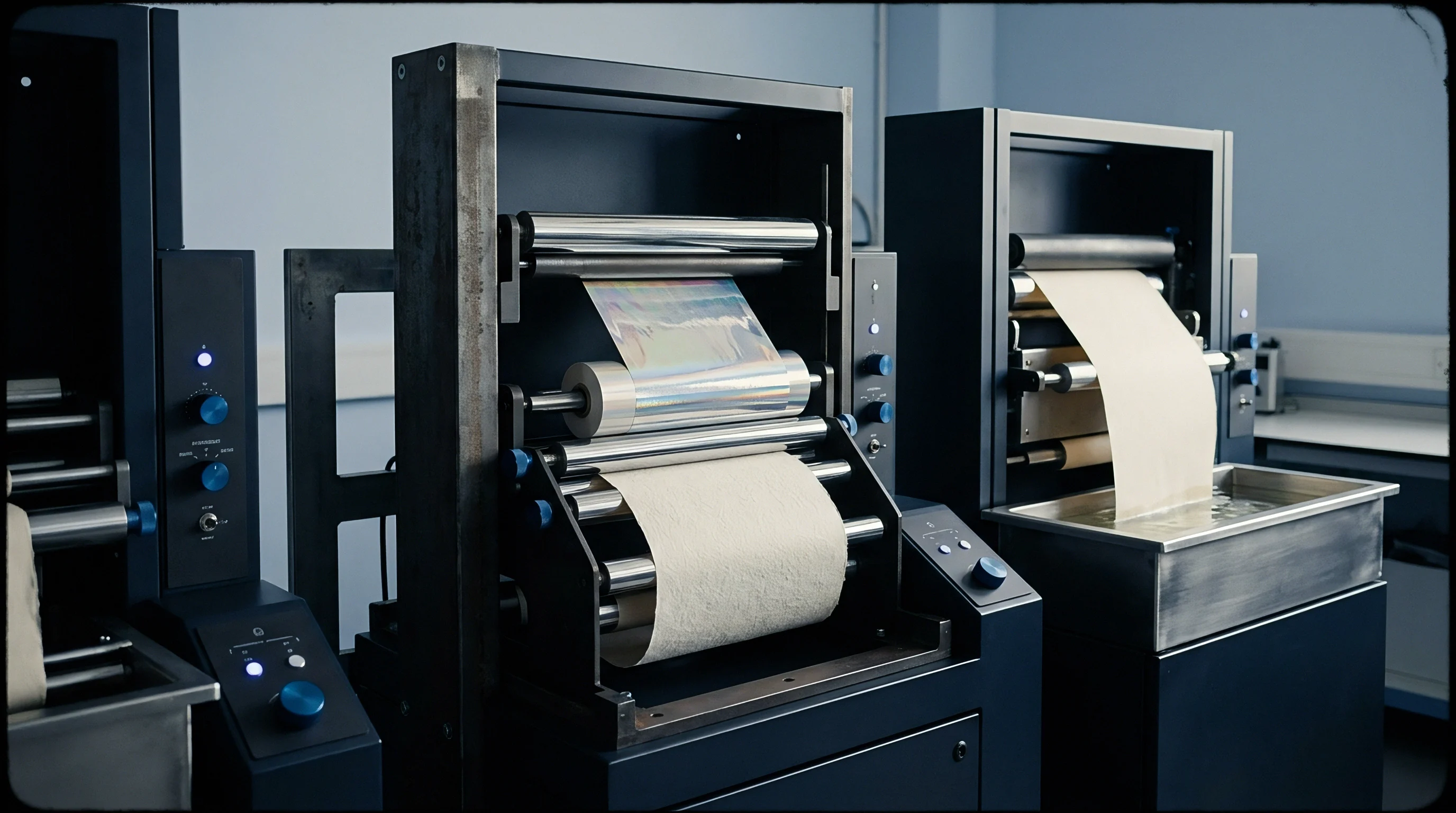
Acceptance
Receiving inspection for treated polypropylene webs demands rapid, reproducible laboratory workflows before roll stock enters production queues. Roll stock ages in transit. A pallet delivered forty days post-extrusion cannot be evaluated using legacy dyne pens without introducing substantial commercial risk.
Sourcing teams and plant chemists must isolate the polar surface component using automated sessile drop instruments, rejecting lots that fail to meet minimum polar thresholds despite total surface energies exceeding 38 millinewtons per meter.
Tension holds steady. Measuring water contact angle directly on incoming rolls offers a rapid screening test. When the water contact angle exceeds 75 degrees on incoming corona-treated BOPP, the polar fraction sits below 0.15, signaling that solventless polyurethane lamination passes will suffer unacceptably low bond strength.
Receiving Protocols for Stored Film Rolls
Plant receiving docks must pull samples three wraps deep into the roll core to avoid testing film exposed to ambient warehouse humidity. Testing must occur under climate-controlled conditions of 23 degrees Celsius and 50 percent relative humidity following ISO 187 conditioning guidelines. Technicians run two test fluids: deionized water and diiodomethane.
Automated droplet dispensers eliminate hand-pipette kinetic shock, yielding contact angle values within two minutes of sample extraction.
Immediate mathematical reduction provides the exact polar and dispersive split. Rolls displaying a dispersive component near 32 millinewtons per meter and a polar component below 5 millinewtons per meter get flagged for corona refreshing on the laminator unroll stand.

Economic Consequences of Interface Delamination
Running unverified film through a multi-pass lamination line risks complete product loss. Assume a 30,000-meter production run of three-ply barrier laminate using 20-micron BOPP, 12-micron metallized polyester, and 50-micron linear low-density polyethylene sealant film. The substrate cost averages 0.18 currency units per square meter for the primary web, while adhesive and processing overhead add 0.24 units per square meter per pass.
A bond failure detected during downstream pouch forming writes off the entire structure, yielding a raw material loss exceeding 12,000 currency units per lot, excluding customer rejection penalties and production schedule delays.
Installing an in-line corona refreshing unit adds roughly 0.004 currency units per square meter in electrical and maintenance costs. This single auxiliary pass restores the polar component from decayed values of 3 millinewtons per meter back to 10 millinewtons per meter, elevating the polar fraction above 0.22 and guaranteeing structural bond integrity across demanding retort and vacuum pouch packaging applications.