Evaluating Z-Directional Tensile Strength Variance across Multi-Ply Recycled Furnishes
Z-directional tensile variance in multi-ply recycled board stems from uneven wet consolidation, high ash, and poor starch cooking, causing severe converting failure.
Couch
Delamination begins at the wet line where separate slurries meet under pressure. In multi-ply cylinder and multi-Fourdrinier forming, individual plies take shape on independent wires before the couch roll brings them together to consolidate into a single multi-layer sheet. Recycled furnishes bring severe drainage resistance and erratic freeness swings into this zone.
Furnish recycled through repeated cycles contains short, hornified fibres with low specific surface area and impaired fibrillation. Wet pressing establishes inter-ply contact. When wet webs join at solids contents diverging by more than four percent, mechanical intermingling across the boundary drops.
The fibres fail to cross the junction, leaving a stratified boundary held together by capillary pull rather than entangled fibrillar networks.
Variations in z-directional tensile strength originate directly from this wet consolidation boundary. A multi-ply white lined chipboard or coated recycled board carries distinctly different furnish recipes across its cross-section. The top liner uses deinked pulp or unbleached kraft to maintain brightness and score integrity.
The middle plies incorporate mixed waste paper, old corrugated containers, and mechanical screen rejects to build caliper cheaply. The back liner relies on sorted newsprint or mixed office waste. Each ply exhibits an individual drainage profile and shrinkage rate during drying.
Differential shrinkage generates shear stresses at the ply boundaries as the board passes through the dryer section.
Hydrogen bonds dictate internal cohesion. Because recycled fibres exhibit reduced water retention values, frequently below 1.1 grams of water per gram of dry pulp compared to 1.8 for virgin kraft, the swelling needed for close molecular contact during pressing remains absent. The resulting sheet exhibits wide z-directional tensile strength variation across both cross-direction and machine-direction profiles.
Excessive machine calender pressure compresses bulk while shearing wet-formed inter-ply zones before chemical starch can cure.
Uneven couch vacuum pressures exacerbate this deficit across wider machine deckles. A vacuum variation of 8 kilopascals across a five-metre forming roll creates localized zones of low wet web density. These wet streaks retain moisture into the press section, crushing the internal boundary under the press nip and creating latent delamination pockets.
- Differential Drainage Velocity across adjacent plies pulls fines away from the forming interface, creating a starved zone devoid of bonding elements.
- Uneven Nip Loading during wet couching introduces micro-cracks along the central recycled core that survive into the dried reel.
- Furnish Shrinkage Mismatch forces the outer virgin plies to pull outward against the shrinking recycled middle during drum drying, setting up persistent internal shear tension.
Mill technical managers explain these boundary failures by pointing to raw waste paper bales that arrived with unexpected moisture swings and unmanageable freeness swings from the municipal sorting stream.

Ash

Does Starch Spray Compensate for Recycled Fines?
Mineral filler accumulation in recycled furnishes displaces functional fibre mass. Mixed waste streams carry calcium carbonate from coated brokes, kaolin clay from catalog papers, and titanium dioxide from decorative printings. When mills push recycled content toward one hundred percent, ash levels in the middle filler plies routinely climb above 18 percent by mass.
Mineral filler displaces load-bearing fibres. Calcium carbonate particles deposit on external fibre walls, physically shielding hydroxyl groups from forming hydrogen bonds with adjacent fibrils. High ash loads destroy cohesion.
The sheet retains thickness and bulk, but the internal tensile strength measured normal to the sheet face collapses.
Mills counteract this strength loss by spraying uncooked or partially cooked native corn or potato starch directly between the wet plies before the couching nip. Starch spray application rates typically run between 2.0 and 5.5 grams per square metre per ply interface. The starch gelatinizes as the damp web passes through the dryer cylinders, melting into a continuous adhesive film across the recycled layers.
Conditioned at 23 degrees Celsius and 50 percent relative humidity under ISO 187, recycled testliner plies exhibit Z-directional tensile drops exceeding 45 kilopascals when mineral ash content surpasses 16 percent.
The distribution of spray starch across the machine deckle rarely remains flat. Spray nozzles clog with recirculated recycled fines and biological slime, generating dry streaks along the web. In those unglued zones, z-directional tensile values drop from a nominal 280 kilopascals to below 110 kilopascals.
Thermal energy in the dryer section must also penetrate the outer liners to cook the core starch. If the dryer cylinder surface temperatures sit below 85 degrees Celsius in the first dryer tier, starch granules fail to gelatinize fully. They remain inert, round particles that act as inorganic fillers, deteriorating the internal bond they were bought to salvage.
| Grade Designation | Total Grammage (g/m²) | Ash Content Middle Plies (%) | Spray Starch (g/m²) | ZDT Value ISO 15754 (kPa) | Scott Bond TAPPI T 569 (J/m²) |
|---|---|---|---|---|---|
| Coated Recycled Board CRB | 350 | 19.4 | 3.2 | 145 ± 28 | 115 ± 22 |
| White Lined Chipboard WLC | 400 | 22.1 | 2.8 | 130 ± 34 | 102 ± 26 |
| Recycled Testliner 2 | 175 | 14.2 | 4.5 | 290 ± 22 | 210 ± 18 |
| Recycled Testliner 3 | 150 | 18.8 | 2.1 | 210 ± 31 | 145 ± 24 |
| Folding Boxboard Recycled Middle | 300 | 11.5 | 4.8 | 240 ± 19 | 185 ± 15 |
Fibre shortening compounds the ash problem. Recycled furnish pulped through high-consistency hydrapulpers undergoes aggressive shearing. Secondary fines, consisting of broken cell wall fragments smaller than 75 micrometres, consume cationic wet-end additives.
These colloidal fines attract wet-strength resins and retention aids, depriving the longer structural fibres of bonding chemistry. The fines settle into micro-voids at the inter-ply boundary. Instead of bridging the gap, they create dense, brittle sheets of low shear resistance that crack under modest out-of-plane loading.
Whether modern enzymatic modification of native starches can reliably cross-link hornified fines without blinding forming fabrics remains an active point of mill debate.

Platen
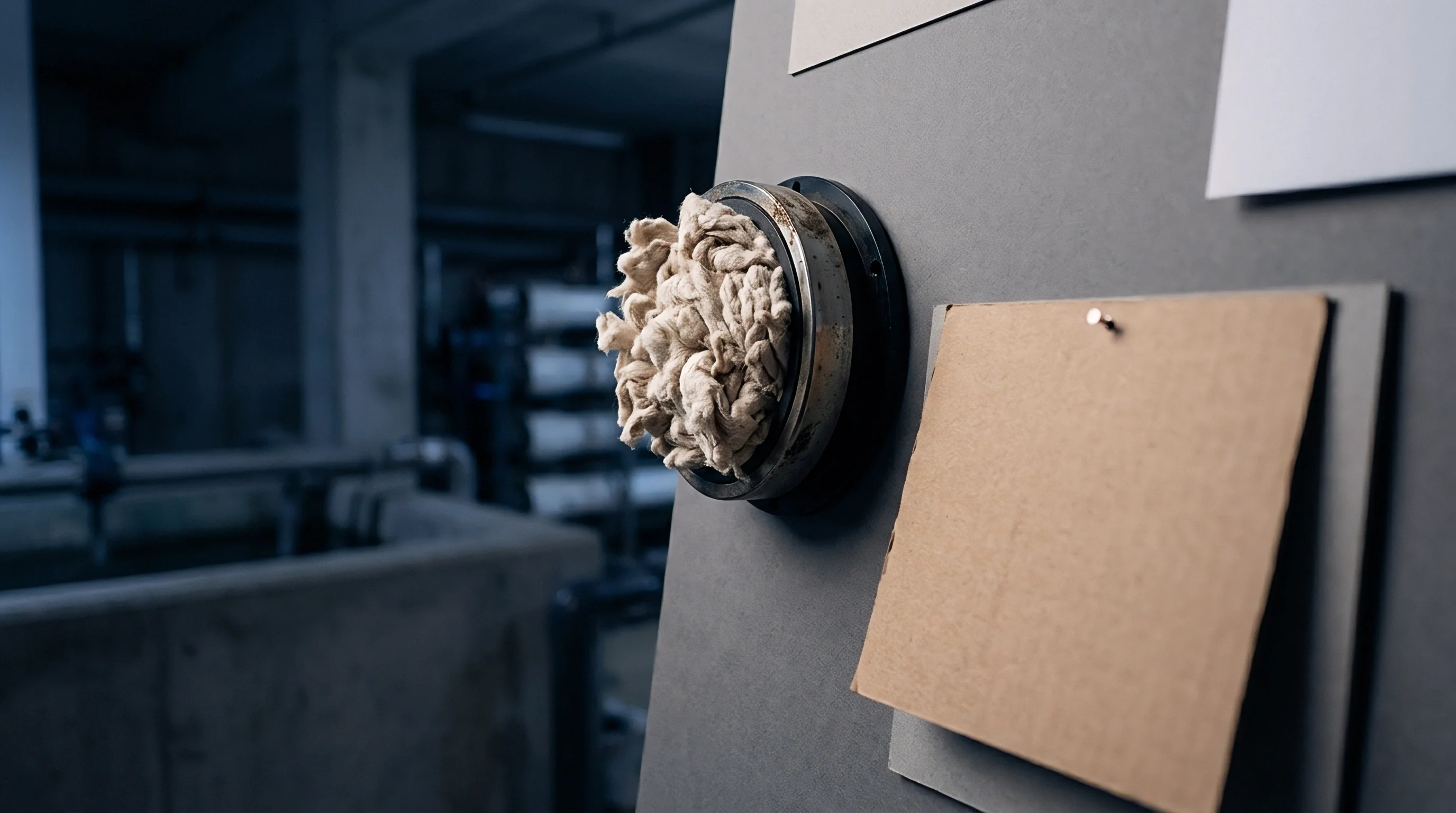
Direct measurement of internal cohesion demands absolute physical alignment. Two primary mechanical methods evaluate this property: the Scott internal bond test defined by TAPPI T 569, and the true z-directional tensile test governed by ISO 15754 and TAPPI T 541. The Scott test uses a falling pendulum to strike an aluminum angle adhered to the paper surface, calculating the dynamic rupture energy in joules per square metre.
The dynamic test combines shear, peel, and tensile stresses in unknown proportions. The z-directional tensile method mounts the paper sample between two rigid metal platens using high-tack double-sided adhesive tape, pulling the assembly apart in pure tension perpendicular to the plane of the sheet at a controlled crosshead speed.
Tension pulls normal to the surface. Platen alignment tolerances in ISO 15754 permit less than 0.05 millimetres of angular deflection across a 50 square centimetre platen face. Any non-parallel clamping induces peeling stresses along the specimen edge, artificially suppressing the recorded failure load by up to 30 percent.
Invoking ISO 15754 clause 7.2 permits rejection of parent reels exhibiting a coefficient of variation across the web greater than 14 percent on z-directional tensile strength.
Tape selection creates substantial laboratory error. Double-sided adhesive tape exhibits creep. If the adhesive tape flows under the standard 1.0 megapascal clamping pressure applied during sample mounting, it penetrates the porous surface of recycled board.
This penetration artificially reinforces the top plies, forcing failure deeper into the unreinforced core and generating artificially high readings. Conversely, low-adhesion tape delaminates from clay-coated surfaces, reporting false substrate failures.
- Platen Degreasing cleans residual acrylic adhesive from ground steel faces using high-purity acetone to prevent uneven clamping thickness.
- Tape Lamination applies double-sided adhesive film to both sides of the specimen without trapping airborne dust or micro air pockets.
- Specimen Compression seats the composite assembly under a hydraulic or pneumatic dwell of 1000 kilopascals for exactly thirty seconds.
- Tensile Extension pulls the opposing platens apart at a uniform velocity of 2.5 millimetres per minute until mechanical rupture occurs.
- Rupture Area Inspection confirms that failure occurred entirely within the sheet structure rather than at the tape-to-metal boundary.
Specifying testing compliance under ISO 15754 with a minimum sample population of twenty specimens per parent reel guarantees statistical identification of weak cross-direction lanes before converting commitments proceed.
Blister

Can Inverted Creasing Rules Mitigate Delamination?
Converting equipment subjects multi-ply board to severe out-of-plane stress regimes. During sheet-fed offset lithography, tacky polymerizing printing inks apply high vertical peel forces as the blanket cylinder separates from the sheet. Offset inks exert strong tack forces.
When high-speed presses operate at 15,000 sheets per hour with four or six heavy ink films, the dynamic separation stress exceeds 180 kilopascals. If the board core carries a z-directional tensile strength below 160 kilopascals, the ink film pulls the top liner entirely off the recycled filler plies, forming large surface blisters that foul printing blankets and crush subsequent impressions.
Blistering ruins high-speed carton runs. In heatset web offset printing, moisture trapped within recycled core plies flashes into steam inside hot-air drying tunnels operating at 160 degrees Celsius. Low internal bond strength allows vapor pressure to split the board internally, inflating the sheet into structural bubbles.
Offset ink tack forces separate outer white liners from recycled filler plies during high-speed lithographic printing passes.
Die-cutting and scoring introduce even harsher local shears. Rotary or flatbed creasing rules force the board down into female matrix grooves, deliberately delaminating the internal plies in a controlled hinge line so the carton folds cleanly at ninety degrees without exterior liner cracking. When the z-directional tensile variance across the furnish is erratic, the delamination spreads uncontrollably away from the score matrix into the main carton panels.
| Converting Operation | Stress Mode | Minimum ZDT (kPa) | Acceptable CoV (%) | Primary Failure Manifestation |
|---|---|---|---|---|
| High-Speed Offset Litho | Blanket Peel Force | 175 | 8.5 | Liner tearing, ink blanket picking |
| Heatset Web Printing | Internal Vapor Pressure | 190 | 10.0 | Core expansion blistering |
| High-Speed Folding & Gluing | Torsional Spring-Back | 150 | 12.0 | Score rupture, unglued carton seams |
| Hot Melt Glued Flaps | Perpendicular Tensile Pull | 165 | 9.0 | Fiber tear failure inside core plies |
Inverted creasing rules mitigate premature cracking only when the female creasing channel width expands to accommodate the higher bulk of recycled furnish. The wider matrix accommodates low-cohesion filler plies without forcing sudden shear fractures. If die parameters ignore furnish variance, glue flap pop-opens emerge on automated cartoning lines, dropping packaging line throughput from 400 cartons per minute to a complete standstill.
Ignoring z-directional tensile variance in high-speed converting specifications produces catastrophic box-erection failures, unseated carton seams, and massive waste charges passed directly to the packager.
Intake
Commercial acceptance of recycled multi-ply board depends on statistical qualification at goods-in inspection. Swatch books represent idealised hand sheets or machine runs produced under peak operational control. Delivered containerboard and boxboard reels carry moisture and basis-weight drifts accumulated across thousands of metres of machine production.
Recycled furnishes drift across seasons. Municipal waste streams absorb higher moisture during winter months and accumulate greater ash proportions during unseasonal recycling spikes, driving z-directional tensile values down across delivered production lots.
Mill certificates quote average production values. An average z-directional tensile strength of 180 kilopascals on a mill certificate can obscure extreme lane-to-lane variance across the web. If the edge lanes drop to 120 kilopascals while the centre web reaches 240 kilopascals, converted cartons cut from edge reels will fail in production.
Sourcing contracts that define pass-fail thresholds solely on arithmetic lot averages surrender commercial protection.
Sound procurement specifies both a lower absolute limit and a maximum allowable coefficient of variation across the reel profile. A buyer calculating usable yield evaluates the landed cost per thousand cartons against the scrap rate induced by delamination. A paperboard lot purchased at an eight percent discount per metric tonne turns commercially negative when converting delamination forces a ten percent make-ready reject rate on high-speed gluer lines.
Reels that fail goods-in verification must not reach the converter floor. A rigid incoming testing procedure verifies every delivery before roll stands unlock the material for production runs. Paperboard that demonstrates uniform internal bonding runs without incident through every converting stage.