Optimizing Hot Foil Stamping Dwell Times on Corona Treated Laminates
Maintain laminate surface energy above 42 dynes/cm to hold flatbed stamping dwell between 35 and 65 ms at 115°C, preventing board distortion and adhesive bleed.

Contact
Pinning down dwell duration on corona treated film begins with the thermodynamics of the adhesive layer. Modern foil stamping runs on biaxially oriented polypropylene and polyethylene terephthalate laminates demand an interface contact time between 35 and 65 milliseconds on flatbed presses when surface tension registers at or above 42 dynes per centimeter. Lower surface energies force the heated platen to pause longer on the impression stroke so the hot-melt sizing can wet the oxidized film.
Extending this impression window past 120 milliseconds melts the underlying adhesive bond between the polymer skin and the paperboard core, causing blistering and visual distortion across image areas.
The interaction between the stamping foil adhesive and the treated film hinges on rapid heat penetration. A heated die face running at 115 degrees Celsius requires adequate contact duration to drive energy across the polyester carrier film, melt the release layer, and activate the ethylene-vinyl acetate sizing. Film processors alter non-polar polyolefin structures through high-voltage electrical discharge, generating carbonyl, carboxyl, and hydroxyl functional groups on the exterior face.
These polar sites allow the liquid adhesive to spread rapidly upon contact.
A surface energy below 38 dynes per centimeter prevents proper sizing wet-out unless platen contact extends past the thermal threshold of the polymer skin.
Adhesion fails below this line. When platen dwell is trimmed to boost machine speeds, the sizing layer never transitions beyond its glass transition point, yielding incomplete foil transfer and flaking along fine typographic serifs. Conversely, setting excessive contact periods overheats the film carrier, initiating uncontrolled lateral flow of the adhesive matrix.
This causes image spreading, bridging between fine lines, and ragged foil edges.
Surface Wetting Dynamics on Biaxially Oriented Films
Polypropylene films present severe chemical resistance due to their non-polar molecular structure. Corona discharge units installed on solventless laminators bombard the web with ionized air, breaking carbon-carbon bonds and forming polar oxidation products. These functional groups elevate the surface energy from a baseline of 29 dynes per centimeter to an operational window between 40 and 44 dynes per centimeter, measured via standard dyne test pens adhering to ISO 8296 guidelines.
The elevated energy level reduces the liquid-solid contact angle of the molten sizing. Fast mechanical presses cycling at 5,000 sheets per hour establish impression periods as brief as 40 milliseconds. Within this tight interval, the hot adhesive must flow into micro-voids created by the discharge process.
If the surface exhibits poor oxidation, the adhesive forms discrete droplets rather than a continuous film.
Cold platens cause pinholing. When the contact period drops below the thermal transfer threshold of the specific foil formulation, the aluminum vacuum layer shears unevenly from the polyester carrier. The operator frequently diagnoses this defect as insufficient mechanical tonnage and applies extra pressure, which crushes the caliper of the cartonboard without improving chemical adhesion.

Dyne Levels and Adhesive Sizing Activation
Stamping foils engineered for plastic laminates employ modified acrylic or polyamide sizing layers designed to soften between 95 and 125 degrees Celsius. Testing these films requires strict environmental conditioning according to ISO 187 parameters of 23 degrees Celsius and 50 percent relative humidity. Substrates conditioned outside these tolerances yield erratic surface readings, obscuring true oxidation degradation.
The window for successful transfer narrows as the base film thickness increases. Standard 12-micron metallized polypropylene demands less thermal input than 20-micron soft-touch films, which act as thermal insulators. When soft-touch coatings are present, dwell settings must accommodate the low thermal conductivity of the polyurethane matte coating, which absorbs heat before the corona-activated surface reaches bonding temperature.
- Adhesive micro-bridging occurs when excessive contact time causes low-viscosity sizing to bleed beyond the die boundary, bonding adjacent non-image areas.
- Premature carrier release happens when prolonged heat exposure degrades the wax release coat before uniform impression pressure establishes complete mechanical contact.
- Flake voids appear across solid foil zones when insufficient dwell prevents the sizing layer from reaching its melting point across the entire impression area.
- Laminate delamination develops when heat soaking decomposes the solventless polyurethane lamination adhesive anchoring the polymer to the fiberboard substrate.
Operating a finishing press with mismatched dwell parameters generates massive waste during the subsequent die-cutting and folding steps, where poorly bonded foil shears off carton edges and fouls creasing channels.


Heat
Thermal energy migration through a hot stamping configuration obeys Fourier-law conduction across several distinct material boundaries. Energy flows from the heated chase through the metallic die, passes through an air interface, traverses the 12-micron polyester carrier film, liquefies the release layer, conducts through the 20-nanometer aluminum layer, and terminates in the sizing coat. Thin gauges conduct heat faster.
The entire sequence must complete during the momentary halt of the press platen, making thermal conductivity the primary governing variable of dwell calibration.
Thermal conductivity differentials among stamping dies drastically alter the required contact duration. Brass dies machined via computerized numerical control offer a thermal conductivity around 115 Watts per meter-Kelvin, allowing rapid recovery of die-face temperatures between cycles. Copper dies provide even higher conductivity at roughly 385 Watts per meter-Kelvin, transferring energy into the foil package in half the time required by standard magnesium dies, which sit near 150 Watts per meter-Kelvin but suffer from poor thermal capacity.
Magnesium dies cool significantly upon contacting cold sheet stock, necessitating longer dwell durations to achieve identical adhesive activation.
| Die Material | Thermal Conductivity (W/m·K) | Minimum Dwell on BOPP (ms) | Minimum Dwell on PET (ms) | Durability Limit (Impressions) |
|---|---|---|---|---|
| Machined Brass | 115 | 45 | 40 | 500,000 |
| Chemical Etched Copper | 385 | 35 | 30 | 250,000 |
| Etched Magnesium | 150 | 65 | 55 | 50,000 |
| Silicone Rubber (Metal Backed) | 0.5 | 140 | 120 | 100,000 |

Thermal Transmittance across Multi-Layer Laminate Sandwiches
A laminated folding carton substrate constitutes a thermal heat sink. When the stamping die strikes the sheet, the paperboard base stock, possessing a thermal conductivity of only 0.12 Watts per meter-Kelvin, absorbs energy sluggishly while drawing calories away from the top polymer surface. Clay coatings, moisture levels within the paperboard, and base film compositions alter this thermodynamic balance.
Moisture levels above 7 percent in the board extract thermal energy through vaporization, dropping interface temperatures below activation thresholds.
Excess heat wrinkles the web. Trapped air halts heat transfer. When uneven make-ready leaves microscopic air pockets between the counter die and the sheet, heat transfer ceases across those specific coordinates, causing intermittent dropouts.
Die make-ready sheets composed of calibrated glass-epoxy or hard pressboard must deliver uniform contact force to compress air films out of the contact zone.
Die Face Temperatures and Thermal Barriers
Increasing die face temperature represents the standard press operator response to compensate for high machine speeds and reduced contact duration. Elevating the temperature from 115 degrees Celsius to 140 degrees Celsius cuts the required activation dwell time by 30 percent, but introduces acute physical hazards on corona treated polypropylene films. Polypropylene softens at 130 degrees Celsius and melts completely between 160 and 165 degrees Celsius.
Exceeding its softening temperature destabilizes the molecular orientation imparted during film extrusion, shrinking the laminate film away from carton cut edges.
Polyester films maintain greater thermal stability, withstanding temperatures up to 190 degrees Celsius without losing structural integrity. For oriented polypropylene films, the processing envelope remains strictly bounded between 105 and 125 degrees Celsius at the die face. Operating within this narrow band mandates exact dwell stabilization to ensure the sizing receives sufficient heat without causing film shrinkage.
Under DIN 53364 testing criteria, film surface tension must maintain a minimum value of 40 millinewtons per meter to prevent structural adhesive detachment.
Carrier Release Mechanics under Compression
The mechanical release of the foil from its polyester backing depends on the melting kinetics of an ultra-thin layer of carnauba or synthetic wax. Clean releases demand sharp shear. As the die presses the foil sandwich against the board, this wax layer transforms into a liquid lubricant, freeing the vaporized aluminum coating.
If the dwell is curtailed to under 30 milliseconds on a flatbed press, the wax layer fails to liquefy across the entire cross-section, causing the aluminum to tear jaggedly rather than release cleanly.
High speed rotary presses overcome this restriction through concentrated mechanical line pressure rather than extended thermal dwell. Because the contact strip on a cylinder press is only a few millimeters wide, the local pressure can exceed 25 megapascals, mechanically shearing the release layer even at shortened thermal contact durations. On platen presses, where pressure rarely exceeds 4 megapascals across a full sheet image area, dwell time must carry the burden of thermal transmission.
Commercial purchasing specifications for packaging laminates incorporate a formal performance warranty stipulating that converted sheets withstand cross-hatch tape testing per ASTM D3359 Method B without aluminum detachment, shifting the financial liability of delamination onto the finishing pass operator when thermal control drifts.

Platen
Mechanical geometry defines the relationship between press cycle velocity and true contact duration. Flatbed platen presses utilize a reciprocating motion where a moving bed strikes an upper fixed heater plate, bringing the entire sheet into contact simultaneously. The effective dwell duration represents only a fraction of the total machine cycle, typically ranging between 12 and 18 percent of the single-sheet stroke time.
A machine running at 4,500 impressions per hour completes one cycle in 800 milliseconds, leaving an absolute impression window of 96 to 144 milliseconds.
Within this gross impression stroke, effective dwell represents the period where operational pressure reaches at least 80 percent of its peak target. Peak pressure is critical because thermal conduction across interfaces rises exponentially with compressive force, as microscopic surface asperities on both the die and the treated laminate yield plastically to form intimate physical contact. Without adequate pressure, heat transfer rates drop precipitously, forcing operators to run at slower strokes to maintain adhesion.
Press Mechanics across Flatbed and Rotary Systems
Clam-shell platen presses, common in small-format trade finishing, introduce an angular closing motion that initiates contact along one edge of the sheet before closing across the remainder. This mechanical action creates an uneven dwell gradient, where the trailing edge experiences up to 20 milliseconds less dwell than the leading edge. High-tonnage toggle-motion automatic flatbed presses mitigate this discrepancy by raising the lower platen on four massive eccentric gears, maintaining absolute parallelism within a tolerance of 0.02 millimeters across the entire platen surface.
High tonnage crushes board fluting. On corrugated micro-flute laminates, such as F-flute and N-flute cartons lined with corona-treated films, excessive impression force collapses the internal flute structure, destroying the box compression strength. Flatbed dwells on these substrates must remain prolonged, around 80 milliseconds, paired with lighter tonnage to achieve complete foil transfer without crushing the structural paper core.

Which Cylinder Geometries Shorten Effective Thermal Transfer?
Cylinder presses alter dwell mechanics completely by trading broad planar surface contact for narrow line contact. In a cylinder machine, the sheet passes between a rotating impression cylinder and a flat die bed, or between two synchronized rotating cylinders. The contact zone is restricted to a narrow stripe between 3 and 8 millimeters wide, dictated by the diameter of the cylinder and the compressibility of the packing material.
At identical sheet-per-hour running speeds, a cylinder press delivers an effective dwell duration that is a tenth of the time experienced on a flatbed press. Where a flatbed press provides 60 milliseconds of uniform heat, a cylinder pass provides between 4 and 10 milliseconds at the contact nip. Operating successfully on corona-treated laminates under such compressed time scales mandates higher surface energy levels on the film and specialized foils featuring ultra-fast release chemistries and low-temperature hot-melt sizings.
| Press Architecture | Running Speed (Units/Hour) | Contact Nip Width (mm) | Effective Dwell (ms) | Operating Pressure (MPa) |
|---|---|---|---|---|
| Clam-Shell Platen | 1,500 | Full Area | 120–180 | 2.5–3.5 |
| Reciprocating Auto Flatbed | 5,000 | Full Area | 45–70 | 3.5–5.0 |
| Stop-Cylinder Press | 3,200 | 5.0–8.0 | 8–15 | 12.0–18.0 |
| Narrow-Web Rotary | 9,000 | 2.5–4.0 | 3–6 | 20.0–30.0 |
Pressure Distribution across Micro-Etched Tooling
Intricate foil designs containing microscopic line work alongside solid graphic masses present severe operational hurdles. Solid areas require heavy pressure and prolonged dwell to eliminate pinholes, whereas fine line details require minimal pressure and rapid dwell to prevent filling in. Toolmakers resolve this conflict through stepped-height dies, relieving the relief depth of solid areas by 0.05 millimeters or texturing them with micro-etching to focus contact pressure along micro-ridges.
Foil sizing activates within milliseconds. The challenge resides in driving sufficient energy through the film without burning the fine highlights. Hard counter dies made of vulcanized fiberboard or glass-reinforced phenolic laminates help maintain this balance by preventing the die edges from sinking deeply into the cartonboard substrate.
A resilient counter die absorbs impression pressure and robs the foil interface of critical thermal contact.
When the counter die yields under sustained tonnage, the actual pressure at the interface drops, interrupting the thermal bridge between the brass die and the film. Hard makeready practices ensure that every millisecond of platen dwell translates directly into heat conduction.

Drift
Corona treatment does not persist indefinitely. Surface energy on treated polymer laminates decays from the moment of electrical discharge, following an exponential decline driven by molecular rearrangement and additive migration. Thermodynamically, polymer chains seek their lowest energy state.
Polar groups generated on the surface rotate inward toward the bulk of the film, while non-polar polymer segments rotate outward to the atmospheric interface, diminishing wettability over time.
Slip additives poison the interface. Primary among these migrants are fatty acid amides, including erucamide and oleamide, compounding resins added during film manufacturing to lower the coefficient of friction for smooth processing through packaging machinery. These low-molecular-weight additives migrate toward the film surface over storage periods ranging from three days to six weeks.
The migrating slip layer forms a microscopic barrier that masks the polar oxidation sites created by corona treatment, driving dyne readings down from 44 dynes per centimeter to less than 34 dynes per centimeter.
Polymer Relaxation and Additive Blooming Phenomena
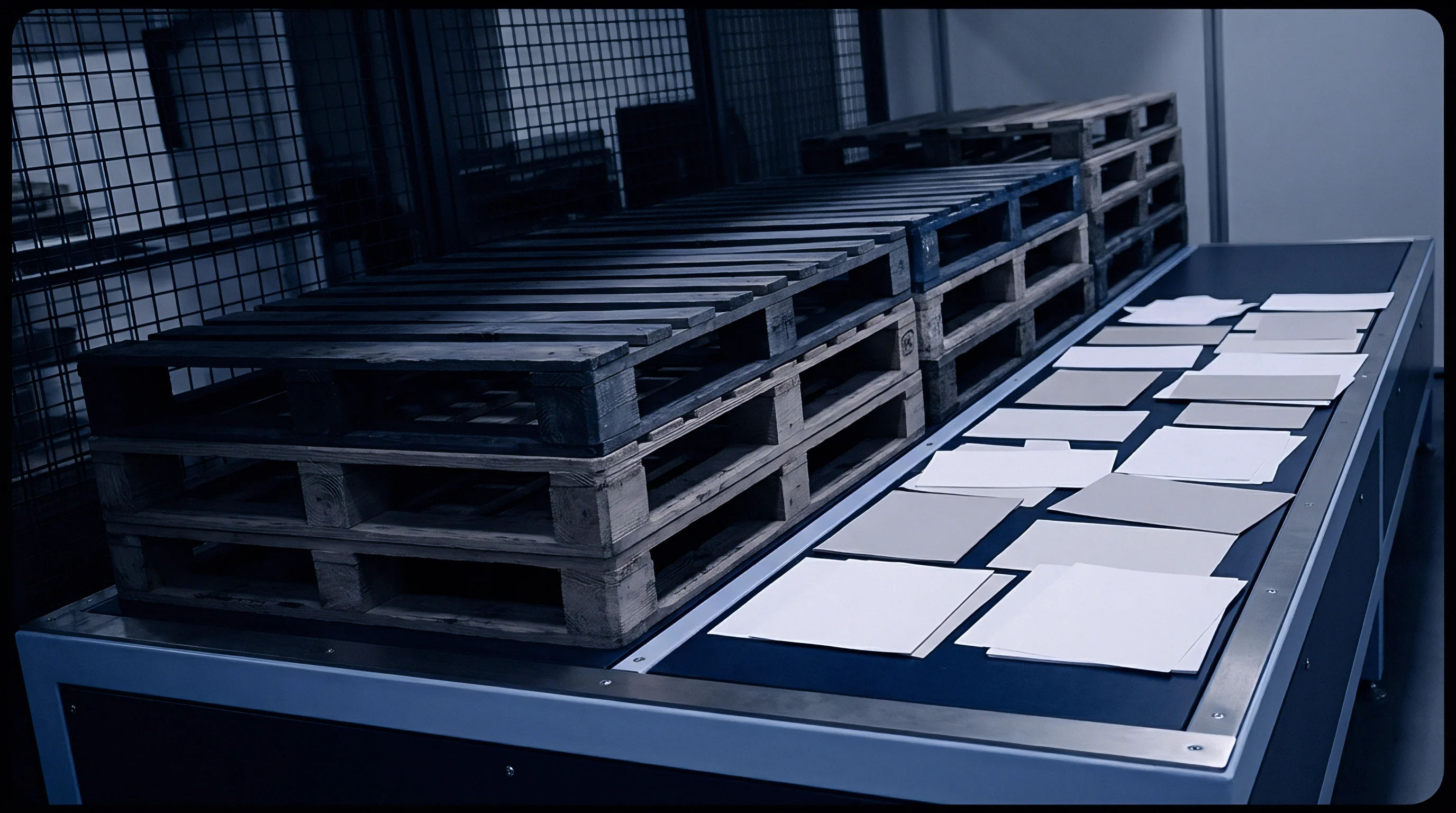
Ambient storage temperatures accelerate the migration of slip additives. Pallets stored in unconditioned warehouse environments at temperatures exceeding 30 degrees Celsius undergo rapid dyne loss within 72 hours of lamination. Humidity accelerates this decay by bonding water molecules to exposed hydroxyl groups, rendering them inactive for adhesion with the foil sizing.
Testing with dyne solutions according to ASTM D2578 reveals this degradation directly on the plant floor. A production lot showing 42 dynes per centimeter immediately post-lamination can decay to 36 dynes per centimeter after two weeks of storage. A drop of this magnitude invalidates the established press parameters, forcing the make-ready foreman to alter platen settings to recover transfer quality.
- Incoming dyne inspection validates that the surface energy exceeds 40 dynes per centimeter across the drive and operator edges of every pallet before staging at the press.
- Make-ready temperature stepping establishes the lowest viable die face temperature that achieves complete release without inducing thermal sheet curl.
- Dwell threshold determination calculates the minimum impression duration required to pass an immediate 90-degree peel tape adhesion test.
- Crease resistance verification checks that folded edges pass standard Sutherland rub tests without foil detachment along the bead.
Can Surface Energetics Compensate for Reduced Platen Dwell?
Elevating the surface energy beyond 46 dynes per centimeter allows noticeable reductions in dwell time. When films receive in-line corona treatment immediately before the stamping pass, the high density of freshly generated polar radicals promotes instantaneous chemical bonding with the molten sizing. This energetic state allows machine speeds to climb by 15 to 25 percent, compressing flatbed dwell toward 35 milliseconds without risking flaking.
Polyester carriers tolerate narrow elongation. Stamping foils subjected to prolonged dwell absorb excessive heat that softens the carrier film, causing it to stretch under mechanical web tension upon stripping. This stretching results in foil tearing, jagged edges, and foil flakes depositing inside the press mechanical guides.
Maintaining higher surface energy on the laminate avoids the necessity of prolonged heating cycles, keeping the polyester carrier cool and structurally rigid for clean high-speed stripping.
| Time Post-Lamination | Surface Energy (dynes/cm) | Required Dwell at 115°C (ms) | Tape Adhesion Retention (%) | Process Stability Rating |
|---|---|---|---|---|
| 1 Hour | 46 | 35 | 100 | Optimal |
| 24 Hours | 44 | 40 | 100 | Stable |
| 7 Days | 41 | 55 | 98 | Acceptable |
| 14 Days | 38 | 85 | 88 | Marginal |
| 30 Days | 35 | 130 | 62 | Failed |
When questioned about sudden foil pull-off defects on older inventory, converters frequently hear that the foil roll formulation must have experienced chemical variation at the manufacturing plant, obscuring the natural degradation of the laminate surface.

Outlay
Production economics in packaging conversion depend directly on net press output per shift. Dwell time optimization represents the single largest operational variable governing throughput on flatbed foil stamping machinery. Extending platen dwell from 45 milliseconds to 110 milliseconds to force adhesion on aged, low-dyne laminates reduces line speed from 4,800 sheets per hour to 2,900 sheets per hour.
This speed penalty cascades through the balance of the converting schedule, eroding machine contribution margins.
Speed dictates unit margin. Operating a large-format flatbed press at reduced velocity inflates overhead allocation costs per thousand sheets. If a press carries an hourly operational rate of 180 dollars, running at 2,900 sheets per hour generates an application cost of 62.07 dollars per thousand sheets.
Restoring the surface energy to allow a 45-millisecond dwell elevates production to 4,800 sheets per hour, dropping the cost to 37.50 dollars per thousand sheets. Across a 100,000-sheet folding carton order, this dwell difference represents an unrecoverable variance of 2,457 dollars.

Machine Velocity Tradeoffs and Running Scrap Rates
Running a foil press at the outer edge of its dwell envelope introduces catastrophic scrap risks. When operators push die temperatures to 140 degrees Celsius to compensate for short dwell durations on marginal films, sheet distortion causes registration drift between the printed image and the stamped foil. Across a 40-inch sheet layout carrying 48 cartons, thermal expansion of the board stock introduces register variations up to 0.6 millimeters between the front and tail rows.
Thermal drift ruins registration tolerances. Rejection rates for luxury cosmetic and pharmaceutical cartons typically cap allowable register error at 0.2 millimeters. Running hot to cheat dwell time pushes scrap rates from a baseline of 1.5 percent to well over 6 percent, destroying the profitability of the run through expensive board and foil waste.

Tooling Metallurgies and Setup Capital
Selecting die materials involves a calculated balance between initial capital outlay and press productivity. Brass dies cost approximately 40 percent more than chemically etched copper dies and three times more than etched magnesium plates. However, brass outlasts chemical copper dies and permits sharp thermal recovery, supporting machine speeds that magnesium cannot sustain on corona treated stocks.
- Magnesium tooling packages carry low initial engraving costs but demand 20 to 30 milliseconds of additional dwell time, restricting production speeds to protect die life.
- Precision CNC brass dies sustain crisp edges across millions of cycles and facilitate fast heat transfer, allowing maximum platen cycling speeds.
- Bimetallic combination dies execute stamping and structural embossing in a single dwell stroke, requiring precise force balancing to avoid puncturing the heated film layer.
- Rotary brass cylinders represent substantial upfront capital investments that become cost-effective only on continuous runs exceeding 200,000 impressions.
Rotary tooling carries higher investment. The amortized tooling cost on a dedicated rotary brass cylinder can add 15 dollars per thousand cartons on short runs, whereas on long runs it drops below 50 cents while delivering triple the output velocity of a flatbed press.

Unit Pack Economics across Extended Runs
A comprehensive commercial view models the total financial impact of dwell optimization by combining machine hourly costs, tooling depreciation, scrap rates, and post-converting customer claim exposure. Consider a packaging run of 50,000 cartons on 350 gsm folding boxboard laminated with 15-micron corona treated matte BOPP film. Sourcing film with guaranteed surface treatment stability of 42 dynes per centimeter carries a premium of roughly 8 percent over standard uncertified commodity film, translating to a material surcharge of 240 dollars for the run.
Failing to secure this surface energy forces the finisher to drop press speeds by 35 percent and increase make-ready spoilage by 800 sheets during initial parameter adjustment. The speed reduction adds 4.2 press hours, costing 756 dollars in operational machine time, while the additional scrap wastes 360 dollars in paperboard, film, and foil. The apparent material savings achieved by purchasing uncertified film generates a net manufacturing loss of 876 dollars on a single production job.
Standard quality agreements in commercial printing stipulate that cartons failing foil adhesion tests at incoming client inspection trigger immediate rejection of the entire delivery lot, exposing the converter to total replacement costs and expedited freight penalties.
The unresolved question remains whether in-line atmospheric plasma treating units mounted directly on flatbed foil stamping presses can permanently decouple dwell time optimization from upstream film storage decay across varied polymer substrates.