Mechanics of Dynamic Shear Modulus in High Speed UV Varnish Applicators
Dynamic shear modulus governs high-speed UV varnish transfer, where balancing loss and storage moduli prevents misting, cavity pinholes, and coat-weight drift.


Chamber
In high-speed ultraviolet coating applicators operating above 400 meters per minute, fluid delivery systems subject liquid varnishes to extreme kinematic shear rates exceeding 500,000 reciprocal seconds within micro-scale gaps. At these velocity gradients, the dynamic shear modulus governs fluid flow, mechanical energy dissipation, and coat-weight stability across the web. The dynamic shear modulus consists of two distinct scalar quantities: the storage modulus, which quantifies elastic energy stored during transient deformation, and the loss modulus, which measures energy dissipated as heat through viscous flow.
When an anilox roll or smooth applicator roll rotates against an enclosed doctor blade, fluid experiences rapid stress cycles that alter its molecular configuration within milliseconds.
Polymer chains and monomeric diluents in UV acrylates realign under intense deformation. If the loss modulus dominates completely across all shear regimes, the varnish flows readily into anilox cells but risks slinging, misting, and leaking past ceramic blade seals under excess hydraulic head. Conversely, a varnish exhibiting an elevated storage modulus at high deformation frequencies acts like a semi-solid rubbery membrane, resisting cellular filling and generating starvation bands along the coating nip.
Achieving consistent laydown requires balancing these viscoelastic components across the operational velocity profile of the press line.

Hydraulic Pressures in Fast Varnish Delivery
Positive fluid pressure within enclosed blade cavities prevents air entrainment during rapid roll revolution. As line speed increases from 200 to 600 meters per minute, fluid drag along the moving roll surface accelerates varnish inside the enclosed manifold, building hydrostatic pressure against the trailing blade edge. This induced hydrodynamic head exerts an upward lift force that alters blade deflection angles and alters doctoring efficiency.
Excessive internal fluid pressure forces liquid under the contact land of the metering blade, thickening the wet varnish film beyond specification. Insufficient pressure allows ambient air entrainment, causing micro-foaming within the fluid reservoir. Managing fluid dynamics inside the manifold involves setting precise supply pump flow rates and back-pressure relief valves to maintain equilibrium regardless of line acceleration.
- Fill the supply lines with tempered UV varnish until air bubbles purge through the top manifold return port.
- Adjust the positive displacement pump speed to establish a steady recirculating flow rate of four liters per minute across the blade contact zone.
- Set the pneumatically controlled back-pressure regulator to hold internal manifold pressure at 0.35 bar during low-speed idle.
- Accelerate the press to target line speed while monitoring manifold transducers to verify hydraulic stability within plus or minus 0.05 bar.

Shear Gradient Profiles across Metering Gaps
The space between a ceramic doctor blade tip and an anilox roll surface narrows to dimensions under thirty micrometers. Fluid passing through this restrictive channel experiences a steep linear velocity gradient bounded by the stationary steel blade wall and the rotating ceramic land. Velocity profile linearity breaks down as non-Newtonian varnish chemistries demonstrate shear thinning or transient shear thickening.
At a shear rate of 500,000 reciprocal seconds and 40 degrees Celsius, the loss modulus of a standard oligomeric acrylate varnish drops below 1,200 Pascals while the storage modulus stabilizes near 450 Pascals.
High shear forces align hyperbranched oligomers, reducing apparent viscosity by up to two orders of magnitude compared to zero-shear bench measurements. Fluid mechanics near the blade contact tip dictate how cleanly varnish wipes off the land area while remaining within engraved cell structures. When dynamic shear rates peak, fluid elasticity creates normal stress forces perpendicular to the shear direction, pushing back against the blade edge and inducing mechanical vibration known as blade chatter.
Coating suppliers frequently attribute blade weeping or laydown streaks to improper mechanical blade seating when non-linear fluid elasticity actually forces the blade edge open at high line speeds.

Viscoelasticity
Deformation responses in ultraviolet curing materials depend directly on the time scale of mechanical loading relative to the internal relaxation time of the polymer formulation. The Deborah number, defined as the ratio of polymer structural relaxation time to the characteristic flow duration within the applicator gap, determines whether a varnish behaves as a viscous liquid or an elastic solid. On high-speed converting equipment, the dwell time of fluid inside a doctor blade contact zone drops below ten microseconds.
Under these fast impulse conditions, long-chain acrylate oligomers lack sufficient time to untangle and deform purely through viscous flow, storing mechanical energy elastically instead.
The phase angle between applied stress and resulting strain shifts dynamically as shear frequencies increase. At low rotational speeds, the phase angle approaches ninety degrees, indicating predominant viscous liquid behavior. As operational speed accelerates into the megahertz equivalent frequency range, the phase angle narrows, signaling a shift toward elastic energy storage.
This elasticity prevents fluid from cleanly filling sub-micron surface topography on rough paperboard substrates, leaving micro-voids beneath the finished glossy surface.

Storage and Loss Behavior at High Frequencies
Dynamic mechanical testing across high strain rates reveals the molecular resistance of complex UV formulations. Oligomeric backbones based on aromatic epoxy acrylates present higher elastic storage response under high-frequency shearing than flexible aliphatic polyether acrylates. Reactive diluents, including hexanediol diacrylate and trimethylolpropane triacrylate, act as rheology modifiers that lower overall complex viscosity while shifting the elastic transition point to higher shear frequencies.
Excessive elasticity at high deformation rates causes coating misting at the exit of the applicator nip. When the fluid film splits, stored elastic energy snaps back like an stretched rubber band, shattering liquid filaments into tiny airborne droplets. Formulators adjust monomer ratios to maintain the loss factor, defined as loss modulus divided by storage modulus, well above 2.5 across the entire application shear spectrum.
| Formulation Chemistry | Storage Modulus G’ (Pa) | Loss Modulus G” (Pa) | Loss Factor tan(δ) | Apparent Viscosity (mPa·s) |
|---|---|---|---|---|
| Aromatic Epoxy Acrylate Base | 820 | 1,640 | 2.00 | 3.28 |
| Aliphatic Urethane Acrylate | 410 | 1,435 | 3.50 | 2.87 |
| Polyether Triacrylate Blend | 250 | 1,250 | 5.00 | 2.50 |
| Hyperbranched Polyester Acrylate | 180 | 1,080 | 6.00 | 2.16 |
Thixotropic Breakdown and Structural Recovery
Substrate contact requires rapid structural recovery after fluid exits the doctor blade and application roll gap. High shear forces in the metering chamber break down transient hydrogen bonds and physical entanglements within the fluid, lowering resistance to flow. Once the fluid transfers to the paperboard web, applied shear drops to zero, initiating a time-dependent thixotropic recovery process.
Leveling demands low viscosity immediately post-transfer to flatten roll marks and cell pattern structures. If viscosity rebounds too quickly due to rapid elastic memory, surface orange peel patterns freeze into place before the sheet reaches the curing station. If structural recovery occurs too slowly, varnish sinks into porous paper fibers, resulting in loss of surface gloss and poor barrier continuity.
Elevating the applicator roll surface speed beyond the fluid relaxation threshold forces the liquid film to fracture into airborne droplets before surface leveling completes.
High loss modulus formulations maintain liquid mobility long enough to yield self-leveling surfaces prior to ultraviolet lamp irradiation.


Cavitation
Fluid film splitting at the exit zone of co-rotating application rollers generates intense negative pressure fields within the diverging gap geometry. Liquid varnish bound between the two surfaces experiences rapidly increasing tensile stress as the roll surfaces separate. When local tensile stress exceeds the cohesive strength of the liquid or liquid-substrate interface, sub-atmospheric pressure zones initiate dissolved gas nucleated void formation.
Bubbles expand rapidly within these low-pressure pockets, growing until structural wall collapse splits the fluid filament. High dynamic shear modulus values exacerbate cavitation severity by increasing peak tensile stresses generated during film splitting. Stiffer fluids resist gentle necking down during filament extension, creating sharper pressure drops that trigger violent micro-cavitation events across the contact width.

Film Splitting and Atmospheric Drop Off
Splitting behavior dictates the volumetric ratio of varnish transferred to the substrate versus fluid retained on the applicator roll surface. Symmetrical film splitting leaves fifty percent of wet coating on each surface, but non-Newtonian fluid elasticity distorts this ratio. Stored elastic stress causes asymmetrical filament rupture, forming elongated fluid tails that snap back and create surface pinholes.
Sub-surface micro-cavitation voids that fail to burst before reaching the ultraviolet curing zone become permanently trapped inside the solid polymer layer. These embedded micro-spheres scatter incident light, reducing optical clarity and dulling printed color density on dark underlying inks. Fluid forces govern coat weight.
How Do Dynamic Shear Forces Trigger Misting?
Centrifugal acceleration on fast rotating application rollers drives fluid outward while tensile filament rupture generates small detached satellites. High line speeds increase shear. Stated simply, dynamic shear elasticity prevents filaments from drawing down smoothly into clean break points, building mechanical energy until filaments rupture explosively.
Airborne varnish aerosol drifts into press surroundings, fouling optical sensors, contaminating printing plates, and posing health hazards for line operators.
- Filament Stretching Extensional forces draw wet varnish into thin columns spanning the diverging roll nip gap.
- Elastic Snapback High storage modulus causes extended liquid columns to fracture abruptly rather than necking smoothly down to zero diameter.
- Aerosol Generation Fractured fluid columns snap into microscopic droplets that fly off roll surfaces under centrifugal force.
- Plate Contamination Airborne droplets settle on active printing plates, creating hardened cured hickeys under ultraviolet ambient bleed.
- Optical Scattering Suspended fine mist particles settle on cured varnish surfaces, creating diffuse reflection zones that degrade surface gloss.
Failure to match fluid loss modulus with roll application speed leads to severe aerosol generation that ruins press hygiene and invalidates surface defect guarantees.

Bench
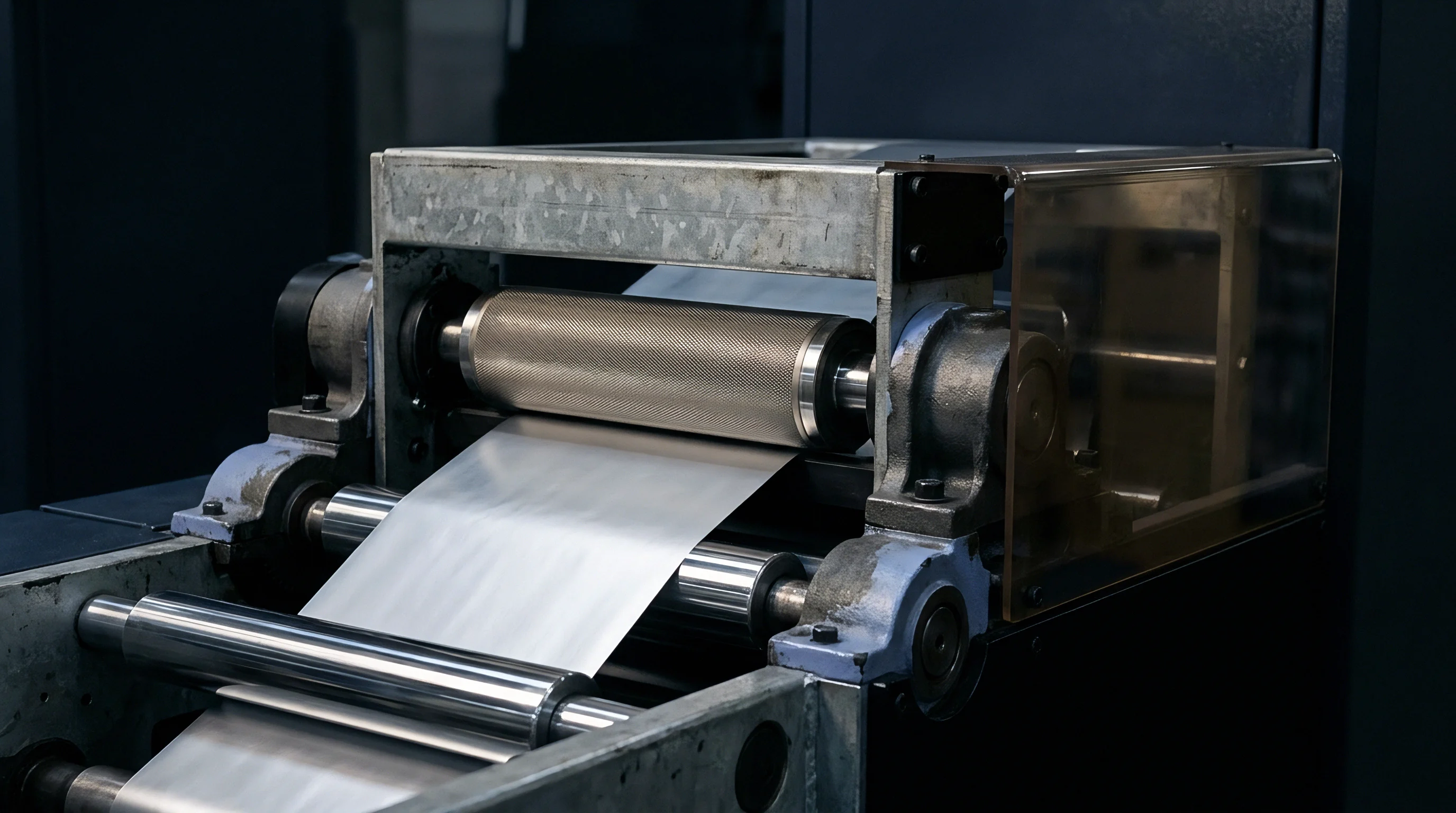
Laboratory evaluation of coating materials historically relied on low-shear rotational viscometers or outflow cups, but these static techniques fail to predict performance under high-speed industrial converting conditions. Measuring varnish rheology at low shear rates misses non-Newtonian structural changes, elastic energy storage, and shear-thinning transitions occurring inside high-speed applicator chambers. Modern rheometry utilizes dynamic mechanical analysis and oscillatory strain control to characterize viscoelastic parameters across broad frequency sweeps.
Superimposing controlled high-frequency oscillations onto continuous rotational shear enables simultaneous determination of storage modulus, loss modulus, and dynamic viscosity. Capillary rheometers force fluid through narrow orifice dies at controlled volumetric rates, reaching shear rates up to 10^6 reciprocal seconds. These continuous stress profiles yield precise rheological data matching actual press application mechanics.
High Frequency Oscillatory Shear Measurements
Oscillatory shear experiments apply sinusoidal strain deformations to varnish samples sandwiched between parallel plate geometries. Measuring the amplitude ratio and phase shift of the resulting stress wave isolates elastic components from viscous dissipation elements. Temperature controls must hold sample chambers within 0.1 degree Celsius, as viscous heating generated during high-shear testing quickly shifts fluid parameters.
Under ISO 3219 criteria, failing to maintain sample temperature within 0.1 degree Celsius during high-shear sweeps invalidates the reported loss factor by distorting viscous heating corrections.
High-frequency rotational rheometers utilize tiny gap settings down to twenty micrometers to avoid inertial artifacts during high-speed oscillation. Data collected across temperature sweeps generates master curves via the time-temperature superposition principle, allowing researchers to extrapolate mechanical responses at shear frequencies inaccessible to physical test instruments.
| Test Methodology | Applicable Standard | Maximum Shear Rate (s^-1) | Primary Measured Parameter |
|---|---|---|---|
| High-Frequency Oscillatory Rheometry | ISO 6721-10 | 100,000 | Storage and Loss Moduli (G’, G”) |
| High-Pressure Capillary Viscometry | ISO 3219-2 | 1,500,000 | High-Shear Viscosity Curve |
| Rotational Cone-Plate Rheometry | ASTM D4287 | 12,000 | High-Shear Rate Viscosity |
| Extensional Filament Rheometry | Internal Protocol | 50,000 (Extensional) | Apparent Extensional Viscosity |

Temperature Sweeps and Viscous Dissipation
Viscous dissipation converts mechanical energy into thermal energy within high-shear gap zones. As varnish passes through doctor blade contacts at high line speeds, fluid temperatures increase by five to fifteen degrees Celsius within fractions of a second. This rapid temperature rise dramatically reduces fluid loss modulus, altering film splitting dynamics and film thickness transfer.
Evaluating varnish formulations over controlled temperature sweeps reveals thermal sensitivity profiles. Formulations with steep temperature-viscosity curves suffer from coat weight drift during long production runs as press temperature stabilizes. Stable formulations utilize temperature-insensitive monomer combinations that preserve target loss factor ratios throughout shift temperature swings.
- Sweep Range Selection Establish test temperature profiles spanning ambient start temperatures up to maximum running press chamber temperatures.
- Strain Amplitude Verification Confirm oscillatory measurement strains stay within the linear viscoelastic region of the uncured resin.
- Gap Geometry Alignment Zero plate gaps accurately to eliminate thermal expansion measurement errors during elevated temperature cycles.
- Shear Rate Correlation Map laboratory frequency data directly to calculated press applicator gap shear rates using kinematic equivalency formulas.
Whether laboratory high-shear modulus measurements can fully replicate short-duration transient normal stress forces inside actual asymmetric roll gaps remains an open analytical question.


Allowance
Mismatches between varnish shear modulus parameters and press line application speeds incur heavy financial costs through elevated waste factors, excess energy consumption, and raw material over-application. Applying coating with incorrect viscoelastic balance forces press operators to increase dampening rates, adjust blade pressures, or reduce line operating speeds to prevent defect formation. Running a packaging press line at 350 meters per minute when target design speed is 500 meters per minute increases fixed hourly press operational cost burden per unit produced.
Coat weight control directly impacts monomer consumption balance sheet line items. Over-applying UV varnish by just 0.3 grams per square meter across a high-volume packaging print run consumes hundreds of extra resin kilograms daily without adding visual surface gloss or physical rub resistance. Polymer chains untangle instantly.
Conversely, under-application caused by high elastic snapback leaves pinholes that fail barrier resistance tests, rendering entire converted board lots unmarketable under regulatory packaging standards.

Coat Weight Variance and Energy Tariffs
Inadequate rheology control impacts curing energy requirements downstream in the press line. Thicker, irregular varnish deposits resulting from uneven elastic film splitting demand increased ultraviolet lamp output to achieve full monomer conversion through the entire wet film depth. Operating ultraviolet curing lamps at elevated power settings raises facility electrical demand charges and accelerates expensive medium-pressure mercury bulb degradation.
Viscous dissipation generates heat. Uncured monomer residues left in thick varnish pockets due to incomplete lamp penetration risk photoinitiator migration through paperboard substrates, invalidating food contact declarations under European Regulation 1935/2004. Coat weight uniformity maintained by proper shear modulus formulation keeps curing energy consumption predictable and compliant.
| Operational Variable | Matched Rheology Baseline | Uncontrolled Elasticity Shift | Net Commercial Variance |
|---|---|---|---|
| Average Line Speed | 500 m/min | 350 m/min | 30% reduction in press output |
| Applied Coat Weight | 3.2 g/m^2 | 3.8 g/m^2 | +60 kg UV varnish consumption |
| UV Lamp Power Setting | 120 W/cm | 160 W/cm | +33% electrical energy tariff |
| Make-Ready Waste Sheet Count | 450 sheets | 1,800 sheets | +1,350 spoiled substrate sheets |
Commercial Contract Terms for Coating Defect Waste
Supply agreements between packaging converters and consumer brand buyers specify strict visual surface defect allowances, gloss units, and rub resistance thresholds. Uncontrolled misting or cavitation pinholes violate these specification clauses, triggering quality rejection claims and commercial chargeback penalties against the converter.
Uncontrolled varnish misting deposits cured resin film onto press impression cylinders, forcing unscheduled stop cycles that consume billable press hours.
Standard purchase dockets incorporate quality acceptance thresholds stipulating that delivered converted folding cartons exhibiting gloss values lower than 85 units at a sixty-degree measurement angle, or demonstrating surface micro-pitting over more than 0.5 percent of total surface area, shall be subject to complete lot rejection at the supplier expense.