Selecting Metering Blades and Rolls for High Barrier Paper Packaging Operations
Select ceramic-tipped bent blades for rough paperboard or tri-helical anilox cylinders for smooth webs to apply pinhole-free barrier films without fiber damage.
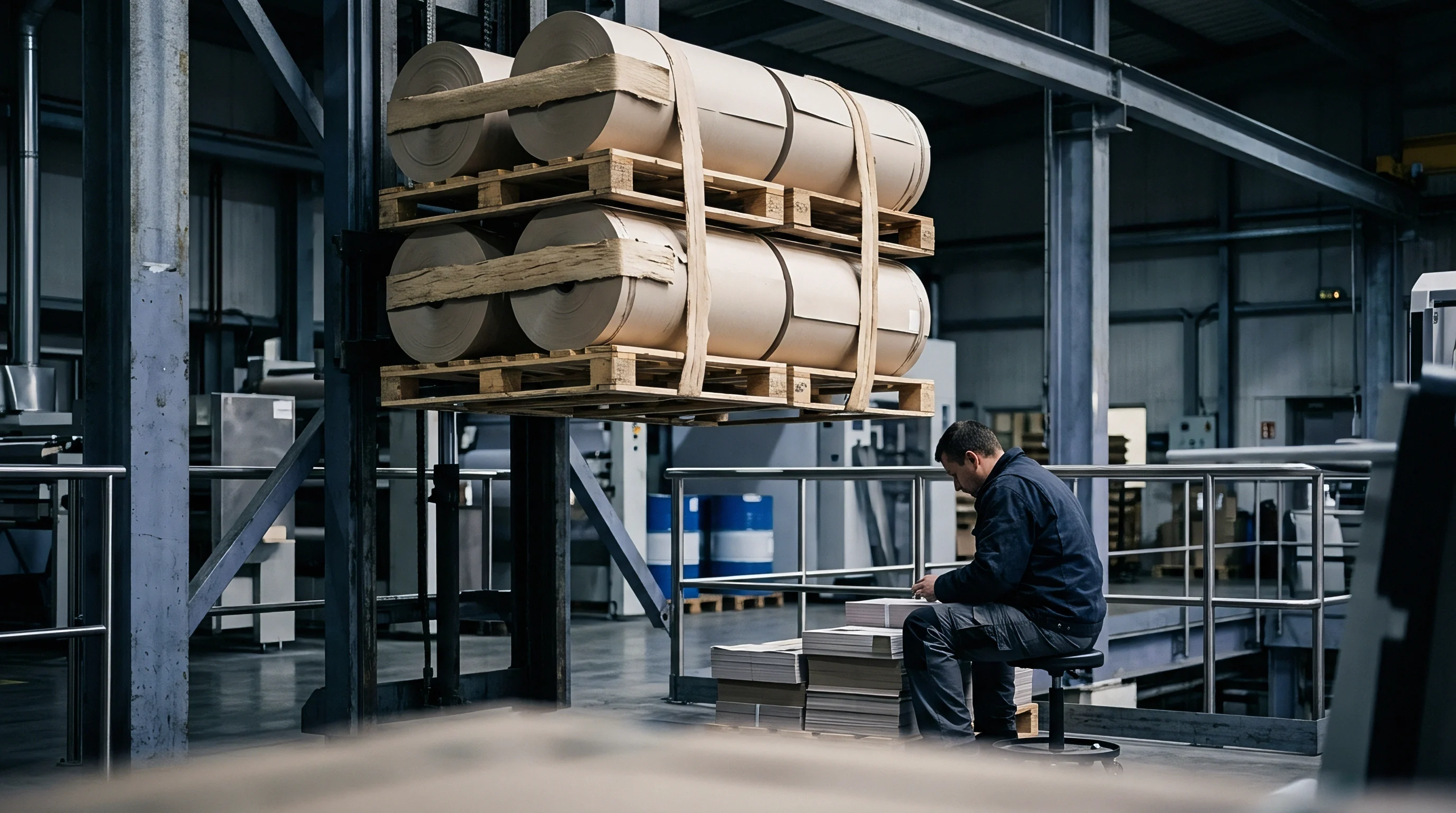
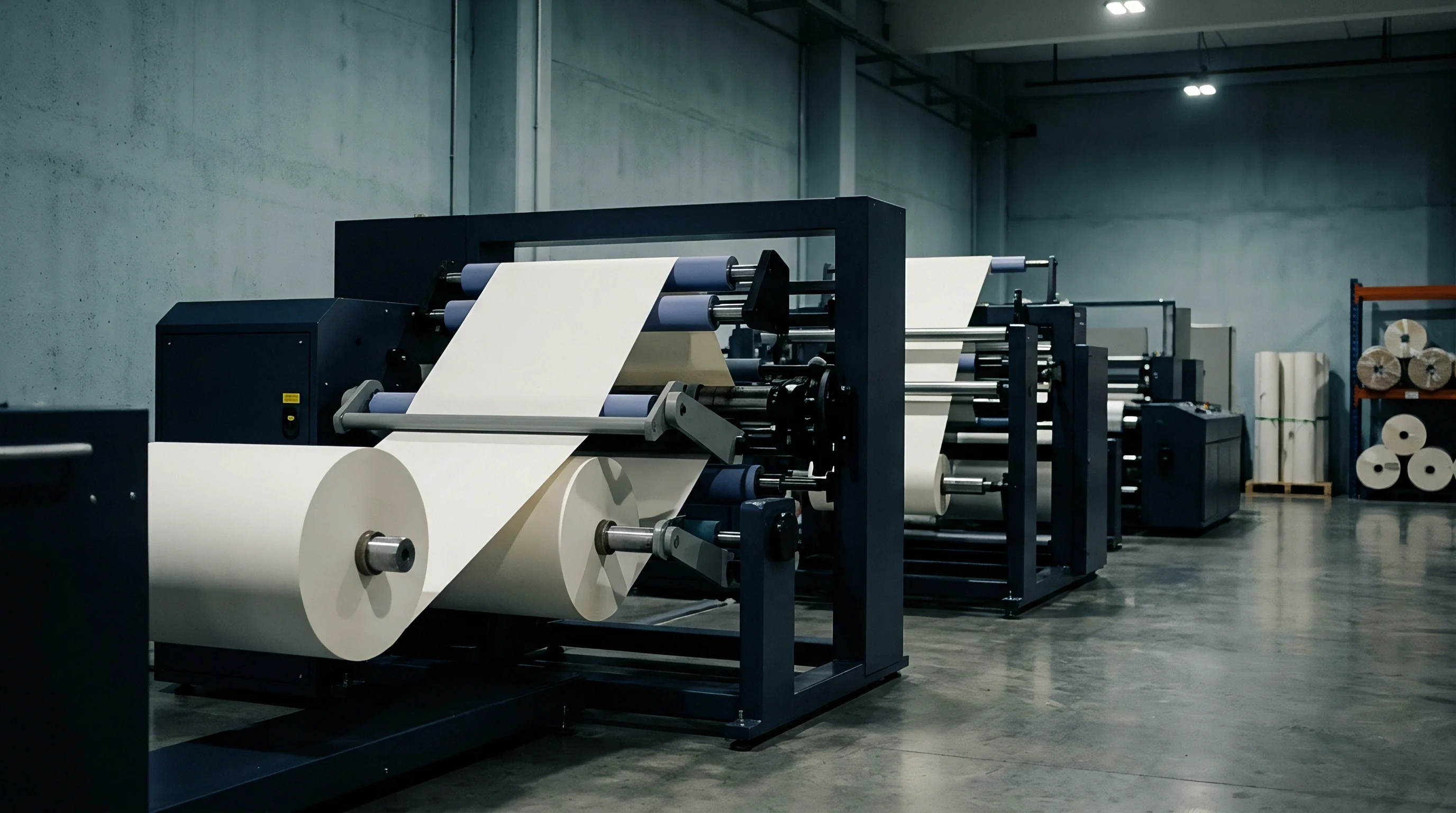
Edge
A barrier coating film fails at the pinhole before it fails anywhere else. When waterborne polymer dispersions like ethylene acrylic acid, polyvinyl alcohol, or waterborne acrylic copolymers hit a moving paper web at 400 meters per minute, the metering tip decides whether the applied dispersion forms a gas-tight matrix or a perforated layer. The blade does not merely level liquid.
The edge controls hydrodynamics, hydrodynamic lift, fiber deflection, and wet film thickness simultaneously.
Bent blade metering runs at shallow contact angles between 15 and 25 degrees. The blade flexes under pneumatic tube pressure, creating an extended hydrodynamic zone. This geometry handles low to medium viscosity formulations around 200 to 600 mPa·s.
It floats over high base sheet roughness, depositing a contour-following film. Contour films preserve base sheet structure. Base papers with high surface roughness (Parker Print-Surf values above 4.5 µm at 1000 kPa) bridge uneven fiber topography under a bent blade without scraping the peaks bare.
The coating weight stays elevated over the valleys. When running water vapor barrier coatings that demand pinhole-free coverage at low dry weights of 6 to 9 g/m², bent blades prevent fiber picking. Web breaks drop.
Stiff blade systems operate in stark contrast. Mounted at steep angles from 38 to 48 degrees, a stiff blade operates under mechanical tip pressure rather than hydrodynamic lift. The beveled tip shears away liquid surplus, packing the coating into the paper valleys to yield absolute surface smoothness.
Bevel angles range from 35 degrees up to 55 degrees to match web contact geometry. When base paper holds a Parker Print-Surf roughness below 2.0 µm, a stiff blade produces superior water vapor and oxygen barriers. The flat surface accepts secondary functional coats without pinholing.
Running stiff blades on rough or uncalendered kraft board causes immediate barrier failure. The blade tip snags high-standing hardwood fibers, tearing them out of the web matrix. The resulting micro-scratches destroy water vapor transmission resistance instantly.
Blade tip metallurgy dictates production life and barrier consistency across extended runs. Cold-rolled carbon steel blades wear within four to six hours when metering abrasive slurries. Even unpigmented polymer dispersions contain silica matting agents, titanium dioxide, or talc fillers that abrade raw steel edges rapidly.
Wear rounds the honed entry edge, altering the wet film split. Ceramic-tipped blades carry a thermal-sprayed aluminum oxide or zirconium oxide layer 150 to 300 µm thick along the working face. The ceramic compound resists abrasive erosion, maintaining exact bevel profile across forty to eighty running hours.
Tungsten carbide coatings applied via high-velocity oxygen fuel deposition deliver denser, crack-free matrices. They prevent microscopic edge chipping that produces linear streaks across barrier webs.
| Blade Configuration | Tip Angle (Degrees) | Typical Viscosity (mPa·s) | Wet Film Thickness (µm) | Fiber Disturbance Risk | Tool Life Range (Hours) |
|---|---|---|---|---|---|
| Beveled Carbon Steel | 45 | 400 ~ 1200 | 8 ~ 15 | High | 4 ~ 8 |
| Ceramic-Tipped Bevel | 45 | 400 ~ 1500 | 8 ~ 18 | Moderate | 40 ~ 70 |
| Tungsten Carbide Edge | 38 | 500 ~ 2000 | 10 ~ 22 | Low | 80 ~ 120 |
| Bent Spring Steel | 18 | 150 ~ 600 | 12 ~ 28 | Very Low | 12 ~ 24 |
| Polymer Composite Tip | 22 | 100 ~ 450 | 14 ~ 30 | Lowest | 16 ~ 30 |
Metered film uniformity requires precise mechanical deflection management across wide machine decks. Web centerlines naturally experience lower blade loading if backing rolls bow under beam pressure. Modern barrier coating lines employ segmented profiling clamps positioned on 50 to 75 mm centers.
Profiling screws or thermal expansion bolts adjust local blade deflection against the backing roll. A deflection change of two micrometers shifts local wet coat weight by up to 0.8 g/m². That shift alters Oxygen Transmission Rate (OTR) by an entire order of magnitude when running high-barrier coatings like polyvinylidene chloride or ethylene vinyl alcohol.
Machine operators monitor wet film thickness gauges downstream to apply micro-adjustments continuously.
Soft-tip polymer blades introduce an alternative mechanism for delicate webs. Constructed from high-density polyethylene or polyurethane compounds, these thick metering strips compress against the paper surface without abrading fibers. They operate at low running angles between 20 and 30 degrees.
Soft tips deform around projecting fibers rather than tearing them. The resulting barrier layer retains structural integrity over low-cost recycled fluting and porous cartonboard. Surface roughness limits soft-tip speed.
Frictional heat softens polyurethane tips when running beyond 350 meters per minute, inducing hydrodynamic waviness across the wet layer.
A blade angle shift of two degrees moves coat weight by half a gram.
Edge wear morphology reveals process stability. As a blade operates, the hydrodynamic pressure of the coating fluid generates a counter-force against the clamping mechanism. A bevel edge that exhibits rounded wear along its heel indicates insufficient clamping pressure or excessive running angle.
Heel wear leads to bleeding, where coating formulation builds up on the dry blade face before dropping onto the moving web. Parallel linear wear grooves signify foreign particulate matter trapped against the tip. Once a groove forms, coat weight spikes directly behind it, producing a thick streak that fails to dry completely under standard infrared drying lamps.
Scrap cartonboard accumulates downstream.
Every coater technician knows that a sharp edge cuts while a polished heel seals.
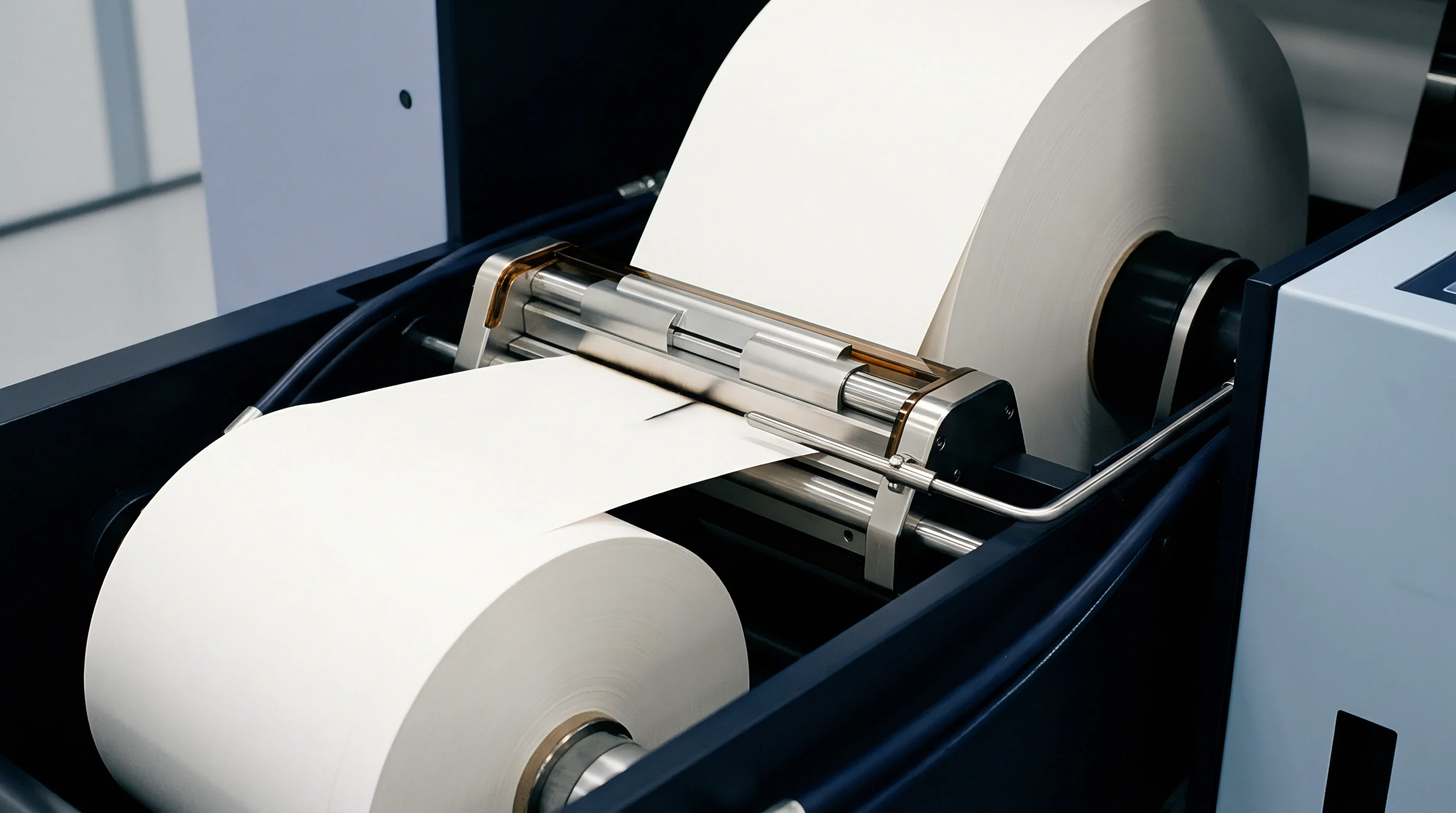
Cylinder
Roll-based metering replaces linear shearing with rotational fluid transfer. Instead of wiping an excess coating pool with a stationary edge, metering rolls transfer discrete liquid volumes from engraved microscopic cells or controlled roll nips directly onto the web. This separation of metering and application eliminates the scratch-inducing friction of blades.
It brings different fluid dynamics to light.
Does Cell Geometry Dictate Barrier Continuity?
Anilox rolls meter waterborne barrier emulsions through laser-engraved ceramic surfaces. The choice of engraving pattern decides whether droplets coalesce into an impermeable continuous barrier or dry as isolated islands. Hexagonal 60-degree cells represent the converting baseline.
Standard hexagons trap air at elevated line speeds. When high-solids barrier emulsions enter small hexagonal cells, surface tension and high viscosity prevent complete liquid discharge onto the paper web. The roll retains up to 55 percent of its internal cell volume.
Dried polymer then accumulates inside cell pockets, reducing coat weight drift over long runs.
Tri-helical and channel engravings resolve cell evacuation constraints. Continuous open grooves cut at angles between 30 and 45 degrees provide an uninterrupted channel for liquid displacement. Air escapes laterally as the paper meets the roll face.
Barrier dispersions evacuate readily from open channels, leaving 70 to 80 percent of the wet volume on the passing substrate. This transfer efficiency prevents micro-foaming. Tri-helical engravings allow coaters to apply heavy barrier layers up to 14 g/m² wet in a single pass.
Ribbed striations occasionally track into the wet film along the channel pitch. The wet formulation requires precise leveling kinetics to flatten those ridges before entering the drying tunnel.
Coating transfer from tri-helical channels exceeds seventy percent wet release at four hundred meters per minute.
Reverse gravure systems run the applicator cylinder against web travel direction. The counter-rotational shear smears the metered emulsion across fiber crowns, erasing cell pattern artifacts completely. Reverse gravure demands precise speed ratios between cylinder surface speed and web linear velocity.
Typical operational ratios sit between 1.1:1 and 1.4:1. Ratios exceeding 1.6:1 create meniscus instability at the nip exit. Instability promotes coating misting, producing fine airborne droplets that settle on dry rolls and generate blister defects across the barrier film.
Line speed suffers directly.
| Cell Structure | Screen Count (Lines/cm) | Theoretical Volume (cm³/m²) | Target Dry Weight (g/m²) | Primary Failure Risk |
|---|---|---|---|---|
| 60° Hexagonal Standard | 120 ~ 160 | 12 ~ 18 | 4.5 ~ 7.0 | Cell plugging and starved film split |
| Tri-Helical Open Channel | 60 ~ 100 | 20 ~ 35 | 8.0 ~ 15.0 | Longitudinal ribbing and ridging |
| Elongated 75° Hexagonal | 140 ~ 180 | 10 ~ 16 | 4.0 ~ 6.5 | Air entrapment at high machine velocity |
| Quadrangular Truncated | 80 ~ 120 | 16 ~ 24 | 6.5 ~ 10.0 | Meniscus spitting and poor cell release |
Smooth roll metering coaters operate without cell patterns. Two-roll and three-roll reverse roll coater configurations meter wet film through micron-scale mechanical gaps between precision-ground chilled cast iron or chrome-plated steel rolls. Total indicated runout across the roll face must not exceed 1.5 µm.
A gap deviation of three micrometers alters the metered fluid layer by fifteen percent. The metering roll rotates backward against the application roll, shearing the fluid film to exact caliper before transfer to paper. Smooth roll metering runs high-viscosity barrier pastes ranging from 1,000 to 4,000 mPa·s without generating shear-induced streaks.
The capital investment for rigid, vibration-isolated smooth roll coating heads remains triple that of blade assemblies.
- Tri-helical cell geometries discharge viscous barrier polymers cleanly without trapping boundary layer air at industrial web velocities.
- Direct gravure application leaves cell shadow patterns on porous base sheets, demanding low surface tension surfactants for proper wet leveling.
- Reverse roll coaters apply thick pinhole-free films without fiber disturbance, requiring mechanical runout precision below two micrometers across the deck.
- Chambered doctor blade systems maintain fluid containment around engraved rolls, preventing solvent or water evaporation that forms skinning particles.
Applicator roll coverings interact chemically with waterborne dispersions. Rubber rolls coated with ethylene propylene diene monomer (EPDM) or polyurethane must withstand continuous water immersion and alkaline pH environments. Dispersions formulated with ammonia or morpholine swell soft elastomer coverings.
Swelling alters nip footprint width, elevating applied pressure and crushing paper calipers. Polyurethane coverings with a Shore A hardness of 70 to 80 deliver stable nip mechanics. Roll deflection crowns must be ground into the elastomer profile to compensate for roll bending under load.
Without accurate crowning, coat weight skews heavy along web edges, producing uneven drying and barrier failures on the slitter.
The roll vendor routinely insists that residual cell plugging stems entirely from the mill’s washdown hygiene rather than incorrect cell geometry.
Rheology
Viscoelastic fluids behave deceptively under high-speed metering edges. High barrier aqueous dispersions contain polymer chains, mineral plate particles, and synthetic surfactants suspended in water. Under quiescent storage in a day tank, the dispersion displays modest viscosity.
Entering the metering zone beneath a blade or between narrow roll gaps, the local shear rate surges past 1,000,000 reciprocal seconds. Fluid viscosity under that localized shear force governs wet film distribution across the web.
Polymer barrier formulations exhibit shear-thinning behavior across wide processing bands. As shear rates mount, entangled polymer chains unravel, orienting parallel to the web flow. Apparent viscosity drops by up to eighty percent.
This thinning allows the formulation to meter cleanly through micro-scale openings without demanding massive mechanical clamping loads. If shear thinning is excessive, the fluid loses all internal resistance. It penetrates deep into base sheet capillaries before drying, starving the paper surface.
Starved surfaces leave bare fiber tips exposed. The pack fails moisture vapor transmission tests under tropical conditions (38 degrees Celsius, 90 percent relative humidity).
Extensional viscosity introduces opposing complications during roll-based metering. When liquid exits the nip between an applicator roll and the paper web, the fluid film splits. Fluid filaments stretch rapidly between the diverging surfaces.
Formulations containing high molecular weight binders resist extensional stretching. Instead of breaking cleanly, stretching filaments pull into long liquid threads. These threads snap, producing airborne mist or snapping back against the wet paper to form orange-peel cratering.
Extensional thickening ruins surface smoothness. Controlling extensional behavior requires careful selection of associative thickeners, favoring hydrophobically modified ethoxylated urethanes over high molecular weight carboxymethyl cellulose.
- Verify raw paperboard sizing degree using an automated Cobb60 water absorption test to establish fluid penetration resistance.
- Measure formulation viscosity on a rotational viscometer at 100 rpm and record wet solids content using a precision moisture balance.
- Pump dispersion through a 100-mesh basket filter into the coater coating head pan, eliminating premature shear-induced agglomerates.
- Set the metering blade angle or roll nip clearance to target wet film caliper, locking mechanical clamps firmly.
- Accelerate the converting line gradually to production speed while tracking web surface temperature through the infrared drying banks.
- Take a full-width paper sample from the reel, apply a pinhole dye test solution, and inspect barrier continuity across five square meters.
Water retention dynamics dictate boundary layer rheology. When aqueous barrier coating contacts dry paper, base fibers draw water immediately out of the fluid via capillary suction. This loss of liquid phase concentrates the dispersion directly at the paper-liquid boundary.
The localized solids content jumps from 48 percent to over 60 percent within milliseconds. If water retention values are inadequate, this desiccation forms an immobilized filter cake beneath the metering blade. The blade catches on the immobilized paste, generating chatter marks across the web.
Cellulose ethers and synthetic rheology modifiers slow down water dewatering into the sheet, preserving fluid mobility through the metering zone.
Dewatering rates into porous paper determine whether the barrier polymer stays fluid enough to level across fiber crowns.
Temperature swings across a single converting shift shift viscosity targets unpredictably. Viscosity drops approximately two to three percent per degree Celsius rise in fluid temperature. Friction generated inside supply pumps, shear energy under the metering blade, and radiant heat from drying ovens raise coating pan temperatures from 20 degrees Celsius at shift startup to 36 degrees Celsius by midday.
Wet coat weight drops steadily as viscosity falls, thinning the barrier layer below acceptable protection levels. Jacketed fluid tanks and heat exchangers maintain coating slurry temperature within a tight window of plus or minus one degree Celsius.
The exact interplay between extensional filament breakup and surfactant stabilization kinetics under ultra-high shear rates remains difficult to quantify without specialized optical shear cells.
Defect
Barrier coatings tolerate zero physical discontinuities. In decorative printing, a micro-void of ten micrometers passes unnoticed by human vision. In high barrier paper packaging for dried foods, pharmaceuticals, or electronic components, a single ten-micrometer pinhole permits water vapor and oxygen ingress that degrades packaged goods within weeks.
Quality control shifts from aesthetic perception to absolute structural continuity.
Blade scratches form the most common defect pattern on blade-metered lines. When agglomerated pigment, insolubilized polymer, or detached paper fibers wedge between the stationary blade tip and the moving web, the foreign particle blocks liquid deposition. A distinct continuous streak runs down the roll length.
The streak represents a zone of low coat weight or bare paperboard. Pinholes emerge along streak margins as surrounding fluid fails to bridge the gap. Inspecting incoming coating slurries through pressurized vibrating filter screens with 75-micrometer openings eliminates particulate seeds.
Maintaining proper blade wash cycles prevents edge drying during line stops.
Orange peel defects appear during roll coating when wet films split unevenly at the roll-web exit nip. Surface tension pulls torn fluid filaments into microscopic domes rather than allowing them to settle flat. The resulting wavy topography exhibits thin valleys and thick ridges.
Valley bottoms offer poor barrier performance. Adding fluorosurfactants or silicon-free leveling agents lowers equilibrium surface tension, speeding leveling kinetics before hot air dryers lock the wet film structure. The drying balance must not flash water too quickly.
Overly aggressive infrared drying boils the coating skin, creating micro-bubbles that burst into crater defects.
- Blade bleeding agglomerates fall from the dry blade face onto the moving sheet, crushing into the web and tearing holes at winding nips.
- Substrate micro-pinholes emerge when air trapped inside paper pores expands outward through wet coating layers under hot air dryer impingement.
- Ribbing striations persist when open-channel anilox rolls transfer heavy polymer films without sufficient leveling dwell time before heat exposure.
- Crater formations develop from silicone grease contamination in the slurry, which depresses local surface tension and forces liquid away from droplet centers.
Substrate-induced defects frequently masquerade as coater metering failures. Highly porous base sheets contain large interstitial air voids between unrefined wood pulp fibers. When aqueous dispersion coats the dry sheet, liquid enters pores, forcing displaced air outward.
This expanding air bubbles through the metered wet film. If the wet film dries to a skin before air bubbles escape and heal, hollow blisters form. These blisters crack under slitting tension, leaving microscopic pinholes that destroy gas barrier properties.
Pre-coating the base paper with a high-holdout starch or polyvinyl alcohol sizing layer seals porous channels before barrier pass application.
Mechanical vibration in the coater head translates directly into barrier variations. Worn drive gears, unbalanced applicator rolls, or loose blade clamp assemblies introduce harmonic oscillation. Chatter marks appear as periodic cross-directional bars of varying coat weight across the web.
The valleys of chatter bars lack sufficient dry polymer mass to sustain Oxygen Transmission Rate requirements. Resolving chatter demands dynamic vibration analysis of the coating station, rigid foundation anchoring, and continuous monitoring of roll bearing tolerances.
Packaging operations that ignore sub-surface micro-pinholes face total lot rejections when barrier testing confirms shelf-life failure at the filling plant.
Docket
Every finish pass specified on a packaging job docket carries measurable waste, tooling wear, and machine time expenses. Selecting between blade and roll metering platforms alters the unit economics of high barrier paper packaging. High barrier properties require minimum dry coat weights, typically 8 to 12 g/m² for water vapor barrier coatings targeting under 5 g/m²·day at 38 degrees Celsius and 90 percent relative humidity.
Achieving this barrier level in a single application pass reduces machine passes, scrap, and landed pack costs.
Blade coaters achieve heavy coating weights at the expense of blade life and make-ready scrap. Carbon steel blades cost little initially, but frequent blade swaps discard valuable barrier coating during line stops. Bringing an off-line coater back up to speed consumes 300 to 600 meters of web before coat weight stabilizes across the sheet.
When running high-cost barrier dispersions priced between 3.50 and 8.00 dollars per dry kilogram, startup waste erodes job profitability. Ceramic-tipped and carbide blades cost five to eight times more than carbon steel, but they run continuously across full shift rotations without profile drift. The tooling investment pays for itself within three production shifts by eliminating make-ready scrap cycles.
| Metering Hardware | Tooling Cost ($) | Tooling Changes | Make-Ready Waste (m) | Coating Waste ($) | Barrier Rejection Risk |
|---|---|---|---|---|---|
| Beveled Carbon Steel Blade | 120 | 4 | 1800 | 1450 | Elevated (12 ~ 18%) |
| Ceramic-Tipped Metering Blade | 580 | 0 | 450 | 360 | Low (2 ~ 4%) |
| Carbide Profiled Blade | 850 | 0 | 350 | 280 | Very Low (<2%) |
| Hexagonal Anilox Cylinder | 4200 | 0 | 200 | 160 | Moderate (5 ~ 8%) |
| Tri-Helical Anilox Cylinder | 4800 | 0 | 250 | 200 | Low (2 ~ 3%) |
Engraved cylinder systems require high upfront capital expenditures for engraved anilox rolls, ranging from 3,500 to 6,000 dollars per roll depending on face length and diameter. However, anilox rolls meter precise liquid volumes without operator intervention. Make-ready scrap drops below 250 meters.
Roll systems maintain fixed volumetric application regardless of machine speed, simplifying operator control during ramp-up. Anilox roll maintenance demands ultrasonic or chemical cleaning tanks to strip dried polymer residues between production jobs. Failure to maintain clean cell cavities degrades applied dry coat weight over time, triggering barrier non-compliance without visible warning signs on the production line.
Consider a practical conversion example. A brand specifications docket calls for 500,000 square meters of high-barrier folding boxboard with a target Water Vapor Transmission Rate below 3.0 g/m²·day. The formulation is a 50 percent solids waterborne acrylic-wax emulsion applied at 10 g/m² dry weight.
The paperboard base sheet is 250 g/m² folding boxboard with a Parker Print-Surf roughness of 2.8 µm. Running carbon steel blades requires six blade changes across the run, creating roughly 3,000 meters of startup waste board and wasting 150 kilograms of dry barrier chemistry. The scrap cost approaches 2,200 dollars in lost board and wasted coating alone.
Running a single ceramic-tipped blade allows an uninterrupted run, holding coat weight within plus or minus 0.4 g/m² across the entire 500,000 square meters. Waste falls below 500 meters.
Recyclability and repulpability criteria complicate the barrier equation. Under European harmonized standards (such as CEPI recyclability test guidelines) and PTS test method RH:021/97, aqueous dispersion coatings must disperse cleanly during hydrapulping without generating sticky deposits or unpulped flakes. High coat weights of synthetic polymers threaten repulpability scores.
Applying 12 g/m² of non-dispersible polymer creates fiber yield losses exceeding twenty percent during screening. Utilizing micro-grooved metering rods or tri-helical cylinders to apply highly uniform, thinner films down to 7 g/m² dry weight preserves repulpability certification. Reduced polymer consumption also mitigates Extended Producer Responsibility fees levied on plastic-coated paper packaging.
Contract specifications penalize moisture transmission failures by demanding full replacement of contaminated packaged contents.
Supply agreements for high-barrier packaging must establish unambiguous technical verification protocols. A standard contract clause should define the exact test method (such as ISO 15106-2 for water vapor transmission or ISO 15105-2 for oxygen permeability), sample conditioning parameters (23 degrees Celsius and 50 percent relative humidity for temperate climates, 38 degrees Celsius and 90 percent relative humidity for tropical validation), and sampling frequency across master reels. When buyers specify barrier thresholds without defining the metering method and base paper holdout, mills optimize for raw production speed rather than layer continuity.
The finished carton splits at the scoreline, and packaging barrier performance collapses.
Section 8.4 of the standard converter supply terms specifies that barrier integrity claims remain contingent upon testing performed within seventy-two hours of converting, shifting liability for post-cure delamination entirely to the brand owner.