Stretching Resistance
Fluid behavior during non-shear deformation governs how polymers behave when passing through small nozzles or during the rapid film blowing process. Extensional viscosity describes the resistance a material offers to elongation rather than simple sliding flow, defining the limit for drawing stable filaments. High values ensure that polymer chains sustain tension without breaking or necking during manufacturing stages.
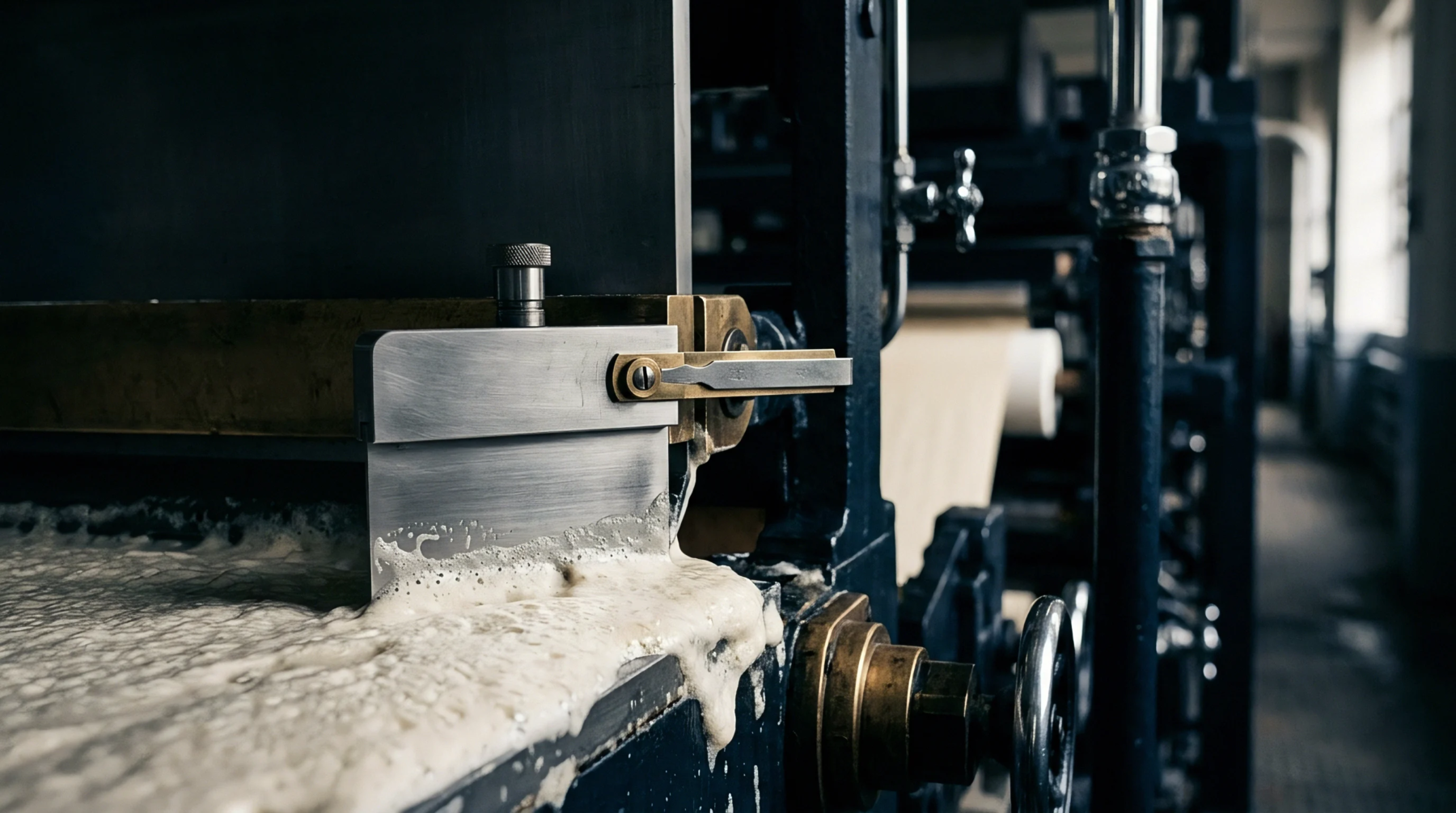
Because paper coatings rely on precise transfer through high-speed blade or curtain coaters, this property dictates the maximum machine speed before the liquid bead loses integrity.
Elongational Character
Flow patterns inside a coating head create strong pulling forces that align molecules in the direction of web movement. Extensional viscosity responds to these forces by hardening the liquid, preventing droplets or filaments from splashing onto the substrate. Mills measure this through capillary breakup or counter-rotating rheometry to ensure the blend handles mechanical stress without thinning out.
If the material offers too little resistance, the coating film tears or develops voids under the tension of the moving paper surface. Converting lines demand a stable window where the fluid stays uniform even when the application speed climbs. Changes in the chemical structure or molecular weight distribution alter the way the liquid resists these pulling forces.
Additives modify these internal networks to shift the breaking point, allowing engineers to maintain uniform thickness across wide rolls. Stronger links within the polymer matrix create higher resistance, which supports faster production rates on standard equipment. Precise control of this rheological trait prevents uneven spots on finished rolls.
Operational Bound
Coating defects arise when the drawdown forces exceed the internal strength of the fluid. Extensional viscosity serves as the threshold for maintaining a continuous layer on a carrier sheet. Any misalignment between the fluid response and the application speed produces streaking or poor film formation on the finished stock.
Proper adjustment of the formulation ensures that the material survives the transition from the metering device to the fiber surface. Reliable paper products depend on this consistency during the liquid application phase.