Flexographic Barrier Coating Viscosity Measurements for Aqueous Latex Formulations
Aqueous latex barrier performance depends on controlling dynamic high-shear viscosity to ensure complete anilox cell release and eliminate film pinholing.
Flow
Aqueous latex barrier coatings undergo extreme shear transitions during flexographic application. Storage tanks and pump supply lines sit at low shear, between 1 reciprocal second and 10 reciprocal seconds. By contrast, the enclosed doctor blade chamber and the metering nip between the anilox roll and printing plate push shear up to 100,000 reciprocal seconds.
Fluid behavior across this four-order-of-magnitude gradient dictates laydown uniformity, determining whether the barrier polymer forms a continuous, pinhole-free film over paperboard fibers or leaves voids that ruin water vapor transmission resistance.
Acrylic, styrene-butadiene, and vinyl acetate ethylene latex dispersions all shear-thin under stress, with particle volume fraction, surfactant packaging, and synthetic thickeners controlling how fast the internal structure breaks down. At rest, polymer spheres and associative thickener networks form a resting matrix that resists movement. Mechanical forces from pump impellers and doctor blades disrupt these associative bonds, dropping effective viscosity during transfer.
Hydrophobic alkali-swellable emulsions and non-ionic synthetic associative thickeners build high-shear viscosity without driving low-shear viscosity so high that tank agitation stalls.
Viscoelastic recovery immediately following blade metering governs film leveling on board stock. As latex exits the anilox cell and hits the paperboard, shear drops to zero within milliseconds. Viscosity must recover fast enough to prevent sag or capillary strike-through, yet slowly enough for discrete dots or stripes to coalesce into a seamless layer.
If elasticity rebounds too quickly, fluid motion stops prematurely, leaving surface ridges, orange peel, and micro-voids. If recovery lags, the wet coating drains into substrate pores, thinning the effective barrier over the cellulose matrix.
Dilatant latex formulations under flexographic blade shear freeze inside the cell micro-geometry and starve the wet film laydown.
Achieving solid fiber coverage requires strict flow control. Surface tension gaps between the wet latex and paperboard complicate film consolidation at press speed. Most aqueous barrier formulations target 28 mN/m to 38 mN/m using silicone or fluorinated surfactants.
When liquid surface tension exceeds the substrate’s critical surface energy, dewetting produces craters and fish-eyes during leveling. Measuring dynamic surface tension at bubble lifetimes under 50 milliseconds correlates directly with doctor blade performance at high speeds, whereas static du Noüy ring values miss the rapid surface tension dynamics occurring above 300 meters per minute.
Shear Rate Regimes in Flexographic Metering
Coating delivery loops create starkly different hydrodynamic conditions from point to point. In the supply tank, gentle stirring keeps particles suspended at shear rates between 5 s⁻¹ and 20 s⁻¹. Delivery hoses and inlet manifolds raise shear to between 100 s⁻¹ and 1,000 s⁻¹.
Enclosed doctor blade chambers generate variable shear fields as fluid recirculates against the spinning anilox roll. Peak shear occurs right at the metering blade tip, calculated by dividing web velocity by tip clearance: a press running at 400 meters per minute with a 10-micrometer blade boundary zone subjects the coating to 666,666 s⁻¹.
Evaluating full rheological profiles across this spectrum catches formulation defects before coatings hit the pressroom. Low-shear viscosity indicates whether latex will settle or cream during transit and storage. Medium-shear viscosity, from 100 s⁻¹ to 1,000 s⁻¹, dictates pumping efficiency and chamber filling without entraining air.
High-shear viscosity at 100,000 s⁻¹ determines hydrodynamic pressure under the blade, setting the final wet film thickness on the anilox. Relying on a single mid-range shear measurement hides high-shear behavior, leading to unexpected coat weight swings on high-speed lines.
Pseudoplastic Breakdown and Thixotropic Recovery Mechanics
Associative thickeners shape flow by forming reversible networks between hydrophobic latex particle surfaces and water-phase polymer backbones. Hydrophobically modified ethoxylated urethane additives build high-shear viscosity while maintaining modest low-shear yield stress, aiding transfer through anilox cells. Hydrophobically modified alkali-soluble emulsion additives deliver higher yield stress and stronger pseudoplasticity, preventing sag on non-absorbent board.
Under high shear, anisotropic polymer chains and latex clusters align with flow streamlines, cutting inter-particle friction and lowering dynamic viscosity during metering.
The duration of thixotropic breakdown dictates film leveling after release from the anilox. Network reconstruction takes time while Brownian motion reorients polymer chains and reforms hydrophobic crosslinks. Controlled-stress rheometer hysteresis loops map this structural recovery energy.
A wide loop between ascending and descending shear sweeps signifies slow recovery ~ beneficial for leveling on smooth stock, but prone to strike-through on porous uncoated recycled linerboard. Narrow loops indicate rapid recovery, preserving sharp print edges and limiting penetration.
Poor control over high-shear viscosity leads directly to pinholes in the barrier layer, raising water vapor transmission and triggering costly board rejections during quality audits.

Meter
Quality control labs often rely on efflux cups to assess flow through a calibrated orifice. ASTM D1200 Zahn cups, ISO 2431 flow cups, and DIN 53211 containers measure the time a fixed volume takes to drain under gravity. However, cup timing misses high-shear behavior entirely.
Gravity exerts low, uncontrolled shear ~ roughly 10 s⁻¹ when full, decaying toward zero as liquid exits. These single-point kinematic values reveal virtually nothing about the shear-thinning or thixotropic nature of aqueous latex coatings.
Rotational viscometers apply controlled mechanical shear to establish dynamic viscosity profiles. Brookfield units operating under ISO 2555 use defined spindle geometries and speeds to output apparent viscosity in millipascal-seconds. Standard disc spindles, however, generate non-uniform shear across the sample cup, preventing precise shear rate calculations.
Coaxial cylinder viscometers conforming to ISO 3219 address this with a narrow, defined gap between cylinder and cup. That uniform gap maintains consistent shear throughout the fluid, allowing reliable viscosity curves across fixed rotational speeds.
Cone-and-plate rheometers provide the precise shear control required for high-shear testing, utilizing a low-angle cone against a flat plate to maintain uniform shear across the gap. Capillary rheometers force fluid through precision bores under hydraulic pressure, reaching shear rates that mirror actual doctor blades. High-shear characterization of flexographic barrier formulations relies on capillary rheometry.
Comparing cup times with high-shear capillary sweeps highlights the gap: two latex coatings showing identical Zahn 4 cup readings of 25 seconds can differ in dynamic viscosity by over 300 percent at shear rates above 50,000 s⁻¹.
ASTM D1200 efflux cup timing outside the twenty to eighty second window voids the coating compliance certificate on export packaging stock.
Temperature fluctuations alter latex rheology significantly. Viscosity drops as temperature rises because added thermal energy increases particle mobility. If lab ambient conditions drift, readings shift accordingly, distorting pass/fail decisions.
A change of just 3 °C moves apparent viscosity by 8 to 14 percent, depending on solids content and surfactant package. Standardized testing requires strict thermal control at 23.0 °C ± 0.5 °C using water-jacketed cups or Peltier plates, preventing unneeded formulation adjustments on the press floor.
Efflux Orifice Limitations with Non-Newtonian Latex
Efflux cups are suited primarily for Newtonian fluids like solvent gravure inks and clear varnishes, where viscosity remains constant across shear rates. Aqueous latex dispersions, containing suspended polymer spheres and soluble rheology modifiers, do not behave this way. The cup orifice introduces extensional shear at the inlet, stretching and aligning polymer chains in a manner bearing little relation to the shear environment of an enclosed blade chamber.
Timing errors worsen when latex exhibits internal structure or yield stress. Toward the end of the drain, gravity fails to overcome fluid yield stress, causing the stream to break into uneven droplets before emptying. Manual timing adds further variance, introducing up to 4 seconds of discrepancy between operators testing the same batch.
Efflux cups also miss dilatant thickening behavior that triggers severe blade chatter, rendering them unsuitable for raw material inspection on high-speed barrier lines.
Rotational Viscometry and Spindle Shear Calibration
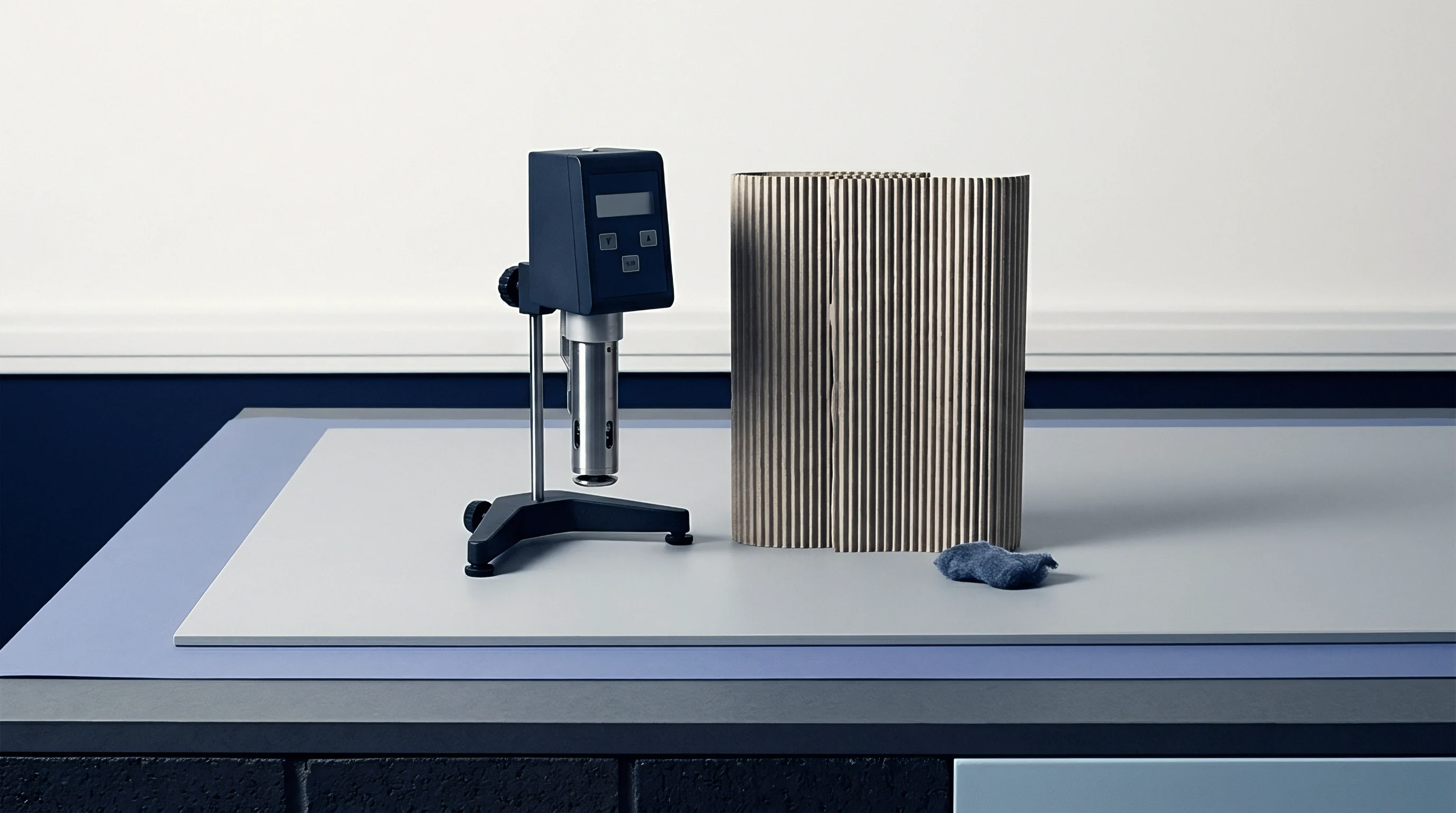
Rotational viscometers isolate yield stress and shear-thinning response across low to medium shear ranges. Brookfield RVT and HA models equipped with cylindrical spindles (such as spindle 1 and spindle 2) produce repeatable results provided torque stays between 20 and 90 percent of full scale. Readings below 10 percent suffer from spring deflection errors, while values above 90 percent risk mechanical overload and invalid calculations.
Converting rpm to shear rate in reciprocal seconds requires geometric conversion factors tied to spindle diameter and container dimensions.
Calibrating viscometers requires certified silicone fluids verified across operating temperatures. Hydrocarbon oils degrade latex surfactant packages, causing immediate coagulation during cleanup. Newtonian silicone standards certified under ISO/IEC 17025 verify torque spring accuracy and spindle alignment.
Weekly performance checks using two standards bracketing production target values maintain measurement integrity over extended campaigns.
| Measurement Method | Standard Reference | Shear Rate Range (s⁻¹) | Primary Operational Utility | Latex Yield Stress Sensitivity |
|---|---|---|---|---|
| Efflux Cup (Zahn / ISO) | ASTM D1200 / ISO 2431 | 10 to 100 | Rough pressroom check | None |
| Rotational Disc Viscometer | ISO 2555 / TAPPI T 666 | 1 to 200 | Batch release verification | Moderate |
| Coaxial Cylinder Rheometer | ISO 3219 / DIN 53019 | 10 to 5,000 | Formulation design screening | High |
| Cone and Plate Rheometer | ASTM D4287 / ISO 3219 | 500 to 12,000 | Anilox transfer prediction | High |
| High-Shear Capillary Rheometer | ASTM D3835 | 10,000 to 500,000 | Doctor blade hydrodynamic profiling | Very High |
Accurate evaluation of latex viscosity requires identifying measurement artifacts before logging data into quality records.
- Wall slip phenomena occur in narrow rheometer gaps when water migrates toward cold metal walls, creating a thin lubrication layer that yields artificially low viscosity readings under shear.
- Sample drying effects cause skinning around cup perimeters during long rotational sweeps, adding mechanical friction to the spindle and falsely inflating yield stress.
- Micro-air entrainment inside viscous latex cushions spindle resistance, causing erratic torque spikes and poor repeatability across test cycles.
- Shear heating accumulation in high-shear capillary channels raises core fluid temperature, artificially lowering measured viscosity during fast continuous sweeps.
- Phase separation events from prolonged high shear forces polymer agglomeration, causing torque spikes followed by sharp drops during testing.
Single-point cup times are often considered sufficient because press operators understand cup seconds much faster than rheology curves.
Cell
Anilox rolls transfer liquid onto printing plates through engraved micro-cavities, where shear-thinning behavior governs cell evacuation. The doctor blade wipes excess fluid from roll land areas, leaving coating strictly inside the cells. Volumes range from 4 cm³/m² for thin moisture barriers up to 18 cm³/m² for heavy grease-resistant coatings.
The volume of wet film transferred to the plate depends on cell release efficiency ~ the ratio of evacuated volume to total cell volume.
Surface tension and fluid rheology control cell release during roll rotation. As cells exit the enclosed chamber, capillary forces retain latex within the cavity. High rotational speeds generate centrifugal acceleration that drives fluid toward the opening.
Contact with the printing plate forms a liquid bridge that snaps as surfaces separate. High-shear viscosity during extension governs filament stretching and the breakup point; excessive dynamic viscosity slows necking, leaving residual coating trapped at the cell base.
Cell release directly influences pinhole formation. Ceramic anilox rolls employ various micro-geometries, including 60-degree hexagonal, 45-degree quadrangular, and open-channel tri-helical patterns. Tri-helical channels reduce high-shear resistance by eliminating cross-walls, enabling viscous latex to evacuate cleanly.
Hexagonal cells provide uniform laydown but complicate cleaning when high-solids latex dries in cavity bases. Selecting cell count requires balancing volume against resolution; lower counts between 80 lines per cm and 140 lines per cm provide larger openings that mitigate shear trapping.
ISO 2555 rotational testing at twenty-three degrees Celsius yields four hundred twenty millipascal-seconds at one hundred revolutions per minute using spindle two.
Coagulation within cell micro-geometry degrades effective volume during extended runs. High shear beneath the doctor blade strips protective surfactant from latex particles, causing destabilized polymer to coalesce into rubbery deposits in cell corners where local shear drops toward zero. This buildup restricts volume, driving a gradual loss in coat weight over time.
Water rinses and ultrasonic tanks struggle to remove dried latex without damaging delicate ceramic cell walls, making preventive wet-state washdowns critical during press stops.

Micro-Cavity Release Dynamics and Wet Film Transfer
Extraction hydrodynamics determine the liquid split fraction between the anilox and photopolymer plate. Simple models assume an ideal 50/50 split for Newtonian fluids, but latex dispersions deviate from this baseline due to normal stress differences under high shear. Viscoelasticity causes the stretching liquid bridge to store energy during nip deformation and release cleanly without generating aerosol mist around the press deck.
Matching surface energies across the ceramic anilox, photopolymer plate, and wet coating drives efficient cell emptying. Chromium oxide surfaces exhibit surface energies around 45 mN/m, whereas photopolymer plates range lower, between 24 mN/m and 32 mN/m. For spontaneous wetting and clean liquid bridge formation, coating surface tension must remain below the plate’s surface energy.
Dosing dynamic wetting surfactants optimizes transfer without inducing foam inside doctor blade chambers.
Where Does High Shear Rheology Alter Pinhole Formation?
High-shear viscosity dictates film leveling immediately after liquid bridge rupture. As filaments split, they leave micro-ridges and valleys on the plate that transfer to the board surface. Viscosity in the mid-shear regime ~ between 100 s⁻¹ and 1,000 s⁻¹ ~ controls how rapidly these ridges merge into a continuous film before hot-air dryers evaporate water and fuse the polymer particles.
Excessive medium-shear viscosity inhibits leveling, trapping open void channels between unmerged coating peaks. These void channels form pinholes extending to surface fibers, permitting moisture vapor and oils to bypass the barrier. Conversely, if medium-shear viscosity is too low, the coating flows readily but drains away from high paperboard fiber peaks, leaving thin spots susceptible to cracking during carton conversion.
Whether cell geometry can be mathematically optimized to eliminate shear-induced trapping without altering wet film thickness remains an open engineering question for press manufacturers.
Pump
Recirculation loops maintain doctor blade chamber volume during continuous production. Delivery pumps feed latex from totes to press chambers at rates between 5 and 20 liters per minute. Peristaltic pumps use rollers to compress flexible tubing, sending cyclic shear pulses through the fluid.
Double-diaphragm pneumatic pumps apply lower localized shear, though un-dampened pressure surges can cause chamber liquid levels to fluctuate.
Shear within pump heads and bypass valves accelerates latex breakdown. Continuous recirculation forces coating through narrow manifolds repeatedly, where friction heat can elevate tank temperatures by 5 °C to 12 °C over a four-hour run. Temperature rises alter surfactant solubility, triggering particle agglomeration and viscosity shifts.
Maintaining supply totes at 20 °C stabilizes surfactant structure and protects dynamic viscosity.
Adding defoamer alters bulk fluid behavior. Air entrainment in enclosed chambers occurs as the anilox enters and exits the fluid at high surface speeds. Turbulence incorporates air into the viscous latex, generating stable foam.
Micro-foam bubbles under 100 micrometers lodge inside anilox cells and transfer to the plate, creating voids in the dried film. Defoamers collapse this foam but require precise dosing; excessive additions trigger surfactant shock, causing craters, pinholes, and localized repellency spots.
Excessive shear within tight-clearance circulation loops causes mechanical coagulation of aqueous latex particles before film deposition.
Viscosity tends to drift over long runs as water evaporates inside enclosed chambers. Exhaust airflow removes moisture from wet coating surfaces, raising solids content by 1 to 3 percent over extended shifts. As solids approach maximum random packing near 60 percent volume fraction, viscosity climbs exponentially across all shear rates.
Automated viscosity control systems offset this by dosing temperature-adjusted deionized water, keeping dynamic viscosity and coat weight on target.

Recirculation Shear Degradation and Micro-Foam Formation
High pump shear disrupts protective surfactant bilayers around latex particles. Exposed hydrophobic polymer cores agglomerate on collision, forming insoluble flakes that clog chamber filters and anilox cells. Using low-shear peristaltic pumps fitted with wide neoprene hoses reduces stress compared to gear pumps or narrow centrifugal units.
Substrate absorbency is evaluated alongside rheological measurements when establishing coat weight targets.
Micro-foam accumulates faster as fluid viscosity increases. High dynamic viscosity slows bubble rise velocity ~ in accordance with Stokes’ Law ~ trapping air during the fluid’s brief residence time in the chamber. Antifoams containing hydrophobic silica or polyether-modified polysiloxanes rupture bubble walls by lowering local surface tension.
Adding defoamer slowly in small increments ensures uniform dispersion without generating hydrophobic spots that cause fish-eyes on printed board.
Temperature Accumulation Effects in Enclosed Chambers
Doctor blade chambers function as heat exchangers at high press speeds. Friction between end seals and the spinning ceramic cylinder raises contact temperatures up to 60 °C. This thermal energy transfers into the circulating latex, evaporating water and altering thickener solubility. Non-ionic ethoxylated surfactants can undergo phase separation at elevated temperatures, losing their ability to stabilize particles against shear.
Integrated cooling circuits stabilize delivery loop temperatures. Monitoring supply versus return fluid temperatures identifies mechanical drag before coagulation begins. Restricting the temperature rise across doctor blade chambers to under 2 °C stabilizes viscosity, preventing coat weight drift and micro-foaming over extended production runs.
| Pump Architecture | Local Shear Rate (s⁻¹) | Micro-Foam Risk Profile | Hourly Viscosity Drift Rate (%) | Latex Coagulation Potential |
|---|---|---|---|---|
| Peristaltic (Standard Hose) | 500 to 1,500 | Moderate | + 1.5 | Low |
| Air-Operated Double Diaphragm | 200 to 800 | Low | + 0.8 | Very Low |
| Positive Displacement Gear | 3,000 to 10,000 | High | + 4.2 | High |
| Centrifugal Impeller | 5,000 to 15,000 | Very High | + 6.5 | Extreme |
Controlling mechanical parameters across the delivery loop prevents rheological breakdown and extends bath life.
- Pump speed regulation keeps fluid line velocities below 1.5 meters per second, minimizing turbulent shear creation inside chamber inlet ports.
- Chamber pressure balance prevents air suction past end seals by maintaining positive internal hydraulic head pressure between 0.1 bar and 0.3 bar.
- In-line filtration mesh sizes between 100 micrometers and 150 micrometers capture agglomerated latex grit without inducing excessive back-pressure shear.
- Supply tote temperature control maintains aqueous latex bath conditions at 20 °C ± 2 °C throughout multi-shift production runs.
- Automated solvent dosing replaces evaporated water fractions continuously, holding coating solid content within ± 0.3 percent of formulation target.
Chamber delivery systems designed for minimal shear keep dispersions stable much longer than high-velocity circulation loops.
Audit
Incoming quality control on delivered totes establishes baseline compliance before coating enters pressroom tanks. Receiving inspections verify batch consistency across shipments. Certificates of analysis provide total solids, pH, and single-point Brookfield viscosity, but relying solely on supplier COAs leaves operations vulnerable to transit vibration, thermal swings, and storage aging.
Standard receiving procedures should require lab re-testing of every tote before release to production.
Representative sampling requires drawing fluid from the top, middle, and bottom of the tote using a stainless steel thief sampler. Settling during storage can create solids gradients of up to 2 percent from top to bottom. Agitating incoming totes for 30 minutes at low shear (50 rpm) homogenizes the batch prior to sampling.
Testing must evaluate pH alongside viscosity, as volatile amine loss depresses pH, triggering thickener collapse and severe viscosity drops.
Pressroom viscosity management requires standardized adjustment procedures rather than ad hoc water additions. Adding unmeasured tap water drops solids, lowers dry coat weight, introduces destabilizing mineral ions, and causes severe pinholing. Receiving specs are based on rotational rheometer scans rather than single-point cups.
Precise dilution tables ~ utilizing deionized water with matching surfactant concentrations ~ preserve emulsion stability while allowing operators to adjust viscosity for specific anilox configurations.
TAPPI T 666 rotational testing establishes multi-point viscosity compliance boundaries across low, medium, and high shear rate regimes.
Rigorous quality specifications establish clear operational windows for incoming raw materials. Standard procurement contracts typically specify Brookfield RVT viscosity within ± 10 percent of target values. Tightening that tolerance to ± 5 percent reduces press setup time and eliminates manual adjustments during high-speed runs.
Rejecting non-conforming batches at receiving prevents downtime, wasted material, and ruined board stock.
Pressroom Viscosity Monitoring and Dilution Control
Pressside testing balances speed against technical accuracy. Laboratory rheometers generate comprehensive flow curves, but press operators require durable tools that provide rapid results. Portable rotational viscometers with digital readouts yield temperature-compensated values in under two minutes.
Standardizing sample vessel dimensions and thermal jackets maintains pressside measurement repeatability close to laboratory standards.
Automated viscosity control loops integrated into enclosed doctor blade systems monitor flow resistance continuously. In-line acoustic or vibrational sensors in supply lines track viscosity without manual sampling. Feedback signals drive micro-dosing pumps that inject precise volumes of deionized water or concentrated rheology modifier, maintaining viscosity within ± 2 percent of specification across 24-hour runs.
Quality Control Tolerances for Aqueous Latex Consignments
Developing robust raw material specifications requires linking laboratory rheology to converting performance. Low-shear viscosity at 1 s⁻¹ predicts storage stability; medium-shear at 100 s⁻¹ reflects pumping characteristics; high-shear at 10,000 s⁻¹ governs wet film thickness on press. Evaluating all three parameters creates an operational window that identifies non-compliant batches before totes connect to press lines.
Mapping temperature sensitivity provides clear adjustment factors for press personnel. Measuring viscosity across temperatures from 15 °C to 35 °C establishes a correction factor for each formulation. Operators use this value to normalize ambient readings back to the 23 °C reference standard, preventing erroneous adjustments caused by ambient temperature swings.
The quality control workflow for verifying incoming aqueous latex barrier coatings runs as follows:
- Place the delivered tote in a temperature-controlled receiving bay at 22 °C for twelve hours to stabilize bulk thermal mass.
- Lower a stainless steel thief sampler to the tote bottom, drawing five hundred milliliter representative samples from three distinct vertical depths.
- Measure sample pH with a calibrated glass electrode meter, verifying values sit within the target window of 8.2 to 8.8.
- Run total solids analysis using a micro-balance drying oven at 105 °C for thirty minutes, confirming the solid fraction matches the supplier COA within ± 0.5 percent.
- Mount the sample on a rotational viscometer fitted with a 23.0 °C water jacket, recording dynamic viscosity at 10 rpm, 50 rpm, and 100 rpm with spindle two.
- Calculate the shear-thinning index by dividing the 10 rpm reading by the 100 rpm reading, confirming a pseudoplastic ratio between 2.5 and 3.2.
- Filter the tote through a 120-micrometer nylon mesh bag while transferring fluid to the pressroom vessel under low shear.
- Hook up the supply vessel to the enclosed doctor blade loop, starting automatic temperature-compensated in-line tracking prior to press startup.
Including TAPPI T 666 compliance limits in purchasing contracts holds chemical vendors accountable whenever unexpected viscosity drops cause pinholing on paperboard converting lines.
Yield
Barrier performance depends on forming a continuous, pinhole-free film over paperboard fibers, but substrate absorbency works directly against this. Uncoated recycled board and bleached kraft sheets feature porous, uneven fiber networks that draw water out of wet coating via capillary action. Rapid water loss elevates solids concentration at the interface, causing premature coagulation before leveling completes.
Highly absorbent boards thus require higher wet coat weights to form an equivalent dry barrier, increasing material consumption and cost per unit area.
Dry coat weight directly determines landed cost. Formulations with poorly controlled high-shear viscosity sink deep into substrate pores, placing polymer beneath the surface plane where it provides no barrier functionality. Increasing coat weight from 8 g/m² to 14 g/m² compensates for penetration, but increases raw material expenditure by 75 percent.
Tuning high-shear viscosity at 100,000 s⁻¹ holds latex at pore openings, constructing an unbroken film above the fiber plane at lower coat weights and saving material per thousand square meters.
Water vapor transmission rates (MVTR) and Cobb values quantify barrier efficiency per gram of polymer. ASTM E96 tropical testing (38 °C, 90% RH) demonstrates that an optimized acrylic-polyolefin latex applied at 9 g/m² dry weight achieves an MVTR below 15 g/m²/day. An unoptimized, low-viscosity formulation at the same dry weight yields MVTR values above 80 g/m²/day because incomplete coalescence leaves pinholes over surface fibers.
Matching that performance with the unoptimized latex requires 16 g/m² dry coat weight, eroding running economics.
Substrate smoothness, measured via Bendtsen or Sheffield methods, dictates the necessary rheology profile. Smooth solid bleached sulfate (SBS) board, with Bendtsen roughness under 100 ml/min, accepts thin barrier films readily. Coarse recycled linerboard above 400 ml/min requires elevated yield stress and rapid shear-thinning recovery to bridge wide fiber valleys without cracking.
Wet coat weight drops by fifteen percent when shear viscosity exceeds five hundred millipascal-seconds on press. Tailoring rheology to substrate roughness prevents barrier failure on lower-cost recycled board.

Coat Weight Optimization and Substrate Absorbency
Cobb 60 and Cobb 180 tests verify film continuity across converted board. A defect-free barrier reduces 180-second Cobb absorption from 120 g/m² on raw kraft down to under 2 g/m² after coating. Pinholes caused by micro-foam or inadequate high-shear flow allow water penetration, pushing Cobb values above 20 g/m² and risking carton delamination in cold supply chains.
Board moisture content influences drying kinetics and film formation. Base stock supplied at 6 to 8 percent moisture balances water extraction from the wet coating layer. Over-dried board below 4 percent extracts water too rapidly, causing micro-cracking during infrared drying.
Moisture levels above 10 percent retard evaporation, necessitating longer drying tunnels and increasing blocking risks in wound reels.
Landed Cost Arithmetic for Barrier-Coated Paperboard
Calculating true landed packaging costs requires evaluating raw material pricing, yield, press speeds, and scrap rates. Aqueous barrier latex ranges from $2.80 to $4.50 per dry kilogram depending on polymer chemistry and additive packages. Applying a 10 g/m² dry coat weight onto 250 g/m² SBS board adds $0.035 in chemical cost per square meter.
Optimizing viscosity enables press speeds to increase from 200 m/min to 350 m/min, cutting machine operating expenses per unit area by 42 percent.
To illustrate the financial impact, consider a plant producing 5,000,000 square meters of frozen food barrier packaging annually. Formulation A is an unoptimized, low-viscosity latex applied heavily to cover pinholes. Formulation B is an optimized pseudoplastic latex engineered for high-shear metering and rapid leveling.
Formulation C is an over-thickened latex prone to blade chatter and inconsistent coat weight.
| Performance and Economic Parameter | Formulation A (Low Viscosity) | Formulation B (Optimized Flow) | Formulation C (High Viscosity) |
|---|---|---|---|
| Solids Content (%) | 45.0 | 48.0 | 50.0 |
| Zahn Cup 4 Timing (s) | 18 | 26 | 45 |
| High-Shear Viscosity at 100,000 s⁻¹ (mPa·s) | 25 | 65 | 180 |
| Target Dry Coat Weight (g/m²) | 15.0 | 9.5 | 13.0 |
| Wet Coat Weight Applied (g/m²) | 33.3 | 19.8 | 26.0 |
| MVTR at 38 °C / 90% RH (g/m²/day) | 42.0 | 11.5 | 28.0 |
| Cobb 180 Water Absorption (g/m²) | 14.0 | 1.8 | 6.5 |
| Maximum Press Speed (m/min) | 350 | 320 | 180 |
| Coating Material Cost ($/ dry kg) | 3.10 | 3.40 | 3.20 |
| Coating Material Cost ($/1,000 m²) | 46.50 | 32.30 | 41.60 |
| Base Substrate Cost ($/1,000 m²) | 180.00 | 180.00 | 180.00 |
| Press Machine Operating Cost ($/1,000 m²) | 28.50 | 31.25 | 55.50 |
| Total Landed Substrate Cost ($/1,000 m²) | 255.00 | 243.55 | 277.10 |
Formulation B delivers superior barrier performance while reducing landed material costs by $11.45 per thousand square meters compared to Formulation A ~ generating $57,250 in annual savings across 5,000,000 square meters. The higher chemical unit price ($3.40/kg versus $3.10/kg) is easily offset by a 36.6 percent reduction in dry coat weight, achieved by eliminating pinholes through high-shear viscosity control.
Formulation C demonstrates the cost penalty of over-thickening. High shear resistance at the doctor blade forces reduced press speeds to avoid chatter and misting, nearly doubling operating costs per unit area. Furthermore, poor cell release leaves an uneven laydown profile, raising MVTR and risking complete batch rejection during quality audits.
Substrate selection interacts directly with rheology to dictate final economics. Bleached virgin board accepts thin, lower-viscosity coatings, whereas unbleached recycled board requires structured, high-shear formulations to span loose surface fibers. Evaluating yield across board grades allows converters to balance substrate savings against chemical expenditures, securing required package protection at minimum landed cost.