Quantifying Specific Migration Limits in Creased Modified Latex Packaging Matrices
Creasing modified latex barriers creates micro-fissures that accelerate migrant diffusion, requiring strain-matched polymer selection and standardized cell testing.

Binder
Aqueous barrier coatings metered onto paperboard at ten to fifteen grams per square meter dry weight replace extruded polyethylene films in folding carton packaging. These synthetic dispersions rely on synthetic polymer particles suspended in water, forming a continuous hydrophobic film upon heating and water evaporation. Carboxylated styrene-butadiene rubber dispersions, styrene-acrylic copolymers, and polyvinyldiene chloride modified latexes represent the primary polymer families applied on air-knife, metering rod, and curtain coaters.
Dry coat weight equals twelve grams. The latex matrix establishes resistance against water, aqueous liquids, mineral oils, and grease by forming a dense physical barrier over the porous cellulose fiber web.
Barrier efficiency relies on polymer chain density, crystallinity, and the absence of pinholes. Carboxylated styrene-butadiene rubber latex utilizes copolymerized carboxylic acid monomers, such as methacrylic acid or itaconic acid, to achieve colloidal stability and strong adhesion to bleached chemical pulp fibers. Polybutadiene segments grant flexibility to the polymer backbone, while polystyrene segments supply mechanical strength and hydrophobic barrier performance.
Styrene monomers migrate through thin barriers. Glass transition controls film ductility. Uncoated paperboard offers zero grease barrier.
| Latex Chemistry Family | Glass Transition Tg (°C) | Elongation at Break (%) | Uncreased WVTR (g/m²·day) | Creased WVTR (g/m²·day) | Target Migrant Compounds |
|---|---|---|---|---|---|
| Carboxylated Styrene-Butadiene (XSB) | -5 to +15 | 220 to 450 | 12 to 25 | 85 to 210 | Styrene monomer, 4-phenylcyclohexene, 1,3-butadiene dimers |
| Styrene-Acrylic Copolymer (SA) | +10 to +30 | 110 to 280 | 18 to 40 | 140 to 380 | 2-Ethylhexyl acrylate, residual butyl acrylate, acrylic acid |
| PVDC-Modified Acrylic Latex | +15 to +35 | 80 to 180 | 1.5 to 5.0 | 25 to 110 | Vinylidene chloride monomer, triethyl citrate, organophosphates |
| Bio-Based Starch-Latex Graft | +25 to +50 | 35 to 90 | 45 to 90 | 290 to 620 | Crosslinking aldehyde residues, alkyl ketene dimer hydrolysates |
Surfactants used during emulsion polymerization remain inside the dried polymer matrix as low-molecular-weight compounds. Sodium dodecylbenzene sulfonate, fatty alcohol ethoxylates, and sulfosuccinate salts reduce surface tension during application but act as potential migrants when in contact with food simulants. Non-reactive emulsifiers gather at particle boundaries during film coalescence.
Synthetic latex particles coalesce during drying. Thermal drying at web temperatures between ninety and one hundred thirty degrees Celsius forces latex particles to deform, pack tightly, and fuse into a continuous matrix.

Carboxylated Polymer Formulations and Additive Inventories
Polymerization auxiliaries added to control latex latex viscosity, foam formation, and shelf stability alter the chemical migration profile of the coated board. Defoamers containing mineral hydrocarbons, aliphatic ester wax additives, and synthetic biocides like benzisothiazolinone remain free within the un-crosslinked latex network. Crosslinking additives, including ammonium zirconium carbonate, glyoxal resins, and polyfunctional aziridines, increase water resistance by linking carboxyl groups across polymer chains.
Excessive crosslinking restricts chain mobility, raising the glass transition temperature and decreasing the elongation capacity of the dry latex film.
A modified latex dispersion applied at twelve grams per square meter maintains an uncreased mineral oil barrier performance above six hundred hours at twenty-three degrees Celsius.
Un-crosslinked carboxylated latexes display high flexibility but suffer from solvent swelling when exposed to fatty food simulants. When fatty acids or ethanol-water mixtures penetrate the polymer matrix, free monomers and oligomeric residues dissolve into the contacting phase. The specific migration limit for styrene monomer stands at sixty milligrams per kilogram of food under European Union plastics regulation framing, while 4-phenylcyclohexene face strict screening due to organoleptic odor thresholds.
Chemical supply chain documentation frequently attributes barrier degradation under mechanical stress to incorrect oven drying temperatures rather than polymer chemistry selection.
Score
Creasing and scoring prepare solid bleached sulfate and folding boxboard substrates for precise folding along box edges. The mechanical process compresses the paperboard caliper locally, forming an internal delamination plane that acts as a hinge during carton erection. Male scoring rule depth determines fold strain.
When a male rule pushes the paperboard into a female matrix channel, the outer liner carrying the modified latex barrier experiences severe tensile strain. Tensile strain across folds reaches fourteen percent. The latex coating must stretch along the outer arc of the bend without fracturing or detaching from the top fiber layer.
Crease cracking exposes raw paperboard fibers. The ratio between the male rule width, the female groove width, and the paperboard caliper governs the strain distribution across the crease fold. Insufficient female groove width increases peak shear stress at the coating-board interface, inducing microscopic ruptures within the latex film.
Micro-cracking reduces effective barrier thickness.
At What Strain Level Does Modified Latex Crack?
Coating yield point dictates the threshold where elastic deformation transitions into irreversible micro-cracking during ninety-degree and one hundred eighty-degree carton folding. Latex formulations with high glass transition temperatures fail at strain levels as low as three to five percent, generating microscopic fissures ranging from two to fifteen micrometers in width. Formulations modified with ductile polybutadiene or soft acrylate segments tolerate tensile strains up to twelve percent before continuous fissure networks open across the score crest.
- Micro-fissure propagation develops along stress concentration lines where mineral pigments or micro-voids interrupt the continuous latex phase.
- Interfacial shear delamination occurs when the latex film tensile strength exceeds the internal bond strength of the clay coat layer beneath it.
- Coating pinholing emerges as localized tensile failure at thin coating spots over raised paperboard surface fibers.
- Substrate fiber tearing breaks the cellulosic support foundation, projecting sharp fiber ends through the barrier polymer layer.
Fiber orientation relative to the crease line alters fracture patterns. Creasing parallel to the paperboard grain direction imposes concentrated bending stress across fewer cellulose fibers, increasing outer latex liner elongation demand. Creasing perpendicular to the grain direction distributes strain across a broader fold radius, lessening localized latex film stretch but increasing the force required to achieve a clean ninety-degree box angle.
| Board Caliper (mm) | Male Rule Width (mm) | Female Groove Width (mm) | Penetration Depth (mm) | Outer Liner Strain (%) | Fissure Frequency (cracks/cm) |
|---|---|---|---|---|---|
| 0.35 (350 µm) | 0.71 (2 Pt) | 1.20 | 0.28 | 4.2 | 0 to 2 |
| 0.35 (350 µm) | 0.71 (2 Pt) | 1.00 | 0.35 | 8.7 | 12 to 18 |
| 0.50 (500 µm) | 1.05 (3 Pt) | 1.60 | 0.42 | 6.1 | 3 to 5 |
| 0.50 (500 µm) | 1.05 (3 Pt) | 1.30 | 0.52 | 13.4 | 28 to 45 |
| 0.60 (600 µm) | 1.42 (4 Pt) | 2.10 | 0.50 | 5.5 | 1 to 4 |
| 0.60 (600 µm) | 1.42 (4 Pt) | 1.70 | 0.62 | 15.8 | 40 to 65 |
Mechanical Rule Geometry and Creasing Matrix Mechanics
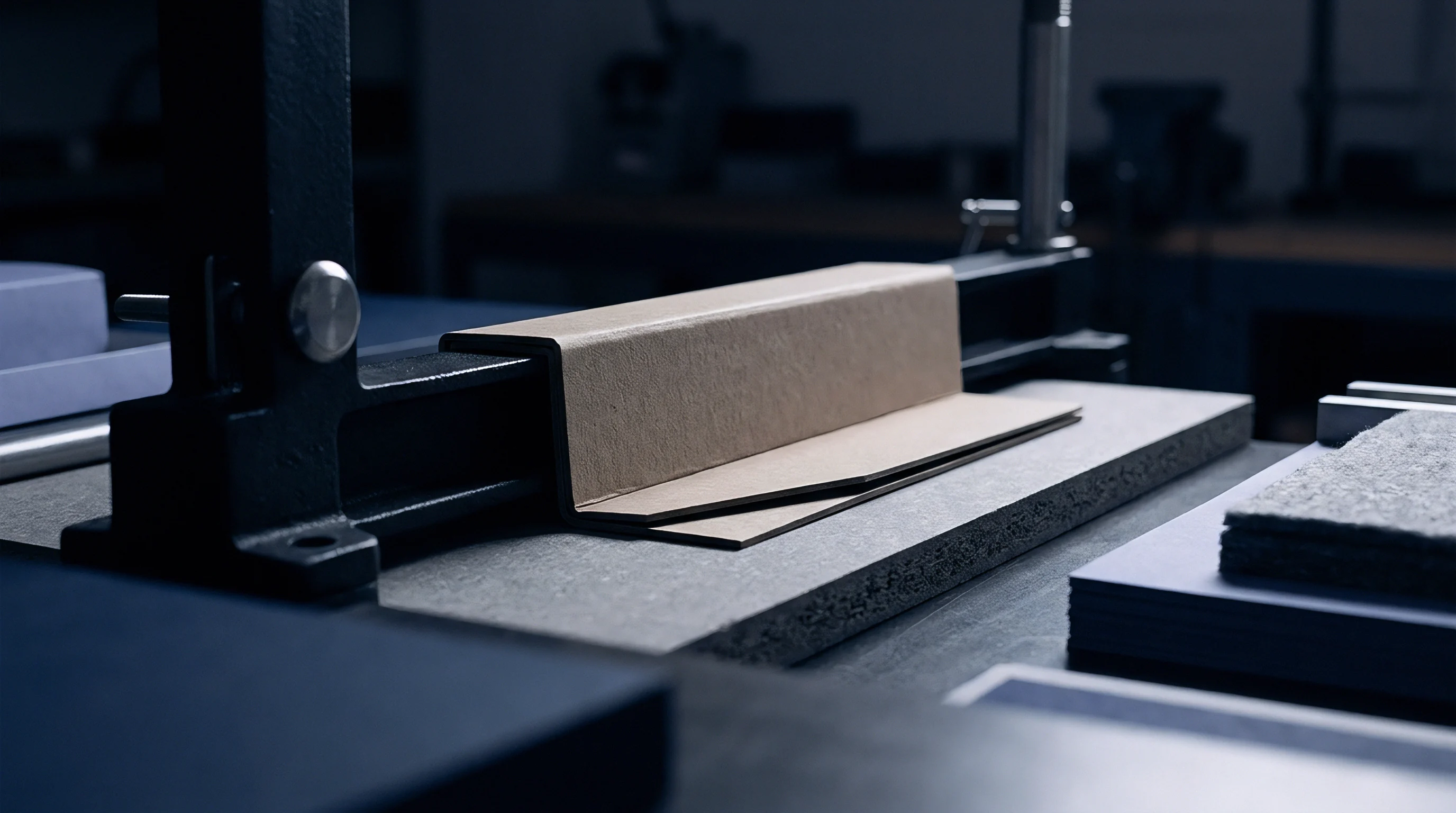
Precision conversion equipment utilizes counter-milling channel plates or creasing matrix strips attached to press cutting plates to control score geometry. Correct selection of the female channel width follows standard converting equations: female groove width equals 1.5 times the paperboard caliper plus the male rule thickness. Selecting a groove width below this threshold increases board compression, crushes internal cellulose fluting, and forces the outer modified latex coating to crack along the fold axis.
Crease groove width selection controls outer liner strain more effectively than adjusting male rule penetration depth.
When scoring parameters fall out of tolerance, mechanical fractures breach the barrier polymer layer, providing capillary channels for liquid and gaseous migrants. A converter running incorrect matrix dimensions on high-speed press runs risks delivering packaging lots that fail food contact compliance checks at the crease line.
Cell
Testing specific migration limits from creased latex packaging matrices into food simulants requires standardized exposure equipment. Single-sided migration cells isolate the functional barrier side of the paperboard, preventing liquid simulant from contacting uncoated backboard fibers or raw cut edges. EN 1186 standards govern cell design, specifying stainless steel or inert polymer rings clamped against the test sheet to establish a sealed liquid reservoir.
Tenax absorbs volatile diffusates rapidly.
Food simulants model real food chemical characteristics: Simulant A (10% ethanol v/v) models hydrophilic foods, Simulant B (3% acetic acid w/v) tests acidic foods, Simulant D2 (vegetable oil, iso-octane, or 95% ethanol) models lipophilic foods, and Simulant E (poly 2,6-diphenyl-p-phenylene oxide, known commercially as Tenax) models dry, fatty foods. Ethanol simulants swell synthetic elastomer films. Modified latex coatings on creased boards require controlled exposure profiles, typically ten days at forty degrees Celsius for ambient long-term storage, or ten days at sixty degrees Celsius for accelerated compliance screening.
- Cut representative specimens from creased paperboard sheets, ensuring the fold line passes centered through the exposure diameter.
- Clamp the specimen securely into the EN 1186 single-sided cell with the modified latex coating facing the inner chamber.
- Fill the test chamber with pre-conditioned food simulant at a volume ratio of ten milliliters per square decimeter of exposed board surface.
- Seal the migration cell units and store them in a calibrated climate chamber at the specified test temperature for the duration of the exposure period.
- Decant the simulant solution into inert glass vials, rinse the inner cell surface with fresh solvent, and concentrate the liquid for chromatographic analysis.

Simulant Selection and Time-Temperature Exposure Profiles
Selecting appropriate simulants for modified latex matrices involves evaluating polymer solubility parameters. Liquid simulants like 95% ethanol or iso-octane penetrate latex films, causing artificial polymer swelling and accelerating migrant transport beyond realistic food contact conditions. For high-fat dry foods, modified polyphenylene oxide powder (Tenax) provides direct contact extraction without modifying the mechanical structure of the creased latex film.
Migration limits apply per kilogram food.
Testing under EN 13130-1 requires substituting fatty food simulants when modified latex film swelling alters the activation energy of migrant diffusion.
The standard exposure area to simulant volume ratio equals six square decimeters of packaging surface per kilogram or liter of food simulant. For creased samples, the cell area must capture a defined length of creased line per square decimeter, typically two lineal decimeters of crease per square decimeter of contact area, ensuring consistent crack density representation across test runs. Under standard EN 13130 testing conditions, any mechanical damage occurring during cell clamping invalidates the specific migration dataset.

Peak
Quantification of chemical migrants extracted during cell exposure relies on high-resolution chromatographic instruments coupled to mass spectrometers. Gas chromatography with flame ionization detection or mass spectrometry (GC-MS) isolates volatile and semi-volatile substances, including unreacted monomers, solvent residues, and mineral oil saturated or aromatic hydrocarbons (MOSH/MOAH). Liquid chromatography coupled to tandem mass spectrometry (LC-MS/MS) quantifies non-volatile additives, photoinitiators, emulsifier residues, and oligomeric species.
Fickian diffusion laws describe migrant transport through homogenous polymer films. Fick’s Second Law models migrant concentration changes over time as a function of the diffusion coefficient D and spatial position x. In an intact latex coating, diffusate molecules migrate along concentration gradients through intermolecular spaces between polymer chains.
Physical creasing alters this process by introducing physical fissures, micro-voids, and delamination zones that eliminate the polymer transport barrier locally.
Chromatographic Resolution and Diffusate Mass Transfer
Chromatograms of extracts from creased latex boards exhibit elevated peak areas for specific migrant compounds compared to uncreased control samples. Creasing increases the effective diffusion rate by shortening the path length through the polymer film and exposing raw cellulose fibers that adsorb and transport migrants via capillary action. Mass transfer acceleration factors across creased matrices range from three-fold to over twenty-fold, depending on crack width and migrant molecular weight.
| Migrant Compound | CAS Number | Specific Limit SML (mg/kg) | Uncreased Board Concentration (mg/kg) | Creased Board Concentration (mg/kg) | Diffusion Coefficient D (cm²/s) |
|---|---|---|---|---|---|
| Styrene Monomer | 100-42-5 | 60.0 | 0.42 | 8.85 | 1.2 × 10⁻¹⁰ |
| 4-Phenylcyclohexene (4-PCH) | 4994-16-5 | 0.05 (sensory) | 0.008 | 0.062 | 4.5 × 10⁻¹¹ |
| 2-Ethylhexyl Acrylate | 103-11-7 | 0.05 | 0.011 | 0.048 | 8.1 × 10⁻¹¹ |
| Sodium Dodecylbenzene Sulfonate | 25155-30-0 | 30.0 | 0.15 | 1.20 | 2.3 × 10⁻¹² |
| MOSH (C16 to C35 Fraction) | N/A | 2.0 (toxicological) | 0.31 | 4.12 | 6.8 × 10⁻¹¹ |
| MOAH (C16 to C35 Fraction) | N/A | 0.50 (screening) | 0.04 | 0.78 | 5.2 × 10⁻¹¹ |
Calculating the effective diffusion coefficient within a creased latex matrix requires adapting standard transport models. When micro-fissures penetrate eighty percent of the coating depth, mass transport transforms from pure molecular diffusion to a combination of bulk fluid transport through open cracks and anisotropic diffusion through strained polymer boundaries. Water vapor transfer doubles after creasing.
SBR emulsions contain residual monomeric styrene. Chromatographic integration must isolate target migrant peaks from complex hydrocarbon humps originating from recycled fiber substrates or printing ink vehicles.
A mathematical sensitivity evaluation demonstrates the impact of crease damage. Assume a packaging carton with ten square decimeters total surface area containing three lineal meters of creased edges. If uncreased latex demonstrates a styrene migration rate of 0.04 milligrams per square decimeter, total styrene transfer equals 0.4 milligrams per kilogram of food.
If creasing creates micro-cracks along those three meters that elevate local migration fifty-fold over a two-millimeter-wide crease zone, migration within the creased area contributes an additional 1.2 milligrams of styrene. Total calculated migration reaches 1.6 milligrams per kilogram, remaining below the 60 mg/kg absolute legal limit for styrene but crossing sensory perception thresholds for odor-sensitive food products.
How do chemical analysts distinguish between migrant compounds originating from the latex barrier film itself and background contaminants migrating from recycled paperboard pulp cores through creased coating fissures?

Paperwork
Declarations of Compliance (DoC) document legal authorization for food-contact packaging materials under European Union Regulation EC 1935/2004 and Regulation EU 10/2011, alongside national frameworks such as German BfR Recommendation XXXVI for paper and board. Packaging converters must supply detailed technical dossiers proving that finished articles do not transfer constituents to food in quantities that endanger human health or alter food organoleptic properties. A DoC issued for flat, uncreased coated board fails to cover the legal liabilities of converted, creased folding cartons if creasing invalidates barrier performance.
- Substrate specification statement defines fiber origin, recycled content percentage, and base board physical mass parameters.
- Monomer inventory disclosure lists functional monomers, additives, and processing aids with corresponding chemical abstracts service numbers.
- Simulant equivalency documentation provides chemical justification for selected testing media, exposure durations, and temperature profiles.
- NIAS risk assessment protocol documents screening procedures for non-intentionally added substances, breakdown products, and impurity profiles.
- Crease integrity validation certificate confirms that mechanical converting operations maintain migrant release below statutory specific migration limits.
Regulatory Compliance Dossiers and DoC Architecture
Auditing packaging supply chains requires verifying every chemical substance against positive list authorizations. Under BfR Recommendation XXXVI, aqueous synthetic latex dispersions must restrict residual monomers, emulsifiers, and crosslinkers to explicit percentage limits by weight of dry coating. Overall migration limits (OML) set a cap of ten milligrams per square decimeter of packaging surface, regardless of individual compound toxicity.
Specific migration limits apply to identified hazardous monomers and additives.
Regulatory declarations for dispersion-coated board lose legal validity if the converting creasing matrix alters the physical integrity of the barrier layer.
Compliance dossiers must incorporate worst-case physical scenarios, evaluating migration from creased, folded, and glued carton samples. Brand owners specifying latex-coated boards require converters to provide verified GC-MS screening data showing that micro-fracturing along score lines does not cause specific migration limits to exceed statutory caps during product shelf life. Creasing line settings belong in standard operating specifications.

Ledger
Commercial packaging lines balance functional barrier requirements against material costs, press throughput, and end-of-life recycling fees. Dispersion-coated paperboard carrying modified latex barriers commands a price premium of fifteen to thirty percent over standard clay-coated folding boxboard, yet eliminates separate film lamination steps. Laminating solid board with polyethylene or polyethylene terephthalate films adds secondary offline processing costs, extends production lead times by three to five working days, and incurs higher waste factors during set-up.
Make-ready spoilage during die-cutting and creasing consumes significant production capital. Adjusting creasing matrix alignment, male rule pressure, and press impression depth on high-speed automatic platen cutters creates scrap board before achieving clean, fracture-free crease lines. Running high-ductility latex coatings reduces make-ready waste by widening the acceptable operating window for crease depth and female matrix width, lowering scrap rates on long production runs.

Recyclability Scoring and Landed Pack Economics
End-of-life processing schemes penalize non-separable plastic-paper combinations through Extended Producer Responsibility (EPR) eco-modulated fee structures. Paperboard coated with modified latex dispersions achieves high repulpability scores under standard testing protocols such as PTS-RH 021/97 or CEPI recyclability guidelines. Repulpability testing requires wet disintegration.
During industrial pulping, latex barrier films break down into discrete polymer flakes that standard screening and flotation de-inking equipment separates efficiently from cellulose fibers.
EPR fee structures in major European jurisdictions discount mono-material paper packaging that achieves over ninety-five percent yield in standard paper recycling mills. Polyethylene-laminated board faces higher EPR surcharges due to film fragmentation issues that clog repulper screens and contaminate pulp streams. The lower EPR fee applied to dispersion-coated board offsets the initial raw material cost premium of modified latex chemistry, lowering the net landed cost per thousand cartons over high-volume retail packaging runs.
Calculating overall packaging economics involves summing board substrate cost, dispersion application cost, converting make-ready spoilage, compliance verification testing, and EPR fee adjustments. A typical production run of one hundred thousand folding cartons utilizing twelve grams per square meter modified latex barrier board yields net unit cost savings compared to film-laminated alternatives once eco-modulation rebates and eliminated converting passes enter the final ledger balance.