Thermal Expansion Mismatch Mechanics in Flexible Packaging Lamination
Thermal expansion mismatches induce severe interlaminar shear stresses during web cooling, requiring matched web tensions and staged chill rolls to prevent tunneling.
Gradient
Lamination nips force chemically dissimilar webs into contact under elevated thermal and mechanical energy, creating an immediate thermodynamic imbalance as the composite exits the nip. Linear thermal expansion coefficients across common flexible packaging substrates span more than an order of magnitude. Aluminum foil expands at approximately 23 multiplied by ten to the negative sixth per Kelvin.
Oriented polyester expands at roughly 17 multiplied by ten to the negative sixth per Kelvin. Unoriented low-density polyethylene expands at rates exceeding 200 multiplied by ten to the negative sixth per Kelvin. When heated to bonding temperatures between 60 and 95 degrees Celsius on a heated steel drum, each material layer attempts to expand according to its native volumetric response.
Thermal expansion differentials govern this interface.
Biaxially oriented polyethylene terephthalate demonstrates a linear thermal expansion coefficient of 17 multiplied by ten to the negative sixth per Kelvin between 20 and 80 degrees Celsius, whereas low-density polyethylene expands at 220 multiplied by ten to the negative sixth per Kelvin over the identical span.
Adhesives applied across the nip, whether solvent-based polyurethanes, waterborne acrylics, or two-component solventless systems, lock these disparate dimensional states into a single composite structure before thermal equilibrium returns. Cooling back to an ambient converting floor temperature of 21 degrees Celsius generates significant differential contraction. The polyolefin sealant ply contracts vigorously, while the stiff aluminum or polyester barrier ply resists dimensional change.
Stiff plies resist lateral shrinkage. The resulting shear stresses concentrate entirely within the thin cross-section of the curing adhesive interlayer. Polyethylene stretches easily under load.
| Substrate Material | Caliper Range (microns) | CTE (10^-6 / K) | Tensile Modulus (MPa) | Glass Transition (deg C) |
|---|---|---|---|---|
| Biaxially Oriented PET | 12 to 23 | 17 to 20 | 3800 to 4400 | 78 to 82 |
| Biaxially Oriented Polyamide 6 | 15 to 25 | 28 to 35 | 2400 to 2900 | 48 to 55 |
| Biaxially Oriented Polypropylene | 18 to 35 | 110 to 135 | 1800 to 2200 | -10 to -5 |
| Low-Density Polyethylene | 30 to 120 | 200 to 250 | 200 to 350 | -120 to -110 |
| Cast Polypropylene | 25 to 80 | 140 to 180 | 450 to 650 | -5 to 0 |
| Aluminum Foil (Soft Temper) | 6.35 to 9.0 | 23 to 24 | 65000 to 70000 | Not Applicable |
| Bleached Kraft Paper (MD) | 40 to 80 | 6 to 12 | 5000 to 7500 | Not Applicable |
Substrate thickness ratios dictate where the neutral mechanical axis sits within the combined laminate. In a 12-micron polyester to 70-micron polyethylene structure, the substantial cross-section of the sealant layer exerts a dominant contracting force during post-nip cooling. Aluminum foil barely moves.
If the polyurethane adhesive achieves green strength while the polyolefin web remains thermally expanded, the cooling phase induces internal shear strain across the bondline that seeks release through curling, pucker, or cohesive tear.
Tension
Mechanical web handling compounds the thermal distortion initiated at the heated drum. Operating tension applied to draw each web into the laminating nip imposes an elastic strain determined by the material elastic modulus and cross-sectional area. A polyethylene sealant film drawn at 15 newtons per meter of web width experiences elastic elongation exceeding one percent, whereas an adjacent twelve-micron polyester carrier drawn at thirty newtons per meter elongates less than 0.08 percent.
The adhesive layer accommodates shear.
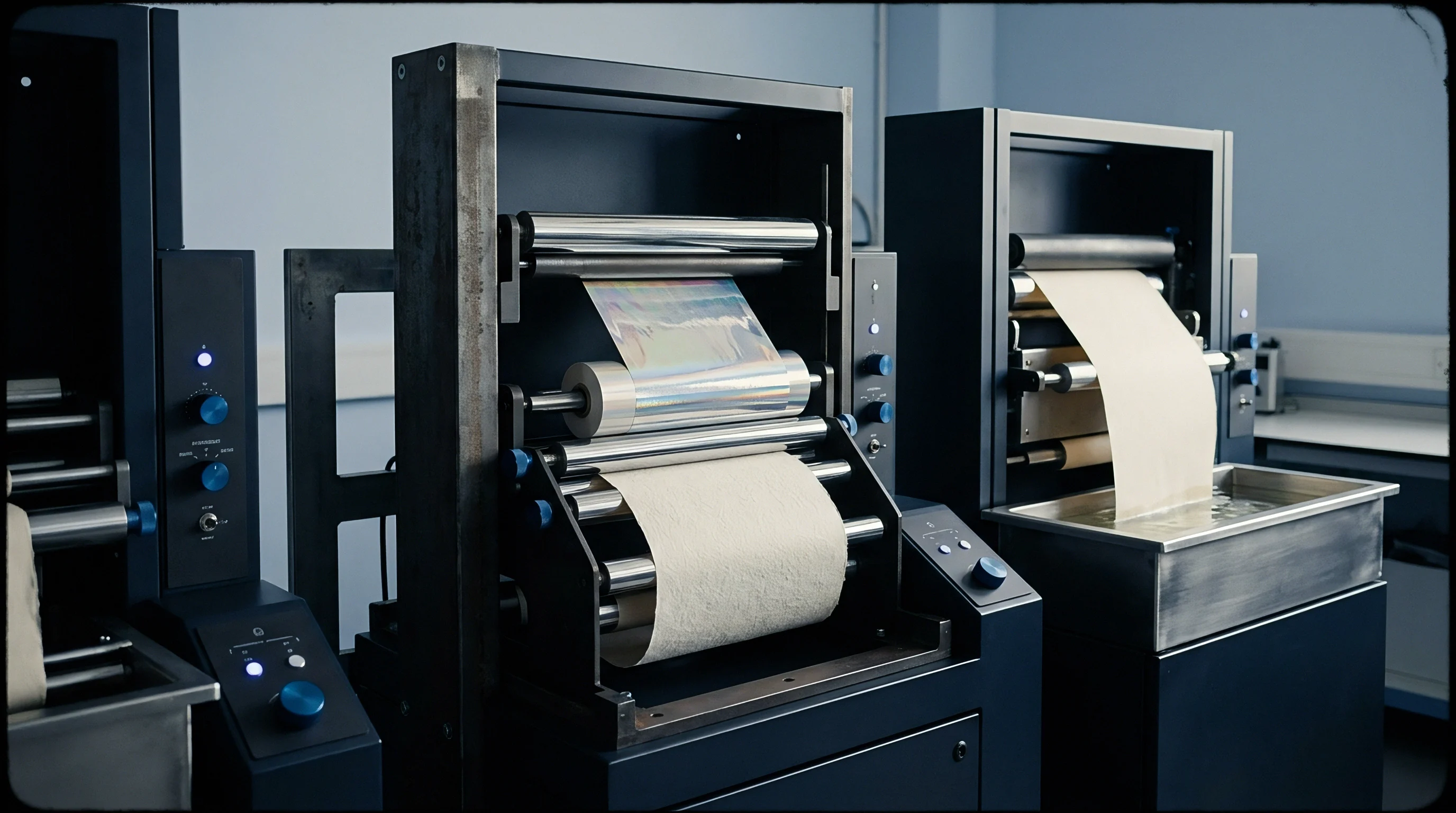
Which Web Layer Dominates Cooling Contraction?
Contraction behavior downstream of the chill roll couples both thermal recovery and elastic strain recovery into an interdependent dimensional displacement. As the multi-layer web drops from 75 degrees Celsius to 25 degrees Celsius, the polyolefin ply contracts simultaneously from thermal shrinkage and mechanical elastic recovery. Thermal contraction and elastic draw act in identical directions on the sealant film.
Cooling locks this imbalance in. When the carrier ply possesses a high tensile modulus and a low thermal expansion coefficient, it acts as a rigid beam resisting the contraction of the sealant. Curvature develops across the laminate.
Differential contraction across the adhesive boundary forces the low-modulus film ply into out-of-plane buckling when interlaminar shear exceeds local peel resistance.
Interlaminar shear stresses distribute asymmetrically along the web, peaking at the slit edges and relaxing toward the roll center. The classical Timoshenko bi-metal thermostat model illustrates this behavior when adapted for viscoelastic polymer films bonded with an adhesive layer. Internal bending moments develop according to the mismatch between the combined product of thermal expansion and temperature drop against mechanical strain.
The resultant stress gradient manifests across production reels through defined structural distortions.
- Edge Curl Inward appears when the sealant ply undergoes greater cumulative strain recovery than the barrier carrier, pulling the finished web toward the inner sealant surface upon slitting.
- Transverse Direction Bowing occurs under uneven thermal profiles across heated rolls, producing localized curvature across the web center.
- Interlaminar Bond Fatigue develops as continuous cyclical temperature swings during curing break down green adhesive networks before complete crosslinking occurs.
- Gage Band Ridge Formation concentrates where localized caliper variations exacerbate thermal mass differences, creating narrow bands of excessive tension across the winding roll.
Failure to reconcile web draw tension with post-nip thermal contraction turns entire master rolls into scrap as edge curl prevents automated pouch-forming equipment from achieving proper track register or hermetic fin seals.
Blister
Secondary defects arise when the adhesive system lacks sufficient immediate green strength to resist the continuous contraction forces exerted by cooling webs. In dry bond solvent-based lamination, adhesive applied to the carrier web passes through drying ovens between 60 and 85 degrees Celsius to flash off ethyl acetate. Residual solvent trapped within the applied resin acts as a plasticizer.
Solvent retention softens the bondline. The lowered shear modulus allows the expanding and contracting webs to slip micro-mechanically against each other before crosslinking completes.
| Defect Mode | Primary Substrate Pair | Interface Temperature Delta | Critical Shear Stress (N/mm2) | Visual Manifestation |
|---|---|---|---|---|
| Tunneling | BOPET / LLDPE | Greater than 45 deg C | Exceeds 0.35 | Transverse parallel ridges |
| Edge Wrinkling | Al Foil / LDPE | Greater than 35 deg C | Exceeds 0.20 | Diagonal flutes along edges |
| Delamination | BOPA / Cast PP | Greater than 40 deg C | Exceeds 0.45 | Full optical separation |
| Micro-tunneling | Kraft Paper / LDPE | Greater than 50 deg C | Exceeds 0.15 | Wavy longitudinal blisters |
| Telescoping | BOPP / Metallized BOPP | Greater than 25 deg C | Exceeds 0.10 | Lateral reel core slippage |
Tunneling manifests as elongated, hollow blisters running either parallel or transverse to the machine direction. When a laminated reel winds under high roll tension, the inner wraps become trapped against the core. Roll radius dictates inner compression.
The outer wraps stretch. Thermal contraction forces within the reel accumulate across storage hours. Polymer chains contract during solidification.
If the adhesive peel resistance remains below 1.5 newtons per 15 millimeters during the cooling window, the contracting sealant ply shears away from the barrier carrier, buckling outward into continuous tunnels.
- Viscosity Depression occurs as heated lamination rolls lower the liquid adhesive viscosity below optimum shear resistance thresholds prior to nip engagement.
- Micro-void Nucleation begins at the interface where localized expansion differentials pull the uncured adhesive into tensile cavitation pockets.
- Defect Propagation advances along machine direction stress lines as cooling webs deliver concentrated shear energy into the expanding micro-voids.
- Permanent Planar Distortion settles across the film structure once the adhesive cures fully around the lifted blister geometry.
Converters routinely hear their resin suppliers state that unexpected tunneling during summer converting schedules traces directly to operator over-tensioning on unwind stands rather than an inherent curing rate deficiency within the adhesive formulation under fluctuating plant temperatures.
Chill
Thermal management downstream of the lamination nip provides the primary defense against mismatch defects. Cooling must occur under controlled mechanical confinement before winding. Passing the freshly bonded web over a dedicated chill drum maintained between 15 and 20 degrees Celsius strips sensible heat from the composite before internal stresses can mobilize the uncured adhesive layer.
Chilled drums extract residual heat.

Will Temperature Staging Eliminate Interlaminar Shear?
Staged temperature reduction across consecutive cooling cylinders prevents thermal shock across brittle barrier films. An abrupt drop from an 80-degree lamination nip directly to an 8-degree chill drum induces acute surface contraction in aluminum foil or metallized polyester coatings. Thermal shock triggers immediate delamination.
Brittle vacuum-deposited aluminum layers, measuring only 20 to 40 nanometers in thickness, crack under sudden transverse contractions, ruining moisture and oxygen barrier properties. Gradual thermal decrescendo preserves barrier continuity.
Matching web temperatures prior to lamination prevents the cooler ply from shrinking beneath the warmer ply during pallet cooling.
Modern high-speed solventless laminating lines utilize dual chill rolls with independent fluid loops to match the contraction rates of divergent films. Water circulation rates through the double-shell spiral baffle drums must maintain a surface temperature uniformity within 1.5 degrees Celsius across the entire roll face. Thermal gradients across the roll face generate widthwise stress differentials, translating into persistent edge camber or localized lane puckering.
- Dual Unwind Pre-Conditioning aligns the inbound web temperatures so neither substrate enters the nip with a significant thermal offset relative to its mating ply.
- Torque-Controlled Winding Zones compensate for web shrinkage during cooling, continually decreasing tension to avoid crushing the core as reel diameter builds.
- Controlled Hot-Room Curing holds rolls at steady 40-degree environments, allowing polyurethanes to build high cohesive strength before cold warehouse storage.
- Differential Nip Pressure Profiling prevents excessive mechanical strain from compounding thermal expansion across the center of wide-web converters.
A web balanced in temperature and tension before the nip will lie flat on the pallet after the roll cools.
Docket
Converting specifications for multi-ply flexible packaging must formalize thermal boundaries alongside mechanical tolerances to eliminate financial exposure from post-lamination failures. A job specification that defines line speed, adhesive coating weight, and web tension without stipulating nip temperatures and exit web thermal limits leaves the buyer unprotected. Solventless polyurethanes require prolonged curing.
Retained heat inside wound rolls accelerates chemical curing kinetics, but thermal mismatch simultaneously drives internal shear stress. Creep relieves peak bondline stresses.
ASTM F88 seal verification failure following heat sealing triggers immediate rejection when residual thermal shrinkage exceeds two percent across the bonded perimeter.
Validation protocols must isolate thermal stability under accelerated aging conditions. Testing laminate flat-sheet specimens under ASTM D1204 at 60 degrees Celsius for 24 hours exposes hidden shrinkage tendencies before master rolls advance to slitting and pouch making. Standard bond strength assessments per ASTM D903 conducted immediately off-machine versus 24 hours post-lamination reveal whether adhesive green strength successfully resisted thermal shear strains during reel cooling.
Bond strength develops over hours.
| Test Protocol | Standard Designation | Acceptance Criteria | Commercial Risk Addressed |
|---|---|---|---|
| Free Thermal Shrinkage | ASTM D1204 (80 deg C, 30 min) | Dimensional change below 1.2 percent | Pouch mouth distortion in sealing jaws |
| Green Peel Adhesion | ASTM D903 (20 min post-lam) | Bond strength above 1.2 N / 15mm | Tunneling during master roll storage |
| Fully Cured Peel Adhesion | ASTM D903 (72 hr post-lam) | Film tear or bond above 3.5 N / 15mm | Delamination during retorted processing |
| Flat-Sheet Curl Angle | ISO 11556 (23 deg C, 50% RH) | Curvature deflection below 10 degrees | Misfeed on high-speed flow wrappers |
| Oxygen Transmission Shift | ASTM F1927 (Post-forming) | Barrier degradation below 15 percent | Foil fracturing from cooling shear |
Commercial contracts protect converting operations by inserting explicit raw material thermal coefficient bands into substrate supply agreements, ensuring that batch-to-batch variations in polyethylene density or polypropylene orientation ratios do not shift the thermal mismatch point outside validated converting line windows. The converter enforces a warranty exclusion clause stating that finished barrier claims are void if the converter operates lamination nip temperatures exceeding eighty-five degrees Celsius without customer engineering sign-off.