Analytical Verification of Unannounced Chemical Thermo Mechanical Pulp Substitutions in Export Folding Cartons
Spectroscopic FTIR peak ratios and Klason lignin extraction reliably detect unannounced chemi-thermomechanical pulp substitutions in export carton shipments.


Furnish
A digital micrometer landing on delivered pharmaceutical cartonboard often reads thirty microns thicker than the nominal caliper specified on the purchase contract. Sourcing managers frequently mistake this excess bulk for generous manufacturing. Mill technicians know that elevated bulk at a specified basis weight signals the introduction of high-yield mechanical fibers into what was sold as pure solid bleached sulfate stock.
Bleached chemi-thermo-mechanical pulp, known across the trade as BCTMP, yields between eighty-five and ninety percent usable material from raw timber, while bleached chemical kraft processes yield roughly forty-five to fifty percent. That vast processing difference drives substantial cost discrepancies across international fiber markets.
The economic incentive to dilute pure chemical furnish remains permanent across converting regions. When virgin chemical pulp trades at nine hundred dollars per metric ton and high-yield chemi-mechanical pulp sells at six hundred and eighty dollars, mills adjusting multi-fourdrinier headboxes can quietly swap fifteen to thirty percent of the interior furnish. The invoice stays unchanged.
Buyers ordering high-density solid bleached sulfate board for export cartons receive a hybrid sheet mimicking folding boxboard mechanics without contractual consent.
Residual Klason lignin content exceeding zero point eight percent by weight under TAPPI T 222 signals mechanical pulp introduction in bleached chemical board.

Structural Differences between Virgin Chemical and Mechanical Fibers
Bleached sulfate processing dissolves aromatic binders to leave high-purity cellulose and hemicellulose chains. Chemical pulping strips away the amorphous polyphenolic matrix that binds wood cells together, creating flexible, hollow ribbons that flatten readily during wet pressing on the wire. These ribbons maximize surface-to-surface contact, generating immense hydrogen bonding across fiber networks.
The result is a dense, smooth sheet possessing superior fold endurance and excellent creasing latitude.
Chemi-thermo-mechanical pulp preserves the wood morphology through mild chemical pretreatment with sodium sulfite followed by mechanical refining under steam pressure. Refining fractures the middle lamella, producing stiff, cylindrical fibers surrounded by broken fibrillar debris known as fines and shives. BCTMP fibers resist compaction during consolidation, producing an open, bulky network with voluminous air voids.
While this structure yields remarkable bending stiffness per unit of mass, it diminishes sheet cohesion.
- Incoming Pallet Weighing identifies basis weight anomalies against specified caliper, flagging suspiciously low densities before press make-ready commences.
- Cross-Section Staining exposes lignin-rich fiber bundles under optical stereomicroscopy, revealing whether interior plies contain unannounced mechanical wood pulps.
- Laboratory Fiber Swelling differentiates mechanically separated fibers from chemically delignified tracheids through polarized microscopy according to TAPPI T 401 procedures.
- Commercial Stock Rejection occurs when formal laboratory certification confirms furnish deviation, triggering direct insurance claims and seller indemnification.

Economic Drivers behind Secret Fiber Dilution
Bleached chemi-thermo-mechanical pulp trades at a discount of two hundred dollars per metric ton against northern bleached softwood kraft. Carton converters running forty thousand metric tons annually capture massive raw material margins by introducing cheaper fiber fractions into packaging substrates. Brand owners buying packaging across Asia or Eastern Europe routinely specify pure chemical board to withstand deep freeze distribution or direct food contact.
Unscrupulous board manufacturers substitute BCTMP into the center plies while preserving thin bleached kraft skins on both outer faces.
Peroxide bleaching masks early detection. Modern BCTMP lines achieve ISO brightness ratings exceeding eighty-five percent through aggressive hydrogen peroxide washing. Visually, a freshly sheeted cartonboard looks pristine white throughout its cross-section.
The substitution goes unnoticed during initial receiving inspections unless physical testing targets fiber anatomy or lignin residuals. Mill representatives routinely dismiss these physical variances as standard machine drift stemming from seasonal variations in northern woodchip species.


Lignin
Acid hydrolysis isolates the insoluble polyphenolic network responsible for structural rigidity in unrefined timber. Chemical pulping systematically strips lignin levels down to trace fractions below zero point five percent by weight, corresponding to a Kappa number below three under ISO 302 standards. Mechanical defibration leaves nearly the entire original lignin complement intact within the wood fibers, preserving twenty to thirty percent lignin by dry mass.
This fundamental chemical disparity renders quantitative lignin determination the absolute benchmark for verifying furnish integrity.
Standardized wet chemical assays reliably expose adulterated cartons. When middle plies are split away from outer chemical liners using precision mechanical delamination, testing those center layers reveals the precise furnish recipe. Settled paper science states that pure bleached chemical kraft pulp retains less than zero point five percent residual lignin by mass.
Any carton sample yielding residual lignin above one percent contains deliberate mechanical fiber additions. Sourcing teams relying on surface inspections fail to catch these substitutions because surface coatings mask bulk chemistry.
Fourier-transform infrared spectroscopy reveals aromatic lignin vibrations shielded beneath opaque surface pigment layers.

Is Klason Lignin Sufficient for Trace Quantification?
Standard gravimetric protocols under TAPPI T 222 measure residual polyphenols following digestion in seventy-two percent sulfuric acid. Carbohydrates hydrolyze into soluble mono-saccharides, leaving an insoluble dark residue that technicians filter, dry, and weigh. This Klason lignin gravimetric technique functions with absolute precision when board specimens contain more than two percent mechanical pulp.
The Kappa number conversion factor of zero point fifteen percent lignin per Kappa unit under ISO 302, resting on Nordic woodchip blends from 2018 pulp trials, shifts toward zero point thirteen when mills switch to plantation eucalyptus. A careful laboratory adjusts its calculations to accommodate the known wood species of the manufacturing region.
Digestion methodologies face limitations when handling highly coated cartons containing calcium carbonate and styrene-butadiene latex binders. Carbonate minerals react violently with sulfuric acid, generating calcium sulfate precipitates that artificially inflate gravimetric residue weights. Converting laboratories must extract mineral pigments using dilute hydrochloric acid washing before commencing primary Klason digestion.
Skipping this extraction step invalidates gravimetric findings entirely.
| Substrate Classification | Test Standard | Klason Lignin Content | FTIR Peak Ratio (1510 / 1030) | Mechanical Pulp Fraction |
|---|---|---|---|---|
| Solid Bleached Sulfate (SBS / SBB) | TAPPI T 222 / ISO 302 | Under 0.50% | Under 0.08 | 0.0% Pure Chemical |
| Low-Inclusion Hybrid Board | TAPPI T 222 / FTIR | 0.80% to 1.80% | 0.12 to 0.22 | 5.0% to 15.0% BCTMP |
| Folding Boxboard (FBB / GC1) | TAPPI T 222 / ISO 302 | 4.50% to 9.20% | 0.35 to 0.65 | 35.0% to 65.0% BCTMP |
| White Lined Chipboard (WLC / GD2) | TAPPI T 222 / Microscopic | 6.00% to 12.50% | 0.45 to 0.80 | Variable Recycled Mix |
| Values determined following pigment binder extraction; conditioned at 23 degrees Celsius and 50 percent relative humidity under ISO 187. | ||||
Spectroscopic Peak Ratios in Ply Fingerprinting
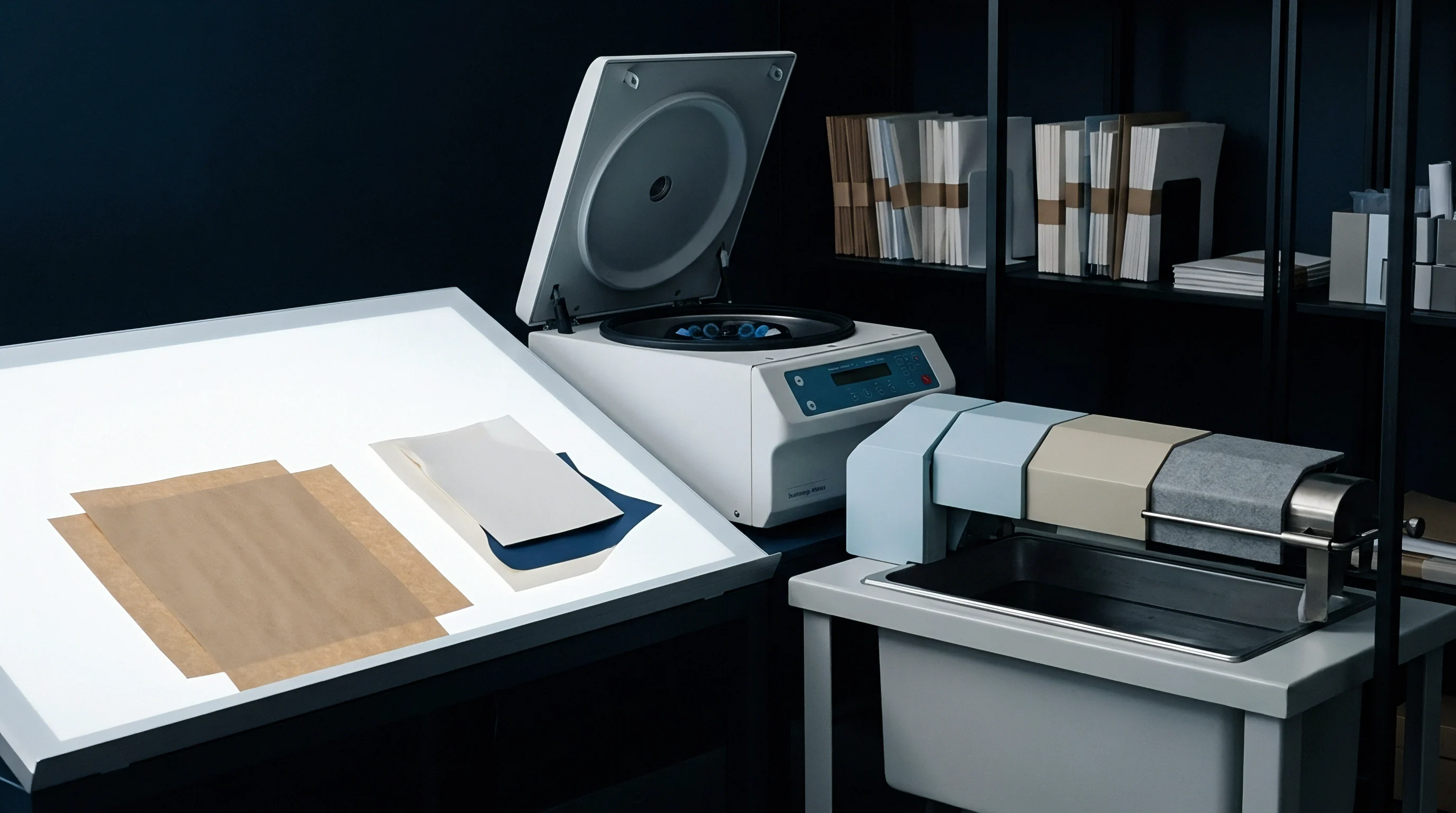
Fourier-transform infrared spectra isolate absorption bands across the fingerprint region between eight hundred and eighteen hundred reciprocal centimeters. Aromatic skeletal vibrations originating from phenylpropane units within wood lignin produce a sharp, diagnostic absorption band at fifteen hundred and ten reciprocal centimeters. Pure cellulose and hemicellulose lack this aromatic feature, exhibiting their primary C-O stretching band at ten hundred and thirty reciprocal centimeters.
Calculating the baseline-corrected absorbance ratio between the fifteen hundred and ten peak and the ten hundred and thirty peak provides a direct measurement of furnish composition.
An FTIR peak ratio threshold of zero point eighteen marks roughly ten percent BCTMP inclusion under controlled laboratory calibration sets. Contamination from kaolin clay surface coatings can shift this ratio by up to zero point zero four, necessitating pristine mechanical separation of interior plies before spectral scanning. Attenuated total reflectance sensors pressed directly against split inner cores generate spectra within minutes, establishing furnish substitution without hazardous acid handling.
Spectra establish the unannounced substitution.
Overlooking unannounced mechanical pulp fractions exposes brand owners to sudden customs impoundment, complete packaging line shutdowns, and costly unsaleable inventory.
Sheet
Multi-ply formers deposit pulp slurries across separate headboxes to build stratified paperboard structures. Converting operations demand rigorous internal bonding strength to withstand mechanical scoring, folding, and gluing at speeds exceeding sixty thousand cartons per hour. When high-yield mechanical pulps displace long-fiber chemical furnish in the middle plies, physical sheet performance alters dramatically.
The tare weight registers light.
Take a 40-tonne lot of specified 300 gsm solid bleached sulfate cartonboard destined for luxury confectionery packaging. Assume a mill substitutes twenty percent chemi-thermo-mechanical pulp into the middle plies while maintaining a constant sheet caliper of 400 microns. Chemi-thermo-mechanical pulp delivers a bulk of approximately 1.8 cubic centimeters per gram compared to 1.33 cubic centimeters per gram for bleached kraft.
Maintaining the 400-micron caliper with this bulkier furnish drops the total basis weight from 300 gsm down to 272 gsm. The buyer receives 28 tonnes of actual fiber rather than 40 tonnes for an identical surface area of cartons. At nine hundred dollars per tonne, the mill pockets approximately twenty-five dollars per thousand delivered cartons in stolen yield while charging standard virgin board prices.
That spread breaks production budgets.
Mechanical fibers yield bulk at the expense of internal bonding resilience.
Do Middle Plies Conceal Chemi-Thermomechanical Pulps?
Outer layers of pure bleached sulfate pulp sandwiching a mechanical center create high bending stiffness at lowered basis weights. This structure forms the operational principle of folding boxboard. Selling this structure under a solid bleached sulfate contract constitutes commercial fraud.
Buyers pay a cash premium for pure chemical board because pharmaceutical packaging and luxury cosmetics demand total carton integrity, low trace extractives, and defect-free creasing.
Container shipping lanes across equatorial routes experience hold temperatures above forty-five degrees Celsius, matching conditions inside industrial dry-curing kilns. This thermal stress accelerates physical moisture equilibration across packed pallets. As relative humidity shifts within container holds, differential expansion coefficients between stiff mechanical inner plies and flexible chemical outer plies induce severe internal sheet stress.
Cartons manufactured with unannounced BCTMP cores arrive at destination ports with pronounced edge curl and warped panels.
Cross-ply shear strength drops thirty percent. Delamination ruins high-speed carton packing. High-speed cartoning machines push folding flaps inward against scored hinges; rigid mechanical fibers shear apart instead of bending smoothly, causing cartons to jam feeder magazines.
Delamination Risks under High Speed Converting
Rotary die-cutting units exert severe z-directional tension across score lines during carton erection. Pure chemical sheets dissipate this energy through localized plastic deformation within the cellulose matrix. Mechanical fibers lack this inter-fiber compliance.
Lignified fiber walls break brittlely under compressive scoring forces, causing score lines to rupture cleanly through the outer liner.
Internal bonding strength measured via Scott Bond testing under TAPPI T 569 reveals the structural degradation. Premium solid bleached sulfate maintains Scott Bond values above two hundred and fifty joules per square meter. Introducing twenty-five percent BCTMP into the center plies drops internal bond values below one hundred and forty joules per square meter.
The cutter blade dulls rapidly. Stiffness plunges along the crease.
- Scott Bond Threshold Verification confirms whether internal ply cohesion meets the two hundred joule minimum required for high-speed pharmaceutical packaging lines.
- Cross-Direction Crease Testing determines whether carton hinges form smooth rounded beads or fracture under ninety-degree automated folding mandrels.
- Z-Direction Tensile Profiling isolates weak interior ply interfaces susceptible to blistering during heated blister packaging and hot-melt adhesive application.
- Thickness To Weight Ratio Audits flag abnormal bulk levels exceeding one point four cubic centimeters per gram in boards labeled as pure chemical stock.
A carton sheet exhibiting excessive caliper alongside soft crease resistance invariably conceals cheapened mechanical pulp within its inner structure.

Reversion
Solar radiation initiates rapid photodegradation across phenolic structures within unprotected mechanical fibers. While chemical kraft pulps show remarkable optical stability over multi-year storage cycles, mechanical pulps undergo rapid brightness reversion when exposed to light or elevated heat. Residual lignin contains conjugated chromophores, notably quinones and stilbene structures, that absorb near-ultraviolet radiation.
This excitation triggers oxidative cleavage and generates deep yellow quinoid complexes. The color shifts toward amber. Lignin oxidizes under ambient air.
Peroxide bleaching does not remove lignin; it merely oxidizes existing chromophoric groups into temporarily colorless structures. Once export cartons encounter ambient sunlight during dockside staging or retail display, photo-yellowing begins immediately. Solid bleached sulfate cartons retain their high ISO brightness of ninety percent for years.
Cartons containing unannounced BCTMP fractions yellow within days of display exposure, degrading printed graphics and destroying luxury packaging value.

Accelerated Photo Decay and Brightness Loss
Exposure tests conducted under ISO 5630-4 subject test strips to high-intensity xenon arc illumination. Pure chemical boards exhibit a brightness loss of less than one point five ISO brightness units across a standard seventy-two-hour exposure cycle. Sheets containing even fifteen percent mechanical fiber lose between six and twelve units of brightness across the same test interval.
Accelerated aging cabinets strip away the cosmetic disguise created by mill peroxide bleaching.
Thermal stability testing under ISO 5630-1 demonstrates parallel degradation. Heating board specimens to one hundred and five degrees Celsius for twenty-four hours accelerates thermal oxidation. Pure chemical cartons emerge with minimal yellowing, whereas BCTMP-substituted boards exhibit severe browning across their unprinted back plies.
Kraft yields drop sharply here.
| Fiber Furnish Formulation | Initial Brightness (ISO 2470) | Post-Xenon Brightness (ISO 5630-4) | Total Brightness Delta | Hexanal Headspace (GC-MS) |
|---|---|---|---|---|
| Virgin Bleached Kraft (100% SBS) | 90.2% | 88.9% | -1.3% | Under 0.2 mg/m² |
| Substituted Core (15% BCTMP) | 89.8% | 82.4% | -7.4% | 1.4 mg/m² |
| Commercial Folding Boxboard (GC1) | 88.5% | 76.8% | -11.7% | 3.8 mg/m² |
| Recycled Newsprint Center (WLC) | 81.0% | 67.2% | -13.8% | 8.5 mg/m² |

Organoleptic Contamination in Food Cartons
Residual resin acids and unsaturated lipids release volatile aldehydes under elevated warehouse temperatures. Wood extractive compounds, including linoleic and oleic fatty acids, stay trapped within chemi-thermo-mechanical pulps due to gentle low-temperature cooking. In contrast, intense alkaline kraft digestion completely saponifies and dissolves these lipids into soluble tall oils during black liquor extraction.
Trapped lipids inside BCTMP auto-oxidize into hexanal, heptanal, and nonanal vapors.
Food packaging applications demand rigorous sensory testing. Robinson sensory evaluations under EN 1230-1 expose sensitive foodstuffs like chocolate to carton headspace vapors before grading taint on a four-point scale. A volatile aldehyde threshold of one point two milligrams per square meter marks sensory failure.
Panels evaluate taint subjectively, introducing variance across different testing centers. Sourcing managers counter this subjective variance by enforcing absolute Klason lignin quantification rather than relying on sensory scores alone.
- Volatile Aldehyde Off-Gassing contaminates dairy, chocolate, and dry pharmaceutical goods packaged inside unannounced mechanical fiber substrates.
- Optical Graphic Degradation distorts calibrated four-color brand artwork as the underlying substrate yellows beneath transparent ink layers.
- Odor Migration Penalties trigger massive product recalls across supermarket chains enforcing strict food-contact safety compliance standards.
- Surface Fiber Dusting fouls offset printing blankets when unbonded mechanical fines pull away from poorly consolidated sheet surfaces.
Whether high-barrier waterborne barrier coatings can fully arrest volatile aldehyde migration from mechanical middle plies across multi-year retail shelf lives remains uncertain across packaging laboratories.


Recourse
Overseas purchasing contracts require rigorous analytical documentation when delivered containerboards fail specification thresholds. Buyers finding themselves holding thousands of tons of downgraded packaging stock cannot rely on informal vendor conversations. Mills routinely deny substitution claims by citing loose trade customs or claiming tolerance allowances under regional trade guidelines.
Commercial protection requires embedding analytical test standards directly into purchase specifications before purchase orders are signed.
Laboratory reports establish legal breach of warranty. International commercial arbitration bodies resolve technical quality disputes through third-party referee analysis performed by accredited laboratories. When testing proves the presence of unannounced mechanical fibers in goods specified as pure chemical board, the commercial dispute transitions from a subjective quality disagreement into an outright material misrepresentation claim.
The freight rate stays identical. Rejection follows at the terminal.
Incorporating ISO 5630-4 accelerated thermal aging standards into export purchase contracts enables buyers to reject light-degraded cartons before ocean shipment.

Rejection Protocols for Delivered Ocean Freight
Containerized cargo arriving at destination ports undergoes immediate quarantine upon receipt of conflicting laboratory certificates. Sourcing teams take representative samples across ten percent of delivered pallets according to ISO 186 rules. Testing begins with non-destructive FTIR scanning on middle plies.
If spectral peak ratios exceed zero point twelve, technicians initiate full acid digestion under TAPPI T 222 to quantify Klason lignin content.
Formal notifications of non-conformity issue within fourteen days of vessel discharge. Contracts specifying solid bleached sulfate must explicitly bar mechanical or chemi-thermo-mechanical pulps of any kind, setting an absolute lignin ceiling at zero point eight percent. Exceeding this boundary legally triggers immediate shipment rejection, demanding complete replacement or full financial restitution including reimbursement for inbound ocean freight, customs tariffs, and terminal handling charges.

Technical Evidence in Commercial Arbitration
Independent laboratory dossiers submitted to international arbitral tribunals require unbroken chains of custody. Qualified technical dossiers combine FTIR spectral data, SEM cross-sectional micrographs showing middle lamella fragments, and certified Klason lignin gravimetric yields. This comprehensive laboratory proof leaves defaulting paper mills with no defensible argument.
Faced with definitive chemical evidence, suppliers invariably settle claims through substantial credit notes rather than risking public arbitral awards.
A contract clause specifying TAPPI T 222 Klason lignin verification alongside ISO 5630-4 photo-reversion limits binds the seller to immediate container replacement upon analytical failure.