Viscoelastic Stress Relaxation Limits under Dynamic Multiaxial Hygral Loading in Recycled Fibres
Dynamic hygral loading accelerates viscoelastic stress relaxation in recycled fibres, demanding higher safety factors and virgin reinforcement in packaging.
Creep
Mechano-Sorptive Dissipation in Recycled Networks
A double-wall corrugated box manufactured from 100 percent recycled containerboard loses up to 60 percent of its compressive load capacity when ambient relative humidity cycles between 50 percent and 90 percent, even if the peak moisture content remains well below saturation. Static moisture uptake softens paper by plasticizing the amorphous cellulose matrix. Transient moisture movement under simultaneous mechanical load introduces an additional acceleration of strain known as mechano-sorptive creep.
In secondary fibres, this phenomenon exhibits tighter stress relaxation limits than in virgin stock. Repetitive re-wetting and drying cycles during previous conversion cycles cause irreversible closure of internal micro-cavities, a phenomenon designated as hornification. Hornified recycled papermaking fibres retain reduced swelling capability, decreased internal fibrillar mobility, and a diminished count of accessible inter-fibre hydrogen bonds per unit volume.
When a recycled sheet experiences multiaxial tension and compression during ambient humidity fluctuations, the transient flux of water molecules through the cell wall disrupts active load-bearing hydrogen bonds. External stress forces the broken polymer segments to slide past one another into stress-relieved positions before water molecules desorb and permit bond re-formation. Because recycled furnish possesses fewer active bonding sites and shorter average fiber lengths, this structural reorganization exhausts the elastic headroom of the paper web rapidly.
Stress relaxation rate equations derived for virgin fibres consistently underestimate recycled web degradation under dynamic conditions. The stress relaxation modulus decays along an exponential curve accelerated by the rate of moisture change rather than the absolute moisture quantity.
The stress relaxation modulus decays twice as fast during active moisture transport across the web caliper as it does at a constant 85 percent relative humidity equilibrium.
Microstructural Bond Rupture and Load Transfer
External loads applied across orthogonal axes force the fibre network to redistribute shear forces along internal bond surfaces. Under dynamic hygral excitation, these inter-fibre joints experience cyclic volumetric expansion and contraction. Softwood kraft fibres retain sufficient flexibility to redistribute localized stress concentrations across adjacent cell walls.
Recycled fibres, hardened through multiple press-drying and repulping cycles, transfer shear stresses directly to fragile inter-fibre bonds. Micro-fractures develop at the sheet surface long before visual creasing or structural collapse occurs.
Creep rate acceleration scales with the frequency of relative humidity oscillations. Rapid atmospheric cycles create steep moisture gradients across the web thickness, establishing localized differential swelling strains. These internal strain mismatches superimpose on external multiaxial loads, pushing local stress vectors past the yield point of recycled fibre joints.
The material yields through incremental micro-slippage. Papermakers cannot compensate for this loss simply by increasing basis weight, because heavier grammage sheets slow down moisture equilibration across the z-axis, generating higher localized differential stresses during humidity ramps.
Bending stiffness degrades rapidly under dynamic multiaxial loads. Specifiers who rely on static tensile testing or equilibrium humidity conditioning curves underimpose safety margins on recycled packaging designs. Ignoring the interaction between transient moisture flux and multiaxial stress field limits leads directly to collapsed pallet stacks in unconditioned transit warehouses.

Anisotropy
Directional Relaxation Rate Differentials
Paper is inherently anisotropic due to machine-direction fibre alignment on the wet end of the paper machine. The machine direction displays higher initial tensile stiffness and lower ultimate elongation than the cross direction. Under static conditions, stress relaxation occurs faster in the cross direction because fewer continuous fibres align with the principal axis of strain.
Dynamic hygral loading alters this baseline response by introducing severe anisotropic dimensional changes. Cellulose fibres swell predominantly in diameter rather than length during water absorption. Cross-direction web dimensions expand up to ten times more than machine-direction dimensions when relative humidity shifts from 30 percent to 90 percent.
When multiaxial mechanical loads act on a sheet experiencing hygral expansion, the directional relaxation rates diverge. Machine-direction tension combined with cross-direction compression creates a complex shear environment at every fibre intersection. The cross-direction relaxation rate accelerates faster than the machine-direction rate during desorption phases.
As water leaves the fibre wall, transverse shrinkage forces generate tensile stresses in the cross direction while the external load maintains machine-direction tension. Recycled fibres demonstrate minimal elastic rebound during desorption, resulting in permanent micro-buckling of cross-direction fibres.
| Substrate Grade | Furnish Blend Ratio | MD Relaxation Rate Factor | CD Relaxation Rate Factor | Hygral Expansion CD Percentage |
|---|---|---|---|---|
| Uncoated Kraftliner | 100 percent Virgin Softwood | 1.00 | 1.45 | 0.85 |
| Testliner Grade 1 | 80 percent Recycled OCC | 1.32 | 2.10 | 1.25 |
| Testliner Grade 3 | 100 percent Mixed Waste | 1.68 | 2.85 | 1.60 |
| Semi-Chemical Fluting | 100 percent Virgin Hardwood | 1.05 | 1.60 | 0.70 |
| Recycled Fluting | 100 percent Waste Corrugated | 1.40 | 2.30 | 1.40 |
Thickness Swelling and out of Plane Shear
Out-of-plane z-direction stress relaxation controls the delamination resistance of multiply recycled paperboard during hygral cycling. The thickness swelling coefficient of recycled furnish exceeds that of virgin stock due to void space redistribution within hornified fibre mats. Dynamic relative humidity cycling forces water molecules into the internal ply interfaces.
Fiber swelling pushes adjacent plies apart, reducing z-direction tensile strength and inter-ply bond integrity.
Multiaxial loads applied to converted cartons produce severe out-of-plane shear stresses along panel edges and score lines. Creasing operations disrupt internal ply structure by design to enable clean folding. Moisture ingress into these damaged creasing zones accelerates localized stress relaxation.
The score line loses its mechanical resistance, transferring structural loads onto unsupported panel walls. Panel wall deformation accelerates, initiating tertiary creep and ultimate box collapse.
Why Does Relative Humidity Cycling Accelerate Structural Relaxation?
Moisture movement acts as a mechanical molecular catalyst within the papermaking polymer network. As water enters the cell wall, hydrogen bonds holding amorphous cellulose chains together break sequentially. The applied multiaxial load pulls freed polymer chains into new geometric configurations before the water molecule migrates onward.
Upon water desorbing from the local site, hydrogen bonds form in the deformed geometry. Every humidity transition repeats this break-shift-rebind sequence millions of times per gram of paper. Static high humidity creates a single softened state, whereas humidity cycling actively drives progressive mechanical distortion through the network.
Uncertainty remains regarding the exact mathematical formulation governing non-linear interaction between z-direction swelling strain and planar shear relaxation in secondary fibres during rapid environmental shifts.
Bench
Dynamic Mechanical Analysis and Biaxial Testing Setups
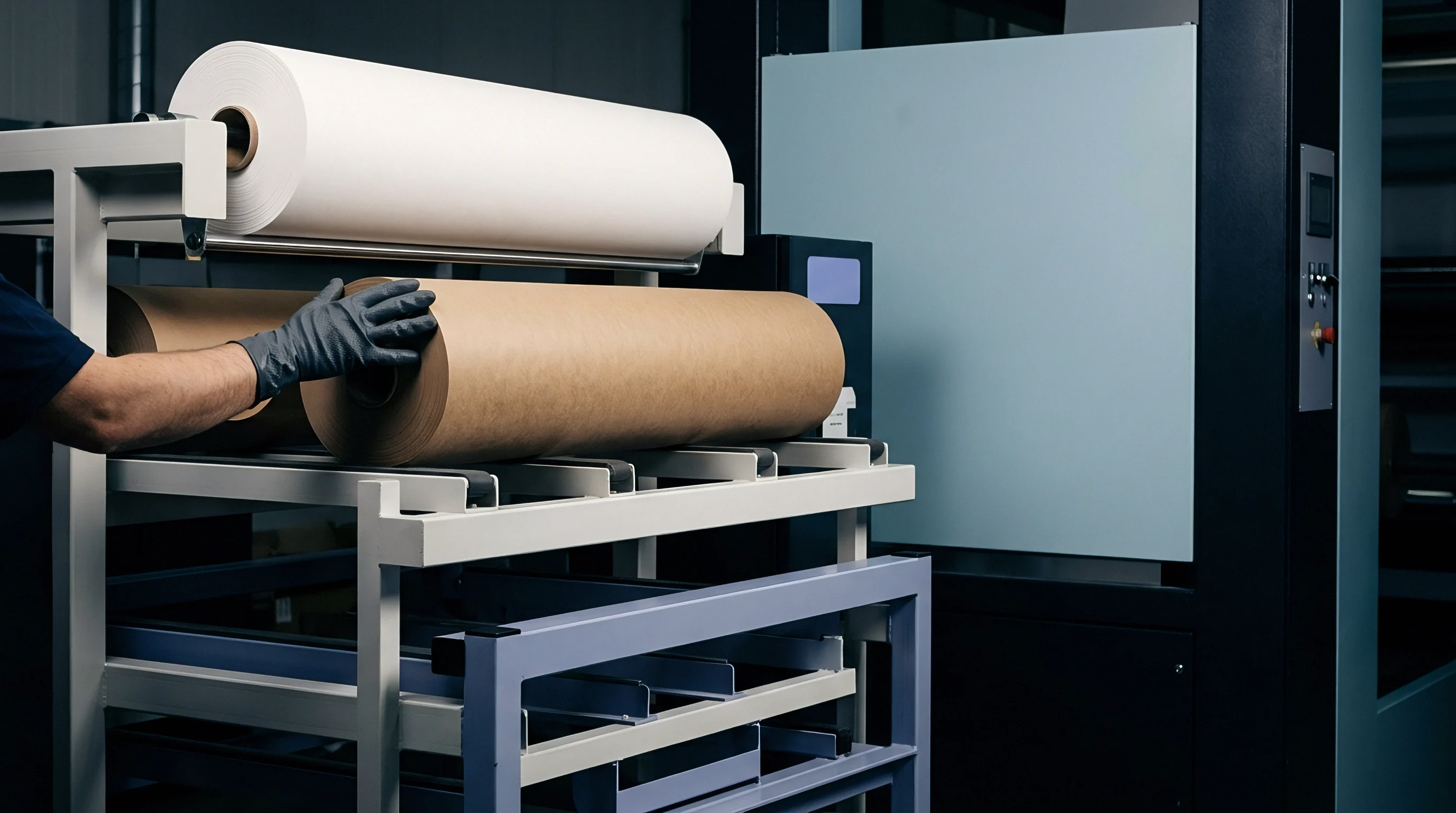
Standard static material tests fail to quantify viscoelastic relaxation limits under dynamic environmental exposures. Evaluating stock performance requires dynamic mechanical analysis equipped with precision environmental control chambers. Biaxial tensile testers fitted with controlled relative humidity generators supply the empirical data necessary for accurate structural modeling.
Testing protocols must isolate the independent contributions of stress amplitude, humidity cycle frequency, and furnish recycled content.
Specimens must undergo conditioning per ISO 187 at 23 degrees Celsius and 50 percent relative humidity prior to fixture mounting. Biaxial instruments apply controlled tensile or compressive strain along orthogonal machine-direction and cross-direction axes while the environmental chamber executes programmed relative humidity ramps. A standard qualification program applies a constant static bias stress equal to 30 percent of ultimate tensile strength while cycling ambient relative humidity between 30 percent and 85 percent at a rate of 1.0 percent relative humidity per minute.
Standard ISO 187 equilibrium conditioning masks up to 40 percent of dynamic creep deflection occurring during active relative humidity transition periods.
Standardized Methodologies and Test Limits
Characterizing papermaking stocks under dynamic multiaxial hygral loads requires precise adherence to recognized standardized methodologies while extending their parameter boundaries.
- ISO 1924-3 Tensile Properties establishes baseline stiffness and energy absorption parameters under constant atmospheric conditions without dynamic environmental modification.
- TAPPI T544 Creep Response measures unidirectional long-term compressive deflection in controlled static environments, omitting multiaxial mechanical loading vectors.
- ISO 5626 Folding Endurance evaluates mechanical fatigue durability under cyclic bending without incorporating dynamic hygral conditioning profiles.
- ISO 12048 Container Testing provides complete package compression performance figures under static, elevated, or stepped environmental schedules.
Data collection instruments must record load dissipation, dimensional strain, relative humidity, and sheet temperature at sampling frequencies no lower than 10 Hertz. Slower data capture misses peak transient stress relaxation rates occurring during initial sorption phases. Recycled furnishes display peak relaxation rates within thirty seconds of an environmental relative humidity shift.
A standard procurement specification requires delivered containerboard reels to demonstrate a dynamic relaxation rate parameter below 1.85 times baseline static relaxation under standard test program conditions.
Collapse
Converting Floor Crease Degradation and Panel Deformation
Converting operations inflict mechanical damage on paper stock during creasing, die-cutting, and slotting. Scoring tools crush internal ply structures to allow tight folding angles without surface cracking. In recycled boards with low strain-to-break values, creasing fractures internal bonds within the fibre matrix.
When the converted package encounters dynamic atmospheric humidity during ocean transport or cold-chain transit, moisture penetrates these damaged score lines preferentially.
Local moisture accumulation inside score lines creates localized zones of extremely fast viscoelastic stress relaxation. The score line loses its structural memory and structural resistance, transferring localized bending moments into adjacent flat panels. Flat panels subjected to vertical top loads experience multiaxial compression and shear stresses.
Viscoelastic creep relaxes panel stiffness, inducing out-of-plane bulges along structural sidewalls.
| Container Flute Profile | Paperboard Furnish Type | Static RH Failure Time Days | Cyclic RH Failure Time Days | BCT Loss Rate Percentage |
|---|---|---|---|---|
| C-Flute 125 gsm | 100 percent Virgin Kraft | 120 | 42 | 35 |
| C-Flute 125 gsm | 100 percent Recycled Testliner | 85 | 14 | 62 |
| EB-Flute Double Wall | Virgin Outer Recycled Flute | 110 | 28 | 48 |
| EB-Flute Double Wall | 100 percent Recycled Stock | 65 | 8 | 71 |
Field Failure Mechanics in Logistics Networks
Palletized goods stacked four high in unconditioned distribution hubs experience combined static compressive loads and continuous atmospheric humidity fluctuations. Dynamic relative humidity cycling causes progressive box compression strength loss. Every relative humidity peak accelerates stress relaxation, while every relative humidity trough locks in permanent plastic deformation.
Vertical creep accumulates over days, causing top packages to lean and load distribution across lower tier boxes to shift unevenly.
Uneven load distribution creates localized eccentric compression force vectors. Edge crush strength values determined in static laboratory environments fail to predict box performance under eccentric dynamic conditions. Internal corner posts buckle under shear stress, leading to catastrophic stack collapse across entire pallet arrays.
Paperboard suppliers frequently cite improper warehouse stacking or excessive transport vibration rather than acknowledging stock relaxation limits under atmospheric humidity cycling.

Furnish
Fiber Blend Optimization and Refining Strategies
Mitigating stress relaxation acceleration in recycled fibre stocks requires systematic furnish design and mechanical stock preparation. Papermakers must balance recycled content percentages with virgin fiber reinforcement to preserve long-term structural integrity. Adding high-freeness virgin softwood kraft fibers into secondary fiber furnishes creates an continuous load-bearing backbone throughout the sheet structure.
Long virgin fibres distribute localized multiaxial stresses across larger network volumes, buffering the fragile recycled fibre matrix against sudden viscoelastic relaxation.
Refining strategy determines how recycled fibres respond to moisture flux. Excessive refining increases fiber shortening and generates high fine content, worsening sheet shrinkage and hygral expansion rates. Dynamic low-intensity refining is preferred over aggressive high-intensity treatments.
Low-intensity refining gently fibrillates hornified fibre surfaces, exposing hydroxyl groups without reducing average fibre length. Enhanced surface fibrillation increases inter-fibre contact area and bonding density without sacrificing web porosity, allowing water vapor to desorb without building severe internal swelling pressures.
Maintaining a minimum 30 percent long-fibre virgin kraft content in recycled packaging grades prevents catastrophic structural relaxation during transit hygral cycling.
Chemical Additives and Surface Treatments
Chemical sizing agents and structural additives provide crucial defense against hygral creep acceleration. Surface application of cross-linked starches or synthetic sizing agents limits water vapor penetration rates into internal fiber structures.
- Polyamide-Epichlorohydrin Wet Strength Resin forms permanent covalent cross-links between cell walls that remain stable during water ingress.
- Alkyl Ketene Dimer Sizing increases internal hydrophobic resistance, slowing down moisture absorption rates during relative humidity spikes.
- Surface Starch Application reinforces outer plies through size press application, elevating cross-direction ring crush resistance and panel stiffness.
- Microfibrillated Cellulose Additions fills internal network voids, boosting bond density and reducing micro-slippage during hygral transitions.
Increasing chemical additive dosage past optimal thresholds yields diminishing returns. Synthetic sizing agents slow moisture absorption rates but do not alter intrinsic viscoelastic relaxation limits once equilibrium moisture levels enter cell walls. Papermakers must rely on balanced fibre selection rather than surface chemistry alone to ensure structural endurance under cyclic ambient conditions.
A solid rule of thumb indicates that doubling internal wet strength resin dosages yields zero improvement in long-term creep performance if the baseline furnish contains over seventy percent short-fibre secondary waste.

Ledger
Downgauging Limits and Safety Margins
Commercial packaging design balances sheet grammage against landed performance cost. Brand owners often attempt downgauging programs to cut material expense and fulfill sustainability targets. Replacing a 170 gsm virgin kraftliner with a 150 gsm 100 percent recycled testliner reduces raw sheet purchase price by approximately twelve percent per metric tonne.
Under static baseline humidity, the downgauged sheet meets minimum edge crush test requirements.
Under dynamic multiaxial hygral conditions encountered during international transit, the downgauged recycled sheet relaxes far faster than the baseline virgin specification. The safety margin calculated under static laboratory testing vanishes entirely during multi-day transport loops through varying climate zones. Structural failure rates increase, causing product damage claims, repackaging expenses, and brand reputation damage that dwarf initial sheet cost savings.
Yield Arithmetic and Total Landed Cost
Evaluating substrate economics requires converting price per tonne into landed cost per thousand functional containers. Recycled linerboards exhibit lower bulk density and reduced dry strength per unit grammage, requiring converters to run thicker calipers or higher basis weights to match structural stiffness values provided by lighter virgin grades.
Consider a packaging production run requiring 50 metric tonnes of containerboard stock for export shipping cases. Option A specifies a 140 gsm high-performance semi-chemical virgin furnish priced at 850 USD per tonne delivered. Option B specifies a 170 gsm 100 percent recycled testliner priced at 680 USD per tonne delivered to achieve equivalent initial box compression test strength.
Option A produces 357,140 square meters of usable board area from the 50-tonne order. Option B produces 294,117 square meters of board area from the same 50-tonne tonnage allocation.
Direct material yield for Option A equals 7,142 square meters per tonne, whereas Option B yields only 5,882 square meters per tonne. Normalized material cost for Option A calculates to 0.119 USD per square meter. Option B material cost calculates to 0.115 USD per square meter.
The raw square-meter cost advantage of recycled Option B appears to be less than four percent. When calculating transit damage risks, insurance deductibles, and secondary logistics claims arising from accelerated viscoelastic relaxation under atmospheric moisture cycling, Option A delivers a lower true cost per thousand shipped packages.
Commercial purchase contracts must incorporate performance-based hygral dynamic creep specifications alongside static bursting strength or grammage targets. Specifiers who write rigid yield requirements based on static laboratory tests inadvertently drive mills to optimize for short-term dry strength at the expense of dynamic durability. Sourcing practices must demand verified dynamic mechanical test certification before approving recycled stock substitutions for demanding international distribution networks.