Dynamic Climate Chamber Protocol Standardisation for High Humidity Intermodal Freight Qualification
Dynamic climate chamber testing under cyclic relative humidity isolates mechanosorptive creep failure modes that standard static equilibrium conditioning miss.
Creep
Cellulosic fibers absorb ambient water vapor through hydrogen bonding sites along the amorphous regions of the cell wall. In a closed intermodal ocean container traversing tropical shipping lanes, relative humidity cycles between 60 percent during daylight solar heating and 98 percent during night cooling. This humidity oscillation drives a continuous flux of moisture into and out of the corrugated fiberboard structure.
Water molecules act as a plasticizer within the hemicellulose matrix, weakening the intermolecular bonds that hold the cellulose fibrils rigid. Under a constant vertical stacking load, the paperboard specimen exhibits time-dependent deformation. Static laboratory testing at 23 degrees Celsius and 50 percent relative humidity measures initial structural capacity, yet fails to capture the physical reality of mechanical endurance during long-haul transit.
Accelerated deformation under fluctuating atmospheric conditions is known in paper physics as mechanosorptive creep. When corrugated packaging experiences alternating adsorption and desorption cycles, the rate of structural deflection accelerates drastically compared to exposure under a steady high-humidity atmosphere. The physical mechanism stems from localized stress redistribution within the fiber web during moisture movement.
As water enters the fiber, swelling induces micro-scale shear stresses between adjacent fibers. As the sheet dries, non-uniform shrinkage creates localized tension spikes. When this molecular activity occurs while the package supports the weight of overhead pallets, the structural integrity of the container walls degrades systematically.
Compressive strength loss reaches magnitudes between 40 percent and 70 percent over a fourteen-day voyage under unconditioned intermodal conditions.
Standard qualification procedures frequently rely on static conditioning environments specified in TAPPI T402 or ISO 2233. These standards require specimens to reach equilibrium at fixed setpoints, typically 23 degrees Celsius at 50 percent relative humidity, or elevated tropical baseline conditions such as 40 degrees Celsius at 90 percent relative humidity. Static equilibrium tests isolate the baseline moisture content of the paperboard, but they completely miss the mechanical fatigue introduced by transient relative humidity shifts.
Paperboard under dynamic relative humidity cycling between 50 percent and 90 percent every six hours exhibits collapse times that are a fraction of the lifetime observed at a static 90 percent relative humidity. Mechanical breakdown occurs because the transient moisture gradients generate internal hygroexpansional strain rates that exceed the plastic yield strain of the wet cellulose matrix.
- Water vapor adsorption initiates at hydroxyl binding sites on the unrefined amorphous hemicellulose polymers, causing immediate localized softening of the fiber network.
- Transient moisture diffusion creates a steep concentration gradient between the outer linerboard facing and the inner fluting medium, inducing Differential Hygroexpansional Strain across the web thickness.
- Stress redistribution under sustained vertical load forces the load-bearing duty onto dry micro-regions, exceeding the localized buckling yield stress of the linerboard.
- Cumulative plastic strain accumulation progresses during each subsequent drying half-cycle, locking in permanent physical distortion of the flute walls.
- Structural sidewall buckling occurs when the effective flexural stiffness drops below the critical load threshold calculated by the McKee compression formula.
Quantifying the onset of structural failure relies on analyzing sorption isotherms with the Guggenheim-Anderson-de Boer equation to predict equilibrium moisture content across temperature gradients. Corrugated board constructed from 100 percent recycled fiber furnishes exhibits higher equilibrium moisture content at any given relative humidity compared to virgin kraft linerboard. The increased presence of fine fibers, hornified fragments, and residual hemicellulose in recycled paper stock creates a porous structure with high capillary condensation potential.
At 85 percent relative humidity, a recycled linerboard sheet reaches an equilibrium moisture content of 14.5 percent by dry weight, whereas a virgin kraft linerboard stabilizes at 11.8 percent. Higher moisture uptake reduces the short-span compressive strength measured according to ISO 9895, directly lowering the overall box compression test performance of the assembled shipping package.
Relative humidity fluctuations between 50 percent and 90 percent accelerate structural creep strain in recycled corrugated board by a factor of 3.8 relative to static 90 percent humidity exposure.
The flexural stiffness of the corrugated board face sheets determines the structural stability of the container side walls, which weakens as moisture penetrates the material. Starch adhesives used to bond the corrugated medium to the linerboards also experience hydrolytic degradation when subjected to liquid water or condensing high-humidity atmospheres. Unmodified corn starch adhesives soften rapidly above 80 percent relative humidity, lowering the pin adhesion strength evaluated under TAPPI T821.
If the adhesive bond line yields under dynamic humidity conditions, the linerboard facings delaminate from the flute tips. Delamination reduces the effective section modulus of the combined board to that of independent paper layers, causing catastrophic sidewall collapse at loads well below the initial design rating. Unconditioned freight profiles leave packages vulnerable to this compound failure mode.
Microstructural Moisture Diffusion and Fiber Network Degradation
Cellulose wall swelling alters the dimensional geometry of the paperboard sheet. Radial fiber expansion reaches up to 20 percent as water molecules penetrate the crystalline lattice boundaries, while axial fiber expansion along the main fiber direction remains below 2 percent. Because paperboard is an anisotropic material formed on a continuous paper machine wire, the predominant alignment of fibers in the machine direction creates significant directional differences in hygroexpansion.
Machine-direction expansion remains minimal, while cross-machine direction expansion exhibits pronounced physical changes. In a corrugated box, the flutes run parallel to the vertical load axis, placing the cross-machine direction of the linerboard facing along the horizontal axis. Horizontal dimensional expansion creates outward bowing of the panel faces, exacerbating eccentric loading conditions on the vertical corners.
| Ambient Relative Humidity | Equilibrium Moisture Content Range | Transverse Fiber Swelling Percentage | Retained Short Span Compressive Strength | Primary Microstructural State |
|---|---|---|---|---|
| 50% RH (Baseline) | 6.5% – 8.0% | 0.0% (Reference) | 100% | Stable hydrogen bonded network |
| 70% RH (Elevated) | 9.5% – 11.2% | 3.5% – 5.0% | 82% – 87% | Matrix plasticization initiated |
| 85% RH (High Risk) | 13.0% – 15.5% | 8.0% – 12.0% | 58% – 66% | Hemicellulose glass transition softening |
| 95% RH (Condensing) | 18.0% – 24.0% | 15.0% – 20.0% | 32% – 42% | Capillary liquid filling and shear sliding |
The glass transition temperature of hemicellulose depends heavily on moisture content. At dry states, dry hemicellulose exhibits a glass transition temperature above 150 degrees Celsius. As the moisture content of the sheet rises to 15 percent under an ambient relative humidity of 85 percent, the glass transition temperature of hemicellulose drops below typical ambient shipping temperatures of 30 degrees Celsius to 35 degrees Celsius.
This phase transition transforms the rigid hemicellulose binder into a viscoelastic fluid state. Under this thermodynamic condition, individual cellulose fibers slide past one another under external compression forces. Structural recovery becomes impossible once this molecular slipping occurs across the web matrix.
Mechanical tests conducted after re-drying the package demonstrate permanent loss of structural capacity, as internal fiber bonds remain fractured.
Intermodal transit introduces low-frequency dynamic vibrations caused by rail line joints, ocean vessel engine harmonics, and road surface irregularities. Vibration frequencies between 2 Hz and 20 Hz induce continuous cyclic stress on stacked packages. When low-frequency mechanical vibration coincides with high relative humidity cycles, the structural degradation rate accelerates non-linearly.
The mechanical energy supplied by transit vibration breaks weak water-mediated hydrogen bonds within the plasticized fiber network. Pallets stacked three-high in a freight container experience dynamic compression amplification at the bottom tier. Failure to account for the coupled effects of cyclic humidity and low-frequency transport vibration leads to complete box crushing, product damage, and customs rejections of compromised freight lots.
Damp
Intermodal container transport moves goods across severe climatic gradients. A freight container loaded in a humid sub-tropical manufacturing zone and shipped across temperate ocean routes encounters distinct thermodynamic shifts inside its steel shell. Solar heating during daytime increases the internal air temperature, raising the water vapor holding capacity of the air within the void space.
Water vapor evaporates from timber pallets, corrugated packaging, and organic cargo, saturating the interior air volume. As night falls, the steel container roof and walls cool rapidly due to radiant heat loss into the clear night sky. The inner surface temperature of the container roof drops below the dew point of the internal air volume, generating liquid water condensation.
Liquid water drops directly onto the top tier of stacked corrugated boxes.
Dew point transitions occurring within closed freight containers generate liquid water drop rates exceeding 150 grams per square meter of roof area per night.
This phenomenon, known in maritime transport as container sweat, exposes packages to liquid wetting on top panels and extreme high humidity on sidewalls. Standard static conditioning standards completely fail to model liquid water drop events combined with transient cyclic ambient relative humidity. Assessing intermodal container microclimates requires tracking water mass transfer across the corrugated board barrier during daily thermal cycles.
A container roof reaching 55 degrees Celsius during solar exposure drives moisture out of upper cargo tiers into the air. When nighttime cooling drops the roof temperature to 15 degrees Celsius within three hours, the localized relative humidity against the ceiling reaches 100 percent. Droplets coalesce and rain down upon the packaged freight, saturating top linerboards and destroying structural load paths.
| Transit Corridor Route | Ambient Temperature Swing | Internal Relative Humidity Range | Daily Condensation Cycles | Risk Level to Unsealed Paper Packaging |
|---|---|---|---|---|
| East Asia to Northern Europe (Ocean) | 12°C to 42°C | 55% to 98% RH | 1 to 2 cycles / day | Severe (High sweat probability) |
| Trans-North American Rail Intermodal | -5°C to 35°C | 40% to 95% RH | 2 cycles / day | Extreme (Thermal shock and frost) |
| Southeast Asia to Middle East (Ocean) | 25°C to 50°C | 65% to 99% RH | 1 cycle / day | High (Sustained moisture saturation) |
| Intra-European Short Sea Shipping | 5°C to 25°C | 50% to 85% RH | 0 to 1 cycles / day | Moderate (Seasonal condensation) |
Rail transportation introduces additional thermal dynamic challenges. Boxcars and intermodal well-cars pass through microclimates marked by rapid elevation changes and sudden weather shifts. As a freight train enters a mountain tunnel or ascends a high pass, ambient atmospheric pressure and temperature shift rapidly.
The sudden drop in ambient air temperature cools the exterior packaging faces while the interior core of a dense pallet remains warm and moist. This internal-to-external thermal differential creates vapor pressure gradients within the pallet stack itself. Water vapor migrates from the warm interior packages toward the cooler exterior packages, causing localized moisture accumulation in the corner posts of exterior boxes.
Corner posts provide up to 75 percent of a corrugated box’s vertical stacking strength; localized moisture uptake at these structural nodes causes stack instability.
Thermodynamic Phase Changes and Liquid Water Infiltration
Capillary absorption of liquid water proceeds at a rate vastly superior to water vapor diffusion. The Cobb value, measured according to ISO 535, quantifies the mass of liquid water absorbed by a paperboard surface over a set duration, usually 60 seconds or 300 seconds. Unsized or poorly sized recycled linerboards display Cobb 60 values exceeding 100 grams per square meter, absorbing liquid water instantly upon contact with container sweat drops.
Sizing agents like alkyl ketene dimer or alkenyl succinic anhydride added to the wet end of the paper machine impart hydrophobic qualities, reducing the Cobb 60 value below 25 grams per square meter. Sizing alone does not prevent water vapor absorption under high relative humidity. Sizing agents prevent liquid droplet penetration into the fiber pores, but water vapor molecules freely pass sizing barriers to interact with hydrophilic cellulose sites.
Fibreboard saturation leads to loss of structural integrity. When liquid water penetrates the linerboard, the starch-based corrugated adhesive layer encounters direct hydraulic pressure. Standard starch formulations undergo dissolution, leading to complete bond failure between flute tips and facings.
Water-resistant adhesives incorporating cross-linking resins, such as ketone-formaldehyde or melamine-formaldehyde, maintain bond lines even under fully saturated conditions. Qualification protocols must verify both the water resistance of the linerboard facing and the wet pin adhesion of the adhesive joint under liquid immersion testing according to ISO 28193. Standard dry box testing fails to reveal the catastrophic vulnerability of un-crosslinked starch adhesives under real container sweat events.
Air movement inside a loaded shipping container is restricted by cargo stowing density. Stacking pallets tight against container side walls blocks thermal convection currents, creating localized stagnant microclimates. Relative humidity in these pockets remains near saturation for days, unaffected by minor fluctuations in external ambient conditions.
In these stagnant microclimates, mold spores of species such as Aspergillus and Penicillium germinate on cellulosic substrates when moisture content exceeds 18 percent over forty-eight hours. Mold growth degrades the aesthetic appearance of packaging, damages product cleanliness, and triggers mandatory quarantine destructions by customs border agencies enforcing plant health regulations. Protocol standards must qualify packaging systems against both structural collapse and biological colonization risks.
Static chamber tests at elevated humidity are often presented as a conservative worst-case baseline covering all operational transport conditions. This assertion ignores the physical reality of mechanosorptive creep driven by humidity cycling and liquid dew point transitions. A static laboratory pass at 90 percent relative humidity provides zero guarantee that a shipping container will survive dynamic ocean transit across tropical routes.

Chamber
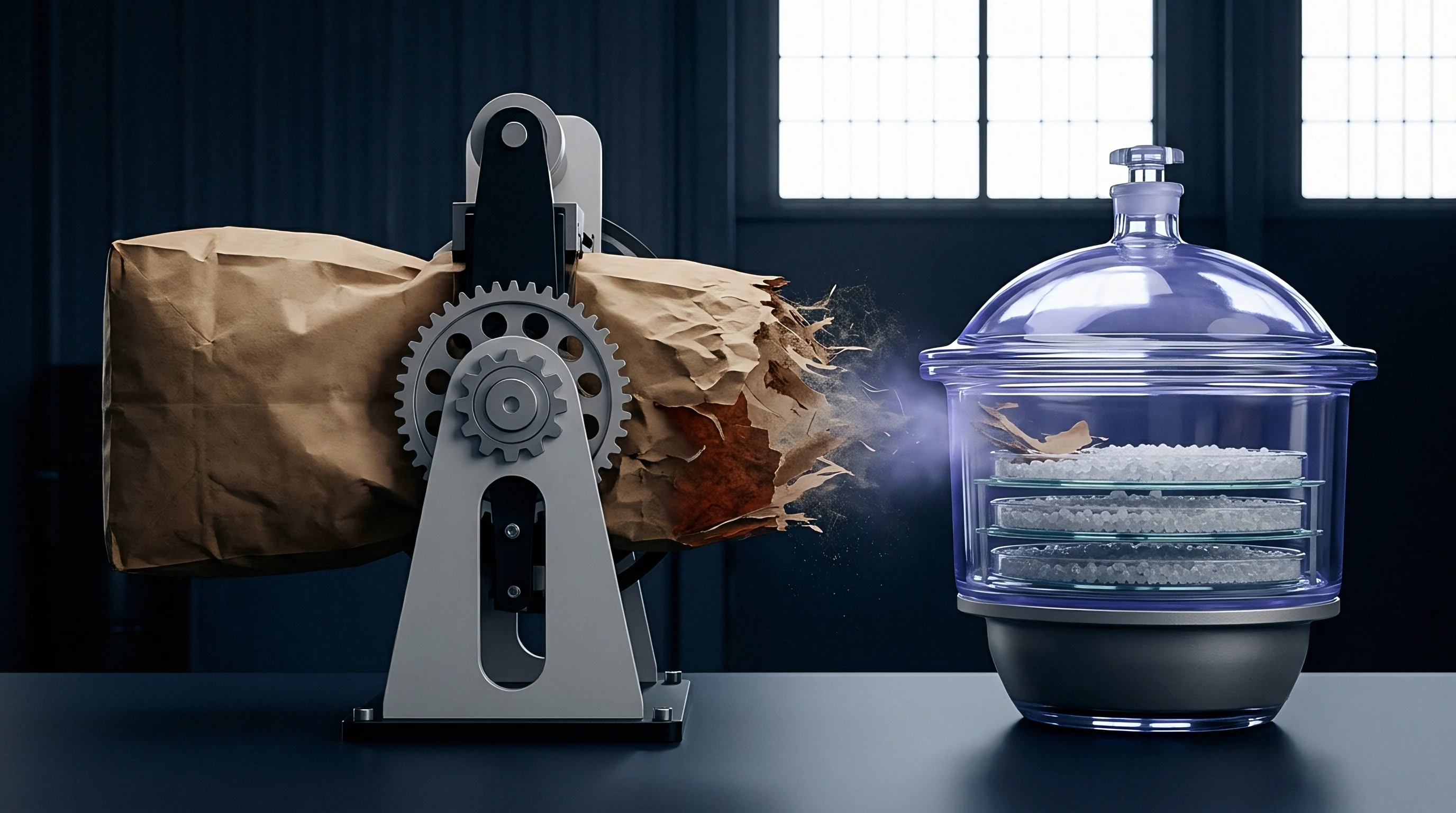
Simulating real intermodal freight microclimates requires advanced dynamic environmental test chambers. Traditional climate chambers maintain steady-state target conditions using simple closed-loop control systems. Standard static chambers control temperature to within plus or minus 1 degree Celsius and relative humidity to within plus or minus 3 percent RH.
Standard qualification protocols, including ASTM D4332 and ISO 2233, specify holding packaging specimens at fixed conditions for periods between twenty-four and seventy-two hours. While useful for quality control comparisons of raw paper grades, static exposure does not produce the moisture gradients, mechanosorptive fatigue, or thermal shock experienced during actual freight movements.
Standardization of dynamic climate chamber protocols requires explicit control over environmental ramp rates, air velocity across specimens, and transient moisture condensation cycles. A dynamic climate chamber engineered for intermodal qualification must feature programmable dynamic control systems capable of generating sinusoidal relative humidity profiles, abrupt step-change ramps, and dew point crossing events. Programmed relative humidity transition rates must range from 0.5 percent RH per minute up to 5.0 percent RH per minute, accompanied by thermal ramp rates of 1.0 degree Celsius per minute.
Replicating container sweat requires precision cooling of chamber walls or direct cold-plate contact to force localized liquid condensation onto specimen surfaces while maintaining control of bulk chamber air properties.
Can Static Atmospheric Conditioning Predict Dynamic Intermodal Stack Collapse?
Static atmospheric conditioning cannot predict dynamic intermodal stack collapse because it eliminates the physical driving force of mechanosorptive creep. Under static conditioning, moisture distribution within the paperboard reaches a uniform equilibrium state, establishing a constant strain rate under load. Real intermodal freight encounters continuous environmental shifts that generate transient internal moisture gradients.
These gradients force localized stress redistributions across the cross-section of the linerboards, accelerating plastic strain and causing structural failure at load levels far below predictions derived from static testing. Dynamic chamber testing exposes packaging to cyclic stress patterns that mimic true freight transport conditions.
| Protocol Standard Designation | Conditioning Regime Type | Temperature Control & Ramp Limits | Relative Humidity Control & Ramp Limits | Air Velocity Boundary Layer Target |
|---|---|---|---|---|
| ISO 2233 / ASTM D4332 | Static Equilibrium | Fixed setpoint (e.g. 23°C ±1°C) | Fixed setpoint (e.g. 50% ±2% RH) | Unspecified (0.1 to 0.5 m/s passive) |
| TAPPI T402 | Static Standard Lab | 23.0°C ±1.0°C | 50.0% ±2.0% RH | Controlled draft (0.15 m/s max) |
| ASTM D4169 (Schedule A) | Static Pre-conditioning | Multiple sequential fixed steps | Multiple sequential fixed steps | Passive air circulation |
| Dynamic Intermodal Standardized Protocol | Dynamic Cyclic & Sweat | Cyclic 15°C to 50°C (1.0°C/min ramp) | Sinusoidal 50% to 98% RH (2% RH/min) | Calibrated uniform flow (1.2 to 2.0 m/s) |
Airflow velocity inside the testing chamber represents a critical operational variable. Air movement controls the convective water vapor transfer coefficient between ambient chamber air and the boundary layer at the paperboard surface. In low-airflow static chambers, stagnant boundary layers slow down moisture absorption and desorption rates, artificially dampening the severity of ambient humidity shifts.
Dynamic climate chambers must maintain uniform, horizontal air velocities across test specimens calibrated between 1.2 meters per second and 2.0 meters per second. This air velocity ensures that thermal and vapor diffusion resistance across the air-surface boundary layer remains low, forcing the paperboard to react rapidly to external climatic ramps.
To implement an effective dynamic qualification protocol, environmental cycling must be coupled with simultaneous mechanical load application. Testing uncompressed boxes in a dynamic chamber and subsequently performing a compression test on a standard crush tester yields inaccurate results. Mechanical strength degradation occurs as a dynamic interaction between active vertical compression stress and transient moisture transfer.
Multi-station climate chambers equipped with servo-hydraulic or electromechanical actuators apply continuous top-load compression forces to individual packages throughout atmospheric cycling. Load cells measure creep deflection continuously, generating time-to-failure curves under dynamic environmental stress.
Standardizing the dynamic chamber protocol requires precise specification of the atmospheric profile sequence. A standardized protocol consists of three consecutive phases designed to replicate severe intermodal shipping conditions:
- Thermal Stabilization Phase ~ Specimens are conditioned at 23 degrees Celsius and 50 percent relative humidity for twelve hours to establish uniform initial moisture content baseline.
- Sinusoidal Moisture Cycling Phase ~ Chamber relative humidity is dynamically cycled between 50 percent RH and 92 percent RH on a four-hour cycle period for seventy-two hours, with air temperature maintained at 35 degrees Celsius.
- Dew Point Shock Phase ~ Air temperature is rapidly dropped from 40 degrees Celsius to 15 degrees Celsius within forty-five minutes while absolute humidity is maintained, forcing heavy liquid condensation onto outer facings for six hours.
Data acquisition systems monitoring dynamic climate qualification tests must measure specimen internal moisture content in real time. Non-destructive moisture measurement technologies, such as near-infrared spectroscopy sensors or high-frequency dielectric impedance sensors embedded within sample container walls, track moisture absorption continuously. Correlating instantaneous structural deformation with moisture ingress rates reveals the precise relative humidity threshold where plastic yield accelerates.
These measurement insights enable package designers to specify exact chemical sizing levels, wet-strength agent additions, or barrier coatings needed to protect structural integrity during vulnerable transit legs.
Chamber calibration protocols must undergo rigorous validation using traceable secondary reference standards. Relative humidity sensors utilizing chilled-mirror hygrometers provide the necessary measurement precision, as standard capacitive RH probes exhibit severe hysteresis drift when subjected to repeated condensation cycles. Capacitive sensors exposed to 98 percent relative humidity lose calibration accuracy, underreporting actual humidity levels during subsequent dry cycles.
Chilled-mirror hygrometry maintains absolute measurement accuracy across repetitive condensation cycles, ensuring that test results remain reproducible across independent laboratory sites. Calibration routines must occur every three months or immediately following high-condensation test programs.
Test protocols must specify air velocity across specimens, target relative humidity ramp rates, and continuous load profiles together, as omitting any single variable renders dynamic climate testing unrepeatable between independent laboratories.

Swell
Water absorption causes physical expansion of paper fibers, altering the macroscopic dimensions of the paperboard panel. Radial expansion of individual wood fibers forces the web structure to expand outward in thickness and cross-machine direction length. Fiber swelling exerts substantial internal shear forces within multi-ply paperboard structures.
In heavyweight linerboards manufactured on multi-wire paper machines, individual plies exhibit varying fiber alignments and sizing levels. When high ambient relative humidity penetrates the multi-ply sheet, differential swelling between the top ply and base ply induces internal stress. This internal stress leads to blister formation, ply separation, and significant loss of z-direction tensile strength, measured under ISO 15754.
Adhesive joints experience severe stress during fiber swelling cycles. Corrugated medium flutes bonded to linerboard facings with starch adhesive form rigid geometrical triangles. As the linerboard facing expands in the cross-machine direction, it exerts lateral pull on the flute tips.
Simultaneously, the corrugated medium swells and alters its flute height profile. The geometric mismatch between expanding liner facings and deforming corrugated medium creates severe shear stress directly across the adhesive bond line. Under cyclic humidity conditions, this stress alternates direction repeatedly, inducing mechanical fatigue in the starch glue line.
Micro-cracks initiate within the brittle starch matrix, propagating along the flute-liner interface until bond separation occurs.
Wet-strength resins must achieve a minimum cross-linked network retention efficiency of 15 percent of dry tensile strength after 24 hours of full water immersion under ISO 3781.
Enhancing wet resistance requires wet-strength resin chemical additions during the wet-end papermaking process. Polyamide-epichlorohydrin (PAE) resins are widely utilized in neutral-to-alkaline papermaking to establish water-resistant covalent bonds across fiber networks. PAE resins cross-link with unreacted hydroxyl groups on cellulose and self-crosslink to form a hydrophobic polymer network around fiber-to-fiber contact points.
This polymer network acts as a physical reinforce structure that prevents fiber-to-fiber bond dissolution upon water immersion. Adding 0.5 percent to 1.5 percent dry resin mass of PAE to virgin or recycled fiber furnish retains 15 percent to 30 percent of the sheet’s dry tensile strength when fully saturated with water.
Chemical Functionalization and Wet-Strength Resin Mechanisms
Paper recycling requirements impose strict boundary conditions on the use of wet-strength resins. Regulatory frameworks, including the European Union Packaging and Packaging Waste Regulation (PPWR) and harmonized standards like EN 13430, mandate that packaging components demonstrate recyclability within standard repulping operations. Highly cross-linked PAE resin networks resist mechanical repulping in neutral water at standard temperatures, leaving un-defibered paper fragments known as flakes in the recycled pulp slurry.
These flakes clog paper machine screens and create structural defects in newly manufactured sheets. Qualification protocols must evaluate wet-strength performance together with repulpability metrics defined by Cepi or PTS method PTS-RH 021/97.
- Excessive PAE Cross-Linking ~ Heavy dosing of polyamide-epichlorohydrin resin above 1.8 percent dry weight creates insoluble fiber networks that yield repulping flake counts above allowable 1.5 percent limits.
- Hydrolytic Starch Degradation ~ Un-modified starch glues undergo complete dissolution under condensing relative humidity, resulting in complete bond line separation across flute tips.
- Sizing Agent Desorption ~ Migration of residual surfactant chemicals reduces the hydrophobic contact angle of alkyl ketene dimer sizing, converting water-repellent surfaces into hydrophilic absorption sites.
- Z-Direction Delamination ~ Differential hygroexpansion between distinct plies in heavyweight linerboards generates internal shear stresses that cause structural multi-ply sheet splitting.
Alternative wet-strength chemistry solutions utilize temporary wet-strength additives, such as glyoxalated polyacrylamide (GPAM). GPAM resins form reversible hemiacetal bonds with cellulose hydroxyl groups. These covalent bonds provide structural stability during short-term liquid contact or temporary humidity spikes.
When immersed in large volumes of water during industrial recycling repulping operations, the hemiacetal bonds hydrolyze cleanly, allowing complete fiber defibering without specialized chemical treatments. GPAM chemistry achieves effective wet-strength performance during brief high-humidity exposure while ensuring full compliance with circular economy recyclability mandates.
| Resin System Additive Type | Dosage Rate (% Dry Fiber) | Retained Wet Tensile Ratio (ISO 3781) | Cepi Repulpability Pass / Fail Rating | Food Contact Compliance Status |
|---|---|---|---|---|
| Unmodified Native Starch | 2.0% – 3.5% | 2% – 4% (Fails wet integrity) | Pass (100% yield, zero flakes) | Compliant (BfR XXXVI / FDA) |
| Polyamide-Epichlorohydrin (PAE) | 0.8% – 1.2% | 18% – 25% (High wet strength) | Conditional (Requires hot repulping) | Restricted (1,3-DCP & 3-MCPD limits) |
| Glyoxalated Polyacrylamide (GPAM) | 0.5% – 1.0% | 12% – 18% (Temporary strength) | Pass (Clean defibering at neutral pH) | Compliant (Regulated monomer limits) |
| Melamine-Formaldehyde (MF) | 1.5% – 2.5% | 22% – 30% (Extreme wet strength) | Fail (Generates high flake fraction) | Non-compliant for direct food contact |
Barrier coatings provide an additional line of defense against moisture ingress. Polyethylene extrusions, water-based dispersion coatings, and bio-based wax alternatives create continuous films over paperboard facings. Water-based dispersion coatings utilizing styrene-butadiene or acrylic copolymers offer effective resistance against liquid water ingress while maintaining repulpability.
The continuous film blocks liquid water droplets from accessing the hydrophilic paper surface, preventing surface swell and dimensional distortion. Barrier coatings must maintain flexibility across operational temperatures. Low temperatures in refrigerated containers cause brittle coating cracking along package fold lines and crease scores.
Cracks break barrier continuity, allowing rapid moisture ingress along stress lines.
Chemical additives used to impart wet strength or water resistance must meet strict food contact regulations when packaging is used for direct or indirect food transport. European Regulation (EC) No 1935/2004 and the German BfR Recommendation XXXVI govern paper and board materials intended for food contact. PAE resins often contain reaction byproducts such as 1,3-dichloro-2-propanol (1,3-DCP) and 3-chloro-1,2-propanediol (3-MCPD).
These substances are potential carcinogens and strictly regulated under European law. Chemical compliance verification requires migration testing using food simulants under specific time and temperature conditions defined in EN 1186 and EN 11886. Packaging suppliers must verify that chemical dosing levels balance mechanical performance requirements with chemical migration compliance boundaries.
Optimizing chemical dosing of temporary wet-strength resins requires converters to satisfy structural creep retention during a twenty-one day ocean voyage while remaining within strict European Union recyclability flake limits.
Audit
Documentary verification forms the foundation of commercial qualification files for intermodal packaging. A physical package test report issued by an accredited laboratory demonstrates performance for the tested sample, but fails to prove compliance for ongoing commercial production lots unless backed by chain-of-custody documentation and robust quality control systems. Verification requires tracing every packaging component from certified raw material suppliers through converting facilities to the final packaging line.
Chain-of-custody schemes, such as FSC (FSC-STD-40-004) and PEFC (PEFC ST 2002), provide formal frameworks for tracking certified wood fiber inputs across complex global supply chains.
When reviewing certification documents, technical auditors must cross-check claims against public verification databases. A printed logo on a corrugated box provides no legal guarantee of compliance. Auditors must verify certificate registration numbers, certificate status (valid, suspended, or terminated), scope details, and covered product groups on the official FSC or PEFC online registries.
Converter certificates must cover specific paperboard manufacturing operations, fluting profiles, and facility locations. A certificate held by a parent corporation does not extend automatically to secondary converting sites unless those sites are explicitly listed in multi-site certificate annexes.
Quantitative nitrogen content assays confirm polyamide-epichlorohydrin dosing levels when reviewing mill declarations for wet-strength resins. Technical declarations issued by mills must detail chemical additive composition, dry-weight percentage additions, and compliance status under relevant regulations. Declarations claiming wet-strength performance must specify the exact chemical abstract service (CAS) numbers of active resin ingredients and provide clear safety data sheets.
Technical claims lacking verified laboratory test data or standard test method references must be treated as unverified marketing declarations and rejected during compliance file audits.
A structured compliance verification sequence establishes the documentary proof required to validate intermodal freight packaging for commercial deployment:
- Verify certificate registration status and product scope on the official public FSC or PEFC database registry to confirm valid chain-of-custody coverage.
- Cross-check purchase orders, delivery receipts, and commercial invoices to ensure certified claim statements match physical material shipments exactly.
- Audit mill safety data sheets and chemical compliance declarations to confirm wet-strength additives meet European Union food contact limits under BfR Recommendation XXXVI.
- Inspect accredited test reports issued under ISO/IEC 17025 to verify that dynamic environmental chamber conditioning followed specified relative humidity and load parameters.
- Review repulpability assessment reports performed under PTS-RH 021/97 to confirm wet-strength resin dosing remains within statutory circular economy recyclability thresholds.
Test reports submitted to support packaging qualification must originate from testing facilities accredited under ISO/IEC 17025. The scope of accreditation must explicitly list the test standards utilized in the report, including ISO 2233, ISO 12048, or ASTM D4169. Test reports issued by non-accredited internal mill laboratories lack independent regulatory credibility and fail to provide legal protection during commercial damage disputes.
The test report must detail sample selection procedures, specimen conditioning histories, ambient laboratory temperature and humidity logs recorded during testing, exact instrument calibration dates, and individual sample standard deviations.
The Packaging and Packaging Waste Regulation (PPWR) introduces mandatory compliance requirements across European Union member states. Article 6 of the PPWR mandates that all packaging placed on the market must be recyclable according to standardized design-for-recycling criteria. Recyclability is graded into performance categories based on yield rates and defibering efficiency.
Packaging containing non-separable wet-strength agents or plastic laminate barriers that reduce repulping yield below 70 percent faces commercial sales bans or severe eco-modulation fee penalties under Extended Producer Responsibility (EPR) schemes. Compliance dossiers must include formal repulpability certificates issued by recognized testing institutes to prove PPWR readiness prior to market introduction.
Verifying food contact safety for recycled paperboard packages requires comprehensive migration analysis. Mineral oil hydrocarbons, comprising mineral oil saturated hydrocarbons (MOSH) and mineral oil aromatic hydrocarbons (MOAH), migrate from recycled newsprint inks into dry food products stored in paperboard containers. High-humidity storage accelerates MOSH and MOAH vapor phase migration through paper layers.
Migration testing using food simulant Poly(2,6-diphenyl-p-phenylene oxide), commercially known as Tenax, evaluated under EN 14338, quantifies organic chemical migration into dry foods during extended storage. Qualification files must contain migration testing data proving that MOSH/MOAH fraction levels remain below health guidance thresholds established by national food safety authorities.
Standard purchase contract clause: “The supplier warrants that all delivered packaging materials strictly conform to certified scope specifications under FSC-STD-40-004, maintain wet strength resin retention yielding full compliance with repulpability standard PTS-RH 021/97, and carry traceable ISO/IEC 17025 test certificates validating dynamic climatic stack endurance; non-conforming shipments shall be returned at supplier expense together with full indemnification for consequential transit freight damages.”
Contract
Commercial risk allocation in intermodal logistics depends on precise technical performance specifications written into supply agreements. Standard commercial purchase agreements frequently use vague quality descriptors, such as heavy-duty board or export-quality packaging. These imprecise terms lack standardized legal definitions, leaving buyers unprotected when packages suffer moisture-induced creep failure during transit.
Buyers must replace subjective language with precise engineering metrics, including minimum short-span compressive strength (ISO 9895), burst strength (ISO 2759), Cobb 60 water absorption (ISO 535), and dynamic humidity creep deflection limits measured under standardized chamber cycling protocols.
Defining clear pass/fail criteria in packaging procurement contracts shifts financial liability for failure during ocean transit directly onto the converting supplier. A legally enforceable performance clause specifies the maximum allowable vertical deflection of stacked packages subjected to dynamic environmental conditioning. A contract clause may dictate that fully loaded packages subjected to 72 hours of dynamic relative humidity cycling between 50 percent and 92 percent RH under a 1.5x stacking safety factor load shall exhibit a total compression deflection not exceeding 8.0 millimeters, with zero panel structural buckling.
Exceeding deflection limits constitutes a technical material breach, entitling the buyer to reject the manufacturing lot.
Inclusion of explicit liability transfer clauses protects brand owners from secondary financial losses associated with packaging failure during intermodal freight operations. When packaging collapses inside a container, direct damage to the immediate package represents a minor fraction of total financial loss. Total financial exposure includes damaged primary product cargo, vessel unloading delay fines, port demurrage charges, re-palletization labor costs, and customs penalty fees assessed on damaged shipments.
Contracts must define whether supplier warranties cover indirect consequential damages or remain capped at the replacement value of the packaging material. Capping liability at packaging replacement value leaves buyers exposed to substantial freight damage costs.
Risk management requires integrating supply chain insurance terms directly with packaging qualification files. Cargo insurers routinely refuse indemnity payments for freight damage caused by inadequate or improper packaging, citing standard exclusion clauses in marine insurance policies (such as Institute Cargo Clauses A, Clause 4.3). Insurers maintain that package collapse under normal ocean transit humidity profiles constitutes inherent vice or unsuitability of packaging.
Operating with complete, accredited dynamic climate chamber qualification files disproves insurer claims of packaging inadequacy. Traceable compliance dossiers prove the packaging was engineered and verified to withstand foreseeable transit stresses, compelling insurers to settle claims for transit damage caused by extraordinary carrier delays or vessel equipment failures.
Substrate substitution executed by converting mills during paper supply shortages presents a critical commercial exposure point. Converters facing kraft linerboard shortages frequently substitute lower-cost recycled testliners without updating customer specifications or modifying package design geometry. Recycled liners absorb water faster and exhibit higher creep sensitivity under dynamic humidity than virgin kraft liners.
Procurement agreements must contain strict change control provisions requiring written buyer approval prior to any substrate substitution, mill source change, or chemical additive alteration. Unauthorized material substitutions void supplier warranty protections, triggering automatic financial indemnity for subsequent freight failures.
Calculating the true landed cost of packaging systems requires balancing initial unit purchase prices against total risk-adjusted transit exposure. Specifying high-performance virgin linerboard with optimized wet-strength chemistry and hydrophobic barrier coatings increases initial packaging unit costs by 15 percent to 25 percent. A single container load failure resulting in collapsed pallets, damaged product, and port rejection creates financial losses that eclipse the marginal purchase cost savings achieved by buying lower-grade unconditioned packaging.
Advanced dynamic climate chamber qualification converts unpredictable logistical failure risks into quantifiable, manageable material engineering specifications, securing cross-border freight transit across volatile climatic corridors.