Polyisocyanate Crosslinker Density Adjustments for High Humidity Crease Crack Prevention in Coated Board
Balancing polyisocyanate addition at 3.5 to 4.5 percent solids maintains high-humidity barrier holdout while preserving the elongation needed to prevent score cracking.


Stoichiometry
Crosslink Density Targets for Barrier Coatings
Water-dispersible aliphatic polyisocyanates react across hydroxyl and carboxyl functional groups in aqueous acrylic or polyurethane dispersions to generate dense crosslinked lattices. Formulators index this reaction through the molar ratio of isocyanate groups to reactive hydroxyl groups, designated as the NCO:OH index. At an index above 1.35, excess isocyanate reacts with ambient water during film drying, forming rigid polyurea domains that elevate the glass transition temperature of the dried coating past 42 degrees Celsius.
The dried film loses tensile compliance. When the board enters the die-cutting platen, the topcoat splits along the apex of the fold.
Tensile elongation governs crease survival. Coated folding boxboard subjected to a 180-degree crease experiences tensile surface strain between 8 percent and 15 percent depending on board caliper and scoring channel clearance. A coating crosslinked to an ultimate elongation below 12 percent fractures when the female channel forces the board into a bead.
Restricting the polyisocyanate dosage between 3.0 percent and 5.5 percent wet weight on dry polymer solids preserves an elongation at break of 18 percent at 23 degrees Celsius and 50 percent relative humidity. That elasticity cushions the bead.
A polyisocyanate addition level of 4.2 percent on binder solids maintains tensile elongation above 16 percent across forty-eight hours of post-cure conditioning at 38 degrees Celsius and 90 percent relative humidity.
Hexamethylene diisocyanate trimers, specifically hydrophilic isocyanurate trimers modified with polyether chains, disperse directly into aqueous topcoats without high-shear mixing. Hydrophilic polyether modifications lower the initial chemical resistance of the film compared to solventborne monomeric counterparts. They permit uniform distribution across carboxylated styrene-butadiene or acrylic latex emulsions without seeding.
When mechanical agitation blends the crosslinker into the coating vat, pot life drops to four hours at 25 degrees Celsius. Secondary reactions consume functional isocyanate over time, altering crosslink density from the start of a roll to the core.
Hydrophilic Index Balance and Elastic Recovery
Formulations relying on unmodified polyisocyanates yield localized micro-gel clusters that act as stress concentration points during bending. Polyether-modified hexamethylene diisocyanates disperse uniformly, yet excessive polyether content draws moisture into the polymer network during storage. Bound moisture hydrolyzes remaining carbamate bonds over extended ocean transit.
Balancing hydrophilic polyether modification against hydrophobic aliphatic cores preserves flexibility while locking out ambient water vapor.
Chemical crosslinking alters film performance across several distinct binder chemistries. Table 1 outlines the functional bounds across typical waterborne systems running on coated paperboard lines.
| Binder System | Crosslinker Chemistry | NCO:OH Index | Film Tensile Elongation (%) | Cobb 600 Water Absorption (g/m²) |
|---|---|---|---|---|
| Carboxylated Styrene-Acrylic | Hydrophilic Aliphatic HDI Trimer | 1.05 to 1.15 | 14 to 18 | 18.5 |
| Anionic Polyurethane Dispersion | Sulfonate-Modified HDI Trimer | 1.10 to 1.20 | 22 to 28 | 12.1 |
| Styrene-Butadiene Latex | Polyether-Modified HDI Trimer | 0.95 to 1.05 | 12 to 16 | 22.4 |
| Acrylic-PUD Hybrid | Low-Viscosity HDI Biuret | 1.15 to 1.25 | 17 to 21 | 14.8 |
Chemical vendors assert that post-cure embrittlement reflects converter scoring rule selection rather than crosslinker stoichiometry.
Moisture

Why Unreacted Isocyanate Groups Cause Brittle Failure
Ambient water vapor penetrates dried aqueous films when pallets sit in unconditioned converting halls. Residual isocyanate groups unreacted during the drying tunnel pass encounter this moisture, yielding carbamic acid intermediates that decarboxylate into primary amines and carbon dioxide gas. The resulting amine reacts instantly with a neighboring isocyanate molecule to form a disubstituted urea linkage.
This secondary urea network builds over four to seven days inside the wound reel. Urea linkages introduce severe hydrogen bonding, raising film modulus and dropping elongation at break by half.
Storage at elevated relative humidity accelerates urea generation. Board held at 85 percent relative humidity reaches moisture equilibrium in seventy-two hours. Cellulose fibers swell, expanding the thickness of the base sheet while softening the starch-bound basecoat layer.
The brittle polyurea-rich topcoat sits atop a plasticized, compliant substrate. When the creasing rule strikes the reverse face, shear displacement detaches the brittle topcoat from the expanding basecoat, producing jagged micro-fissures along the crease shoulder.

Cellulose Fiber Swelling and Interface Shear
Fiber dimensional changes drive shear forces at the interface. Cross-direction swelling of hardwood and softwood kraft pulp reaches six to nine percent under exposure to 90 percent relative humidity at 38 degrees Celsius. The synthetic latex topcoat expands less than one percent under identical exposure.
This hygroscopic mismatch generates internal shear stress along the coating-fiber interface. A crosslinker that produces a rigid network converts that interfacial stress into adhesive delamination, separating the topcoat from the underlying board fibers.
Coating formulators mitigate this interface cleavage through specific compound choices:
- Sulfonated polyisocyanate crosslinkers maintain uniform dispersion without introducing long polyether chains that attract water vapor into the cured matrix.
- Polycaprolactone polyols provide soft-segment backbones that yield elastic deformation during rapid cross-directional fiber expansion.
- Blocked aliphatic isocyanates prevent premature crosslinking in storage vats, releasing functional groups only under radiant dryer heat.
- Polyethylene glycol plasticizers lower internal stress by interrupting rigid polyurea crystalline domains inside the dried film.
A coating film containing flexible soft segments absorbs hygroscopic dimensional expansion without rupturing the surface barrier.
Water resistance declines if crosslinker content drops too low. When the isocyanate dosage falls below 2.5 percent, Cobb 60 values climb past 45 grams per square meter, allowing water droplets to soften the clay pre-coat beneath. The creasing matrix then crushes the saturated base sheet, leaving a bruised, mushy fold that tears open on high-speed folder-gluers.
Controlling the crosslinker index between 1.05 and 1.15 delivers the exact threshold where water repellency remains intact while cross-link density stays low enough to survive mechanical folding.
Excessive curing creates glass while insufficient curing yields mush.

Rule
Channel Clearance and Crease Bead Formation
Scoring geometry determines whether the crosslinked barrier coating sustains pure compressive deflection or fatal tensile tearing. The scoring rule pushes the board into a counter-creasing channel, breaking internal fiber bonding to create an internal delamination bubble without rupturing surface layers. For a 400-micron solid bleached sulfate board, a two-point rule measuring 0.71 millimeters in width pairs with a counter channel width calculated as rule width plus 1.5 times board caliper.
This setup yields a female channel width of 1.31 millimeters.
Narrowing the channel concentrates tensile strain. When press operators employ a channel width equal to rule width plus 1.1 times board caliper to sharpen fold lines, surface elongation on the outer coating layer spikes from 9 percent to 24 percent. No crosslinked topcoat sustains that strain level under humid conditions.
The scoring rule tears directly through the pigment layer, leaving exposed raw fibers along the carton edge. Tooling setup dictates failure modes.
Mechanical Strain Distribution across Tooling Profiles
The tip radius of the creasing rule influences stress concentration. Flat-topped rules create dual shear peaks at their edges, initiating twin longitudinal cracks along the crease shoulders. Fully radiused rules distribute compressive load evenly across the female matrix channel.
Table 2 details standard scoring parameters and the resulting tensile strain values generated on the exterior coating layer for various caliper grades.
| Board Caliper (µm) | Rule Thickness (pt / mm) | Channel Width (mm) | Channel Depth (mm) | Calculated Surface Strain (%) |
|---|---|---|---|---|
| 300 | 1.5 pt / 0.53 mm | 0.98 | 0.30 | 7.5 |
| 350 | 2.0 pt / 0.71 mm | 1.24 | 0.35 | 8.8 |
| 400 | 2.0 pt / 0.71 mm | 1.31 | 0.40 | 11.2 |
| 450 | 3.0 pt / 1.05 mm | 1.73 | 0.45 | 13.8 |
| 500 | 3.0 pt / 1.05 mm | 1.80 | 0.50 | 16.5 |
| Values determined under ISO 187 conditioning at 23 degrees Celsius and 50 percent relative humidity using counter matrix creasing. | ||||
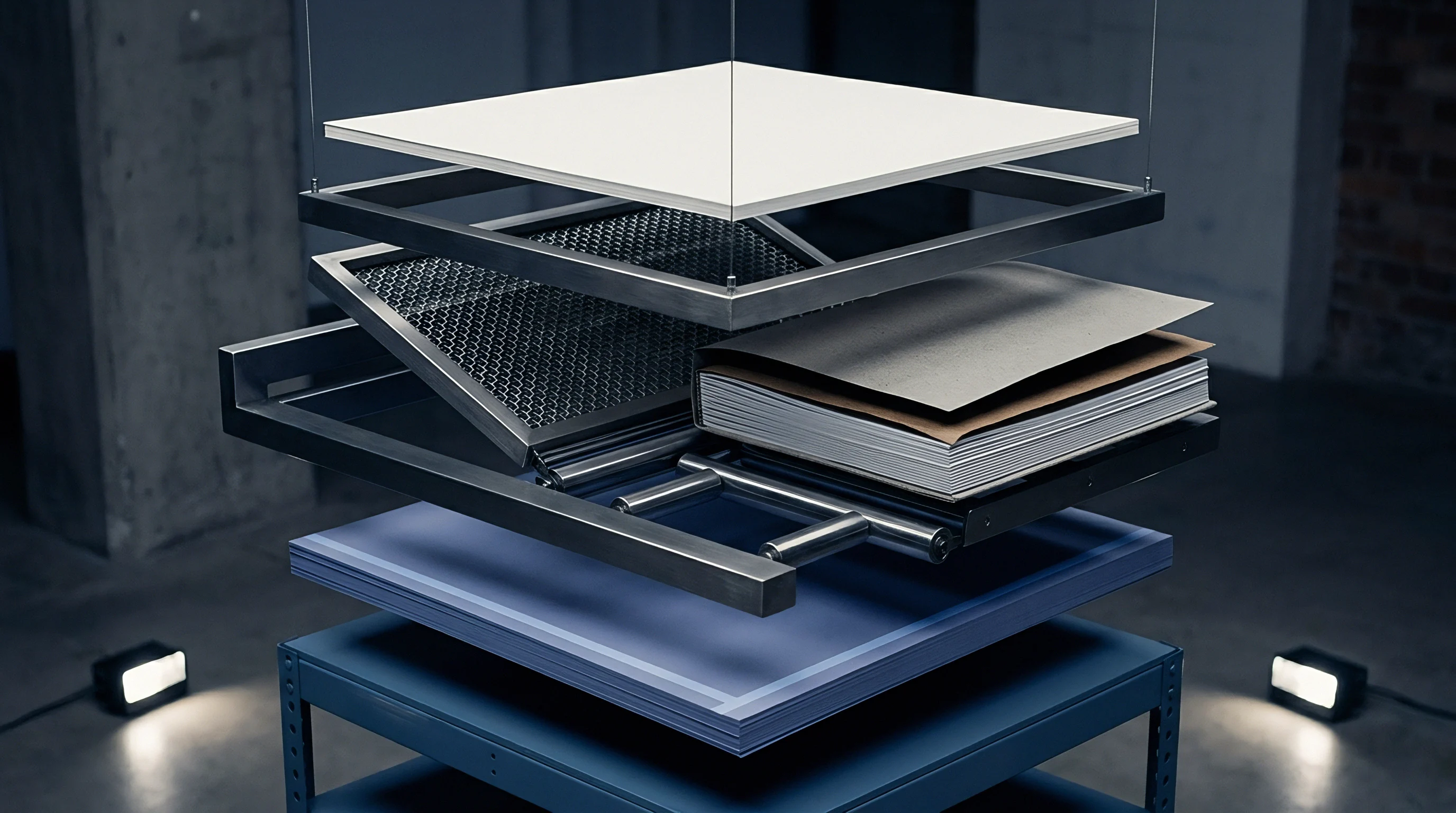
Creasing quality across folding carton runs requires verification through DIN 55437 crease testing, where bending moment curves establish whether internal delamination occurred without coating fracture. Figure 1 clarifies the mechanical sequence on the press platen.
- The radiused steel scoring rule contacts the topcoat surface directly over the center of the phenolic counter-creasing matrix.
- Downward rule penetration compresses the solid bleached board, forcing internal plies to split and form a controlled hinge bead inside the female channel.
- The coated outer ply bends around the channel shoulders, placing the crosslinked polyisocyanate topcoat under localized tensile strain.
- The scoring rule retracts, leaving a defined permanent crease line capable of 180-degree folding without surface flaking.
DIN 55437 acceptance standards mandate a crease ratio between 1.5 and 2.2 to verify that internal delamination occurred without external coating rupture.
Purchasing agreements governing export board packaging specify DIN 55437 compliance across delivered carton lots to validate that barrier coatings withstand high-humidity machine folding without seam failure.

Strain
Will Plasticizing Co-Binders Preserve Crease Elasticity?
Modifying the primary polymer dispersion with ductile co-binders alters the mechanical response of the polyisocyanate-cured matrix. Polyurethane dispersions featuring polycarbonate or polyether soft segments incorporate into acrylic emulsions, functioning as internal stress dissipators. When an aliphatic isocyanate crosslinks the carboxyl groups of an acrylic, the polycarbonate segments remain uncrosslinked, preserving amorphous regions that deform elastically during carton scoring.
A formulation utilizing 70 percent hard acrylic and 30 percent soft polyurethane dispersion delivers an elongation at break of 26 percent while retaining a water vapor transmission rate under 15 grams per square meter per day at tropical test conditions.
Phase separation threatens mixed binder integrity. Blending incompatible dispersions induces macro-phase separation upon water evaporation, generating hazy films with uneven crosslink density across the sheet. Uncrosslinked polyurethane puddles form soft spots that scuff during transport, while acrylic-rich domains crosslink excessively, creating brittle islands that crack when bent.
Co-binders must exhibit matched particle size distributions, specifically between 80 and 140 nanometers, and matched anionic charge densities to prevent flocculation in the coating pan.
Dynamic Mechanical Analysis of High-Humidity Plasticization
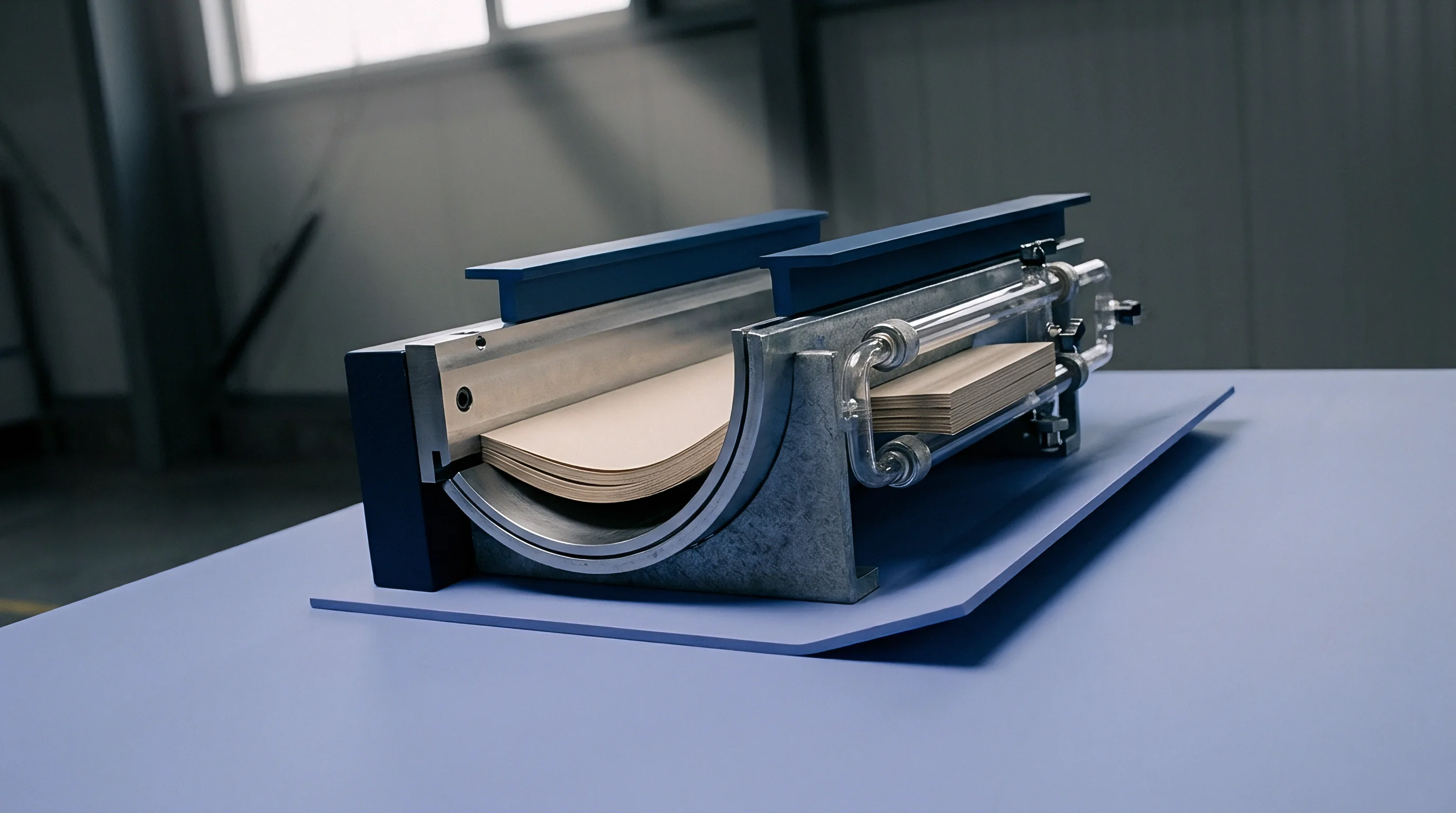
Dynamic mechanical thermal analysis measures glass transition temperature shifts under fluctuating humidity. Dry crosslinked coatings exhibit a primary glass transition temperature of 38 degrees Celsius. Conditioning the same film at 38 degrees Celsius and 90 percent relative humidity depresses the glass transition temperature to 14 degrees Celsius as absorbed water plasticizes hydrophilic regions.
The storage modulus drops from 1.8 gigapascals to 420 megapascals. Plasticization increases elongation, yet it lowers yield strength, predisposing the coating to adhesive peeling when the folded carton rubs against neighboring cartons inside shipping shippers.
The creasing test protocol evaluates mechanical durability across defined environmental exposures:
- Atmospheric conditioning holds die-cut blanks at 38 degrees Celsius and 90 percent relative humidity for seventy-two hours inside an environmental chamber.
- Pneumatic folding executes a rapid 180-degree fold along pre-creased lines at a speed of sixty cycles per minute on an automated folder.
- Pin-hole staining floods the folded crease with an aqueous dye solution containing copper sulfate and a surfactant for thirty seconds.
- Microscopic inspection records the length and frequency of dye penetration tracks through the coating into the baseboard fibers.
Residual strain patterns vary between crosslinking approaches. Table 3 compares three chemical formulations evaluated under identical die-cutting and environmental conditioning regimes.
| Formulation Type | Crosslinker Level (wt %) | Fold Crack Frequency (cracks/m) | Water Vapor Transmission (g/m²·day) | Visual Scoring Rating |
|---|---|---|---|---|
| Standard Acrylic + High HDI | 6.5 | 42 | 8.2 | Poor / Continuous Split |
| Optimized Acrylic + Low HDI | 4.0 | 3 | 12.4 | Pass / Micro-Fissures Only |
| Acrylic-PUD + Sulfonated HDI | 4.5 | 0 | 9.8 | Pass / Clean Hinge |
| Uncrosslinked Control | 0.0 | 0 | 48.5 | Fail / Complete Barrier Loss |
Whether prolonged exposure to sub-zero freezer temperatures reverses the protective elasticity gained through soft-segment formulation remains an open question across high-barrier folding boxboard grades.
Outlay
Coating Pass Economics and Material Chemistry Premiums
Raw material decisions dictate unit economics across large packaging runs. Standard carboxylated acrylic dispersions trade at approximately 2.80 dollars per dry kilogram, whereas flexible anionic polyurethane dispersions cost between 5.50 and 7.20 dollars per dry kilogram. Hydrophilic aliphatic polyisocyanate crosslinkers add 14.00 to 18.50 dollars per wet kilogram.
Introducing a 4.5 percent polyisocyanate addition level into an acrylic topcoat adds 0.012 dollars per square meter of coated board. Moving to an acrylic-polyurethane hybrid dispersion crosslinked with sulfonated isocyanates elevates raw coating cost to 0.038 dollars per square meter.
Waste calculations validate higher chemical expenditures. Take a 20-tonne production run of 350-gram folding boxboard converted into frozen seafood cartons, representing approximately 57,000 square meters of material. Applying a low-cost, high-index crosslinked coating yields a chemical cost of 684 dollars for the topcoat.
If high humidity creasing causes a three percent carton rejection rate at the customer high-speed filling line due to barrier leaks along scored edges, the resulting financial loss includes remanufacturing costs, freight, and scrap disposal fees totaling 4,200 dollars. Investing an additional 1,480 dollars in an optimized hybrid formulation with reduced isocyanate density eliminates the cracking defect entirely, returning a net savings of 2,720 dollars across the lot.
Modulated EPR Fees and Recyclability Grade Penalties
Packaging levies under European Producer Responsibility schemes penalize unrecyclable composite boards. Polyisocyanate-crosslinked barrier coatings that maintain low crosslink density disperse readily during standard hydrapulper screening at 40 degrees Celsius. Coatings cured with excessive polyisocyanate index form insoluble, rubbery micro-flakes that blind papermaking screens, reducing fiber yield below the 85 percent threshold established by the EN 13430 recyclability standard.
Cartonboard failing recyclability assessments incurs maximum packaging disposal fees, escalating from 45 euros per tonne for fully circular fiber packaging to 240 euros per tonne for non-recyclable composite materials.
Food contact certifications place rigorous constraints on crosslinker additions. European Regulation 10/2011 limits specific migration of aromatic and aliphatic amines derived from hydrolyzed isocyanates to 0.01 milligrams per kilogram of food simulant. Excess polyisocyanate added to waterborne coatings leaves unreacted NCO groups that hydrolyze into free amines over extended storage.
An improperly formulated crosslinker level invalidates the food contact declaration of compliance, halting shipment releases at port customs checkpoints.
Miscalculating crosslinker stoichiometry produces cartons that leak along scorelines, fail automated packaging lines, and face costly lot rejections at destination docks.