Paperboard Crease Bending Resistance Evaluation Standard Laboratory Test Protocols
Crease evaluation measures 15-degree sheet stiffness against 90-degree fold resistance, targeting a 30 to 50 percent ratio to prevent cartoning line jams.

Geometry
Delivered pallets of coated folding boxboard arrive at goods-in with thickness certificates that conceal hinge performance. The standard laboratory evaluation of crease bending resistance separates the inherent flexural rigidity of the uncreased substrate from the residual force demanded to fold a prepared score line through a designated angle. Testing according to BS 6965-1 and ISO 2493-1 establishes a two-axis metric: bending resistance of the intact sheet measured at a 15-degree deflection, and crease recovery measured at 90 degrees.
Converting lines running carton blanks at 600 units per minute depend entirely on the mechanical drop between these two numbers. If the crease fails to collapse internally, the panel bows, the carton jams in the folding hopper, and side-seam gluers lose register.
Apparatus configurations split across two established geometries. ISO 2493-1 specifies a 50 mm bending length deflected through 15 degrees at a rate of 5 degrees per second, yielding bending resistance in millinewtons. In contrast, BS 6965-1 and TAPPI UM 403 employ a 10 mm or 50 mm gauge length deflected through a full 90-degree fold within a dwell time of 2.0 to 15.0 seconds.
High-speed cartoning packaging machines execute folding motions in milliseconds. Standard laboratory instruments measure quasi-static resistance over several seconds. The mechanical relationship between these time domains rests on viscoplastic relaxation within the cellulose network.
Conditioning test specimens at 23 degrees Celsius and 50 percent relative humidity under ISO 187 fixes carton board equilibrium moisture between 6.5 and 7.5 percent before any physical deflection occurs.
Specimen preparation dictates the variance of the resulting data. Precision rotary or punch cutters isolate test strips of 38 mm width, aligned strictly parallel and perpendicular to the machine direction. Misalignment by as little as three degrees introduces torsion into the load cell, corrupting pure bending values with shear strain.
The test protocols demand ten valid replicates per board direction. Machine direction scores fold across the transverse axis of aligned fibres, demanding deeper die penetration to disrupt the tensile network of the outer ply. Cross direction scores run parallel to fibre alignment, collapsing at lower peak loads with higher risk of ragged surface split.
Do Tooling Dimensions Govern Resistance Values?
Die-cutting parameters set the initial boundary conditions for laboratory assessment. A steel cutting rule forces the paperboard into an underlying counter-matrix channel, generating controlled shear across internal sheet plies without fracturing the top coating. The standard calculation for channel width balances rule thickness against caliper:
Channel Width = Creasing Rule Thickness + (1.5 × Board Caliper)
Matrix depth corresponds directly to uncompressed board caliper, typically specified as 1.0 to 1.05 times the caliper for solid bleached sulfate and 1.10 to 1.15 times the caliper for multi-ply folding boxboard. A rule width of 0.71 mm paired with a board thickness of 0.45 mm produces an optimal matrix width of 1.385 mm, commercially rounded to a 1.40 mm counter channel. Deviations from this relationship distort laboratory measurements.
An excessively narrow channel shears the liner, lowering measured 90-degree resistance while creating cosmetic micro-fractures along printed score lines. An excessively wide channel yields insufficient ply delamination, generating elevated bending resistance that stalls packaging line pushers.
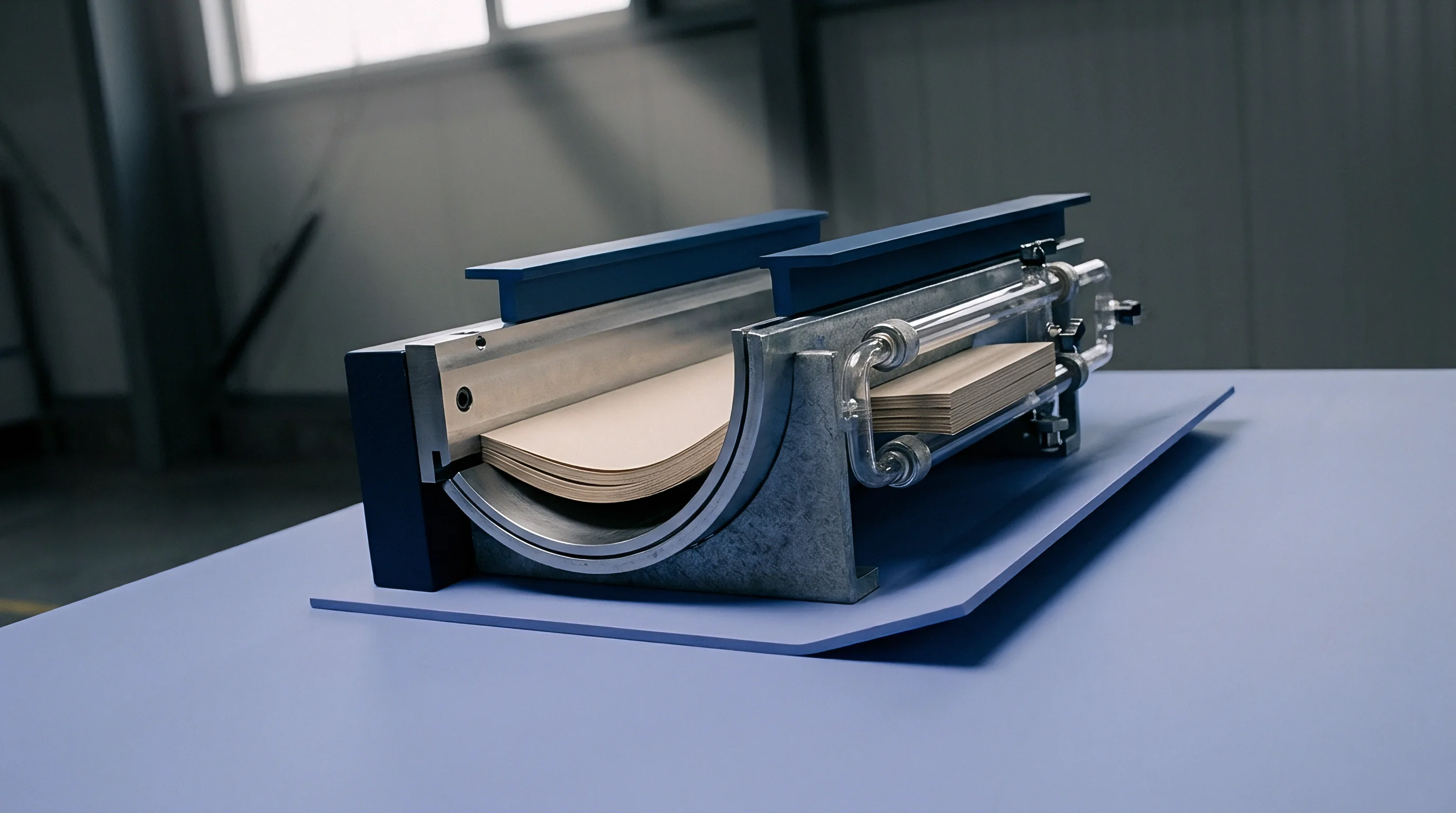
The laboratory crease tester grips the specimen in a pneumatically actuated clamp, holding the uncreased panel flat while an anvil rotates against the creased flap. The distance from the clamp face to the score centreline must remain zeroed to within 0.05 mm. Clamping pressure requires precise calibration between 200 and 400 kPa.
Excessive clamp force crushes sheet bulk within the test zone, producing artificial delamination prior to mechanical bending. Insufficient clamp force permits sample slippage, resulting in load curves with truncated peaks and prolonged displacement tails.
Data acquisition systems record peak force alongside continuous angular resistance curves. Peak force indicates the threshold demanded to break the initial score rigidity. The secondary plateau registers residual springback, revealing whether the cellulose fibres have undergone permanent plastic deformation.
Modern multi-station testers capture both values within a automated single stroke, logging values directly to statistical process software.

Anvil
Contact points between the measuring arm and the sample face govern measurement accuracy. Commercial instruments employ either a cylindrical roller anvil or a flat ground blade to apply the bending moment to the creased flap. The roller reduces friction at the contact zone.
The flat blade creates a localized contact line that remains stationary relative to the board face through the initial ten degrees of rotation. When testing uncreased board stiffness at 15 degrees per ISO 2493-2, anvil friction accounts for less than two percent of total indicated load. During 90-degree crease recovery measurements, frictional drag between the board surface and a stationary blade contributes up to eight percent of the indicated force.
Teflon-coated blades or hardened rotating cylinders prevent this frictional artifact.
Bending span geometry dictates the distribution of internal strain. Standard crease testing applies force at a moment arm of 10 mm from the crease axis. Short spans amplify shear forces inside the board structure.
Long spans emphasize flexural stiffness over hinge delamination. The 10 mm span isolates deformation to the creased zone, preventing parasitic panel deflection across the specimen body.
A change in bending span from 10 millimetres to 50 millimetres reduces the observed bending resistance by approximately seventy percent following fundamental beam deflection principles.
The table below summarizes standard testing configurations across primary global paperboard evaluation procedures.
| Test Protocol | Evaluation Property | Bending Angle | Bending Length | Sample Width | Target Deflection Rate |
|---|---|---|---|---|---|
| ISO 2493-1 | Bending Resistance | 15 degrees | 50 mm | 38 mm | 5.0 deg/sec |
| ISO 2493-2 | Bending Resistance | 15 degrees | 10 mm | 38 mm | 5.0 deg/sec |
| BS 6965-1 | Crease Resistance | 90 degrees | 10 mm | 38 mm | 15.0 deg/sec |
| TAPPI T 556 | Bending Resistance | 15 degrees | 50 mm | 38 mm | 5.0 deg/sec |
| DIN 53121 | Bending Modulus | variable | 10 to 50 mm | 15 to 50 mm | 1.0 to 6.0 deg/sec |
Load cells demand periodic dynamic verification using calibrated spring steel validation shims. Gravimetric dead-weight calibrations confirm static linearity across the 0 to 10,000 mN range. Dynamic verification ensures signal processing filters do not dampen steep initial peaks generated by rigid solid bleached sulfate boards.
A delayed load-cell response artificially flattens peak force curves, misrepresenting high-stiffness virgin furnish as compliant stock. Converters operating automated packaging equipment on unverified data encounter sudden line stoppages, warped package corners, and expensive downtime on critical packing runs.
Mechanics
Creasing paperboard creates an internal hinge rather than a simple fold. Virgin bleached kraft plies delaminate along shear planes when compressed by the male creasing rule against the female channel. The uncreased board behaves as a composite sandwich beam.
Top and bottom outer plies carry tensile and compressive stresses, while the inner furnish absorbs transverse shear. Creasing intentionally destroys ply adhesion within the creased zone, allowing plies to separate into multiple independent thin layers. When folded to 90 degrees, these thin plies buckle inward independently without fracturing the outer liner.
Furnish morphology governs this internal shear failure. Solid bleached sulfate consists entirely of long-fibre and short-fibre virgin chemical pulps. These chemical bonds withstand intense tensile forces on the reverse face while sliding internally to create a uniform delamination blister.
In contrast, white lined chipboard contains recycled fibres shortened by multiple repulping cycles, loaded with calcium carbonate fillers. The internal bond strength of recycled board drops significantly, causing erratic delamination or premature shear through the backing liner.
Fiber orientation magnifies structural differences. During wet-end sheet formation on a multi-ply Fourdrinier or cylinder machine, fibres align preferentially along the running direction. Machine direction specimens exhibit high tensile strength, high elastic modulus, and elevated bending resistance.
Cross direction specimens display lower tensile properties but higher stretch capacity before rupture.
Laboratory assessment reveals distinct load-deflection profiles across substrate types:
- Solid Bleached Sulfate absorbs rule impact with deep, cohesive internal ply separation, yielding a steep initial peak followed by a smooth force decay to thirty percent of maximum value.
- Folding Boxboard utilizes its mechanical groundwood core to create low-density bulk, generating low initial resistance with consistent recovery ratios across seasonal humidity swings.
- Coated Recycled Board exhibits early structural fracture along short filler-loaded bonds, producing erratic multi-peaked curves and frequent surface liner checking under identical tooling clearances.
Moisture content governs cellulose plasticity. When relative humidity drops from 50 percent to 35 percent, paperboard loses bound water, reducing fibre elongation and raising stiffness. Brittle fibres resist delamination, snapping under the creasing rule.
Conversely, equilibrium moisture above 9.0 percent plasticizes the hydrogen bonding network, lowering bending resistance but destroying carton rigidity and stacking performance.
Internal plies must separate cleanly into independent laminations without surface coating rupture to establish a compliant hinge.
Suppliers routinely dismiss elevated score springback as the converter’s die-cutting pressure error rather than a furnish bond defect.
Ratio
Cartoning performance hinges on the crease-to-board stiffness ratio, formally defined as the crease recovery percentage. Technical laboratories calculate this index by dividing the 90-degree crease bending resistance by the 15-degree uncreased board bending resistance:
Crease Ratio (%) = (Crease Bending Resistance at 90° / Board Bending Resistance at 15°) × 100
Packaging line efficiency correlates directly with this percentage. An uncreased solid bleached board of 400 micrometre caliper typically exhibits a machine direction bending resistance of 380 mN. A properly formed crease on this board yields a 90-degree resistance of 150 mN, producing a crease ratio of 39.5 percent.
If the creased score requires 280 mN to bend, the ratio rises to 73.7 percent. At that level, carton panels warp during side-seam folding, causing skewed glue joints.
Standard industrial envelopes delineate functional operating windows:
- Target Range sits between 30 and 50 percent for primary carton packaging, providing structural corner definition alongside rapid blank erection.
- Defective Zone Below Twenty Percent marks catastrophic liner rupture, complete structural failure, or severed plies caused by excessive creasing rule penetration.
- Defective Zone Above Sixty Percent causes carton opening failure, bowed panels, and frequent feeder jams on automatic cartoning equipment.
The economic impact of ratio variance hits production yield immediately. Consider an operating packaging line converting 1,000,000 cartons per month using coated folding boxboard at 350 g/m² with a delivered substrate cost of $1,450 per metric tonne. Each blank weighs 35 grams, representing $0.0507 in raw material per carton.
The baseline scrap rate on calibrated tooling runs at 1.5 percent, accounting for $761 in monthly material scrap.
Assume incoming pallet lots present a crease ratio drifting from 42 percent to 63 percent due to inadequate sheet moisture and degraded ply bond. Converting speed drops from 500 cartons per minute to 320 cartons per minute to prevent erecting misfeeds. Operating line cost averages $280 per hour.
Reject rates climb from 1.5 percent to 5.2 percent as automated sensors reject bowed cartons with unbonded glue flaps. Monthly material scrap escalates to $2,639. The speed reduction adds 39 hours of machine running time, billing an additional $10,920 in press overhead.
Total operating loss attributable to unmanaged crease resistance exceeds $12,790 on a single production shift.
Testing protocols established under BS 6965-1 require score evaluations at both zero-second peak deflection and fifteen-second dwell to capture total viscoelastic springback.
The table below provides reference bending metrics, crease resistance targets, and typical ratio bands across commercial packaging grades tested under standard conditions of 23 degrees Celsius and 50 percent relative humidity.
| Substrate Grade | Caliper (µm) | Grammage (g/m²) | MD Board Stiffness (mN) | CD Board Stiffness (mN) | MD Crease Force (mN) | CD Crease Force (mN) | Target Crease Ratio (%) |
|---|---|---|---|---|---|---|---|
| Solid Bleached Sulfate (SBS) | 350 | 270 | 210 | 105 | 85 | 45 | 40 to 43 |
| Solid Bleached Sulfate (SBS) | 450 | 340 | 480 | 240 | 185 | 95 | 38 to 41 |
| Folding Boxboard (FBB) | 380 | 235 | 260 | 120 | 95 | 48 | 36 to 40 |
| Folding Boxboard (FBB) | 500 | 300 | 590 | 280 | 210 | 110 | 35 to 39 |
| Coated Recycled Board (CRB) | 400 | 320 | 280 | 110 | 135 | 60 | 48 to 55 |
| Coated Recycled Board (CRB) | 500 | 400 | 510 | 200 | 260 | 115 | 51 to 58 |
Balance between machine direction and cross direction ratios determines square carton erection. Cross direction scores generate lower absolute resistance, but cross direction stiffness can be insufficient to resist bulging when machine direction end flaps fold inward. Buyers must monitor directional stiffness ratios during substrate selection.
Higher stiffness delivers carton rigidity. Balanced crease ratios ensure reliable production output.

Cartoning
High-speed packaging lines translate laboratory resistance metrics into real machine clearances. Feeder magazines strip flat carton sleeves using vacuum cups, rotating the blank past mechanical breaker bars that erect the body into an open rectangle. If the score line demands elevated opening force, vacuum cups detach prematurely, leaving partially erected blanks jammed in the drive track.
Modern cartoning equipment relies on the four primary longitudinal creases collapsing under predictable loads.
Springback force introduces secondary complications. When a tuck flap bends into the carton body, residual elastic energy drives the flap back toward its flat orientation. High springback pushes carton closures open before hot-melt adhesive solidifies, breaking glue bonds on the sealing belt.
Laboratory protocols quantify this springback by holding the sample at 90 degrees for 15 seconds, tracking force decay over time. The remaining force at 15 seconds represents the static pressure exerted against adhesive bonds.

Could Ambient Humidity Swings Invalidate Laboratory Approvals?
Warehousing conditions alter board moisture between initial testing and packaging line feeding. Unconditioned packing floors in temperate winters run interior relative humidity levels as low as 20 percent. Paperboard stored on pallets without shrink-wrap loses moisture rapidly from exposed edges.
Edge loss creates differential tension across carton blanks, warping scores and escalating bending resistance by 30 to 45 percent compared to laboratory certificates generated under ISO 187.
A rigorous quality assurance workflow verifies carton readiness across sequential processing gates:
- Confirm inbound pallet equilibrium relative humidity meets specifications using an insertion sword hygrometer.
- Punch test blanks from the centre and edge of the die sheet to detect across-web platen pressure variations.
- Measure 15-degree uncreased bending resistance and 90-degree crease recovery across ten machine-direction and ten cross-direction samples.
- Reject carton lots showing crease-to-board ratios outside the agreed 30 to 50 percent specification band before delivery to packaging lines.
Defective creases undermine productivity across global supply chains. Commercial purchase agreements protect converters by binding suppliers to defined performance parameters. Standard substrate contracts specify that delivered paperboard must maintain cross-direction crease ratios between 35 and 50 percent under ISO 187 conditioning, placing financial liability for line-jam downtime and make-ready waste squarely on the supplying mill.