Standard Chemical Migration Testing Protocols for Paperboard Food Packaging
Paperboard food contact compliance requires verified migration testing using specific simulants and GC-MS or LC-GC-FID analytics to enforce migration safety limits.

Matrix
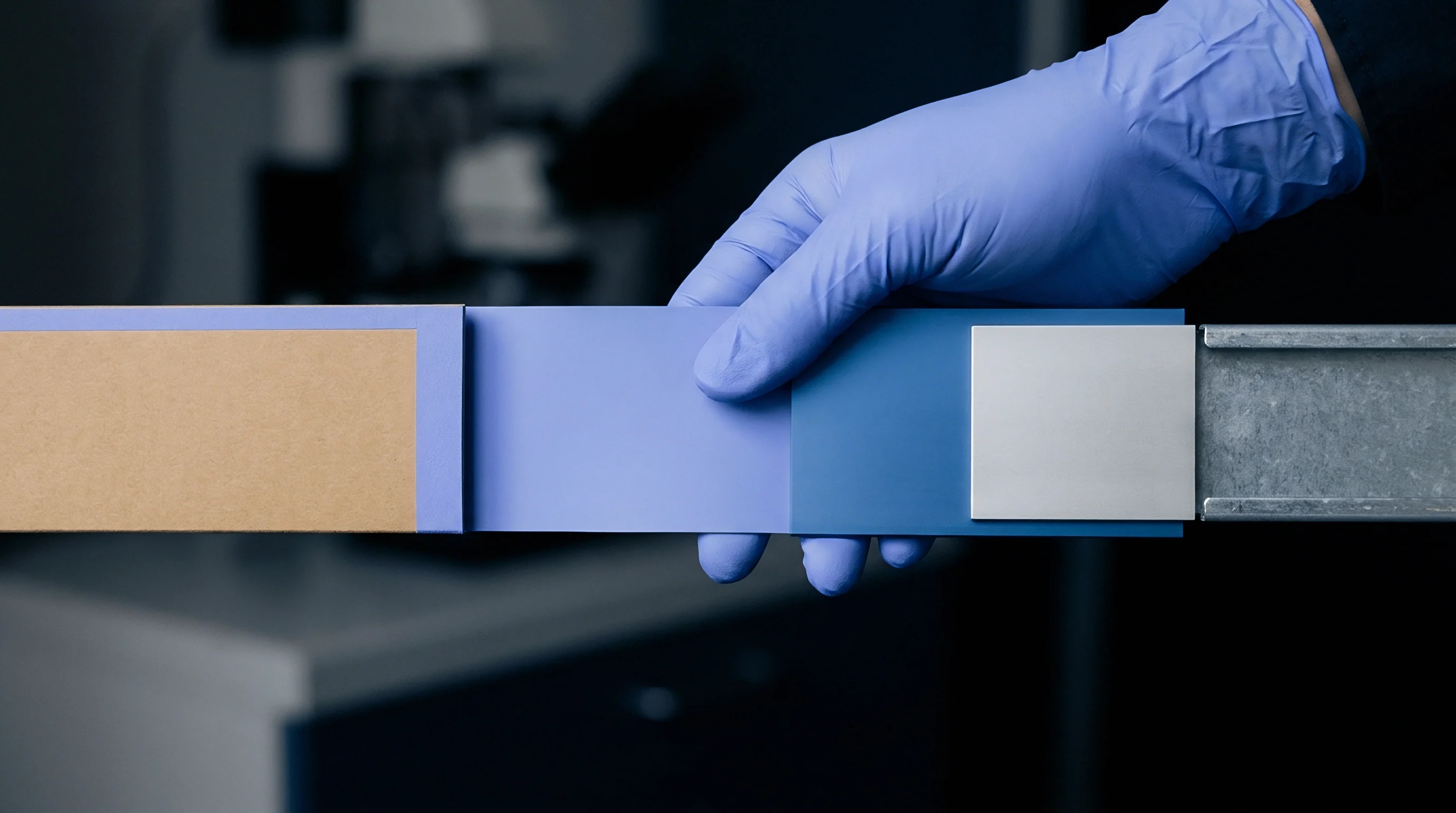
Paperboard for food packaging combines cellulose fibres, sizing agents, wet-strength resins, and surface coatings. Baseline purity depends directly on fibre sourcing. Virgin paperboard releases primary migrants from pulping residues, processing additives, and converting adhesives, whereas recycled board carries secondary contaminants from inks, lacquers, and earlier packaging cycles.
Analytical characterization evaluates both volatile and non-volatile substances that can transfer into food.

Substrate Sourcing and Contaminant Profiles
Virgin fibre networks retain trace resin acids, fatty acids, and lignosulfonates from wood pulping. Chlorine dioxide bleaching can introduce chlorophenols and trace dioxins if operating conditions drift from optimal setpoints. Sizing agents such as alkyl ketene dimer and alkenyl succinic anhydride provide water resistance against aqueous foods, but unreacted residues migrate readily into fatty food simulants.
Similarly, polyamide-epichlorohydrin wet-strength resins can release trace 1,3-dichloro-2-propanol and 3-monochloro-1,2-propanediol into liquid extracts.
Post-consumer collection streams give recycled pulp a far broader baseline of chemical contaminants. Mineral oil hydrocarbons make up the largest fraction, coming mainly from offset printing inks in newspapers and commercial print. Polymers, adhesives, and hot melts introduce plasticizers like diisobutyl phthalate and dibutyl phthalate.
Thermal paper receipts bring in bisphenols, while inks on outer packaging transfer photoinitiators ~ such as benzophenone, 2-isopropylthioxanthone, and 4-methylbenzophenone ~ via set-off during reeling.
Coated functional barriers slow down chemical migration rather than stopping volatile compounds indefinitely.
Applying functional barrier coatings directly to paperboard alters migration kinetics. Extruded polyethylene and polyolefin layers block liquid penetration and slow vapor transport, though low-molecular-weight volatile organic compounds still diffuse through thin polyolefin films over long storage periods. Ethylene vinyl alcohol copolymers form effective gas barriers against mineral oil vapor, but performance drops when relative humidity exceeds sixty percent.
Mineral oil saturated hydrocarbons and mineral oil aromatic hydrocarbons require constant tracking, as short-chain fractions below twenty-four carbon atoms migrate rapidly via gas-phase diffusion across internal air voids.
| Chemical Class | Primary Source | Target Analytes | Specific Migration Limit |
|---|---|---|---|
| Mineral Oil Hydrocarbons | Recycled offset inks | MOSH C10 to C24, MOAH C10 to C25 | 0.6 mg/kg MOSH, 0.15 mg/kg MOAH |
| Fluorinated Compounds | Grease-proofing treatments | PFOA, PFOS, short-chain PFAS | Non-detectable at 0.01 mg/kg |
| Photoinitiators | UV-curable printing inks | Benzophenone, ITX, 4-MBP | 0.6 mg/kg combined benzophenones |
| Chlorohydrins | Wet-strength resins | 1,3-DCP, 3-MCPD | 0.012 mg/kg for 3-MCPD |
| Plasticizers | Adhesives and coatings | DiBP, DBP, DEHP | 0.3 mg/kg for DiBP |
Per- and polyfluoroalkyl substances present a major compliance hurdle in grease-resistant paperboard. Fluorochemical treatments long provided oil resistance in fast-food wraps and microwave popcorn bags, but regulatory bans on long-chain fluorotelomer alcohols have driven the industry toward short-chain alternatives or bio-based, fluorine-free coatings. Because volatile fluorotelomer alcohols migrate into hot fatty foods during microwave heating, testing protocols measure total fluorine and use liquid chromatography-tandem mass spectrometry to verify compliance with non-intentionally added substance limits.
The porous internal structure of paperboard creates natural channels for chemical movement. Uncoated board allows rapid gas-phase transport of volatile molecules once drying solvents evaporate. Heavy multi-ply boards can trap chemical additives within central filler layers, forming reservoirs that steadily release migrants over a twelve-month shelf life.
- Mineral Oil Hydrocarbons include saturated and aromatic fractions from recycled newsprint inks; short-chain molecules below twenty-four carbon atoms move readily across internal packaging voids through gas-phase transfer.
- Fluorinated Compounds deliver grease resistance via surface treatment, but short-chain perfluoroalkyl substances face tight global restrictions owing to bioaccumulation risks in human tissue.
- Photoinitiators transfer via reel set-off during high-speed converting, allowing volatile aromatic compounds to penetrate uncoated inner food-contact layers while reels sit in storage.
- Primary Aromatic Amines form through azo pigment degradation in outer inks, demanding strict analytical screening against specific migration limits in aqueous simulants.
Dense polymer coatings extend shelf life by slowing volatile diffusion, but non-polar substances eventually work through thin polyolefin layers over long storage periods.


Chamber
Testing protocols simulate chemical transfer by exposing packaging to standard food simulants under controlled temperature profiles. Measuring migrants directly in real food is difficult because lipids, proteins, and carbohydrates cause severe analytical interference. Standardized food simulants mirror the solvent properties of key food categories while keeping extraction and chromatographic isolation straightforward.

Which Simulant Selection Holds under Scrutiny?
European standard EN 1186 sets out official liquid food simulants for migration testing on polymer and coated paperboard packaging. Simulant A (ten percent ethanol by volume) targets aqueous foods, while Simulant B (three percent acetic acid mass by volume) covers acidic foods with a pH below four point five. Simulant C (twenty percent ethanol) is used for alcoholic products up to twenty percent strength, and Simulant D1 (fifty percent ethanol) handles lipophilic foods and oil-in-water emulsions.
Refined olive oil or synthetic triglyceride mixtures serve as Simulant D2 for fatty foods, while Tenax simulates contact with dry foods.
Paperboard testing relies heavily on dry food simulants because liquid media degrade uncoated cellulose fibres. Under European standard EN 14338, modified polyphenylene oxide (commercialized as Tenax) acts as Simulant E for solid and fatty dry foods. Tenax remains thermally stable up to three hundred degrees Celsius and possesses strong adsorptive capacity for volatile and semi-volatile organic compounds.
Standard test cells place paperboard samples in direct physical contact with granular Tenax, capturing migrating species without destroying the board structure.
Specific migration of mineral oil saturated hydrocarbons remains under 0.6 mg/kg food for recycled paperboard conditioned at 40°C for 10 days using poly phenylene oxide.
Cold water extraction following EN 645 isolates water-soluble species such as inorganic salts, formaldehyde, and residual wet-strength resins. Hot water extraction under EN 647 models high-temperature contact during hot-filling, microwave reheating, or boiling. Extract solutions require immediate analytical screening to prevent volatile loss or target compound degradation.
| Simulant Code | Chemical Composition | Target Food Category | Standard Exposure Conditions |
|---|---|---|---|
| Simulant A | Ethanol 10% (v/v) | Aqueous non-acidic foods | 10 days at 40°C |
| Simulant B | Acetic acid 3% (w/v) | Acidic foods (pH below 4.5) | 10 days at 40°C |
| Simulant D1 | Ethanol 50% (v/v) | Dairy, oil-in-water emulsions | 10 days at 40°C |
| Simulant D2 | Vegetable oil or triglycerides | Fatty foods, free surface fats | 10 days at 40°C or 2 hours at 70°C |
| Simulant E | Poly(2,6-diphenyl-p-phenylene oxide) | Dry foods, fatty dry foods | 10 days at 60°C or 3 days at 40°C |
| Exposure conditions chosen must reflect worst-case predictable contact temperatures and times during commercial distribution. | |||

Thermal Conditioning and Exposure Timelines
Accelerated temperature conditions simulate extended ambient storage without requiring months of testing. Ten days at forty degrees Celsius models ambient storage lasting longer than thirty days, while ten days at sixty degrees Celsius accelerates high-ambient conditions or ambient exposure up to two years. Exposing samples to seventy degrees Celsius for two hours simulates hot-filling between seventy and one hundred degrees Celsius, provided test cells are precisely calibrated.
Normalizing the surface-to-volume ratio aligns test results with regulatory models. European standards apply a default baseline of six square decimetres of packaging material per kilogram of food. To convert migration values from milligrams per square decimetre to milligrams per kilogram of food equivalent, results are multiplied by six.
Smaller packages with higher surface-to-volume ratios yield higher relative migrant concentrations in the packaged food.
Testing protocols require single-side exposure in specialized migration cells. Immersion testing leaves cut edges open, leading to edge-wicking of liquid simulants into inner paperboard plies. This wicking inflates migration figures by extracting chemicals from core layers that would never touch food in a finished package.
Mounting samples in single-side cells isolates the true contact face, applying simulants strictly to the barrier coating or treated top liner.
Brief contact times in laboratory cells can overestimate real-world transfer when commercial storage temperatures remain below ambient room levels.


Assay
Quantifying trace migrants in food contact paperboard requires high-precision chromatography to resolve complex chemical mixtures. Gas chromatography paired with flame ionization detection or mass spectrometry isolates volatile and semi-volatile compounds, while liquid chromatography coupled to tandem mass spectrometry measures non-volatile, polar, and high-molecular-weight species. Standardized laboratory workflows ensure sub-milligram quantification limits.

Chromatographic Separation and Spectrometric Quantification
Mineral oil hydrocarbon analysis relies on online coupled LC-GC-FID following standard EN 16995. High-performance liquid chromatography separates mineral oil saturated hydrocarbons from aromatic fractions on a silver silica gel column. The isolated fractions transfer automatically through large-volume injection into gas chromatography columns, where flame ionization detectors measure carbon content.
Chromatographic traces show broad humps from unresolved complex mixtures beneath sharp peaks produced by plant wax alkanes.
- Sample swatches measuring exactly one square decimetre are cut from three distinct conversion positions across the paperboard web.
- Specimens are extracted in hexane and ethanol mixtures inside sealed glass vessels for twenty-four hours at room temperature.
- Extracts pass through an online liquid chromatography column to separate aliphatic hydrocarbons from aromatic fractions prior to GC injection.
- Flame ionization detectors quantify total chromatographic humps alongside sharp peaks against calibrated alkane standards.
Screening for Non-Intentionally Added Substances identifies unexpected degradation products, ink impurities, and reaction side-products. High-resolution time-of-flight mass spectrometry checks unknown compounds against spectral libraries, and toxicological risk assessments apply the Threshold of Toxicological Concern framework to uncharacterized substances. Cramer Structural Class I compounds have an exposure threshold of one thousand eight hundred micrograms per person per day.
By contrast, Cramer Structural Class III substances carry high toxic potential, setting a strict limit of ninety micrograms per person per day ~ equivalent to fifteen micrograms per kilogram of food.
Analytical limits of detection drop as high resolution mass spectrometry isolates non intentionally added substances from recycled fibre matrices.

Worked Migration Area Scaling Calculation
Consider a folding boxboard application for dry cereal packaging. The package consists of a 300 gsm paperboard carton with a 12-micron polyolefin inner liner. Box dimensions are 15 cm high, 10 cm wide, and 4 cm deep, yielding a volume of 600 cubic centimetres holding 250 grams of cereal.
Calculating total internal surface area in contact with the cereal: two main faces (15 cm × 10 cm × 2) give 300 square centimetres; two side panels (15 cm × 4 cm × 2) give 120 square centimetres; top and bottom flaps (10 cm × 4 cm × 2) add 80 square centimetres. Total inner surface area equals 500 square centimetres, or 5.0 square decimetres.
Laboratory testing using Tenax at 40°C for 10 days yields a specific migration of 1.2 milligrams of mineral oil saturated hydrocarbons per square decimetre. Total migrant mass released into the carton equals 1.2 mg/dm² multiplied by 5.0 dm², resulting in 6.0 milligrams of MOSH in the 250-gram food portion.
Converting migrant mass to food concentration, dividing 6.0 milligrams of MOSH by 0.250 kilograms of cereal yields an actual food concentration of 24.0 milligrams per kilogram. By comparison, applying the standard regulatory conversion factor (assuming 6 dm² per 1 kg of food) yields 1.2 mg/dm² multiplied by 6 dm²/kg, or 7.2 milligrams per kilogram. The actual package geometry produces a concentration 3.33 times higher than default regulatory assumptions, because lightweight cereal in a small box has a higher surface area to food mass ratio.
Whether current toxicological thresholds adequately protect against long-term, low-dose exposure to unidentified chemical humps in recycled pulp remains an ongoing debate in regulatory science.


Paperwork
Cross-border regulatory compliance requires an unbroken audit trail connecting pulp sources, chemical additives, and converting operations. Framework Regulation EC 1935/2004 mandates that food-contact materials must not transfer constituents in amounts that endanger human health or unacceptably alter food composition. Article 16 of the regulation requires written compliance declarations at every stage of manufacturing and conversion.

Structure of the Food Contact Declaration of Compliance
A valid Declaration of Compliance for paperboard packaging details material specifications, operational limits, and analytical test results. The document identifies the manufacturer, converting facility, and trade name of the paperboard grade, while listing chemical inventory compliance under European, national, and regional rules. Scope statements explicitly define whether the board is suitable for direct contact with aqueous, acidic, dry, or fatty foods.
Good Manufacturing Practice Regulation EC 2023/2006 sets quality control standards for facilities manufacturing food-contact paperboard. GMP documentation verifies that dosing systems on paper machines maintain correct chemical ratios, supported by cleaning logs, raw material qualifications, and vision tracking records. Inks, lacquers, and adhesives used in converting must comply with negative lists and specific migration limits set by Swiss Ordinance 817.023.21 and German BfR Recommendation XXXVI guidelines.
Council of Europe Resolution AP (2002) 1 mandates chemical purity verification for direct food contact paper layers before commercial distribution.
Chain-of-custody documentation tracks material through forest management, pulp mills, board converting, and printing lines. Forest Stewardship Council and PEFC certificates confirm fibre origin, but they do not prove food-contact safety. Compliance dossiers require separate chemical test reports from ISO/IEC 17025 accredited laboratories operating within their defined scope.
| Document Type | Issuing Entity | Covered Parameters | Compliance Gap Exclusions |
|---|---|---|---|
| Mill Declaration of Compliance | Paperboard Mill | Base board purity, heavy metals, cold water extract | Converting adhesives, printing inks, reel set-off |
| Ink Compliance Statement | Ink Manufacturer | Pigment purity, low-migration photoinitiators, PAAs | Drying completeness, gas-phase set-off on web |
| Converter DoC | Packaging Printer | Barrier integrity, overall migration, adhesive safety | Food filling conditions, pack shelf life beyond spec |
| Certificate of Analysis | ISO 17025 Laboratory | Specific analyte concentration, NIAS screening | Batch-to-batch variation across un-sampled lots |
- Dual-Use Additive Declarations identify substances subject to dietary food additive limits, enabling food packagers to calculate total constituent concentrations.
- Functional Barrier Declarations specify the physical thickness and chemical composition of polymer layers certified to block migration under defined temperature regimes.
- Non-Intentionally Added Substance Dossiers summarize analytical screening results and toxicological evaluations for unidentified degradation products detected during migration testing.
- Good Manufacturing Practice Certificates confirm facility compliance with hygiene, quality control, and chemical handling standards during slitting, printing, and die-cutting.
Standard supply contracts typically include clauses stipulating that any unannounced changes to chemical sizing, barrier coatings, or printing inks immediately void the seller’s Declaration of Compliance.


Exposure
Customs authorities and market surveillance agencies run targeted sampling programs to enforce chemical safety limits on imported packaging. Importers bear ultimate compliance responsibility. Shipments are routinely detained when missing analytical test dossiers that match declared harmonized tariff codes.
Inspection agencies use rapid screening tools to check for unauthorized fluorinated grease-proofing agents, heavy metals, and volatile aromatic compounds before clearing goods through customs.

Enforcement Mechanisms and Frontier Detention Risks
National surveillance authorities in the EU publish non-compliance findings through the Rapid Alert System for Food and Feed. Finding unauthorized primary aromatic amines, elevated bisphenols, or mineral oil aromatic hydrocarbons triggers immediate product recalls and store delistings across member states. Financial losses accumulate quickly when non-compliant packaging forces companies to destroy fully packaged food inventory.
The European Packaging and Packaging Waste Regulation increases legal exposure for brand owners and packaging buyers. PPWR enforces strict design-for-recyclability rules alongside substance limits. Heavy metals ~ including lead, cadmium, mercury, and hexavalent chromium ~ must stay below a cumulative limit of one hundred milligrams per kilogram across all paperboard layers.
Materials that fail recyclability grading face substantial eco-modulation fee surcharges under extended producer responsibility schemes.
Missing paperwork stalls customs clearance, forcing testing strategies to balance analytical rigor against commercial shipping timelines. Verification frequency depends on statistical risk modeling: high-risk substrates such as post-consumer recycled board require lot-by-lot screening for MOSH and MOAH fractions, whereas low-risk virgin sulphate board with extruded polyolefin coatings may only undergo annual surveillance audits if raw material formulations remain unchanged. Re-testing becomes mandatory whenever a mill alters its sizing chemistry, pulping sequence, or barrier coating weight.
Failing to verify migration performance against actual end-use conditions leads to container holds at import terminals, expensive lab re-testing, and the complete forfeiture of non-compliant packaging shipments.