
Laboratory Testing Protocols for Recycled Paperboard Chemical Compliance
Recycled paperboard chemical compliance demands specific migration testing via Tenax and LC-GC-FID to quantify MOSH MOAH transfer before signing declarations.
Recycled paperboard chemical compliance demands specific migration testing via Tenax and LC-GC-FID to quantify MOSH MOAH transfer before signing declarations.
Paperboard recycled claims require matching chain of custody certificates, mass balance ledger reconciliation, and certified converter invoices.
Recycled paperboard specific migration testing demands solid simulant Tenax or validated substitute media to prevent fiber breakdown and false analytical results.
Paperboard food contact compliance requires verified migration testing using specific simulants and GC-MS or LC-GC-FID analytics to enforce migration safety limits.

Poly(2,6-diphenyl-p-phenylene oxide) replaces liquid simulants for paperboard, preventing fiber collapse during compliance migration testing.
Functional barrier coat weight and thermal stability determine high-temperature hydrocarbon vapor migration limits in recycled paperboard food packaging.

Tenax TA vapor capture combined with LC-GC-FID and chemical epoxidation provides defensible separation of volatile MOSH and MOAH fractions in paperboard.

Verification of recycled paperboard food contact compliance requires LC-GC-FID testing for MOSH and MOAH migration alongside verified functional barriers.
Paperboard LC-GC-FID testing requires ethanol swelling, mCPBA epoxidation, and accurate UCM baseline integration to verify MOSH and MOAH migration compliance.
Food contact safety for recycled board requires functional barrier proof and complete chain of custody documentation down to invoice line items.

Verifying post-consumer recycled claims in folding boxboard requires cross-referencing FSC/PEFC credit accounts with deinking yield losses and MOSH/MOAH markers.
Extractives and migration testing requires matching food simulants, extraction solvents, and analytical thresholds to specific regulatory contact conditions.
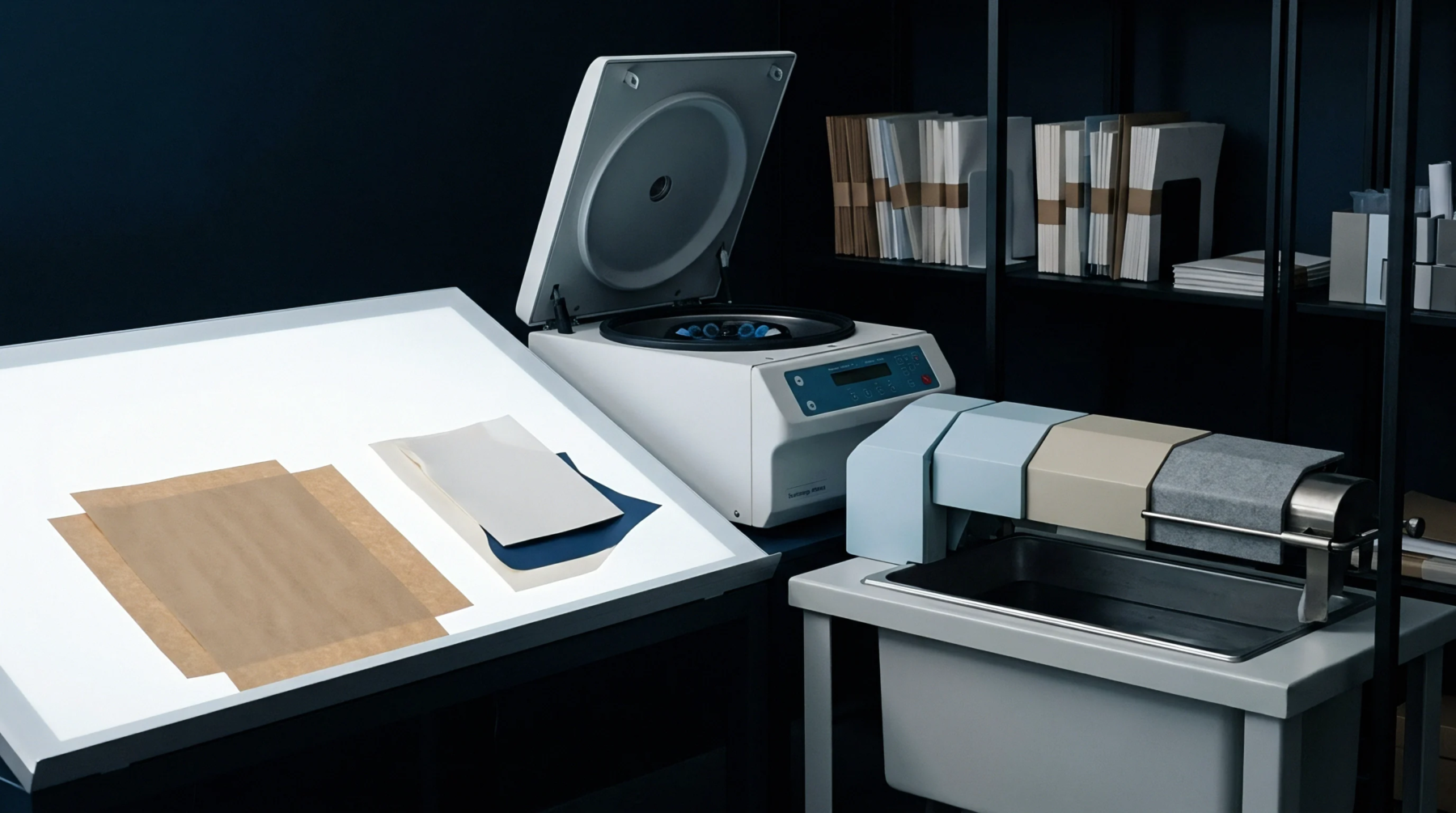
Polymeric coatings block recycled board NIAS migration when layer thickness, crosslinking density, and pinhole frequency meet specific mass transfer criteria.
Dynamic climate chamber testing under cyclic relative humidity isolates mechanosorptive creep failure modes that standard static equilibrium conditioning miss.
Auditing food contact board certificates requires verifying laboratory test simulants, thermal parameters, and surface ratios against real package converting limits.

Recycled paperboard verification requires valid chain of custody certificates, mass balance ledgers, and lab migration test reports to clear retail compliance.

Paperboard chemical migration testing requires matching food simulants to substrate porosity, using Tenax for dry media and certified barrier qualification.

Modified solid simulant Tenax TA testing under EN 14338 verifies gas-phase MOSH and MOAH migration from recycled paperboard without false-positive wax interference.

Harmonized mineral oil aromatic hydrocarbon quantification in paperboard relies on subtractive procedural blank integration to eliminate baseline resolution errors.

Verify hydrocarbon barrier integrity in recycled cartons through LC-GC-FID testing under EN 16995 with Tenax migration simulant to prove MOAH limits under 0.15 mg/kg.

Volatile hydrocarbon qualification in recycled paperboard requires Tenax gas phase migration testing and LC-GC-FID analysis to verify MOAH levels below 0.15 mg/kg.

Verify certificate status against public scope schedules to ensure product group codes, grammages, and converting sites explicitly cover every delivered batch.

Paperboard chemical retention and migration compliance requires verifying wet-end additive fixation, simulant extractions, and mass transfer kinetic barriers.

FSC and PEFC prove auditable timber origin and mass-balance fiber accounting; they do not prove food safety, chemical purity, repulpability, or EUDR compliance.
Expertise is a utility, not a secret. sentiention™ publishes its working knowledge as open reference: intelligence layer covering the materials it sources, the markets it enters, and the reference that serves both.