Determining Viscoelastic Strain Limits during Rotary Embossing Operations
Viscoelastic strain limits during rotary embossing require matching tool shoulder radii and cylinder heat to substrate relaxation times to prevent rupture.
Rupture
In rotary embossing, a moving paperboard web experiences localized, high-rate shear and compressive strain during nip dwell times of 1.5 to 8.0 milliseconds. If equivalent strain exceeds material limits, the fiber matrix undergoes irreversible bond failure, delamination, or surface cracking. Pinpointing the boundary between permanent plastic deformation and full structural rupture requires isolating the rate-dependent mechanics of the pulp fibers, synthetic binders, and mineral coating layers.
At web speeds between 120 and 350 meters per minute, cellulose microfibrils and amorphous hemicellulose shift from ductile behavior into a brittle, glassy regime. That transition narrows the deformation envelope, pulling the critical tensile strain threshold of typical solid bleached sulfate from a static 4.5 percent down to under 1.8 percent inside the nip.
Moisture imbalances or excessive counter-pressure tighten this operating window further. Fiber walls fracture under unrelaxed shear gradients when stresses fail to redistribute through inter-fiber slip. On premium folding boxboard or recycled linerboard, delamination occurs instantly if die geometry forces a displacement steeper than the z-directional stretch limit of the inner plies.
Top-coat micro-fissuring appears along relief edges whenever tangential tensile strain exceeds the cohesive strength of the calcium carbonate and latex matrix. These cracks ruin the integrity of barrier coatings, exposing base fibers to moisture and driving localized edge swelling.
Coated solid bleached board conditioned to 50 percent relative humidity at 23 degrees Celsius experiences surface micro-cracking when local tangential strain exceeds 2.1 percent at an embossing cylinder tangential velocity of 3.0 meters per second.
Defects in high-speed rotary tooling follow specific kinematic paths dictated by tool geometry and substrate rheology. Operating outside permissible strain limits produces distinct fracture patterns.
- Inter-fiber bond cleavage occurs in core plies when through-thickness shear stress breaks secondary hydrogen bonds between adjacent cellulose fibers.
- Top-coat micro-crazing develops along sharp tool shoulders where high pigment-to-binder volume ratios restrict elastic stretch under fast displacement.
- Tensile necking failure concentrates at the apex of male relief elements when web tension adds axial stretch to localized embossing strain.
- Internal delamination blisters form when air trapped in the matrix compresses under the tool tip and expands rapidly upon leaving the nip.
Pushing dies beyond the strain threshold turns high-value printed stock into scrap, impairs downstream gluing, and leads to rejections at the cartoning line.
Grain
Fiber orientation on the forming fabric creates strong mechanical anisotropy across the paper reel. In rotary tooling, the machine direction exhibits higher elastic modulus and lower rupture strain than the cross-machine direction. Cross-direction strain at break is typically 1.8 to 2.4 times greater than machine-direction stretch, changing how the sheet moves over engraved male die edges.
Dies set with long relief edges parallel to the machine direction generate heavy cross-directional tensile stress, using the lower modulus to achieve deeper draws without breaking. Conversely, placing sharp die edges perpendicular to the machine direction concentrates strain along rigid fiber backbones, causing surface rupture at modest relief depths.
Z-directional properties impose even stricter limits on tool engagement. Internal bond strength, measured by Scott Bond testing per TAPPI T 569, dictates resistance to ply separation under three-dimensional embossing stress. Multilayer folding boxboards with mechanical groundwood centers have lower internal shear moduli than solid bleached grades.
Rapid tool penetration wedges into the sheet, generating transverse shear stresses that easily surpass ply bond limits. The interior tears apart horizontally while the outer plies look intact on the surface, leading to structural collapse during subsequent folding and gluing.
| Board Grade | Caliper (µm) | Tensile MD (kN/m) | Tensile CD (kN/m) | Strain Limit MD (%) | Strain Limit CD (%) | Scott Bond (J/m²) |
|---|---|---|---|---|---|---|
| Solid Bleached Sulfate (SBS) | 350 | 24.2 | 12.8 | 2.1 | 4.8 | 195 |
| Folding Boxboard (FBB) | 380 | 18.5 | 8.6 | 1.4 | 3.2 | 130 |
| Coated Recycled Board (CRB) | 400 | 15.1 | 7.2 | 1.1 | 2.6 | 105 |
| Unbleached Kraft Liner | 280 | 26.8 | 14.1 | 2.4 | 5.5 | 230 |
Moisture content dictates the plasticization of amorphous biopolymers in the fiber network. Below 6 percent moisture, hemicellulose stays rigid, lowering strain limits along every axis. At 7 to 9 percent moisture, water molecules weaken hydrogen bonds, doubling allowable strain without tearing fibers.
Above 10 percent moisture, lost web stiffness causes fiber crushing and registration drift under nip tension.
DIN 55437 score line testing demonstrates that board internal bond failures multiply threefold when converted below 5.5 percent absolute moisture content.
Reducing counter-die impression depth can mitigate edge rupture, though web grain orientation relative to the engraving axes remains a governing factor.

Speed
Line speed determines the Deborah number of the embossing process ~ the ratio of material relaxation time to physical dwell in the contact zone. At ambient temperatures, amorphous lignin and hemicellulose have relaxation time constants between 0.01 and 0.50 seconds. A 250-millimeter cylinder running at 200 meters per minute produces an active nip width of roughly 6 millimeters, giving a mechanical dwell time of around 1.8 milliseconds.
With dwell time orders of magnitude shorter than relaxation time, the Deborah number far exceeds unity, forcing the fiber web to behave as an elastic glass that cannot dissipate shear energy through molecular rearrangement.

How Does Rotary Tool Temperature Shift Yield?
Directly heating rotary dies shortens the relaxation time of amorphous polymers. Brass or steel cylinders held between 80 and 130 degrees Celsius warm the outer microns of the board during contact. This sudden heat drives the surface fibers past their glass transition temperature, speeding stress relaxation and dropping viscoelastic yield points by 30 to 50 percent.
As a result, outer plies accept sharp male profiles without splitting. However, heat must be balanced against web speed: excessive temperature at low line speeds boils moisture in the coating, creating steam blisters that ruin varnished surfaces.
Dynamic mechanical thermal analysis maps master curves for packaging substrates using the Williams-Landel-Ferry relationship. A tenfold increase in web speed shifts the viscoelastic response frequency by an amount equivalent to a 7-degree Celsius drop in interface temperature. When a converting line ramps from 50 meters per minute at make-ready to a running speed of 250 meters per minute, the board stiffens, contracting effective strain capacity by roughly 22 percent.
Engagement depths that look acceptable on make-ready pulls can split open once the press reaches full speed.
Strain rate sensitivity varies significantly between virgin chemical pulps and recycled furnish. Virgin fibers absorb more energy under dynamic impact, while recycled fibers ~ stiffened by hornification during earlier drying cycles ~ crack under the same strain rates. Operating speed limits must therefore be set using dynamic strain thresholds rather than static pull tests.
How mechanical work splits between elastic storage, viscous dissipation, and micro-rupture during a four-millisecond impact remains a point of debate between analytical rheologists and press operators.
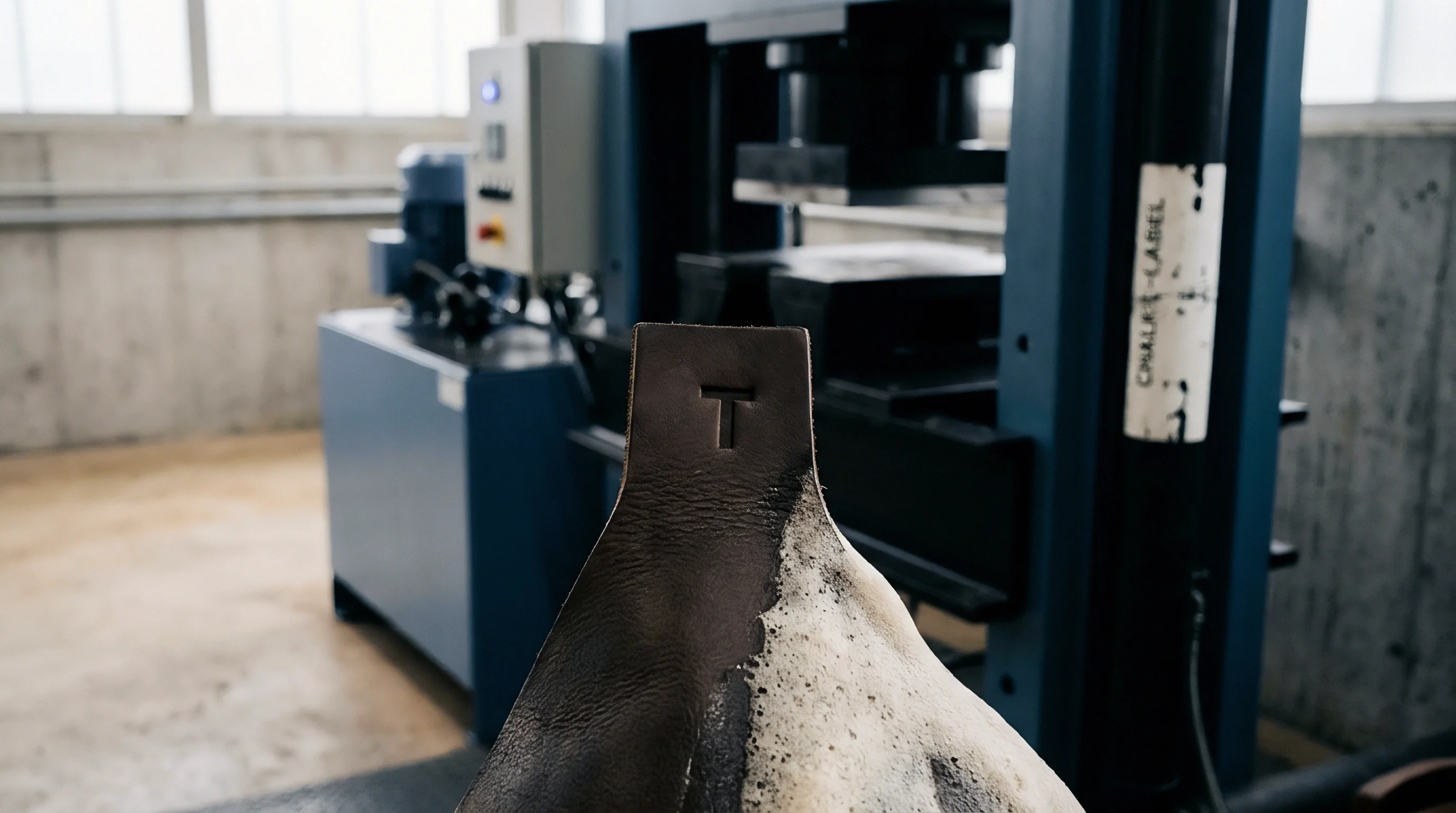
Tool
Die geometry governs how multi-axial strain is distributed in the rotary nip. Male shoulder radii, female cavity clearances, and counterforce materials determine whether the fiber bed stretches smoothly or shears apart. Below 0.15 millimeters, an engraving shoulder radius acts like a cutting edge at line speeds above 150 meters per minute.
Tool builders typically specify male radii between 0.25 and 0.50 millimeters, paired with female cavities designed with bilateral clearance. Clearance must equal 100 to 120 percent of compressed board caliper to prevent hydraulic pinching between opposing metal faces.
Counter-die selection exerts equal control over the strain gradient. Mated steel cylinders provide precise geometry but zero compliance, requiring exact impression setup. Polyurethane sleeves or micro-porous matrix materials offer elastomeric yield, spreading peak compressive forces over a wider area.
That deflection lengthens contact time, lowering the local strain rate and protecting delicate surface coatings.
A structured make-ready procedure ensures rotary embossing dies operate within physical material tolerances without inducing premature web rupture.
- Verify web moisture content with a handheld dielectric probe before reel loading, rejecting rolls below 6.0 percent or above 8.5 percent moisture.
- Measure sheet caliper across three cross-deckle positions using a deadweight micrometer conforming to ISO 534 to set female clearance gaps.
- Install matched cylinders into rigid bearing blocks, verifying parallel radial runout stays below 3 micrometers across the engraved face.
- Engage the nip at zero-pressure clearance, advancing micrometric wedges until female recesses reach 30 percent penetration.
- Bring the press to 25 percent operating speed and pull sample coupons to check for micro-fissuring under 40x magnification with oblique lighting.
- Raise cylinder temperature to 95 degrees Celsius on heated tooling to lower substrate relaxation times before ramping speed.
- Increase line speed to target velocity in 30 meter-per-minute steps, adjusting counter-pressure to compensate for centrifugal deflection.
Engraving geometry sets the local deformation angle. Relief wall angles under 60 degrees spread tensile stretch over a wider zone and prevent necking. Angles near 90 degrees concentrate shear into a narrow line, exceeding the strain limit of any commercial paperboard.
A radius of curvature on male tool shoulders smaller than substrate thickness concentrates shear strains that fracture coated surfaces.
Sharp counterforce shoulders always cut paperboard faster than smooth contours stretch it.

Springback
Leaving the rotary nip, compressed fiber structures undergo time-dependent recovery driven by stored elastic strain energy. While plastic deformation permanently realigns the matrix, the viscoelastic fraction recovers over seconds or weeks. Initial elastic unloading happens in fractions of a millisecond as tool pressure releases.
Delayed viscoelastic springback follows slowly as polymer chains disentangle and moisture balances with ambient conditions. An embossed relief measuring 0.40 millimeters immediately after the nip can settle to 0.28 millimeters after 48 hours in the warehouse.
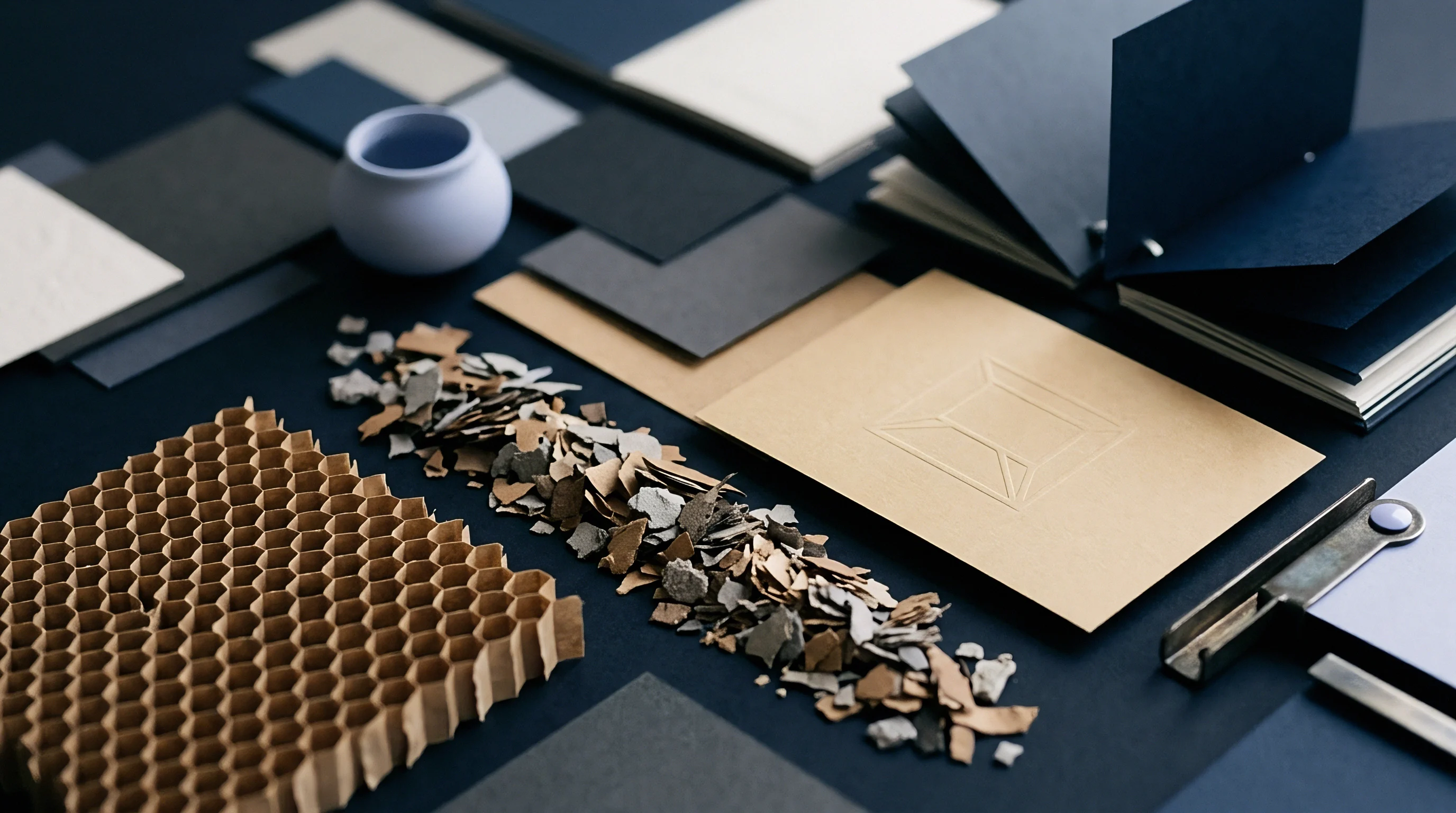
Does Dwell Compression Predict Permanent Caliper Loss?
Compressive dwell forces water out of capillary voids, compacting fiber lumen walls. Higher nip pressures collapse these cell walls permanently, creating dense zones with minimal vertical recovery. When counter-die pressure exceeds the yield limit of the wood fibers, internal capillary structures flatten completely.
This crushing action sharpens visual detail but reduces panel stiffness, leading to bulging on packaging lines. Maintaining structural integrity relies on balancing permanent plastic deformation against uncrushed fiber bulk.
| Tool Clearance (% Caliper) | Initial Caliper (µm) | Nip Depth (µm) | Depth at 1s (µm) | Depth at 24h (µm) | Final Retention (%) | Residual Stiffness (%) |
|---|---|---|---|---|---|---|
| 140 | 350 | 180 | 142 | 115 | 63.8 | 96 |
| 120 | 350 | 220 | 185 | 158 | 71.8 | 91 |
| 100 | 350 | 260 | 230 | 205 | 78.8 | 82 |
| 80 | 350 | 310 | 288 | 265 | 85.4 | 61 |
Predicting final relief height requires evaluating the ratio of viscous flow to elastic compliance. Solid bleached sulfate retains 70 to 80 percent of its tool depth because long chemical fibers undergo plastic slip under heated dies. Mechanical folding boxboard plies behave like small springs; groundwood fibers resist plastic slip, causing springback up to 45 percent of initial engagement.
Latex surface coatings containing cross-linked styrene-butadiene also promote elastic recovery, pulling relief profiles flatter during extended storage.
Packaging specifications incorporating DIN EN ISO 12625 relief measurement clauses enforce delivery rejections if final embossed profile heights decay by more than 20 percent between pallet dispatch and filling line infeed.
Commercial contracts often require delivered cartons to maintain verifiable relief depths across twelve months of shelf storage, regardless of seasonal humidity changes.
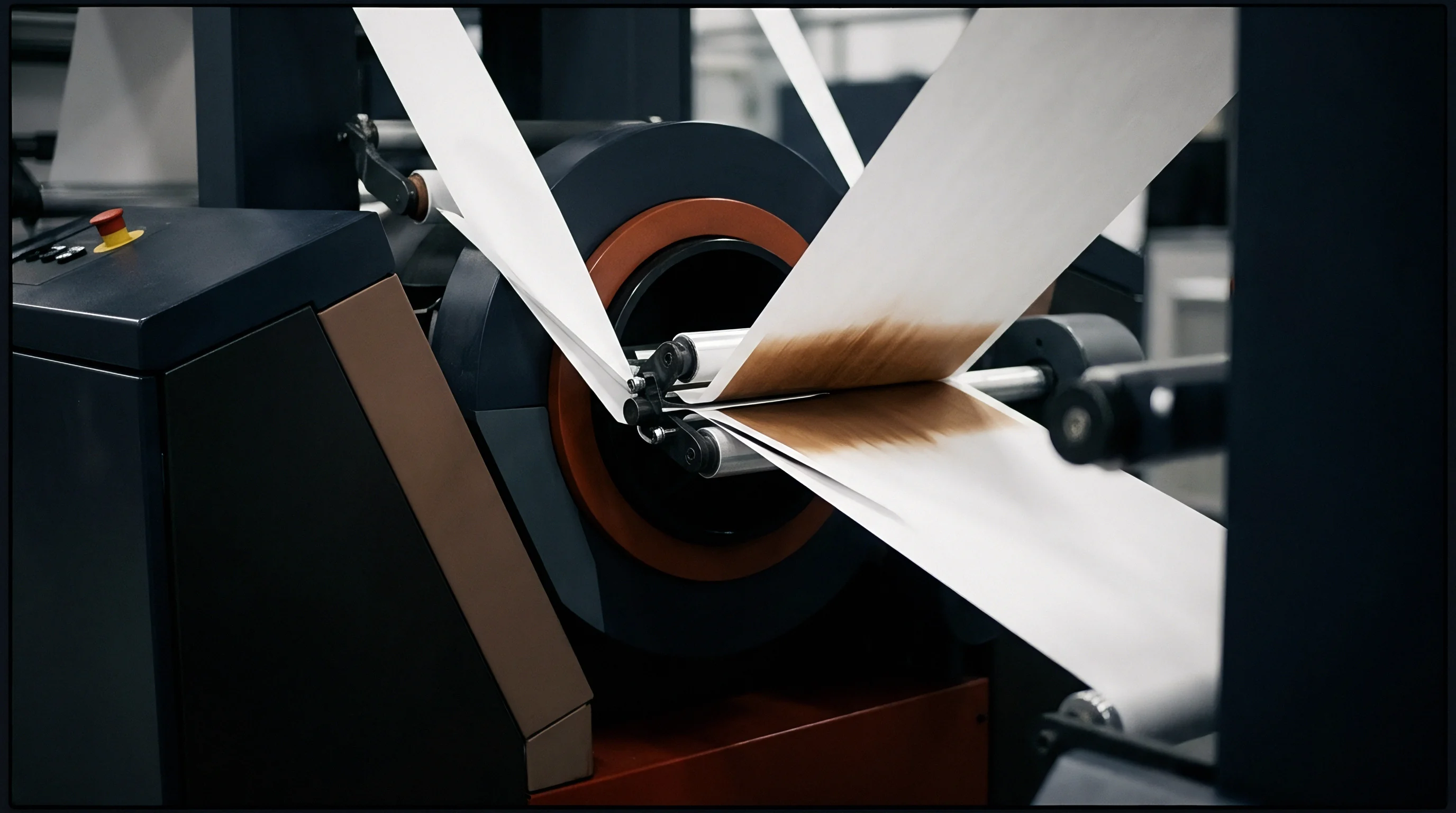
Outlay
Tooling costs and scrap rates drive the economics of rotary embossing. Engraved brass or hardened tool steel cylinder sets cost between 14,000 and 32,000 USD, depending on circumference, detail complexity, and internal oil channels. These precision assemblies suffer severe tooth damage if a web jams or foreign matter passes through the nip.
Running close to the rupture threshold increases scrap, as minor moisture shifts in incoming reels push plastic deformation into surface tearing. A press running 100,000 cartons at 200 meters per minute can generate 4,000 USD in wasted printed stock within twenty minutes if dynamic strain limits fail as the sheet stiffens at speed.
Evaluating a typical high-speed packaging run illustrates these costs. Consider an order of 500,000 folding cartons made from 350-micrometer solid bleached sulfate at 250 grams per square meter. With a web width of 1,020 millimeters, a die circumference of 650 millimeters, and raw stock priced at 1,650 USD per metric tonne, printing and varnishing add 280 USD per thousand sheets before embossing.
Make-ready consumes 650 meters of unprinted stock and 450 printed sheets during cylinder alignment and thermal ramp-up. Operating near the strain limit produces a 3.8 percent spoilage rate from edge micro-cracking and fiber tear. Increasing tool relief radii by 0.15 millimeters and heating cylinders to 105 degrees Celsius lowers scrap to 0.9 percent by staying within the deformation envelope.
On a 500,000-carton run, that adjustment saves 14,500 printed sheets ~ cutting direct material costs by 4,060 USD and eliminating 5.5 hours of downtime.
Exceeding board deformation capacity also creates downstream quality issues. Fractured coatings lose barrier performance, leading to seal failures and discoloration when packaging greasy, moist, or acidic goods. European EN 13430 recyclability standards penalize boards with damaged barrier films, reclassifying them into lower sorting tiers with higher disposal fees.
Designing tooling to stay within viscoelastic limits protects run profitability, maintains line efficiency, and preserves recyclability.