Standard Bench Test Methods for Measuring Paper Absorption Speed
Dynamic bench methods measure sub-second paper absorption speed to prevent glue failure, ink strike-through, and converting line spoilage.
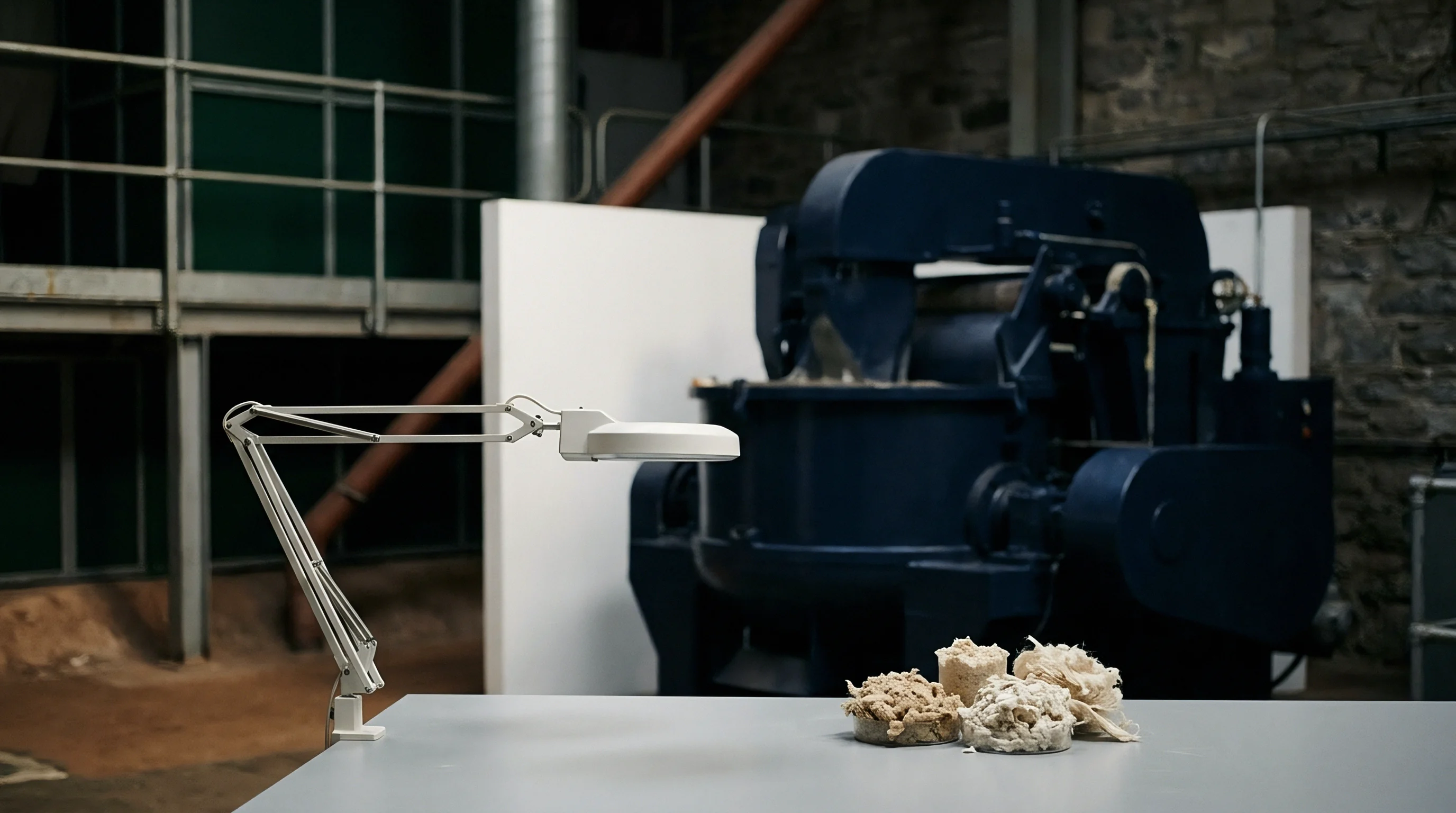

Drop
An automated microsyringe deposits four microlitres of deionised liquid onto the preconditioned sheet surface inside an environmental enclosure held at 23 degrees Celsius and 50 percent relative humidity. High-speed optical goniometry records the silhouette from initial liquid contact through ten seconds of wetting, spreading, and penetration. Automated baseline tracking calculates the contact angle on both flanks fifty times per second, establishing the decay trajectory defined under TAPPI T 558 and ASTM D724.
Sizing chemicals retard liquid uptake by depressing the solid surface energy below the surface tension of the liquid phase. Unsized furnish permits immediate capillary uptake.
Contact angles decay rapidly.
The progression of the liquid boundary separates into two distinct physical phases. The first phase spans the initial three hundred milliseconds, dominated by droplet spreading, surface wetting, and mechanical oscillation dampening from the dispenser detachment. The second phase begins once the contact perimeter arrests, marking true fluid movement through the surface sizing layer and into the inter-fibre capillary pore network.
Instruments logging only static contact angles at sixty seconds miss this transition entirely, concealing batch-to-batch variations in surface hydrophobic sizing agents such as alkyl ketene dimer or alkenyl succinic anhydride.
A steep decline in contact angle during the initial two hundred milliseconds signals inadequate hydrophobic sizing at the sheet exterior.
Dynamic sessile drop analysis yields parameters that map directly to high-speed liquid applications:
- Initial contact angle dictates initial liquid holdout during the first twenty milliseconds of fluid deposition on the convertor floor.
- Wetting velocity quantifies the change in contact angle per unit time during mechanical droplet relaxation.
- Absorption rate measures the reduction in calculated droplet volume after the three-phase contact line achieves spatial stability.
- Total wetting time marks the duration elapsed before the droplet contact angle drops below ninety degrees, indicating the onset of spontaneous capillary suction.
Surface roughness alters initial wetting.
Topographical irregularities expand the true wetted area relative to the apparent geometric area, accelerating apparent contact angle decline on hydrophilic surfaces and arresting advancement on hydrophobic boards. Modern video goniometers incorporate automated base-diameter tracking alongside angle calculation. When droplet volume diminishes while the interfacial contact diameter remains pinned, true liquid penetration occurs.
When volume remains constant while diameter expands, the observed angle drop reflects spreading across surface asperities rather than liquid migration into the z-direction.
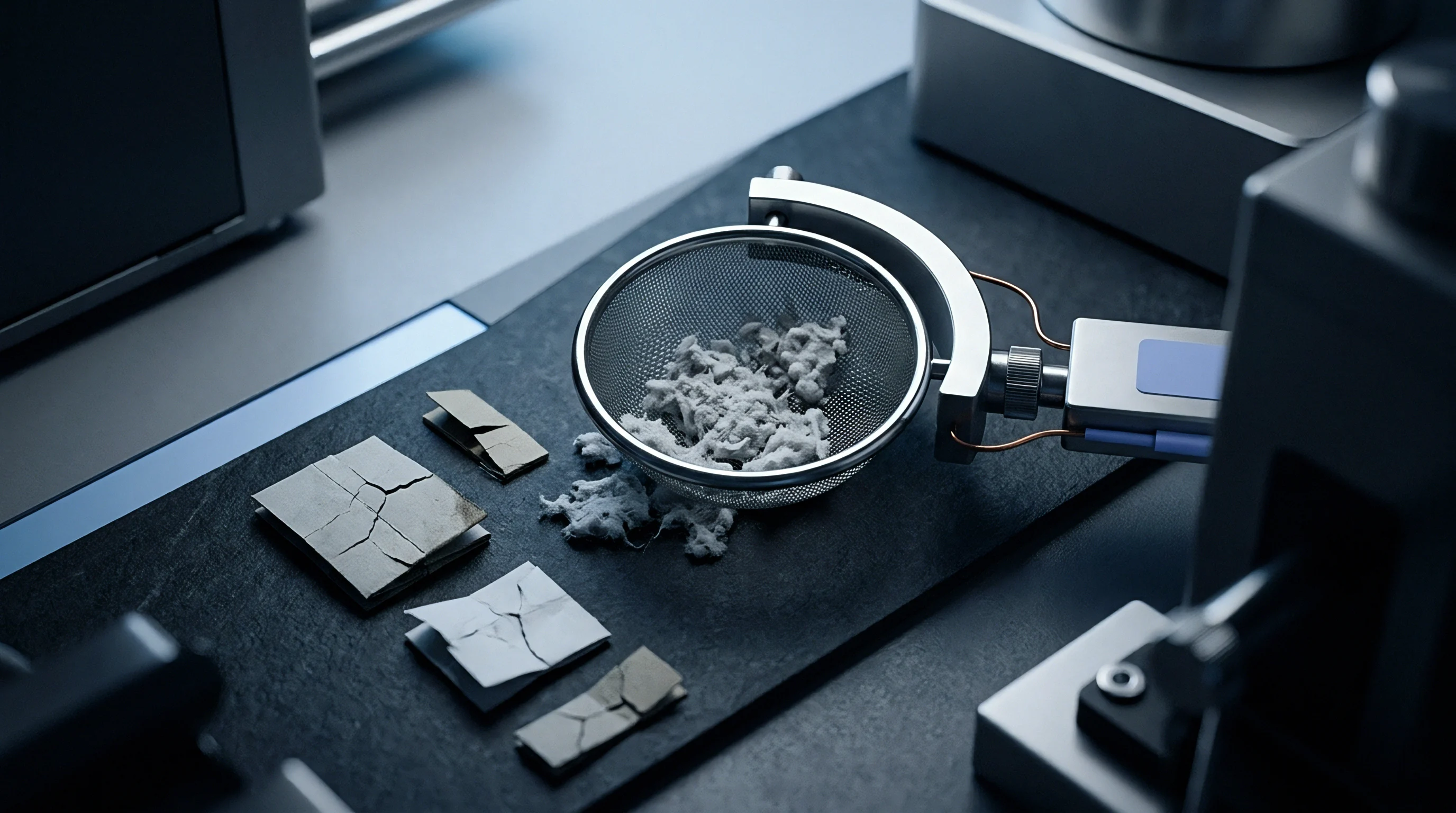
Wheel
A precision fluid applicator containing a metered volume of dyed liquid rests against a specimen strip mounted to the circumference of a motor-driven rotary drum. The Bristow wheel method, governed by ASTM D5455, TAPPI T 558, and ISO 21436, evaluates dynamic fluid sorption across contact intervals ranging from 4 milliseconds to 2 seconds. As the drum rotates at controlled peripheral velocities between 0.005 and 2.5 metres per second, the liquid transfers from the narrow applicator orifice onto the substrate under atmospheric pressure.
The resulting track length provides an inverse measurement of liquid uptake speed under dynamic mechanical conditions.
Liquid volume drops immediately.
The total fluid transfer per unit area splits into two distinct mechanical mechanisms: the roughness volume filling stage and the dynamic penetration stage. During the initial milliseconds, fluid fills the open surface micro-cavities without penetrating the fibre matrix. Once these surface depressions fill, true capillary penetration proceeds at a rate proportional to the square root of the contact exposure time.
The liquid absorption tester records a roughness transfer value of 14.2 millilitres per square metre on uncalendered kraftliner conditioned at 50 percent relative humidity.
Plotting transfer volume against the square root of exposure time yields a linear regression where the intercept on the y-axis defines the surface roughness index and the slope defines the dynamic absorption coefficient. Substrates exhibiting high surface pore volume combined with dense internal sizing demonstrate large intercepts alongside minimal slopes. Conversely, open-structure recycled testliners without surface sizing yield steep slopes, exhausting the applicator fluid within a few centimetres of track length.
| Substrate Classification | Basis Weight (g/m²) | Roughness Index (ml/m²) | Absorption Coefficient (ml/m²·s^0.5) | Wetting Delay Time (ms) |
|---|---|---|---|---|
| Solid Bleached Board (Coated) | 240 | 3.1 | 1.8 | 85 |
| Folding Boxboard (Uncoated) | 280 | 7.6 | 12.4 | 22 |
| Virgin Kraftliner | 175 | 11.4 | 8.7 | 45 |
| Recycled Testliner 3 | 150 | 16.8 | 34.2 | 8 |
| Supercalendered Magazine Stock | 56 | 2.4 | 0.9 | 140 |
Applicator slot geometry dictates measurement precision. Wear across the bronze or stainless-steel applicator blades distorts the fluid meniscus, producing edge-leakage tracks that falsely inflate calculated absorption values. Calibration schedules demand microscopic inspection of blade edges after every two hundred test strips to prevent fluid bypass.
When test strips show feathered boundaries, the operator cleans the reservoir with ultrasonic solvent bath cycles to clear dried pigment residues.
Standard delivery terms under ISO 21436 require suppliers to document both the absorption coefficient and the initial wetting delay time, terminating lot disputes over glue setting speeds on high-speed corrugators.


Pulse
A piezoelectric emitter transmits high-frequency ultrasonic waves through a sheet sample clamped inside a liquid-filled acoustic chamber. Dynamic Penetration Measurement tracks the amplitude attenuation of the ultrasonic wave train as test fluids penetrate the sheet thickness over intervals spanning 10 milliseconds to 100 seconds. Dry cellulose fibres and inter-fibre void networks scatter ultrasound intensely due to large acoustic impedance mismatches between cellulose and entrapped air.
When liquid displaces air, acoustic impedance homogenises, producing a transient rise in transmission signal until liquid-induced fibre swelling disrupts sheet geometry and scatters acoustic energy anew.
The ultrasonic signal decays sharply.
Can Ultrasonic Attenuation Predict Corrugator Delamination?
Water-based starch adhesives rely on precise liquid phase release to form green bonds before the web exits the pressure belt. Ultrasonic penetration curves reveal whether liquid phase transfer outpaces adhesive tack development. If acoustic transmission peaks within sixty milliseconds, water evacuates the adhesive film prematurely, starving the glue line and yielding dry, brittle bonds that fail at the slit-scorer.
Ultrasonic transmission curves delineate specific mechanical regimes across the absorption cycle:
- Air boundary wetting represents the initial fluid contact with surface fibres, recorded as a baseline acoustic signal before transmission increases.
- Liquid front advance registers as a steep positive slope in transmitted acoustic amplitude as capillary action replaces void air with liquid.
- Signal transmission peak identifies the exact moment the penetrating fluid front makes continuous contact with the opposing sheet face.
- Fibre network relaxation manifests as an exponential decay in signal amplitude caused by hygroscopic fibre expansion and micro-delamination within the cellulose wall.
Ultrasonic transmission reaches its structural maximum at the exact point of fluid breakthrough across the z-axis.
Sizing agents delay penetration.
Pore tortuosity and internal sizing chemistry determine the duration from initial immersion to peak acoustic transmission. Highly sized virgin kraftliners sustain the baseline phase for over four thousand milliseconds, whereas recycled fluting mediums show immediate transmission spikes within twenty milliseconds of fluid contact. Such divergence explains why high-speed laminating lines run at half-speed when switching from virgin semi-chemical fluting to short-fibre recycled testliner without adjustive formulation changes in adhesive solids.
The relationship between acoustic signal decay and true structural swelling remains difficult to resolve across complex multi-ply boards where each layer carries distinct filler loads and beating degrees.


Wick
Vertical capillary uptake testing suspends a conditioned strip of paper vertically with its lower edge submerged five millimetres into a reservoir of distilled water or standardized test ink. ISO 8787 details the Klemm capillary rise procedure, recording liquid ascension height against logarithmic time intervals. The method assumes fluid movement complies with the Lucas-Washburn equation, where liquid elevation increases with the square root of time under the driving force of capillary suction balanced against viscous drag.
This bench method provides reliable data for porous, unsized grades including blotting paper, filter stock, and high-bulk saturating kraft.
Capillary action takes over quickly.
Do Standard Sizing Tests Hide Porosity Defects?
Industrial testing labs often substitute the Hercules Size Test under TAPPI T 530 for vertical wicking procedures. The Hercules method applies an acidic dye solution to the upper paper surface, using a photometer to measure the reflectance loss as liquid penetrates downward through the sheet thickness. A sizing threshold set at 80 percent reflectance records the time taken for chemical neutralization and optical darkening.
Highly calendered sheets with dense filler contents demonstrate extended Hercules test times due to physical tortuosity, even when internal sizing chemistry is deficient.
The Cobb test specified under ISO 535 provides a gravimetric measure of water absorptiveness over fixed durations, typically 60 seconds. An operator clamps a 100-square-centimetre sample beneath a metal ring, pours 100 millilitres of water over the surface, drains the cell at 45 seconds, and blots the test piece with a ten-kilogram roller before re-weighing. While standard for commodity specifications, the sixty-second Cobb method averages initial wetting, bulk penetration, and saturation, concealing fast sub-second liquid uptake variations that ruin flexographic print definition.
| Test Method Name | Governing Standard | Primary Fluid | Temporal Resolution | Measured Property | Practical Application |
|---|---|---|---|---|---|
| Dynamic Contact Angle | TAPPI T 558 | Deionised water, ink | 20 milliseconds | Angle decay rate (deg/s) | High-speed inkjet dot gain |
| Liquid Absorption Tester | ASTM D5455 | Dye solution, varnish | 4 to 2000 milliseconds | Roughness index, uptake slope | Flexo printing and coating |
| Ultrasonic Penetration | Emco DPM protocol | Water, alcohol, starch | 10 milliseconds | Acoustic transmission curve | Corrugator glue set time |
| Klemm Capillary Rise | ISO 8787 | Distilled water | 10 to 600 seconds | Wicking height (mm) | Saturating and blotting kraft |
| Hercules Size Test | TAPPI T 530 | Formulated green dye | 0.5 to 1000 seconds | Reflectance decay duration | Acidic ink holdout in offset |
| Timed Cobb Test | ISO 535 | Tap or distilled water | 30 to 1800 seconds | Weight gain (g/m²) | Boxboard water resistance |
Water penetrates the porous network.
Sizing variations explain divergence between test methods across seasonal production runs. During summer months, elevated whitewater temperatures in the mill accelerate sizing degradation during drying cylinder contact, producing sheets that satisfy twenty-minute Cobb limits while failing five-millisecond dynamic absorption thresholds on customer presses.
Mill technical representatives consistently claim that a standard sixty-second Cobb value within commercial tolerance guarantees defect-free liquid holdout during high-speed cold-set converting.

Margin
Economic consequences of unmonitored absorption kinetics emerge downstream on high-speed converting machinery where substrate velocity reaches six hundred metres per minute. At these web speeds, fluid transfer, pigment setting, and adhesive open times occur in window spans under eighty milliseconds. When paper absorption speed shifts outside established operating limits, converters burn margin through waste generation, press wash-ups, and customer rejections.
Fast absorption creates dry bonds.
Consider an operational folding carton line converting 40 tonnes of 280-gram folding boxboard per shift into pharmaceutical cartons using water-based emulsion adhesives. The specification calls for a Bristow absorption coefficient between 10.0 and 14.0 millilitres per square metre per square-root second, yielding a stable adhesive open time of 45 milliseconds. A delivered board batch with an absorption coefficient of 26.5 millilitres per square metre per square-root second draws water from the adhesive film prematurely, driving adhesive solids past the immobilization threshold before the compression belt engages.
Starch penetration demands precise timing.
Resolving line failures caused by substrate absorption variations requires a systematic analytical sequence at the plant floor:
- The laboratory team isolates delivered reels by skid identification number and logs surface temperature directly from unopened pallets.
- Technicians condition specimen strips for four hours inside a climate cabinet operating strictly at standard atmospheric parameters.
- Goniometric contact angle decay curves establish whether surface surfactants or hydrophobic agents suffered thermal degradation at the paper mill.
- Bristow wheel tracks quantify roughness volume versus capillary uptake coefficient using production ink formulations.
- Line managers adjust adhesive application volumes or slow press speeds to realign fluid transfer rates with the measured substrate absorption capacity.
Contractual rejection thresholds take effect whenever dynamic absorption rates diverge by more than twenty percent from certified pre-shipment swatches.
High absorption rates starve glue lines.
The cost arithmetic underscores the sensitivity of converting yields to absorption control. On the assumed 40-tonne boxboard run, unbonded glue flaps force an immediate line stop, generating three percent initial makeready waste and 1,200 kilograms of scrapped cartons. At a landed substrate cost of 1,150 euros per tonne, the direct board loss totals 1,380 euros.
Adding six hours of downtime charged at 350 euros per press hour elevates the direct margin destruction to 3,480 euros per shift, exceeding the entire procurement margin on the order.
Failure to specify dynamic absorption speed via calibrated bench methods leaves buyers absorbing the cost of unbondable board, pressroom delamination, and unrecoverable sorting labor across every production run.