Ground Level Substrate Moisture Balancing in Single Sided Board Lamination
Balancing moisture loss with back-side rewetting and web decurling holds single-sided laminated boards flat across die-cutting and high-speed packing.

Warp
A fresh lift of 350 gsm solid bleached sulfate emerges from the laminating delivery stack with an upward dish profile of fourteen millimeters across a B1 sheet width. The sheet lifts instantly. Within twenty seconds of leaving the heated nip, exposed edges draw upward toward the film-covered face while the center of the sheet rests concave against the delivery pile.
The mechanical cause sits in the cross-direction hygroexpansion coefficient of bleached kraft pulp acting against an impervious biaxially oriented polypropylene skin. Hot thermal nip rollers operating between 105 and 115 degrees Celsius flash unbound water out of the top surface layers directly into the molten adhesive layer. That moisture cannot escape past the polymeric barrier.
The unlaminated reverse side remains open to the ambient pressroom air, venting water vapor into the boundary layer and initiating rapid cross-grain contraction.

Directional Fiber Shrinkage
Papermaking machines align the majority of cellulose filaments along the machine direction, establishing an anisotropy ratio between 2.0:1 and 3.5:1 for tensile stiffness and dimensional stability. Transverse swelling coefficients exceed longitudinal values by a factor of five to eight. When moisture desorbs from the unsealed backing ply during thermal processing, individual fibers shrink across their diameter far more than along their length.
The result is pronounced cross-direction curvature that curls around an axis parallel to the grain. Cellulose fibers contract unevenly. Single-sided barrier films fix the top surface at a constant dimension while the drying reverse plies pull the entire composite into a rigid arch.
Standard cartonboard structures incorporate multiple plies designed to optimize bending stiffness at minimal basis weight. In folding boxboard, mechanical groundwood or thermomechanical pulp forms the bulky middle plies, sandwiched between chemical pulp liners. Mechanical pulp plies display lower hygroexpansion coefficients than pure chemical plies, but their porous network permits rapid moisture migration.
When radiant or conductive thermal energy strikes the coated face, a steep thermal gradient develops through the board thickness. The reverse liner loses equilibrium water content faster than the core can replenish it from internal reservoirs, creating severe internal shear stress along the ply interfaces.
Film contraction on the dry side pulls the sheet toward the coated face whenever moisture departs the unsealed cellulose back.
Asymmetric Moisture Escape
Water movement within paperboard obeys Fickian diffusion governed by temperature, vapor pressure differentials, and local boundary resistance. In bare board, both faces exchange moisture symmetrically with the environment, allowing the sheet to expand or contract evenly without generating out-of-plane torque. Single-sided lamination eliminates mass transport through the top boundary.
The water vapor permeability of a 15-micron BOPP film sits below 5 grams per square meter per day under tropical test conditions, effectively halting all outward desorption through the laminated face. Thermal energy absorbed in the laminator nip raises the internal vapor pressure of the board, driving free and bound moisture exclusively toward the unlaminated bottom ply.
The resulting asymmetric moisture loss curve leaves the reverse face depleted of equilibrium water. Oven drying trials conducted according to ISO 287 demonstrate that a single thermal lamination pass at 110 degrees Celsius at 70 meters per minute reduces overall sheet moisture content from an incoming 6.5 percent down to 4.7 percent. This 1.8 percent moisture loss figure rests on gravimetric oven testing under ISO 287 on forty 350 gsm folding boxboard specimens processed at 110 degrees Celsius at 65 meters per minute; lowering web temperature to 90 degrees or increasing throughput above 100 meters per minute cuts this evaporation below 1.1 percent.
The unlaminated reverse liner absorbs the bulk of this desiccating effect, dropping to an estimated surface moisture content below 3.5 percent at the rewind or delivery pile.
Mechanical Curl Geometries
Converting operations categorize cartonboard distortion into three distinct structural manifestations based on the orientation of the principal curve relative to board manufacturing alignment:
- Cross-direction curl forms a cylindrical arch along the machine direction, driven by transverse fiber shrinkage on the unlaminated sheet face.
- Machine-direction curl generates roll-set curvature aligned with web travel, produced by excessive rewind tension or small-diameter idler wrap during laminating.
- Diagonal twist curl develops when sheet squareness deviates from fiber orientation, inducing torsional shear across opposite corners during rapid moisture exchange.
Uncorrected single-sided board warp causes severe misregistration in subsequent processing stations, tripping automatic feed sensors, destroying side-guide alignment in high-speed blanking presses, and creating permanent flute marking during downstream litho-laminating operations.
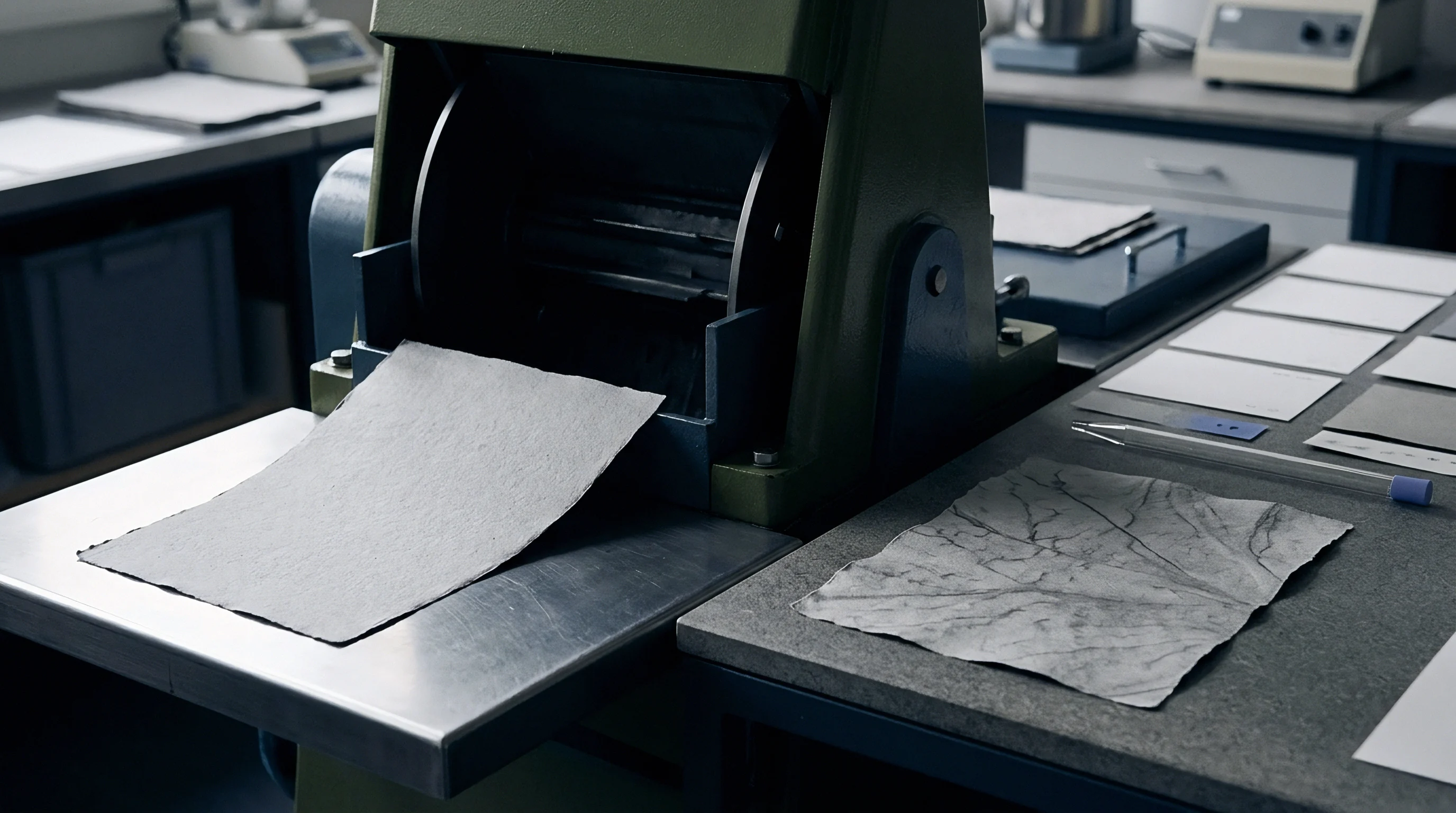
Mist
Restoring hygroscopic equilibrium across the board thickness requires controlled rehydration of the unlaminated reverse surface directly within the lamination pass. The nip drives water out. Spray dampening units positioned immediately post-nip or on the chill-roll stand introduce atomized liquid to the exposed fiber liner before internal stresses set permanently into the cellulose matrix.
Rotor dampening systems meter precise fluid volumes using spinning discs that cast micro-droplets against an adjustable shutter aperture. This non-contact application avoids scuffing the raw liner while ensuring uniform lateral fluid distribution across the web width.
Rotor Spray Application Rates
Applying water to moving paperboard requires strict volumetric governance calibrated against substrate grammage and line velocity. Standard rotor configurations deploy a row of rotating discs operating between 3,500 and 5,000 revolutions per minute, generating a uniform droplet curtain with average particle diameters between 20 and 40 microns. The liquid delivery system uses pulse-width modulated valves or precision gear pumps to regulate flow rates from 0.2 to 3.0 grams of water per square meter of board.
Light boards between 200 and 260 gsm demand lower volume additions to avoid web softening, while dense multi-ply grades above 400 gsm absorb heavier applications without losing structural integrity.
| Substrate Grade | Caliper (µm) | Initial Moisture (%) | Post-Lamination Moisture (%) | Compensating Mist (g/m²) | Final Curl Index (mm) |
|---|---|---|---|---|---|
| Solid Bleached Sulfate (SBS) | 380 | 6.4 | 4.8 | 0.75 | 1.5 |
| Folding Boxboard (FBB) | 450 | 7.2 | 5.3 | 0.95 | 2.0 |
| Coated Recycled Board (CRB) | 420 | 6.8 | 5.1 | 1.10 | 2.5 |
| White Lined Chipboard (WLC) | 500 | 7.5 | 5.4 | 1.25 | 3.0 |
Water Film Penetration Depth
Penetration kinetics govern whether added fluid corrects dimensional curl or degrades board conversion qualities. Liquid deposited on the uncoated back face must penetrate past the surface fibers into the sub-surface matrix within milliseconds of contact. Surfactants blended into the dampening fluid lower surface tension from 72 millinewtons per meter down to approximately 32 millinewtons per meter, overcoming natural sizing barriers such as alkyl ketene dimer or alkenyl succinic anhydride present in the chemical pulp liner.
Rapid capillary absorption prevents liquid pooling on idler rollers and eliminates ink set-off on the reverse side of stacked sheets.
Folding boxboard conditioned to 50 percent relative humidity at 23 degrees Celsius loses 1.8 percent total sheet weight through oven lamination at 105 degrees Celsius.
Suppliers frequently cite a uniform 0.5 grams per square meter water application rate as the universal remedy for single-sided curl, yet line trials show this volume over-saturates lighter bleached boards while failing heavier multi-ply grades; a prudent buyer insists on on-press step trials across 0.3 to 1.2 grams per square meter to verify the exact equilibrium window for their specific grammage. If the fluid penetration extends across more than thirty percent of total sheet caliper before web rewinding or sheeting, the internal sizing bond weakens noticeably. The sheet loses Scott bond internal strength, raising delamination risks when folding cartons undergo high-speed gluing.
Where Do Differential Sorption Gradients Peak?
Internal moisture gradients reach their maximum divergence within the first two seconds following exit from the laminating nip. Thermal shock accelerates shrinkage. The heated nip vaporizes surface moisture while simultaneously raising the temperature of internal pore air.
As the sheet contacts cooler downstream guidance rolls, condensation occurs immediately beneath the impervious plastic film, while the bottom surface continues evaporating into ambient air. Moisture leaves the sheet.
Rotor dampening addresses this divergence by balancing the chemical potential of water across the board profile before the cellulose fibers pass below their glass transition threshold. Adding moisture to the dry reverse liner lowers its tensile contraction force, establishing an equilibrium counter-torque that opposes the contractile tension of the cooling plastic film. Lamination film manufacturers assert that post-lamination warping originates strictly from improper board storage conditions in the buyer pressroom rather than thermal processing variables inside the laminating unit.

Tension
Substrate moisture adjustments interact directly with mechanical web tension maintained across the laminating zone. Web tension stretches the plastic film elastically prior to adhesive bonding. The web snaps back.
When the composite cools and exits the nip, the stretched film attempts to recover its original unstrained length, generating a constant bending moment across the substrate. If this elastic recovery tension aligns with the contractile drying stresses of the paperboard backing, catastrophic dishing occurs. Aligning film elongation with substrate dimensional changes prevents excessive post-cure curl.
Film Elastic Modulus Disparities
Polymeric lamination films display stress-strain behaviors fundamentally distinct from cellulose fiber networks. Biaxially oriented polypropylene exhibits an elastic modulus between 1.5 and 2.5 gigapascals, accompanied by substantial yield elongation. Polyethylene terephthalate films provide higher stiffness, with modulus figures spanning 3.5 to 4.5 gigapascals, resisting mechanical stretch during unwind.
Polymer chains freeze under tension. Cellulose boards exhibit machine-direction tensile moduli ranging from 4.0 to 9.0 gigapascals depending on refining intensity and fiber morphology. The discrepancy in elastic recovery creates unbalanced composite mechanics during temperature and humidity fluctuations.
| Film Polymer Type | Nominal Caliper (µm) | Tensile Modulus MD (GPa) | Thermal Shrinkage at 120°C (%) | Corona Energy (mN/m) | Water Vapor Transmission (g/m²/day) |
|---|---|---|---|---|---|
| BOPP Gloss | 15 | 2.1 | 3.8 | 42 | 4.2 |
| BOPP Matt (Silica Filled) | 18 | 1.8 | 4.2 | 40 | 5.1 |
| PET Gloss (Thermal Grade) | 12 | 4.1 | 1.5 | 46 | 25.0 |
| Cellulose Acetate | 14 | 2.8 | 0.8 | 44 | 180.0 |
| Nylon 6 (BOPA) | 15 | 1.4 | 2.2 | 52 | 32.0 |
Heated Nip Polymer Relaxation
Applying heat to lamination films induces thermal shrinkage alongside elastic stretch recovery. When oriented films pass through nips heated to 110 degrees Celsius, frozen molecular orientations relax, driving thermal contraction. Unchecked, BOPP contracts up to four percent in machine direction if unrestrained at elevated temperatures.
Mechanical brake tension applied at the film unwind roll exacerbates this phenomenon by adding mechanical strain on top of thermal deformation. Early clockmakers noted a similar physical phenomenon in bimetallic strips, where differing thermal expansion coefficients between brass and steel caused predictable out-of-plane bending as ambient temperatures shifted. In laminated cartonboard, the combination of thermal film shrinkage and hygroscopic board contraction creates an identical compound curvature mechanism.

Substrate Shrinkage Matching Criteria
Balancing composite tension demands that operational parameters adhere to a rigorous verification sequence before releasing production pallets to finishing departments:
- Unwind tension regulation calibrates film brake pressure to the minimum load required to maintain a wrinkle-free web, avoiding artificial mechanical elongation.
- Chilled roll temperature profiling maintains chill cylinder surfaces between 16 and 20 degrees Celsius to set the adhesive bond before film relaxation stresses transfer into the board plies.
- Moisture matching ratio targets align reverse-side water application volume with the measured contraction index of the specific film grade running on the line.
- Post-cure stack clamping stabilizes warm pallets under uniform top pressure plates during the initial four-hour cooling window to restrict out-of-plane movement.
The 35 millinewton-meter curl threshold draws from ISO 5629 resonance stiffness testing on fifty finished carton samples evaluated at 23 degrees Celsius and 50 percent relative humidity; this baseline shifts upward if the pulp blend substitutes mechanical groundwood for bleached chemical softwood. Whether advanced inline thermal sensors can decouple web tension transients from instantaneous fiber hygroexpansion in high-speed roll-to-sheet converters remains an open technical challenge for equipment designers.
Decurl
Mechanical interventions complement chemical rewetting systems by plastically deforming the composite web before sheeting. The decurler breaks that curve. Passing the laminated web over an adjustable breaker bar or small-radius decurling rod introduces reverse mechanical strain into the paperboard fibers.
The process bends the composite over an acute angle with the unlaminated board face drawn tight against the bar surface. This sharp wrap forces the outer board fibers into tensile yielding while compressing the laminated top ply, imparting an artificial reverse curl that counteracts subsequent dish distortion.
Breaker Bar Penetration Angles
Adjusting breaker penetration changes the wrap angle and the resulting internal stress profile. Motorized decurler assemblies use hardened steel rods ranging from 6 to 15 millimeters in diameter, or rotating tungsten-carbide sleeve bars for abrasive recycled board surfaces. Increasing the penetration depth pushes the bar deeper into the web path, increasing wrap angle from 15 degrees up to 90 degrees.
Operators select penetration levels based on instantaneous caliper and observed curl severity at the delivery table.
- Verify baseline sheet flatness by pulling a three-sheet sample immediately before the slitter knives.
- Engage the primary breaker bar until the lead edge of the delivered sheet displays zero vertical deflection against the jogger face.
- Inspect the unlaminated reverse liner under oblique lighting to confirm the acute wrap angle has not induced fiber checking or microscopic surface fracture.
- Advance line speed to production velocity and adjust penetration depth to compensate for dynamic web stiffening.
ISO 187 conditioning mandates twenty-four hours of pallet acclimatization at 23 degrees Celsius and 50 percent relative humidity before slit carton blanks enter high-speed folder-gluers.

Will Mechanical Decurling Bars Prevent Delayed Pallet Distortion?
Mechanical decurling delivers immediate sheet flatness at the press delivery, but cannot permanently eliminate stress imbalances driven by active moisture gradients. If board moisture content remains below equilibrium levels when pallets enter storage, ambient moisture absorption through pallet edges will re-initiate sheet distortion within twenty-four hours. High speed magnifies the defect.
Mechanical deformation fractures fiber-to-fiber hydrogen bonds in the reverse liner, reducing elastic recovery forces. If the underlying moisture deficit remains uncorrected by inline misting or environmental conditioning, hygroscopic forces gradually overcome the mechanical reverse strain.
Plastic Deformation of Uncoated Backing
Subjecting paperboard to acute reverse bending alters the stress-strain distribution across individual plies. The outermost fibers on the uncoated liner exceed their elastic limit, transitioning into plastic elongation. This strain relieves the residual contractile stress established during thermal nip processing.
Heavy mechanical working reduces the overall structural stiffness of the finished carton blank. Excessive breaker penetration degrades Taber or L&W bending resistance by five to fifteen percent, compromising carton top-to-bottom compression strength in finished packaging.
Sharp reverse bending breaks fiber bonds to preserve sheet flatness.
Spoilage
Converting warped or improperly balanced single-sided laminated board generates substantial financial waste across post-press operations. Gluer belts reject curved flaps. When curled sheets reach automatic flatbed die cutters, warped front edges strike feeder suction bars and side-guide plates, halting the press.
High-speed converting lines running at 8,000 sheets per hour incur significant monetary penalties for every unscheduled stop. Beyond immediate line stoppages, warped blanks distort inside die-cutting chases, inducing registration drift that ruins tight cutting-to-print margins.
Feeder Jams in Die Cutters
Automatic sheet feeders rely on flat sheet surfaces to establish vacuum seal integrity across pickup suckers and forwarding nozzles. Curled sheets break suction prematurely. The feed rolls spin freely.
When sheets dish upward, forwarding suckers push against the crown of the curl rather than gripping the trailing edge, causing sheets to feed skewed into the infeed table. Modern optical sensors detect misaligned edges down to fractions of a millimeter, triggering immediate press trips to avoid smashing steel die rules. Press operators halt the run.
Make-ready sheets pile up.
Cartons that feed flat into packing lines preserve line speed while curled blanks jam the feeder magazine within thirty seconds.
Folder Gluer Line Stoppage Calculations
Downstream folder-gluers present even tighter tolerances for carton blank flatness. Curved carton blanks twist within feed hoppers, feed unevenly into carrier belts, and cause folding swords to miss pre-broken score lines. Flat boards run without interruption.
The financial penalty of running unstable, unbalanced board accumulates rapidly across automated packaging lines.
| Processing Stage | Uncorrected Warped Board Waste (%) | Moisture Balanced Board Waste (%) | Downtime Penalty per Stop (USD) | Net Financial Loss per 50k Sheets (USD) |
|---|---|---|---|---|
| Thermal Lamination Make-Ready | 4.5 | 2.0 | 120 | 680 |
| Flatbed Die-Cutting & Stripping | 6.2 | 1.5 | 250 | 2,150 |
| High-Speed Folder-Gluer Running | 5.8 | 0.8 | 180 | 1,840 |
| Customer Packaging Line Jams | 3.0 | 0.1 | 450 | 3,200 |
Landed Cost of Moisture Correction Passes
Evaluating corrective passes requires balancing equipment investment against running waste reductions. Installing an inline rotor dampening system on a 1060-millimeter thermal laminator involves a capital expenditure between 45,000 and 70,000 USD. Operating costs for demineralized water and specialized wetting agents average less than 0.08 USD per thousand square meters of converted board.
Alternatively, executing a second conditioning pass through an offline dampening or coating unit adds make-ready time, handling damage, and an extra converting cost between 12.00 and 18.00 USD per thousand sheets.
Commercial packaging supply agreements enforce standard defect provisions through DIN EN 643 and ISO 9001 quality annexes, establishing that delivered board with out-of-plane distortion exceeding three millimeters across a five-hundred-millimeter span constitutes non-conforming product subject to complete lot rejection at supplier expense.