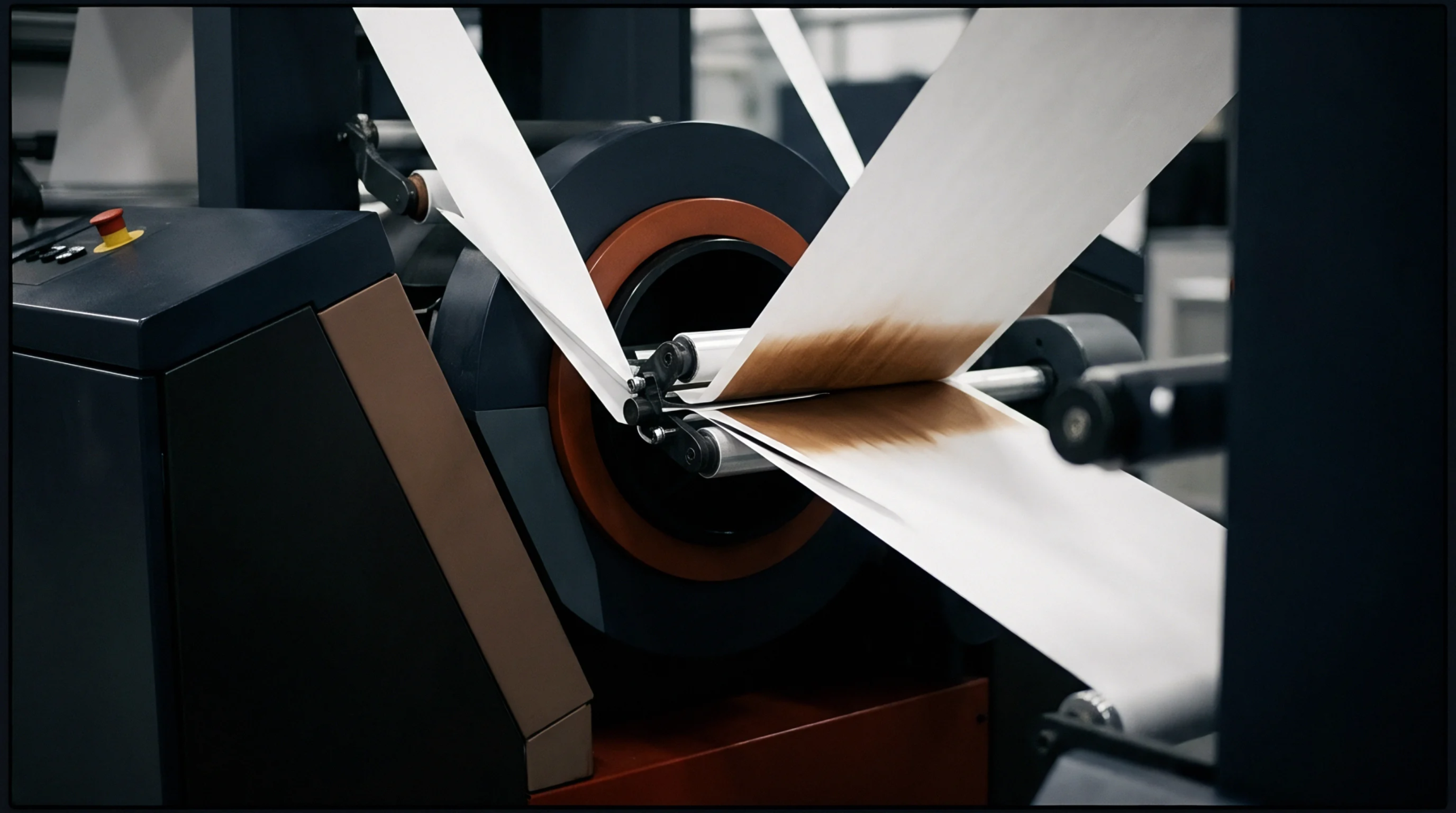
Web Tension
Web tension control mechanisms govern pass-line displacement across rotary printing units and converting lines to prevent register drift and substrate distortion. Mill operations rely on precise load cell feedback to regulate draw geometry between nip rollers. Excessive lateral movement creates skew defects on high-speed presses.
Operators measure mechanical stability in newtons per meter across the web width. This parameter stops applying beyond the final slitter assembly where individual ribbons separate from the parent roll.
Roller Alignment
Mechanical parallelism of idler rollers dictates directional stability on narrow-web laminators and extrusion coaters. Misaligned bearings induce lateral steering forces that stretch one edge of the substrate beyond its elastic limit. Tension zones absorb minor angular deviations without immediate web fracture when stiffness values remain high.
Technicians use optical alignment lasers to verify perpendicularity before starting a production run.
Die Cutting
Rotary tooling demands strict control of pass-line displacement during adhesive lamination and selective die cutting operations. Substrate elongation alters the repeat length of printed graphics relative to the underlying metal cylinder. Press speeds accelerate web vibration frequencies that complicate optical registration systems.
Deflection tolerances shrink to micrometers when converters process thin metallic films alongside coated paperboards.