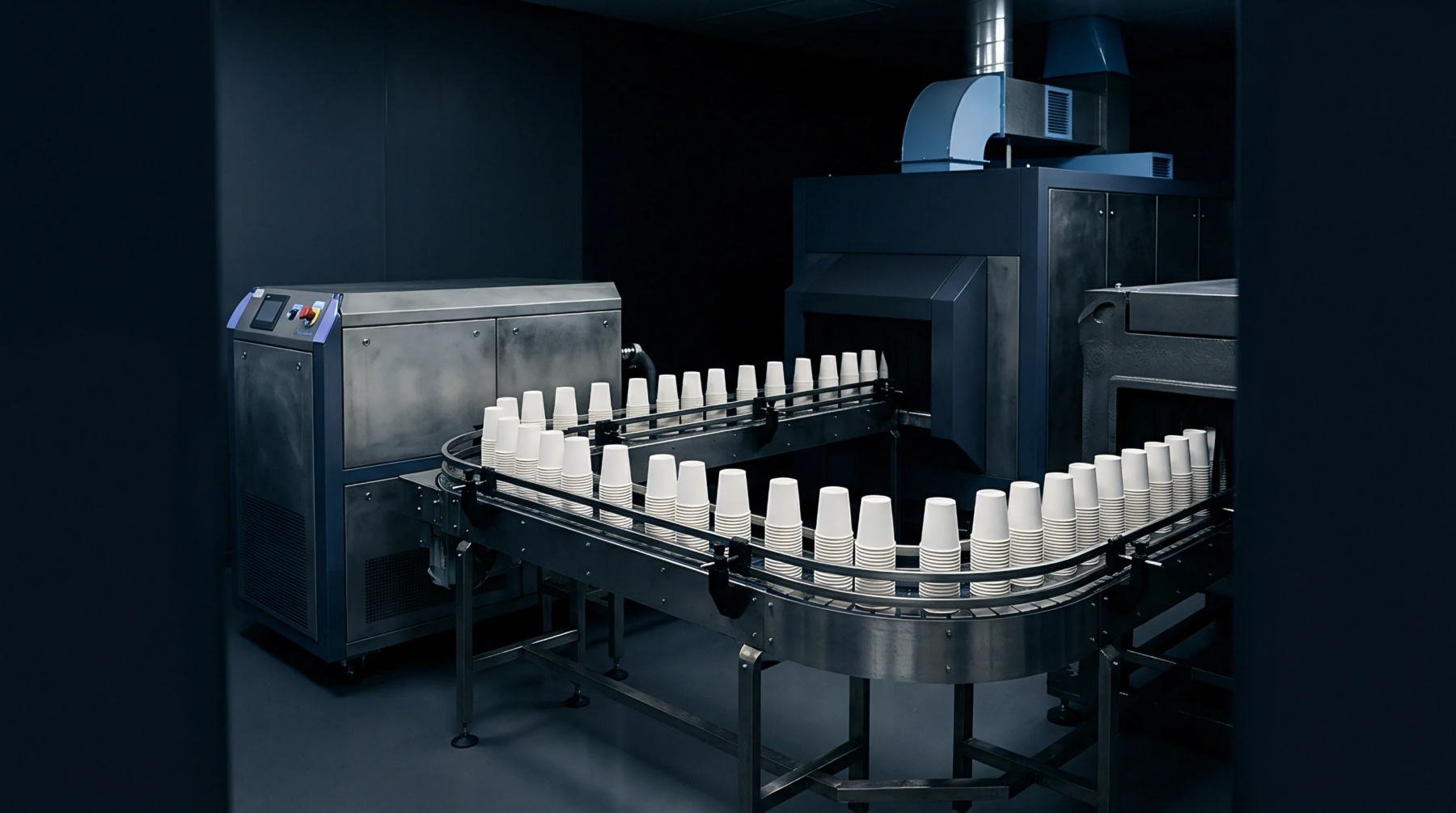
Convection Mechanism
Heated air currents circulate within an enclosed chamber to remove solvent or water from coated paper substrates. A thermal drying tunnel provides the controlled environment required for high speed coating lines where liquid carriers must evaporate before the finished stock contacts any mechanical rollers. Precise temperature regulation prevents heat damage to the underlying fibre while moisture release occurs at a rate that maintains the physical stability of the material.
Effective heat transfer hinges on uniform airflow distribution across the width of the moving web. If air velocity variations occur, the drying profile across the surface of the paper becomes inconsistent. Operators adjust fan speeds and heating element output to manage the evaporation of volatile compounds within the specific limits defined by the coating chemistry.
Evaporation Control
Maintaining a consistent vapor pressure inside the unit prevents skinning on the surface of the coating. A thermal drying tunnel uses modular heat zones to graduate the drying curve from low intensity at the entry to higher thermal loads toward the exit. This staged approach allows solvents to escape through the porous structure of the coating without creating surface defects or blistering.
The residual solvent content decreases as the web advances through the successive zones. Proper regulation of the exhaust volume removes saturated air and replaces it with fresh intake to keep the drying rate optimal. High speed operations depend on this balance to reach target line speeds while ensuring the final coating remains defect free.
Substrate Interaction
Moisture content after the curing phase determines the flatness and dimensional integrity of the final product. A thermal drying tunnel affects the internal tension of the fibre network because rapid moisture loss produces differential shrinkage between the surface and the core of the sheet. Heat exposure must remain below the degradation point of both the cellulose and the added binders to prevent yellowing or embrittlement of the paper.
Controlled cooling stages often follow the heating phase to stabilize the substrate before winding or further converting processes. Consistent thermal application results in uniform ink receptivity across the entirety of the paper surface.