Line Tension
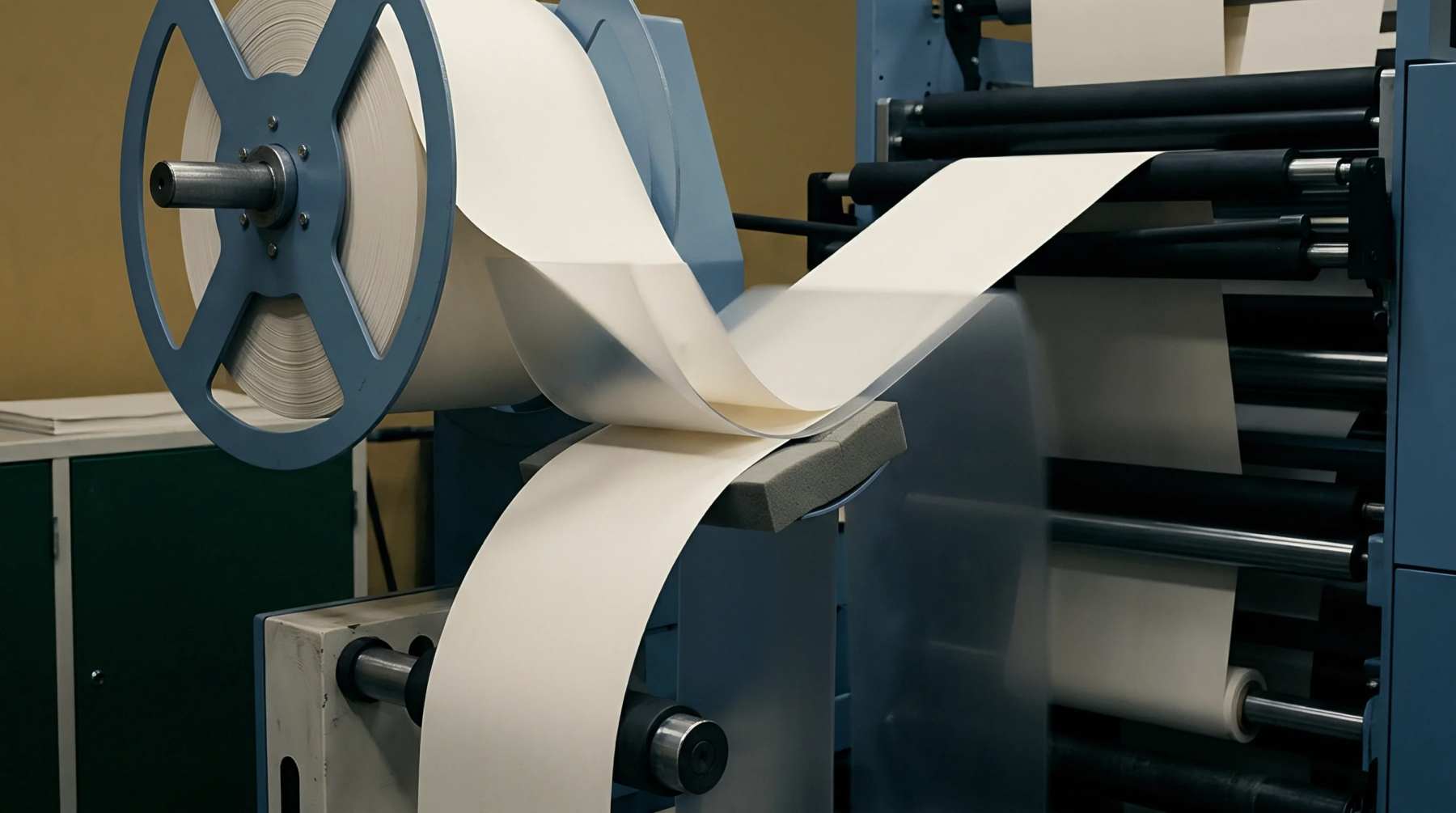
Structural stability in high-speed rotary printing depends on web break frequency, which measures unplanned paper strip ruptures per one hundred kilometers of run. Continuous production relies on this metric to quantify substrate runnability across commercial printing presses and converting machinery. Excessive tension spikes trigger immediate line stoppages, destroying throughput efficiency and wasting thousands of metres of processed stock.
Paper grades containing high recycled content or uneven moisture profiles exhibit higher failure rates during high-speed unwinding operations. Mill suppliers optimize fibre orientation and tensile strength specifications to keep stoppage counts within acceptable contractual tolerances for press operators.
Splicing Integrity
Mechanical continuity across reel changes dictates web break frequency during continuous unwinding sequences. Adhesive selection and tape application accuracy govern whether flying splices hold under high acceleration forces on modern reel stands. Poorly prepared butt joints introduce caliper variations that jam through nip rollers, causing catastrophic strip destruction at high speeds.
Operators calibrate zero-speed splicers to match incoming reel momentum with active press velocity, minimizing shock loads on fragile newsprint or lightweight coated papers. Precision in joint preparation directly reduces unscheduled downtime and prevents costly blanket wrap incidents on rotary offset equipment.
Moisture Equilibrium
Environmental conditioning within the pressroom alters web break frequency by governing paper elasticity and internal bond strength. Relative humidity fluctuations cause moisture loss or gain at the edges of exposed reels, creating brittle zones prone to micro-fissuring under load. Conditioning units inject steam or apply water-based coatings to restore suppleness before the paper enters the drying sections.
Controlling ambient conditions ensures uniform dimensional stability across the entire width of the substrate, preventing edge-crack propagation. Production managers monitor climatic conditions constantly to suppress sudden mechanical failures on sensitive packaging lines.