Cross Direction Coating Thickness Variance Modeling under Dynamic Blade Nip Pressure Transients
Dynamic blade nip pressure transients create cross-direction coat weight valleys that breach migration limits unless closed-loop stiffness dampens high-shear lift.

Nip
Hydrodynamic Force Generation at the Metering Edge
At machine speeds exceeding 1200 meters per minute, fluid film mechanics beneath the beveled blade tip dictate final coat weight distribution. The hydrodynamic pressure generated within this layer scales with suspension viscosity, substrate velocity, and the inverse square of the local fluid gap. Mill trials running aqueous barrier dispersions at 58 percent solids content demonstrate that local mechanical impulses displace the working tip within milliseconds.
When an unscheduled web tension impulse or raw base sheet caliper variation enters the contact zone, the fluid wedge undergoes instantaneous volumetric compression, producing localized upward thrust against the steel blade holder assembly.
Mathematical modeling of this metering boundary treats the color film through lubrication approximations derived from the Navier-Stokes equations for narrow gaps. The governing pressure distribution along the flow coordinate follows the relation:
dp/dx = 6 eta U (h – h_0) / h^3
In this expression, eta denotes the instantaneous high-shear viscosity, U represents web velocity, h defines the variable gap thickness, and h_0 represents the gap at the point of maximum fluid pressure. Transient nip pressure fluctuations alter h_0 across cross-machine coordinates. Because the paper base experiences simultaneous normal compression, the effective gap couples the structural modulus of the paperboard with the instantaneous deflection of the mechanical metering tip.
A transient load increase of 15 kilopascals across a 50-millimeter cross-direction zone reduces local dry coat weight from 12.0 grams per square meter to 8.4 grams per square meter at 1000 meters per minute.
The resulting cross-directional coat weight profile mirrors dynamic compliance variations across both the backing roll elastomeric cover and the pneumatic blade clamping tubes. Mill operators running bent blade configurations observe that high-frequency mechanical vibration modes between 150 Hertz and 400 Hertz induce periodic transverse streaks. These localized streaks correlate directly with non-uniform mineral pigment packing, binder migration anomalies, and localized barrier failure under solvent holdout testing.
Mechanical Impulse Coupling across the Transverse Profile
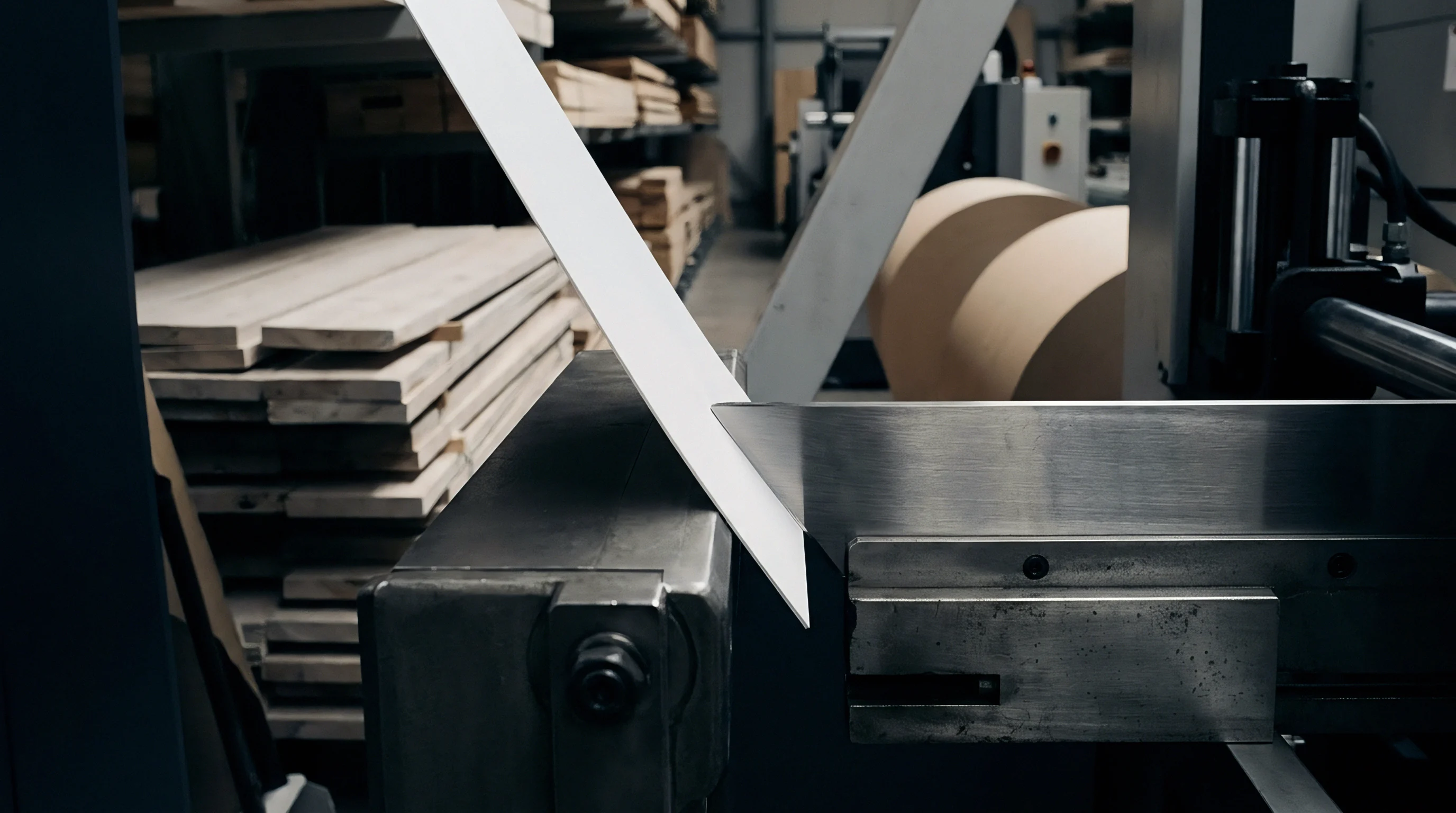
Dynamic nip pressure variations propagate across the transverse width through three coupled structural elements: the continuous spring steel coater blade, the mechanical clamp profiling finger mechanism, and the elastomer-covered backing roll. An impulse originating from an eccentric backing roll journal or an irregular base sheet splice creates a localized deflection wave. As the continuous steel strip deforms elastically, transverse shear coupling distributes force laterally to adjacent metering sectors.
| Subsystem Element | Elastic Modulus (GPa) | Damping Ratio (zeta) | Characteristic Frequency (Hz) | Deflection Sensitivity (microns/kN) |
|---|---|---|---|---|
| Spring Steel Blade (0.457 mm) | 205.0 | 0.008 | 280 | 14.2 |
| Polyurethane Backing Cover (75 Shore D) | 0.85 | 0.120 | 45 | 82.5 |
| Pneumatic Profiling Tube Assembly | 0.02 | 0.350 | 12 | 310.0 |
| Cast Iron Support Beam Base | 120.0 | 0.035 | 110 | 1.8 |
Mechanical responses across these elements exhibit distinct phase lags during transient loading events. The steel strip responds within 3 milliseconds, whereas the viscoelastic polyurethane backing roll cover exhibits delayed deformation recovery over 25 to 50 milliseconds. This temporal hysteresis broadens the physical width of cross-direction thickness deviations beyond the initial footprint of the disturbance.
Rigid profiling clamps suppress low-frequency base weight variations while amplifying high-frequency hydrodynamic flutter along the transverse edge.

Rheology
Viscoelastic Suspension Behavior under Severe Shear Gradients
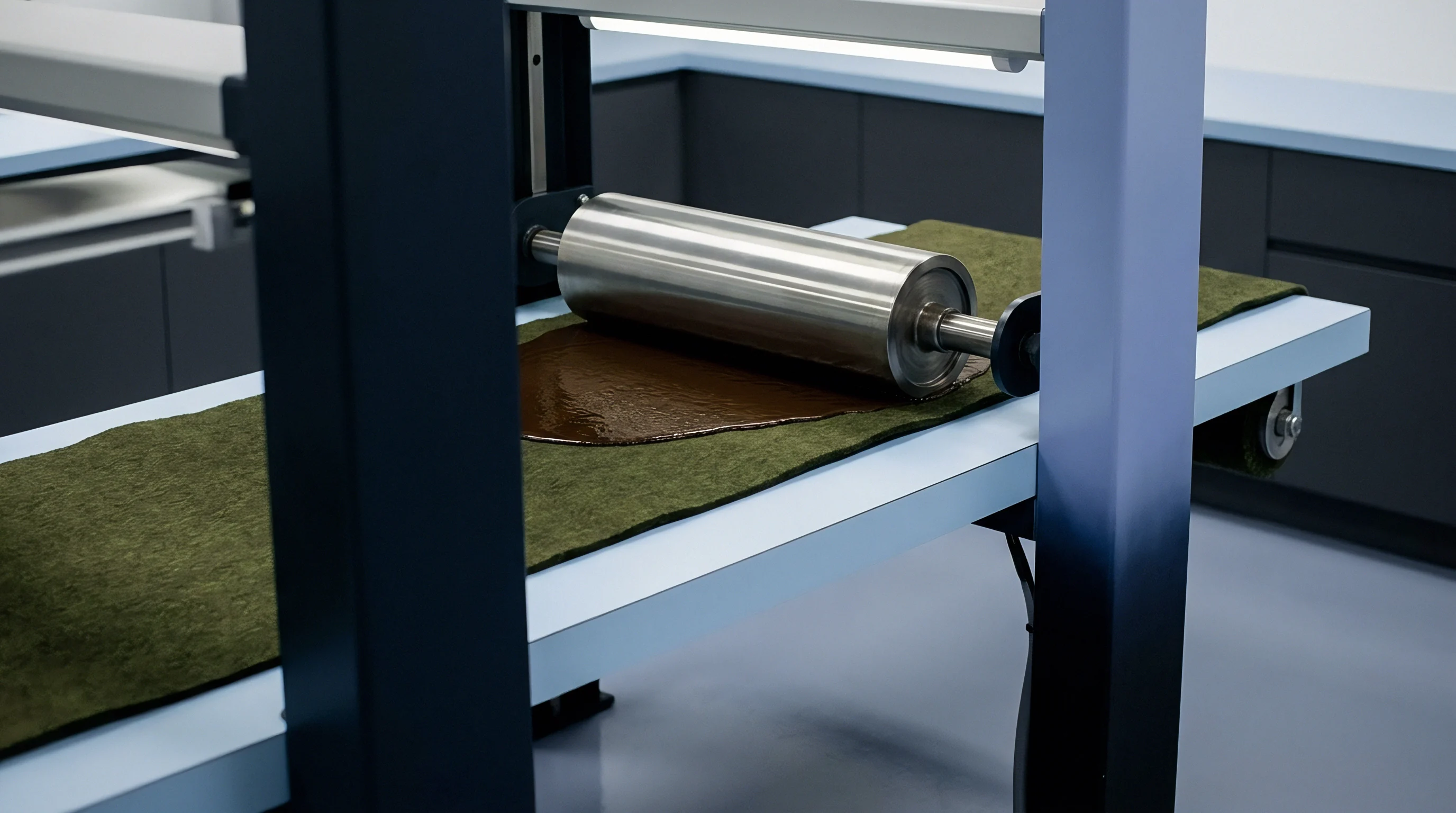
Coating formulations destined for food-contact barrier boards incorporate fine-ground calcium carbonate, engineered kaolin platelets, and synthetic aqueous polymer binders such as styrene-butadiene or styrene-acrylate emulsions. Under the metering tip, where shear rates exceed 1.5 10^6 reciprocal seconds, the suspension shifts from pseudoplastic shear-thinning to abrupt dilatant shear-thickening if pigment volume concentrations exceed critical immobilization limits, typically situated between 61 and 64 percent solids.
The transient stress response of these concentrated aqueous systems involves shear stress relaxation combined with non-zero first normal stress differences. As the fluid enters the converging nip region, normal forces push against the steel edge with magnitudes proportional to the polymer relaxation time:
tau_xx – tau_yy = Psi_1 (gamma_dot)^2
Here, Psi_1 represents the first normal stress difference coefficient and gamma_dot indicates shear rate. When cross-direction base sheet roughness variations introduce sudden shear rate jumps, localized normal force transients lift the blade tip. This lift action creates a micro-swelling of wet film thickness, followed by an immediate trailing starvation zone caused by forward pigment immobilization.
Suspensions formulated above 62 percent solids experience dilatant lock when shear rates exceed 1.2 10^6 reciprocal seconds, forcing mechanical blade deflection.
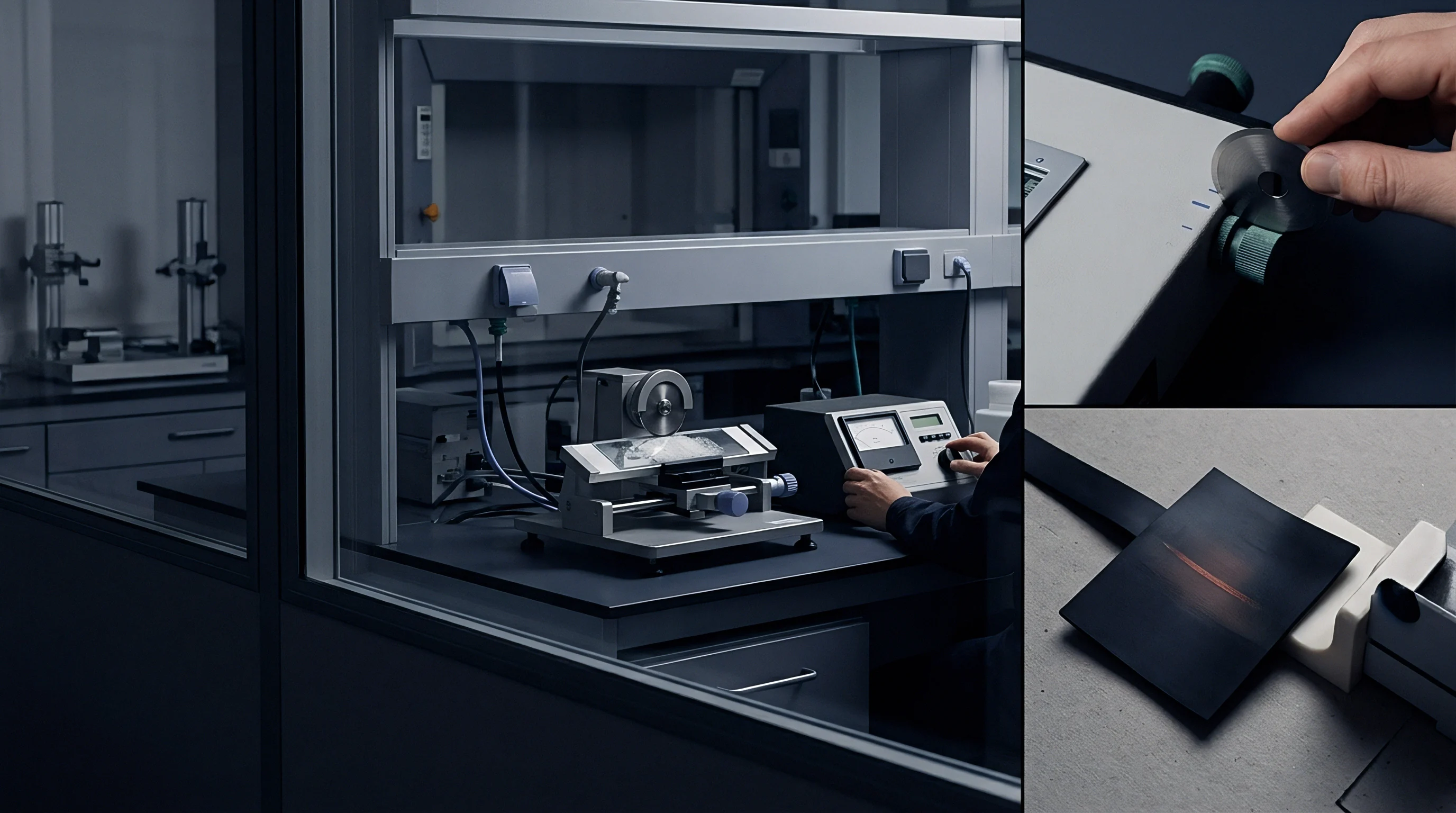
Dewatering dynamics accelerate this hydrodynamic instability. The base paper absorbs aqueous vehicle under capillary pressure combined with external hydrodynamic nip pressure. Base paper absorptivity, measured by dynamic penetration testing according to TAPPI T 553, ranges between 5 and 25 grams per square meter per square root of second.
High base absorptivity dries the immobilized filter cake at the paper surface, effectively altering the local boundary coordinate h(x) and escalating blade nip wear along high-absorption fibre lanes.
Localized barrier pinholes reflect both raw stock variations and formulation immobilization under high shear.
Deflection
Which Parameters Govern Dynamic Blade Deflection Profiles?
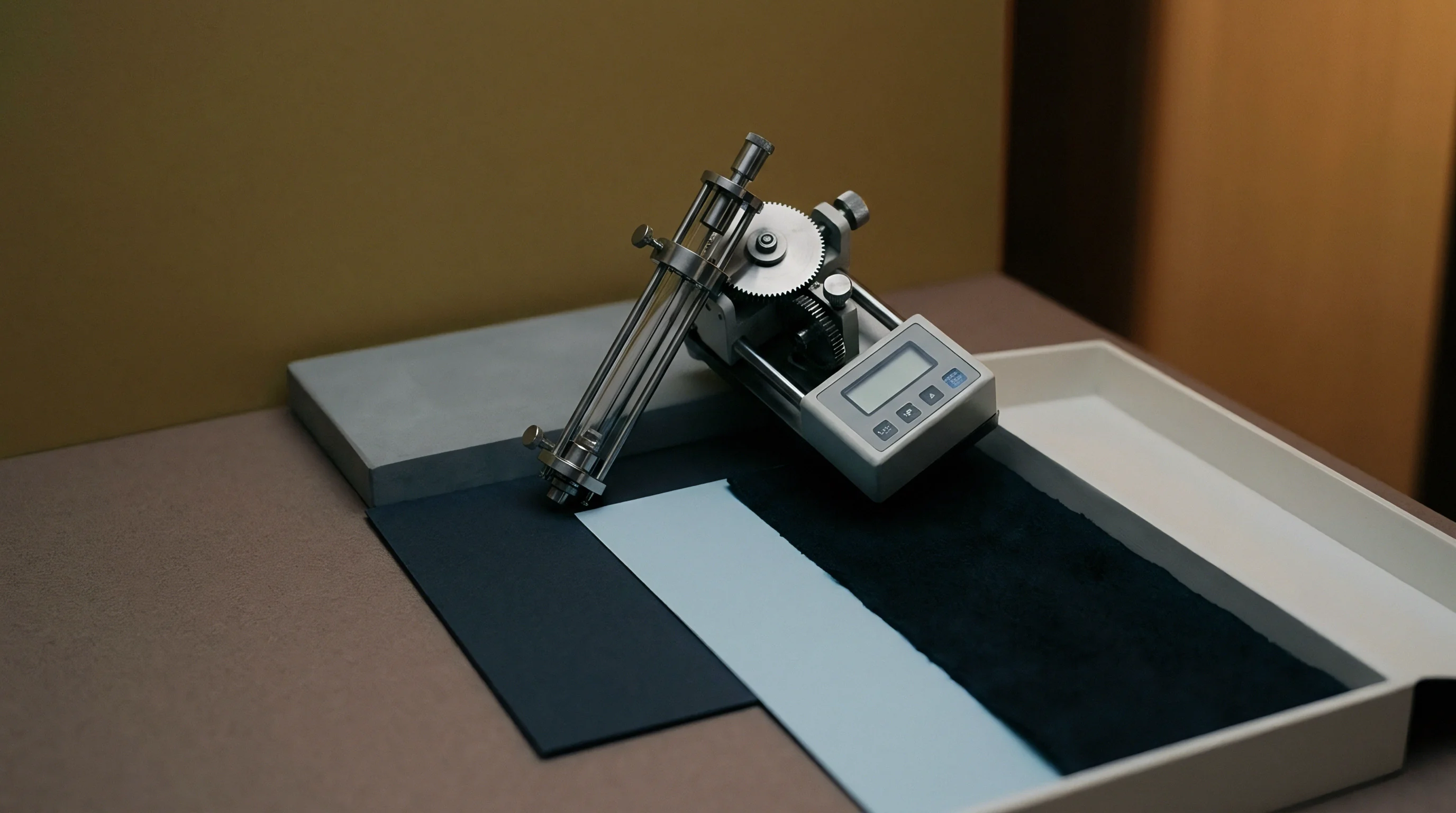
Cross-directional coat weight uniformity depends on maintaining a uniform gap profile across machine widths that frequently span 4 to 9 meters. Structural beam mechanics govern the flexural profile of the blade holder. Treating the metering strip as a continuous thin plate subjected to line loads and discrete point adjustments from profiling actuators yields the fourth-order differential equation for transverse displacement w(y):
D (d^4 w / dy^4) + k_elastic w = q_hydro(y, t) – F_actuator(y)
In this equation, D denotes flexural rigidity equal to E t_b^3 / , t_b defines blade thickness, nu represents Poisson ratio, k_elastic captures backing roll foundation stiffness, q_hydro represents cross-directional hydrodynamic lift, and F_actuator isolates forces delivered by profiling spindles spaced across transverse tracks at 75-millimeter pitch. Turning an actuator at cross-direction position y_i to correct a heavy coat weight streak induces mechanical reaction forces at positions y_(i-1) and y_(i+1), producing parasitic thickness deviations in neighboring inspection lanes.
- Flexural rigidity degradation occurs when frictional thermal energy heats the thin steel blade non-uniformly, creating transverse temperature differentials of 15 degrees Celsius that induce thermal camber warping.
- Actuator pitch limitations prevent mechanical profiling systems from compensating for hydrodynamic transients whose cross-machine wavelengths fall below 150 millimeters.
- Viscoelastic roll recovery introduces a time-dependent displacement variable into the foundation modulus, destabilizing automated feed-forward control algorithms during machine acceleration phases.
- Blade tip bevel erosion alters the contact angle from its nominal 45-degree grinding specification, reducing hydrodynamic lift efficiency by up to 35 percent over an 8-hour production shift.
Dynamic modeling requires finite element discretization of the continuous steel edge coupled with transient hydrodynamic boundary conditions. When calculating profile stability, engineers evaluate whether hydraulic actuators or stepper-motor drives provide sufficient force bandwidth to attenuate high-frequency process disturbances.
| Disturbance Frequency (Hz) | Actuator Response Latency (ms) | Peak Transient Force (N/m) | Unmitigated CD Variance (g/m²) | Closed-Loop CD Variance (g/m²) |
|---|---|---|---|---|
| 0.5 | 250 | 120 | 2.4 | 0.3 |
| 2.0 | 250 | 240 | 3.1 | 0.8 |
| 10.0 | 150 | 510 | 4.2 | 2.9 |
| 50.0 | 50 | 890 | 5.8 | 5.6 |
Control loops operating with update intervals of 10 to 30 seconds fail to counteract transient mechanical impulses occurring within millisecond scales. The resulting coated stock carries short-wavelength mass variations into drying tunnels, fixing uneven cross-directional polymer film thicknesses into the final board structure.
The unresolved engineering dilemma remains whether piezoelectric blade profiling systems can achieve mechanical durability in harsh paper mill environments while supplying the 100-Hertz correction bandwidth necessary to eliminate hydraulic chatter.

Barrier
Functional Failure Mechanisms in Packaging Substrates
A coated paperboard specified for food packaging requires uninterrupted surface coverage to pass regulatory barriers. When dynamic blade nip transients cause the dry coat weight to drop below critical thresholds, base paper fibres puncture the continuous pigment-polymer matrix. Standard water vapor transmission rate targets under DIN 53122-1 at 23 degrees Celsius and 85 percent relative humidity demand less than 5.0 grams per square meter per day for dry food cartons.
A localized coat weight reduction from 14.0 grams per square meter to 9.0 grams per square meter increases water vapor transmission rates beyond 45 grams per square meter per day in affected web lanes.
Migration compliance under European Regulation 1935/2004 and Regulation 10/2011 hinges on continuous defect-free barrier coverage. Testing according to EN 1186-5 using food simulant D1 (50 percent ethanol, v/v) at 40 degrees Celsius for 10 days exposes thinning defects immediately. Where blade nip pressure transients thin the coating layer below 6 microns, mineral oil hydrocarbons, including MOSH fractions between C16 and C35 and MOAH fractions between C16 and C24, migrate rapidly through the hydrophilic paper substrate.
A single pinhole per square decimeter permits mineral oil migration exceeding the limit of detection of 0.15 milligrams per kilogram food simulant.
Testing under EN 1186 conditions at 40 degrees Celsius for 240 hours demonstrates that a four-micron coating thickness dip increases overall migration from 4.2 milligrams per square decimeter to 18.7 milligrams per square decimeter.
Base paper formation defects, measured by beta-radiography, create local caliper spikes that amplify shear stress. As these mass concentrations enter the metering blade gap, they generate sudden nip pressure transients that strip the barrier coating away from fiber crests. Subsequent conversion processes, including scoring, creasing, and glue-flap sealing, subject these thinned coating regions to tensile strain.
Microcracks propagate along low-thickness lanes, destroying liquid holdout properties during flexographic ink application and retail distribution storage.
- Water vapor barrier collapse occurs when localized coat weight falls below the critical pinhole-free threshold of 10.5 grams per square meter, elevating moisture ingress rates across carton crease zones.
- Grease penetration failure manifests under ISO 16532-1 palm kernel oil testing at 60 degrees Celsius, where oil stains appear within 15 minutes along cross-direction low-coat-weight lanes.
- Heptane vapor transmission surges occur in barrier boards intended for dry food packaging, rendering the package non-compliant with standard aroma protection requirements.
- Overall migration exceedance under Commission Regulation 10/2011 invalidates declarations of compliance when extractive quantities surpass the statutory limit of 10 milligrams per square decimeter.
Failure to stabilize cross-direction blade metering pressures causes full batch rejections during converter incoming qualification audits, stranding non-compliant reels in quarantine warehouses.

Recourse
Contractual Allocation of Cross-Direction Defect Liabilities
When coated board exhibits latent functional barrier failures, commercial disputes center on the technical allocation of responsibility between substrate papermakers and converting operations. Paperboard purchase specifications governed by international trade norms frequently incorporate ISO 536 for grammage and ISO 5636-5 for Gurley air permeance. Traditional specifications define average reel values while completely overlooking cross-direction thickness variance profiles measured across short inspection intervals.
Mill technical data sheets quoting average dry coat weights of 12.0 grams per square meter shield manufacturers from liability when delivered rolls contain localized streaks measuring 7.5 grams per square meter.
Under the incoming European Packaging and Packaging Waste Regulation, manufacturers and brand owners face strict legal obligations regarding packaging recyclability grades and functional barrier minimization. Recyclability assessment protocols under CEPI Version 2 demand fiber yields exceeding 85 percent under standard hydropulper conditions. Adding surplus coating to compensate for blade transient thin spots compromises repulpability yields, lowering the substrate recyclability score from Grade A to Grade C. Conversely, under-coating risks food contact compliance failure under Article 3 of Regulation 1935/2004.
| Compliance Parameter | Governing Standard | Operational Threshold | Failure Mode Driven by Nip Transient | Financial Liability Category |
|---|---|---|---|---|
| Recyclability Score | EN 13430 / CEPI v2 | Yield greater than 85% | Over-coating to bridge thin spots causes fiber yield loss | Extended Producer Responsibility Fee Surcharges |
| Specific Migration (MOSH/MOAH) | BfR Recommendation XXXVI | Non-detectable at 0.15 mg/kg | Coating film thinning yields pinhole migration paths | Mandatory Product Recall and Inventory Scrap |
| Overall Migration Limit | EN 1186 (Regulation 10/2011) | Less than 10 mg/dm² | Porous interface allows simulant extraction of sizing | Customs Seizure and Certificate Revocation |
| Water Vapor Holdout | DIN 53122-1 (23°C, 85% RH) | Less than 5 g/m²·day | Micro-valleys permit ambient moisture transfer | Downstream Converting Line Waste Claims |
Technical buyers must enforce contract clauses specifying maximum permissible coefficient of variation values across cross-machine profiles. High-resolution beta gauges or online near-infrared spectroscopic sensors can resolve coat weight profiles at 10-millimeter cross-direction spatial resolution. Incorporating dynamic profile standards into supply agreements converts invisible functional risks into clear rejection parameters before reels are mounted on printing presses.
Under international commercial sales contracts, invoking dynamic tolerance clauses requires buyers to produce continuous cross-direction radiometric scans verifying that localized thickness variations exceeded plus or minus 5 percent over consecutive 100-meter web lengths, directly invalidating mill conformity warranties.