Quantifying Physical Recycled Content in Mass Balance Paper Ledgers
Mass balance paper ledgers attribute recycled credits across production runs, requiring strict dry-fiber yield reconciliation to survive compliance audits.

Pulp
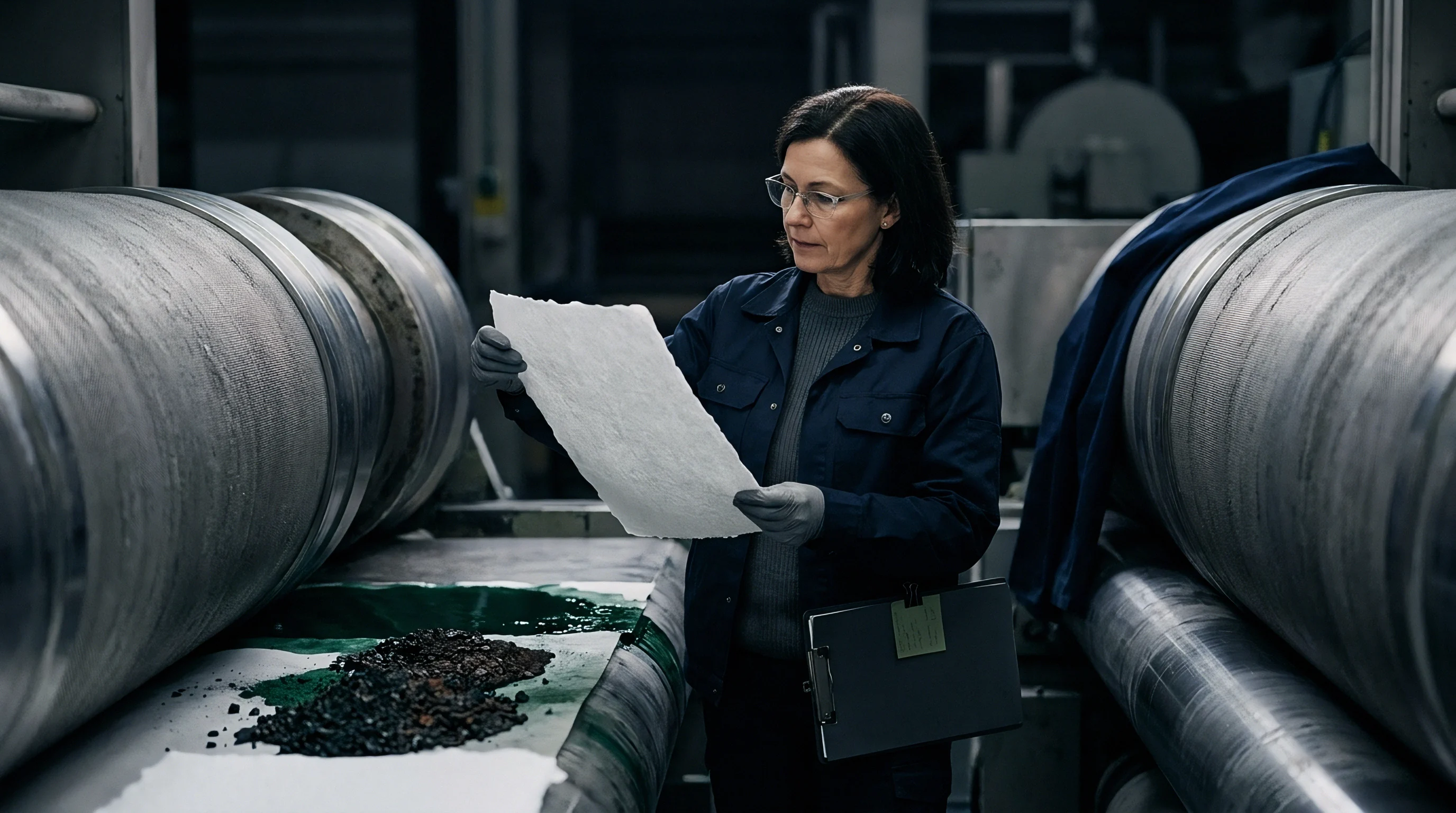
Raw recovered paper enters wet disintegrators alongside virgin wood fibers to form continuous slurries on modern high-speed Fourdrinier machines. Mill operators mix secondary pulps with virgin kraft slurries inside the chest before pumping the stock to the headbox. Continuous wet-end blending prevents the physical separation of recovered cellulose from virgin cellulose during sheet formation.
Industrial paper machines running at 1,200 meters per minute process hundreds of tonnes of dry fiber daily, relying on uniform stock suspension to maintain tensile strength, tear resistance, and caliper uniformity.
Secondary fiber processing causes physical degradation in cellulosic structures. Mechanical repulping shortens individual fibers, with average weighted softwood kraft fiber length decreasing from 2.5 millimeters to under 1.2 millimeters after repeated recycling loops. Hydration during pulping causes swelling in the fiber wall, but subsequent drying on steam-heated cylinders induces irreversible hornification.
Hornification reduces the internal swelling capacity of secondary fibers, impairing their ability to re-establish hydrogen bonds across fiber-to-fiber contact zones. As a result, critical strength indicators like the Ring Crush Test, Short-span Compression Test under ISO 9895, and burst factor drop by 8 to 15 percent per repulping cycle.
Deinking pulping lines lose dry material mass between 12 and 18 percent during flotation processes operated at 45 degrees Celsius.
Freeness metrics reflect this structural decay. Schopper-Riegler freeness values rise from 15 degrees SR in unrefined virgin softwood to over 60 degrees SR in heavily recycled furnishes as fine particles accumulate. Elevated fines concentrations reduce water removal rates on the forming wire, forcing mills to lower machine speeds or apply synthetic retention aids.
To offset physical strength losses, papermakers alter furnish blends by adding native cationic starches, wet-strength resins, or virgin long-fiber softwood kraft. Fiber length drops quickly. Paper strength declines rapidly.
Pulping losses reduce yield. Flotation deinking creates sludge.

Process Losses in Secondary Fiber Extraction
Converting post-consumer recovered paper into usable pulp involves significant mass reduction through contaminant removal. Deinking plants pass recycled slurry through high-density cleaners, coarse screening, flotation cells, dispersers, and fine slotted screens. Heavy contraries like gravel, staples, and sand drop out in centrifugal cleaners, while sticky adhesives, coatings, and plastic films are rejected by slotted screen baskets with aperture widths between 0.10 and 0.15 millimeters.
- Flotation Reject Accumulation removes hydrophobic ink particles and mineral fillers while carrying away up to eight percent of usable short cellulosic material.
- Screening Fractionation Losses discard stiff unrefined fibers and gross contaminants through pressure screens operating at high consistency levels.
- Fines Sludge Discharges reduce total solid mass when washing stages eliminate sub-micron particles to maintain sheet brightness and drainage profiles.
Mass yield calculation across the deinking plant determines the exact conversion factor between raw recovered paper entering the hydrapulper and usable recycled fiber arriving at the headbox. Standard deinking operations yielding 82 percent clean pulp require 1.22 dry tonnes of recovered waste paper to produce 1.00 dry tonne of output stock. Disregarding this mass shrinkage during allocation leads to over-crediting recycled content in outbound commercial declarations.
Substituting physical testing for mass balance ledger accounting without adjusting target sheet grammages leads to structural failures on high-speed corrugating lines.


Ledger
Mass balance attribution framework models assign certified post-consumer fiber quantities to discrete finished paper reels without requiring physical tracking of individual cellulose strands. Standard certification protocols, including FSC-STD-40-004 and PEFC ST 2002, permit paper mills to pool certified input volumes within defined credit accounts. ISO 22095 specifies the structural requirements for mass balance chains of custody, establishing how sites track physical inputs against credit allocations over fixed accounting periods.
| System Architecture | Physical Input Requirement | Credit Transfer Scope | Accounting Window | Physical Mixing Limit |
|---|---|---|---|---|
| Transfer System | 100% Certified Input | Single Batch Basis | Immediate Transaction | No Physical Mixing Allowed |
| Percentage System | Variable Recycled Proportion | Proportional Claim Allocation | Monthly Site Reconciliation | Direct Physical Blend Ratio |
| Credit System | Minimum Threshold Entry | Rolling Balance Account | Up to 24 Months Maximum | Decoupled Within Site Boundary |
Credit accounting allows a mill to process a batch containing 30 percent physical post-consumer pulp while claiming 100 percent recycled content on a designated portion of outbound production reels. The remaining production reels carry zero certified claims, maintaining balance across total dry fiber mass. Paper mills run continuously.
The credit balance expires. Process waste reduces credits.

Credit Allocation Rules and Conversion Math
Accurate ledger maintenance relies on applying precise conversion factors at each manufacturing stage. Conversion factors represent the ratio of dry usable pulp output to dry raw material input, accounting for process shrinkage, moisture variations, and rejects.
- Establish the physical boundary of the manufacturing site where incoming recovered material receives formal weight verification.
- Measure the precise dry-weight input of post-consumer waste paper entering the continuous hydrapulper over a defined accounting period.
- Apply site-specific conversion factors that subtract measured process shrinkage and moisture variations from raw intake weights.
- Enter the resulting net recycled fiber volume into the certified credit account register.
- Allocate available recycled credits to outbound finished product batches up to the maximum permitted percentage limit.
- Deduct sold credit volumes immediately from the active account balance before issuing customer claims documentation.
Credit accounts maintain integrity only when allocation ratios match the process losses of the specific mill equipment.
Over-allocation occurs when mills calculate claims based on wet raw material weights rather than bone-dry fiber masses. Standard recovered paper bales contain between 8 and 12 percent moisture upon delivery, whereas finished paper rolls ship at 6 to 8 percent equilibrium moisture. Converting raw weight directly into finished credit volume without adjusting for moisture differentials creates an artificial inflation of allocated recycled claims.

Rolling Balance Validity and Expiry Mechanics
Certification schemes limit the time window during which credit balances remain valid for allocation. FSC-STD-40-004 sets a maximum rolling credit account duration of 24 months, whereas PEFC ST 2002 restricts credit validity to 12 months. Credits unallocated at the end of the authorized accounting window automatically expire and cannot roll over into subsequent audit periods.
Audit logs demand precision.
Mill operators frequently assert that exact batch-level fiber tracking remains technically unfeasible within continuous wet-end paper machine operations.


Microscopy
Laboratory analysis under ISO 9184 determines furnish composition through chemical staining techniques that identify wood species and pulping methods. Technicians prepare slides by defibering small paper samples in boiling water, treating the fibers with specific reagents, and examining them under optical microscopy at 100x to 400x magnification. Graff C stain remains the standard reagent for differentiating unbleached kraft, bleached kraft, mechanical pulps, and semi-chemical fibers based on characteristic color reactions driven by residual lignin content.
Bleached softwood kraft fibers stain light blue or gray-green under Graff C reagent, while unbleached kraft turns yellow-brown due to higher lignin concentrations. Groundwood and thermomechanical pulps display intense yellow coloration. Hertzberg stain uses zinc chloride and iodine to produce blue reactions in pure cellulose while turning high-lignin fibers yellow.
Lofton-Merritt stain differentiates unbleached sulfite from unbleached sulfate pulps using mixture ratios of Fuchsine and Malachite Green. Staining reveals wood species. Chemical pulping removes lignin.
Fiber stain techniques differentiate hardwood from softwood species but fail to distinguish virgin pulp from pre-consumer mill waste.

Can Laboratory Staining Confirm Post Consumer Recycled Origin?
Optical microscopy cannot verify whether a chemical fiber originated from virgin wood or post-consumer waste paper. Fully bleached chemical pulps contain virtually zero residual lignin, producing identical blue staining reactions under Graff C reagent regardless of how many times the fiber passed through papermaking processes. Structural indicators like lumen collapse, fiber end fraying, and surface fibrillation suggest mechanical repulping history, but these morphology changes also occur during aggressive virgin stock refining.
Automated optical analyzers measure fiber length distributions under ISO 16065-1 by pumping diluted suspensions through thin capillary flow cells. While recycled furnishes exhibit higher proportions of broken fibers and fines below 0.2 millimeters, virgin short-fiber hardwood species like Eucalyptus globulus possess naturally short fiber profiles averaging 0.7 to 0.9 millimeters. Consequently, physical fiber testing cannot falsify a mass balance ledger claim for chemical pulp grades, shifting compliance verification entirely onto documentary chain-of-custody audits.
Whether emerging isotopic ratio mass spectrometry can isolate secondary environmental weathering markers on individual fiber surfaces remains an open industrial debate.

Dossier
Complete traceability packages require consecutive chain of custody records matching raw material purchases to printed packaging deliveries. Inspectors validating mass balance recycled declarations require specific core documents at each transfer point along the supply chain. A failure at any single transaction node invalidates downstream claims across the entire shipment.
| Processing Phase | Physical Input | Moisture Content | Dry Fiber Mass | Yield / Loss Factor | Net Account Credit |
|---|---|---|---|---|---|
| Raw Recovered Paper Intake | 100.00 Tonnes | 10.0% Moisture | 90.00 Dry Tonnes | Base Material Input | 0.00 Tonnes |
| Hydrapulper and Screening | 90.00 Dry Tonnes | N/A (Slurry) | 86.40 Dry Tonnes | 4.0% Coarse Rejects | 0.00 Tonnes |
| Flotation Deinking Line | 86.40 Dry Tonnes | N/A (Slurry) | 74.30 Dry Tonnes | 14.0% Sludge Reject | 0.00 Tonnes |
| Finished Sheet Drying | 74.30 Dry Tonnes | 7.0% Moisture | 74.30 Dry Tonnes | 100.0% Machine Yield | 79.89 Commercial Tonnes |
Assume a paper mill purchases 100 gross tonnes of post-consumer recovered paper at 10 percent moisture. The dry weight entering the pulper equals 90 dry tonnes. Processing through high-density screening and flotation deinking incurs a combined dry fiber loss of 17.44 percent, leaving 74.30 dry tonnes of usable pulp.
Output paper ships at an equilibrium moisture content of 7 percent. The total usable commercial weight credited to the mill’s recycled mass balance ledger equals 79.89 tonnes at standard saleable moisture.

Audit Trail Reconciliation across Converting Operations
Paper converters purchasing certified reels receive delivery notes carrying specific certification claims alongside scheme license numbers. Converters process these rolls into folding cartons, corrugated cases, or printed paper bags, incurring mechanical edge-trim and setup waste. Process waste on sheet-fed offset carton lines averages between 8 and 12 percent of total paperboard mass.
- Certificate Scope Validation verifies that the specific paper machine line and product category appear on the public scheme database before acceptances occur.
- Claim Line Item Auditing confirms that every line item on delivery notes explicitly carries the accurate claim wording and scheme license number.
- Conversion Factor Reconciliation checks that claimed recycled percentages reflect documented manufacturing yields rather than unadjusted raw intake weights.
- Credit Period Synchronization ensures that assigned mass balance credits were generated within the authorized twelve month rolling accounting window.
Converters must subtract process waste when allocating acquired recycled credits to finished converted product batches. Assigning 100 percent of purchased roll credits to finished goods without reducing balances for converting matrix waste violates chain-of-custody rules. Discrepancies generate civil liability.
Clause 5.2 of FSC-STD-40-004 specifies that any claim of recycled content on outbound invoices automatically invalidates the claim if the seller’s certificate status shifts to suspended on the transaction date.
Tariff
Regulatory frameworks under the EU Packaging and Packaging Waste Regulation establish mandatory post-consumer recycled content targets that alter financial liabilities at cross-border customs checkpoints. Importers of record declaring paper packaging into European jurisdictions must prove compliance with minimum recycled content rules to avoid punitive market access fees. Customs authorities mandate that declarations rest on verified chain-of-custody documentation, rejecting uncertified self-declarations.
Extended Producer Responsibility programs apply fee modulation systems that adjust producer payments based on environmental performance metrics. Packaging containing certified post-consumer recycled fiber qualifies for reduced eco-contribution rates, whereas non-compliant packaging faces maximum tariff surcharges. Customs inspectors request proof.
Clause 4.3 of ISO 22095 invalidates mass balance credits if the physical input and output flows do not pass through the same manufacturing site boundary.

Regulatory Obligations under Packaging Directives
The EU Green Claims Directive imposes strict substantiation requirements on explicit environmental claims made on packaging B2C surfaces. General statements such as recycled paperboard face immediate prohibition unless accompanied by precise percentage figures anchored in accredited certification dossiers. Mass balance attribution must be disclosed clearly to prevent misleading consumers regarding physical fiber content.
Regulatory enforcement agencies maintain public registries of non-compliant claims, levying administrative fines up to four percent of annual corporate turnover for severe misrepresentations. Importers declaring recycled status to obtain preferential customs duty treatment risk product seizure and customs penalties if mass balance ledgers show over-allocation or unverified conversion factors upon border audit.
Documentation verification procedures at customs checkpoints require presentation of matching purchase orders, mill ledger allocation extracts, independent audit certificates, and bills of lading before clearing entries.