Reconciling CEPI Laboratory Recyclability Metrics with High Consistency Industrial Hydrapulper Residues
Reconciling CEPI laboratory recyclability metrics with high-consistency pulper residue requires converting dry laboratory screen yields into wet-basis industrial residue mass balances that account for fiber entrapment and screen blinding.
Disintegrator
European paper industry standards evaluate packaging recyclability by disintegrating sample stock in water under controlled bench conditions. European Paper Recycling Council and CEPI laboratory protocols specify disintegrating stock at 2.5 percent oven-dry fiber consistency in water at 40 degrees Celsius, running a standard disintegrator vessel at 3,000 revolutions per minute for 30,000 total revolutions. This low-viscosity fluid setup isolates mechanical shear, letting individual fibers break free from water-soluble glues and non-fibrous attachments.
Commercial recycling mills using high-consistency hydrapulpers work under very different physical mechanics, running stock between 12 and 18 percent solids. Mechanical energy in these industrial systems transfers mainly through fiber-to-fiber hydraulic friction instead of fluid shear from a high-speed impeller.
That difference in pulp density alters how wet-strength resins, acrylic dispersion coatings, extrusion-coated polyethylene films, and hot-melt adhesives behave during repulping. Low-consistency agitation in the lab hydrates individual cellulose structures evenly, dissolving water-dispersible binders and leaving plastic films intact enough for slot screening. High-consistency industrial pulping forces dense paperboard fragments against each other, twisting, tearing, and smearing synthetic barriers into small, irregular particles.
The resulting macro-rejects and sticky contaminants differ sharply in shape, surface tack, and specific gravity from the clean film flakes gathered in bench tests.
On the mill floor, these residues create bottlenecks at the extraction bedplate. Bench tests predict a high yield of repulpable fiber because fluid breakdown is gentle, but high-consistency mill pulping leaves large fiber bundles wrapped tightly around shredded plastic film. Unable to pass the 4-millimeter to 8-millimeter perforations of an industrial bedplate, these aggregates accumulate as dense residue that must be extracted through junk towers or purged in batches through heavy-reject separators.
Standardized laboratory disintegration at two point five percent solids underestimates the mechanical tearing forces exerted on polymer coatings inside twelve percent consistency industrial pulpers.
When testing paperboard with functional barrier layers, laboratory metrics often award high repulpability scores because synthetic film peels off cleanly without dispersing into colloidal particles. In high-consistency mill operations, high-shear rotors break thin barrier coatings into small flakes that blind downstream screen slots or slip through primary cleaning loops into the finished stock. The resulting residue mixes trapped cellulose fibers, entangled synthetic films, and partially hydrated wet-strength compounds, driving up solid waste volumes for disposal.

Industrial Pulping Mechanics versus Bench Protocols
Laboratory protocols isolate material variables under set temperatures, pH, and turbulence levels. The standard CEPI method maintains neutral pH unless specific chemicals are requested, running for a fixed duration to deliver a precise specific energy input per dry gram of sample. Industrial hydrapulpers operate as dynamic mass-balance systems where retention time, shear rates, and stock temperature fluctuate with mill feed rates and incoming waste paper quality.
The breakdown of barrier board in a high-consistency batch pulper proceeds through distinct physical stages that bench disintegrators cannot replicate:
- Initial Wetting Flotation happens when dry packaging bundles hit circulating process liquor and absorb water while high-density rotors pull material down into the primary shear zone.
- Friction Fiber Hydration occurs as high solids force paperboard pieces against each other, rubbing surface coatings off and generating localized heat that alters adhesive tackiness.
- Matrix Fragmentation breaks multi-layer laminated sheets into uneven structural remnants, forcing synthetic membranes to split into elongated ribbons or small particles.
- Screening Extraction Interruption occurs when un-defibered coating flakes align parallel to pulper bedplate holes, clogging stock flow and building up recirculating residue.
Without intense fiber-to-fiber friction, lab testing vessels give optimistic estimates of defibering efficiency. A paper grade achieving a 98 percent yield score in the laboratory can drop below 85 percent usable pulp in a high-consistency mill circuit, with the remaining 13 percent trapped in heavy residue rejections and coarse tailing streams. Converters purchasing certified paperboard based on lab reports alone routinely see higher waste rates in mill processing runs, sparking disputes over technical suitability under commercial recycling conditions.
Excess pulper residue can stem from improper mill operational parameters rather than substrate design flaws.

Sieve
Separating repulpable cellulose from non-paper materials relies on controlling particle size across physical separation barriers. CEPI laboratory methods use a Haindl or Somerville slotted fractionator equipped with 0.15-millimeter (150-micron) or 0.20-millimeter (200-micron) screening plates washed continuously with water. This lab apparatus uses gentle fluid pulsation to wash free cellulose fibers through narrow slots, retaining un-disintegrated flakes and synthetic films as macro-rejects.
The laboratory metric then calculates the macro-reject percentage directly from the dry mass left on the 150-micron slot plate after a set washing period.
Commercial paper mills rely on multi-stage screening systems built around very different geometry and pressure differentials. Industrial pulpers discharge stock through perforated bedplates with holes from 4.0 to 8.0 millimeters wide, followed by high-density cleaners and primary coarse screens operating with 0.25-millimeter to 0.35-millimeter slots under positive pressure. Fluid dynamics inside a commercial pressure screen generate hydrodynamic forces that push flexible, soft, or elongated synthetic particles through screen slots that would reject them under low-pressure laboratory washing.
| Parameter | CEPI Laboratory Protocol (v2) | Industrial High-Consistency Pulper |
|---|---|---|
| Stock Consistency | 2.5% dry solids | 12.0% to 18.0% dry solids |
| Primary Energy Source | Fluid shear via high-speed impeller | Fiber-to-fiber hydraulic friction |
| Primary Separation Mechanism | 0.15 mm slotted screen (Somerville/Haindl) | 4.0–8.0 mm perforated bedplate + pressure screens |
| Target Operating Temperature | 40 °C ± 2 °C | 45 °C to 65 °C |
| Residence Time | 10 to 20 minutes (fixed revolutions) | 15 to 45 minutes (variable batch/continuous) |
| Macro-Reject Definition | Retained material on 0.15 mm slot plate | Rejected solids from pulper bedplate & primary coarse loop |
This mismatch in screening physics causes a dual analytical problem. Rigid coating fragments that pass easily through a 6.0-millimeter pulper bedplate accumulate in recirculating process liquor, gradually clogging downstream pressure screens. Meanwhile, flexible polyethylene film flakes that laboratory Somerville screens capture with ease can deform under industrial screen pressure, passing through coarse slots into fine screening loops to form micro-stickies or cause sheet breaks on the paper machine.
Particle Mass Fraction Dynamics under Screening Shear
Physical separation efficiency depends on how structural properties interact with fluid pressure differentials across screening barriers. Standard laboratory testing assumes non-fibrous components remain dimensionally stable during pulping and screening. High-consistency pulping undermines this assumption by shredding soft polymers and smearing thermoplastic wax layers across cellulose surfaces.
- Sample stock moves from the high-consistency pulper tub into an extraction chamber beneath the perforated bedplate under positive hydraulic head pressure.
- Extracted slurry enters primary high-density centrifugal cleaners running at 1.5 to 2.0 percent consistency to remove heavy grit, metal fasteners, and dense coating aggregates.
- Accepts flow directly to pressure screens equipped with 0.25-millimeter slotted baskets, where rotor blades create high-frequency pressure pulses to prevent matting on the basket face.
- Rejects containing high concentrations of coarse synthetic film flakes and un-defibered paperboard fragments discharge continuously to secondary reject sorters for fiber recovery.
When evaluating barrier-coated folding boxboard, laboratory fractionators record negligible micro-sticky counts because gentle agitation keeps acrylic dispersion coatings from breaking down into particles between 50 and 150 microns. Industrial pulping shear grinds these same coatings into micro-particles that easily pass primary screening, entering process water circuits to coalesce on machine wires and felts. Laboratory recyclability reports regularly miss this failure mode because static bench sieves track macroscopic retention without accounting for fluid shear pressure.
Coarse screening slots that easily pass laboratory macro-rejects can blind continuously when fed high-consistency pulper slurry loaded with unhydrated wet-strength resins.

Mass
Reconciling laboratory recyclability scores with industrial mill performance requires tracking mass balances across incoming and outgoing streams. The CEPI Recyclability Laboratory Test Method Version 2 quantifies recyclability through a score based on total fiber yield, macro-reject percentage, micro-reject percentage, and visual stickies evaluation. The laboratory protocol calculates fiber yield from the dry weight of accepted fiber passing the 0.15-millimeter slot relative to the initial dry weight of the sample.
Industrial mills measure operational yield by tracking air-dry metric tons of usable fiber entering stock preparation against total dry metric tons of solid waste sent to landfill or incineration. High-consistency pulper residues carry substantial water, trapped inorganic fillers like calcium carbonate and titanium dioxide, and un-defibered usable cellulose. Evaluating financial performance requires converting lab dry-mass figures into wet-basis industrial waste volumes.
Industrial pulper residues carry up to sixty-five percent water weight alongside entrapped cellulose, turning minor laboratory reject fractions into heavy commercial waste liabilities.
A paperboard product given a 95 percent recyclability score in laboratory testing can produce an industrial residue stream equal to 12 to 15 percent of total incoming dry weight. This gap arises because lab procedures wash macro-rejects clean of attached cellulose before weighing them dry. Commercial reject sorters and tailing screens use limited wash water to restrict effluent volumes, discharging wet reject cakes that carry up to two grams of dry fiber per gram of dry polymer coating.
| Stream Fraction | Laboratory CEPI Protocol (Dry Mass) | Industrial HC Pulper Circuit (Dry Mass) | Industrial Residue (Wet Basis at 35% Solids) |
|---|---|---|---|
| Acceptable Fiber Yield | 920 kg (92.0%) | 840 kg (84.0%) | Not applicable (in slurry) |
| Clean Synthetic Polymeric Coating | 50 kg (5.0%) | 48 kg (4.8%) | 137 kg wet residue |
| Entrapped Un-defibered Fiber | 10 kg (1.0%) | 62 kg (6.2%) | 177 kg wet residue |
| Inorganic Fillers & Pigments | 20 kg (2.0%) | 50 kg (5.0%) | 143 kg wet residue |
| Total Waste Stream Mass | 80 kg (8.0%) | 160 kg (16.0%) | 457 kg total wet waste |
The mass allocation table shows how small variations in defibering efficiency change commercial waste output. In an industrial circuit, un-defibered fiber trapped inside plastic film matrices increases sixfold compared to lab Somerville screening values. This un-defibered cellulose holds water tenaciously, adding to the total weight of wet residue hauled from the mill floor.
Purchasing departments specifying packaging grades solely on dry-weight lab metrics systematically underestimate disposal costs across production runs.
Residue Mass Reconciliation Procedure
Reconciling discrepancies between lab-reported fiber yield and industrial pulper residue mass requires a systematic qualification process before signing high-volume board contracts:
- Sampling Protocol Execution involves drawing representative wet samples directly from industrial pulper tailing screens and heavy-reject chutes during steady-state high-consistency runs.
- Solids Fraction Separation requires oven-drying wet residue samples at 105 degrees Celsius to separate total dry solid mass from absorbed process water.
- Soxhlet Extraction Analysis uses solvent washing with hot toluene or tetrahydrofuran to extract synthetic binders and polyolefin coatings from dry residue solids, exposing the true weight of trapped cellulose fiber.
- Ash Content Determination combusts extracted organic material at 525 degrees Celsius per ISO 1762 standards to quantify non-combustible inorganic fillers and pigment coatings.
This reconciliation procedure shows whether high pulper residue stems from polymer design limits or incomplete defibering inside the mill hydrapulper. If Soxhlet extraction shows that cellulose makes up over 40 percent of dry residue mass, the packaging design suffers from poor water breakdown performance, calling for chemical wet-strength adjustments or extended hydration time rather than coating redesign.
Misclassifying trapped usable cellulose as non-recyclable polymer waste inflates Extended Producer Responsibility fees by distorting total repulpable yield calculations.

Polymer
Synthetic polymer barriers applied to paperboard for moisture, oil, water vapor, and oxygen resistance dictate how material behaves in high-consistency hydrapulpers. Extruded low-density polyethylene (LDPE) films, aqueous acrylic dispersion coatings, bio-based polylactic acid (PLA), and polybutylene succinate (PBS) layers fail in distinct ways under high-shear agitation. CEPI laboratory protocols measure polymer impact primarily through screen blockage and visual stickies counts, grouping diverse chemistries into simple pass or fail yield categories.
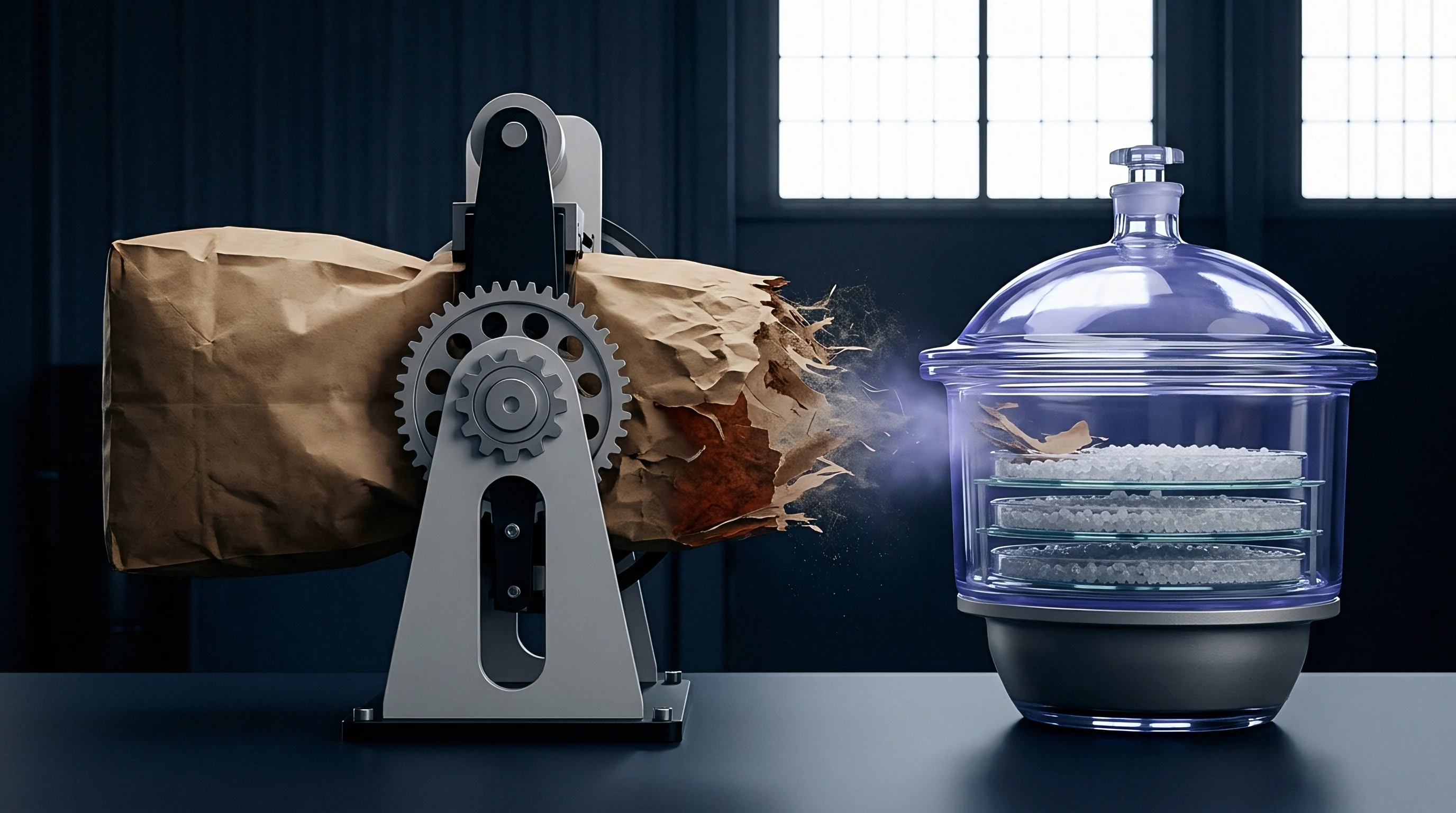
Industrial processing reveals clear functional differences between ductile film layers and brittle dispersion coatings. Extruded LDPE films have high tensile strength and elasticity, resisting breakdown inside high-consistency pulpers. These films peel off cellulose substrates as large continuous sheets, forming dense tangles that wrap around pulper rotors, bind ragger lines, and trap large volumes of usable fiber within their folds.
The resulting pulper residue consists of bulky polymer-cellulose aggregates that require manual or mechanical removal from junk towers.
Water-based acrylic dispersion coatings designed for rapid disintegration often break down into micro-particulate stickies that escape pulper reject loops entirely.
Aqueous dispersion coatings engineered to replace extruded polyolefin films behave quite differently. Under high-consistency shear, acrylic and ethylene copolymer dispersions shatter into small, discrete particles instead of peeling off in sheets. While this fragmentation allows high fiber passage through primary bedplates, it creates severe downstream contamination risks.
Small polymer fragments with specific gravities near 1.0 g/cm³ resist centrifugal separation in high-density cleaners, passing through fine screening loops to contaminate white water circuits.
Why Do Aqueous Dispersion Coatings Flake in Industrial Systems?
Aqueous dispersion coatings rely on cross-linked polymer nanoparticles suspended in water, forming a continuous hydrophobic barrier film upon thermal drying and curing. During low-consistency laboratory disintegration, gentle agitation hydrates the underlying cellulose fiber network, swelling the paperboard matrix and causing the surface coating to detach in uniform flakes. High-consistency industrial pulpers introduce intense inter-fiber friction, localized heat spikes, and pressure cycles that alter this detachment mechanism completely.
Instead of floating free from the swelling cellulose backing, dispersion coatings under intense mechanical shear suffer attrition along surface boundaries. Micro-fractures propagate across cross-linked polymer domains, tearing the barrier layer into thousands of irregular fragments between 20 and 500 microns in size. These fragments feature tacky exposed edges where internal plasticizers and unreacted monomers remain un-crosslinked.
As these micro-flakes circulate through warm process water, they re-agglomerate into tacky stickies that deposit on machine wires, dryer felts, and press rolls.
Replacing traditional extruded polyethylene with thin dispersion coatings eliminates heavy film residues in high-consistency pulpers, but transfers process contamination downstream into mill water loops. Laboratory test methods measuring recyclability based solely on macro-reject screen mass assign top-tier scores to dispersion-coated board because no large film residues remain on the 150-micron Somerville sieve. The micro-particulates passing that sieve enter the paper machine stock system, causing web breaks, sheet defects, and unscheduled cleaning downtime.
Current laboratory test standards leave mills unable to predict whether a repulpable acrylic coating will remain benign or form persistent micro-stickies during closed-loop water recirculation.
Yield
Translating laboratory recyclability certification into commercial paper contracts requires precise yield reconciliation formulas and clear liability terms. The European Union Packaging and Packaging Waste Regulation (PPWR) establishes mandatory recyclability grades based on design-for-recycling criteria and verified repulpability thresholds. Grade A materials must demonstrate repulpable fiber yield exceeding 95 percent on a dry weight basis, while Grade B requires over 85 percent yield, and Grade C mandates over 70 percent yield.
Packaging falling below 70 percent usable fiber yield is classified as non-recyclable, triggering Eco-Modulation fee penalties or outright sales bans across member states.
Discrepancies between CEPI laboratory test results and high-consistency pulper performance create financial risk for brand owners and converters. A paperboard substrate certified as PPWR Grade A based on laboratory disintegration reports can produce 18 percent wet pulper residue in a commercial recycling facility, dropping true operational yield into Grade B territory. When mills process this board, elevated residue levels trigger surcharge levies for solid waste disposal, which are passed back through supply chains to merchants and packaging buyers.
Commercial purchase contracts must include clear technical specification clauses to bridge laboratory metrics and mill realities. Standard agreements relying solely on generic compliance certificates leave buyers exposed to landfill surcharge claims and downgraded recyclability ratings. Contract terms should define exact test methods, state mandatory pulping consistency conditions, and specify financial remedies when pulper residue levels exceed baseline thresholds.
A comprehensive packaging supply contract must contain specific clauses establishing performance parameters, testing protocols, and financial adjustments:
- Baseline Recyclability Protocol Specification obligates the substrate manufacturer to supply test reports performed strictly under CEPI Laboratory Test Method Version 2, including full raw data for macro-rejects, micro-rejects, and adhesive characterization.
- Industrial Yield Conversion Multiplier defines an agreed conversion factor between laboratory Somerville slot yield figures and expected industrial high-consistency pulper yield, establishing a maximum allowable deviation threshold of 4.0 percent.
- Residue Disposal Surcharge Allocation assigns financial liability for mill solid waste disposal fees exceeding baseline targets back to the paperboard mill or converter whenever pulper residue contains over 30 percent entrapped fiber by dry weight.
- Batch Conformity Verification Audit grants the buyer the right to extract production lot samples from delivered reel shipments for independent third-party testing whenever pulper residue rates deviate from historical baselines during commercial recycling runs.
Commercial buyers specifying high-barrier paperboard grades must align document scope definitions directly with real-world mill capabilities. Claiming 100 percent recyclability based on laboratory certificates without verifying high-consistency hydrapulper performance creates legal and financial exposure under strict environmental marketing enforcement laws.
Contractual agreements should stipulate that the seller indemnifies the buyer against Eco-Modulation fee penalties arising from discrepancies between laboratory recyclability claims and verified industrial repulping yields.