Reconciling White Water Soluble Extraction Losses in Chain of Custody Credit Accounting Systems
Reconciling soluble white water extraction losses requires deducting sewer chemical oxygen demand mass from chain of custody credit balances to prevent unbacked yield claims.
Effluent
An auditor reviewing an FSC credit ledger at a continuous containerboard mill routinely inspects the relationship between purchased raw fibre furnish and finished reel mass. The spreadsheet lists ten thousand metric tonnes of certified unbleached kraft pulp entering the hydrapulpers. It records nine thousand four hundred tonnes of finished linerboard wound onto shipping rolls.
The ledger registers a flat six percent conversion loss. That deduction accounts entirely for coarse repulper rejects, centrifugal cleaner rejects, and dry-end edge trim blown back to the broke pit. The process engineering mass balance tells another story.
The primary wastewater clarifier discharges forty-two litres of effluent per second containing twelve hundred milligrams per litre of dissolved chemical oxygen demand. That organic discharge carries twenty-five metric tonnes of dissolved hemicellulose, degraded starch, and native wood extractives straight into the biological aeration basins each week. The credit ledger records none of it.
Fibre balances track oven-dry metric tonnes. In paper machines operating semi-closed or open water circuits, water-soluble organic compounds leach rapidly from chemical and mechanical pulps into the machine backwater. Suspended solids stay on the wire or settle out in saveall disc filters.
Dissolved solids behave differently. Low-molecular-weight polysaccharides, water-soluble pentosans, and de-inking chemistry wash through the forming fabric into the white water sump. When the mill bleeds white water to control conductivity, hardness, or pitch build-up, those dissolved organics exit the production perimeter permanently.
Dissolved organic mass leaving through process sewer streams reduces physical yield without entering trim or reject ledgers.
Standard credit accounting under FSC-STD-40-004 Clause 4.2 demands that organizations establish conversion factors for each processing step. These factors define the ratio between input raw material and output product. Mill accounting systems frequently equate conversion loss with solid reject mass.
They weigh wet bark, monitor hydrapulper ragger ropes, tally reject screen rejects, and weigh bale wire scrap. Dissolved organic losses escape this physical accounting net because they leave the building in liquid solution.
Credit balances inflate when extraction losses remain uncredited. The accounting ledger registers credits for fibre mass that evaporated into biological sludge or broke down into microbial carbon dioxide. When converting plants buy rolls produced under these unadjusted ledgers, the claim on the commercial invoice rests on phantom tonnes.
- Unmetered sewer bleed lines discharge concentrated whitewater during grade changes, carrying dissolved sizing and fibre fragments outside the recovery loop.
- Starch thermal degradation produces water-soluble maltodextrins in the broke pulper that fail to retain on subsequent wire passes.
- De-inking washing stages generate high chemical oxygen demand filtrates containing solubilised wood sugars that bypass primary sedimentation units.
- Conductivity purge valves dump warm white water to the biological treatment plant to prevent calcium scale on drying cylinders.
Mill technical managers often argue that dissolved organic material constitutes process chemistry rather than certified fibre. They insist that native wood extractives and water-soluble carbohydrates represent non-fibrous input components whose loss through wastewater sewers leaves the physical cellulose balance untouched.


Drainage
Process water in a modern paper machine circulates through multiple loops of increasing solids concentration. The forming section drains ninety-five percent of stock water into the primary white water tray. Heavily refined chemical pulps release significant fractions of soluble organic matter during initial wetting and mechanical shearing.
Hardwood kraft furnishes release water-soluble xylan chains into alkaline process loops. Mechanical furnishes discharge wood resins and lignans under elevated temperatures. Recycled packaging stock yields ancient starches and water-soluble retention aids from previous converting cycles.
Laboratory determination of these soluble fractions follows rigorous extraction standards. Technicians measure water-soluble losses using EN 645 for cold water extracts and EN 647 for hot water extracts. Chemical oxygen demand analysis under ISO 15705 and Total Organic Carbon quantification under EN 1484 measure the organic load of the drained filtrate after removing suspended particles through a zero-point-four-five-micron membrane filter.

Where Do Dissolved Solids Depart the Balance?
Filtrate water circulates through saveall disc filters to separate recoverable fines from clarified water. The clarified water passes to showers across the forming fabric, while cloudy water returns to the stock chest. The dissolved organic fraction remains in liquid equilibrium throughout this loop until an operator opens the sewer bleed valve.
Soluble chemical oxygen demand exits downstream.
A closed machine loop bleeding fifty cubic metres of clarified white water per hour at eight hundred milligrams per litre chemical oxygen demand discharges nine hundred sixty kilograms of dissolved organic mass daily.
Furnish selection determines the magnitude of these extraction losses. High-yield pulps release distinct chemical profiles compared to bleached chemical sheets. The mechanical shear inside disc refiners accelerates the extraction rate by opening the inner cell wall structure of the fibres.
| Furnish Type | Refining Level (CSF ml) | System pH | Dissolved COD (mg/l) | Soluble Mass Loss (% Dry Furnish) |
|---|---|---|---|---|
| Bleached Softwood Kraft | 420 | 7.2 | 380 | 0.85 |
| Bleached Hardwood Kraft | 310 | 7.8 | 620 | 1.45 |
| Thermomechanical Pulp (TMP) | 120 | 5.4 | 1450 | 3.20 |
| Old Corrugated Containers (OCC) | 380 | 6.9 | 2100 | 4.60 |
| De-inked Newsprint (DIP) | 250 | 8.2 | 1850 | 3.90 |
Analytical quantification requires a systematic bench procedure to isolate dissolved organic loss from suspended fibre fragments. Chemical oxygen demand testing alone cannot distinguish added functional starches from wood-derived carbohydrates without chromatographic separation.
- Membrane filtration separates all suspended cellulose fines down to zero-point-four-five microns to ensure only truly dissolved chemical species enter the filtrate flask.
- Dichromate digestion oxidises the dissolved organic carbon under strong sulfuric acid conditions at one hundred fifty degrees Celsius for two hours.
- Spectrophotometric determination quantifies the trivalent chromium produced during organic reduction to calculate total chemical oxygen demand mass.
- High-performance anion-exchange chromatography isolates specific monomeric and oligomeric wood sugars to verify the lignocellulosic origin of the extractives.
Dissolved wood sugars stay suspended through every mechanical saveall screen until effluent treatment oxidises them away.
Sump
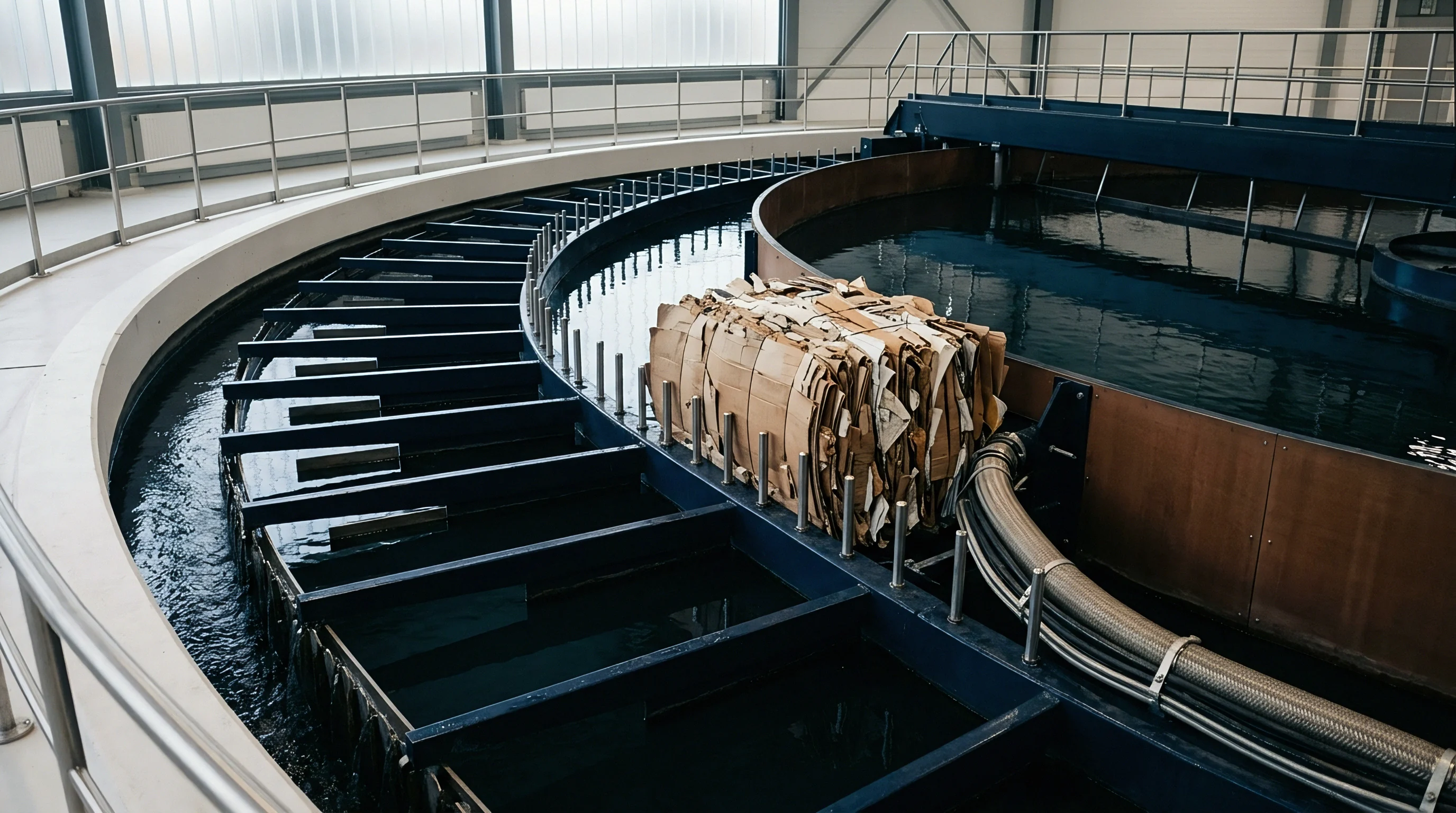
Wastewater infrastructure around paper machines functions as a physical boundary between production accounting and environmental compliance. Clarifiers, settling ponds, and dissolved air flotation cells treat the collected drain lines. Wet-end pits capture heavy drain flows beneath the wire.
Savealls capture long fibres and return them to the machine chest as recovered broke. Clarifier underflow carries true fibrous solids. The remaining clear liquid travels to the secondary treatment sump.
Secondary effluent treatment introduces an accounting conflict for certified credit accounts. In activated sludge systems, aerobic bacteria consume dissolved wood sugars, starch, and volatile fatty acids. These microorganisms convert soluble carbon into biological cell mass.
The secondary clarifier concentrates this bacterial mass into a thick biological sludge. Some mills dewater this secondary sludge, mix it with primary fibre screenings, and pump the cake back into the repulper for low-grade corrugating medium production.
Cellulose dissolves under extreme alkaline conditions. Biological waste cake contains virtually zero intact cellulose fibres. Feeding dewatered secondary bacterial sludge back into a board machine creates an illegitimate mass loop.
The mill claims input credits for certified wood pulp, loses three percent of that mass into water-soluble organic compounds, feeds those compounds to sewer microbes, and then re-enters the dried microbial carcass into the furnish ledger as recycled fibre input. The Chain of Custody credit balance credits the original pulp twice.
A physical conversion ledger balances only when secondary biological sludges exit the fibre accounting perimeter entirely.
When an internal auditor discovers this practice during a mass-balance review, the corrective action invalidates accumulated credit banks. The mill must deduct the microbial sludge tonnage from historical production accounts, exposing delivered orders to retroactive claim cancellations.

Deduction
The mathematical reconciliation of chain of custody credits requires adjusting production yields for non-retained dissolved mass. Credit systems track volume through a rigorous input-output ledger. Under PEFC ST 2002:2020 Clause 6.3 and FSC-STD-40-004 Clause 5.2, certified credits accumulate in credit accounts based on certified raw material inputs multiplied by valid conversion factors.
When conversion factors omit soluble extraction losses, the credit account grows faster than physical inventory allows.

Is Biological Sludge Allowable as Recovered Mass?
Certification rules strictly prohibit counting biological sludge or dissolved chemical oxygen demand mass toward fibre recovery balances. FSC-STD-40-004 specifies that inputs to credit accounts must represent physical virgin timber or recovered wood and paper fibre. Biological sludge constitutes microbial cell mass formed during wastewater aeration.
It does not meet the standard definition of post-consumer or pre-consumer reclaimed material. Mills that reintroduce biological sludge into packaging board cannot allocate chain of custody credits to that portion of the furnish.
Consider a continuous virgin folding boxboard line running bleached chemical pulp on outer plies and mechanical pulp in the core. The line processes one thousand oven-dry metric tonnes of FSC Pure certified input furnish across a four-day production cycle. Standard mill accounting tracks coarse reject screens and dry trim, calculating a historical conversion yield of ninety-three percent.
Physical white water testing reveals four hundred cubic metres of clarified sewer bleed per day with a dissolved organic content of fourteen hundred milligrams per litre.
| Balance Component | Unadjusted Mill Ledger (t) | Physical Measurement (t) | Reconciled Credit Ledger (t) |
|---|---|---|---|
| Certified Pulp Furnish Input | 1000.0 | 1000.0 | 1000.0 |
| Hydrapulper Coarse Rejects | 15.0 | 15.0 | 15.0 |
| Centrifugal Cleaner Rejects | 12.0 | 12.0 | 12.0 |
| Dry Converting & Reel Trim | 43.0 | 43.0 | 43.0 |
| White Water Soluble Losses (COD/TOC) | 0.0 | 22.4 | 22.4 |
| Total Mass Deductions | 70.0 | 92.4 | 92.4 |
| Net Physical Paper Produced | 930.0 | 907.6 | 907.6 |
| Generated FSC Mix Credits | 930.0 | 930.0 | 907.6 |
| Unbacked Credit Variance | 0.0 | 22.4 | 0.0 |
| Assumptions: 1,000 oven-dry tonnes input; 1,600 m3 total sewer bleed volume across 4 days; 1,400 mg/l dissolved COD converted to organic dry mass factor 1.0; 43 tonnes trim re-pulped internally. | |||
The unadjusted ledger produces twenty-two-point-four surplus credits. Over an entire operating year, that single paper machine generates over two thousand tonnes of unbacked FSC Mix Credit paperboard. Commercial buyers purchasing cartons under these inflated certificates carry undetected compliance risk.
Reconciling this deficit requires integrating the environmental discharge monitoring data directly into the enterprise resource planning ledger.
Establishing an audit-proof conversion factor requires specific verification documents. Packaging procurement teams verify whether mill suppliers include white water losses in their annual credit formulas.
- Effluent monitoring reports signed by certified environmental discharge laboratories confirm daily chemical oxygen demand kilograms discharged per tonne of finished board.
- Chemical consumption logs record dry-end functional starch additions to subtract synthetic binder mass from natural fibre yield calculations.
- Sludge disposal manifests prove that primary clarifier solids and secondary biological cakes leave the mill site rather than re-entering the hydrapulper.
- Conversion factor calculation sheets demonstrate that annual yield audits incorporate both mechanical screenings and soluble extraction mass.
Under FSC-STD-40-004 Clause 5.2.3, credit accounts may maintain a positive credit balance for up to twenty-four months, after which excess credits expire without commercial value.

Audit
Procurement teams sourcing certified packaging board operate under stringent regulatory pressures. The European Union Packaging and Packaging Waste Regulation and the Green Claims Directive place direct liability on economic operators who market packaging carrying unverified environmental claims. A customs authority reviewing an import declaration for twenty million pharmaceutical folding cartons checks the consistency between invoice claim codes and the supplier’s chain of custody scope.
If a national accreditation body suspends a mill certificate due to ledger over-crediting, downstream converters face product impoundment.
Pulp yields drop during prolonged pulping. When mills process recycled fibre furnish, de-inking yields drop even lower. Independent supply chain examiners inspect mass balances beyond the finishing room door.
They demand access to wastewater treatment records and environmental discharge filings to verify whether production factors match physical realities. Inaccurate loss factors inflate claim accounts.
A buyer file lacking environmental discharge logs cannot defend a certified credit margin against regulatory scrutiny.
A packaging buyer protects corporate compliance by inserting specific verification covenants into commercial supply contracts. The contract specifies that the paperboard mill must calculate conversion factors using total mass inputs minus all mechanical and dissolved sewer losses. The agreement grants third-party auditors access to wastewater treatment operating sheets and environmental compliance filings during annual surveillance cycles.
Unbalanced ledgers trigger major corrective actions. If an accreditation body discovers that a supplier inflated credit balances by ignoring dissolved organic losses, the certification body issues a major non-conformity. The mill loses the right to apply the credit system until it performs a complete retrospective inventory reconciliation.
That process voids unbacked credits across previous quarters, exposing corporate brand owners to public greenwashing inquiries and customs fines.
The technical challenge remains how international certification bodies will formalise standardised measurement thresholds for dissolved organic extraction losses across complex multi-furnish mills without imposing prohibitive analytical burdens on paper machinery operators.