Recycled Fiber Hydrocarbon Extraction Baseline Analytical Testing Methods
Solvent extraction of recycled fiber requires validated internal standards and silver-phase cleanup to differentiate biogenic waxes from mineral oils.

Spike
Internal standard additions into recycled pulp samples before chemical processing fix the recovery baseline across volatile and non-volatile chromatographic fractions. Fiber substrates derived from recovered paper streams harbor heterogeneous mixtures of petroleum residues, including offset printing ink solvents, mineral oil saturated hydrocarbons, and mineral oil aromatic hydrocarbons. Quantitative determination of these target fractions depends on achieving complete solvent contact while preventing analyte degradation or evaporative loss.
Standardized analytical methods, including DIN 54603 and European standard EN 16995, specify precise solvent mixtures to solubilize non-polar hydrocarbons held within the cellulose matrix.
Solvent Matrix Selection and Extraction Mechanics
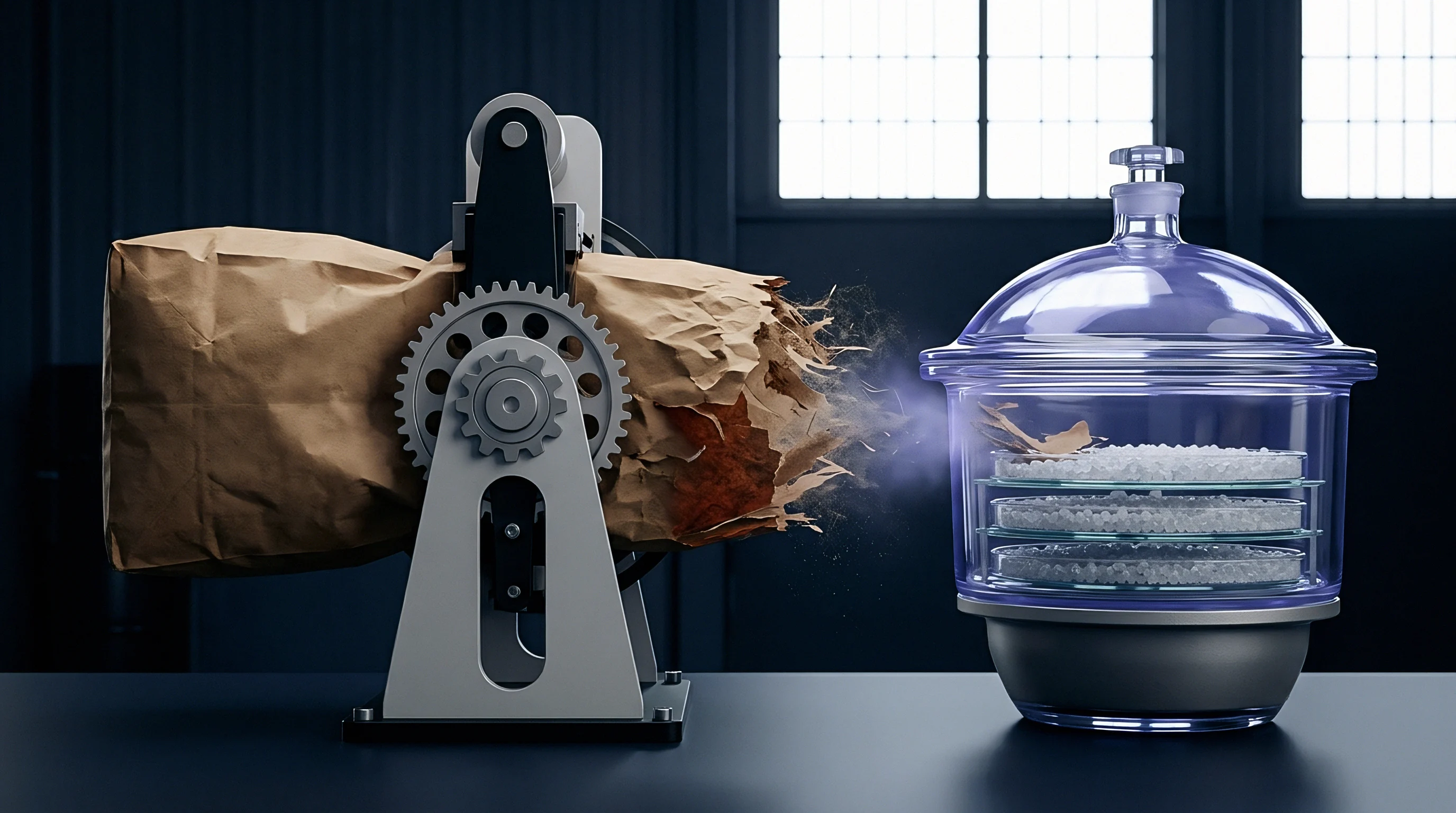
Determining mineral oil concentrations in recovered fiber substrates begins with releasing bound hydrocarbons from the lignocellulosic mesh. Dry paper fibers retain hydrophobic mineral oil compounds through physical entrapment and weak surface sorption. Water-swelling solvents open the compacted fiber structure, permitting non-polar solvents to access internal pore networks.
A mixture of n-hexane and ethanol in an equal volume ratio provides effective cell wall swelling alongside rapid hydrocarbon dissolution. Polar lipids coat fiber walls.
Shaking or sonicating the sample suspension over specified contact intervals transfers target analytes into the liquid phase. Extraction temperature influences both recovery rates and matrix co-extractives. Room temperature extraction minimizes volatile hydrocarbon loss, whereas elevated temperatures increase recovery of high molecular weight wax fractions above thirty-five carbon atoms.
Solvent purity dictates detection accuracy.
Extraction of recycled pulp with hexane and ethanol at room temperature achieves ninety-eight percent recovery of mineral oil saturated hydrocarbons up to thirty-five carbon atoms.
| Solvent System | Extraction Temperature | Contact Duration | MOSH Recovery Rate | MOAH Recovery Rate |
|---|---|---|---|---|
| Hexane and Ethanol Equal Volume | 23 Degrees Celsius | 120 Minutes | 98.2 Percent | 96.5 Percent |
| Dichloromethane and Acetone Mix | 40 Degrees Celsius | 60 Minutes | 94.1 Percent | 91.8 Percent |
| Pressurized Liquid Hexane | 80 Degrees Celsius | 20 Minutes | 99.1 Percent | 97.4 Percent |
Failure to account for low recovery rates during solvent contact results in underreporting total mineral oil content, exposing packaging converters to regulatory penalties when independent surveillance testing identifies non-compliant migration levels.

Elution
High-performance liquid chromatography separates saturated and aromatic hydrocarbon classes before transfer to gas chromatographic detectors. The complexity of recovered paper extracts stems from the simultaneous presence of mineral oils, synthetic polymer oligomers, and natural plant compounds. Online coupled liquid chromatography with gas chromatography and flame ionization detection enables automated separation, preventing cross-contamination between chemical classes.

Chromatographic Fractionation and Unresolved Hump Integration
Gas chromatography equipped with flame ionization detection quantifies mineral oil fractions by measuring total signal area above the instrument baseline. Saturated and aromatic hydrocarbons present in offset inks display broad unresolved complex mixtures. These unresolved humps represent thousands of isomeric structures that cannot be baseline-resolved by capillary columns.
Integration procedures require establishing a stable baseline from the signal start point to the end point of the targeted carbon fraction range. Baseline stability governs quantitation precision.
Carbon number ranges divide analytical results into toxicologically relevant bands, specifically carbon numbers ten to sixteen, sixteen to twenty-five, twenty-five to thirty-five, and thirty-five to fifty. Unresolved humps require manual validation. Analysts adjust integration lines to exclude sharp distinct peaks originating from internal standards or known single compounds.
Proper baseline assignment ensures that underlying mineral oil distributions are correctly calculated without artificial inflation from system background signals.
- Sample Preparation homogenizes ten grams of dry recycled board into fine fiber particles.
- Internal Standard Addition introduces precise quantities of bicyclohexyl and cholestane directly onto the dry fiber matrix.
- Solvent Extraction contacts the fiber mass with an ethanol and hexane mixture under continuous agitation for two hours.
- Liquid Chromatographic Separation isolates saturated fractions from aromatic fractions using silver nitrate silica columns.
- Gas Chromatographic Quantitation measures signal response across designated carbon number ranges against internal standard peaks.
Integrating chromatographic humps from the baseline valley to valley rather than applying horizontal subtraction consistently prevents overestimating mineral oil saturated hydrocarbons.

Cleanout
Recycled paper furnishes contain non-mineral hydrocarbon contaminants that co-extract alongside target petroleum fractions. Polyolefin oligomeric saturated hydrocarbons from hot-melt adhesives and synthetic packaging films mimic mineral oil saturated hydrocarbons during chromatographic separation. Natural waxes, rosin sizing agents, and plant-derived sterols co-elute with aromatic mineral oil fractions unless specific purification steps clear the extract.
System blanks establish baseline cleanout.
How Do Biogenic Interference Peaks Alter Baseline Calculations?
Natural plant waxes, terpenes, and rosin acids generate chromatographic signals that overlap directly with the aromatic petroleum hump. Silver nitrate impregnated silica gel solid-phase extraction columns selectively retain olefinic biogenic compounds while allowing saturated and aromatic hydrocarbons to pass into separate fractions. Saponification with potassium hydroxide in ethanol breaks down fatty acid esters and triglyceride waxes that would otherwise foul chromatographic columns or artificially elevate recovery figures.
Silica gel retains polar species.
Interference masks aromatic hydrocarbon humps. Distinguishing polyolefin oligomers from petroleum-derived saturated hydrocarbons relies on mass spectrometry characterization, where characteristic fragment ions identify branched alkyl chains unique to synthetic polymer backbones.
Complete elimination of biogenic olefins with silver nitrate columns prevents synthetic rubber adhesive oligomers from inflating aromatic hydrocarbon measurements.
- Saponification Check verifies that esterified fatty acids are fully cleaved prior to solid-phase silica separation.
- Olefin Retention Verification confirms silver nitrate columns remove polyolefin oligomers without trapping aromatic rings.
- System Blank Subtraction deducts solvent impurity signals from raw sample chromatograms across all integration windows.
- Biogenic Interference Audit identifies natural wax markers through mass spectrometry scanning when aromatic humps display sharp irregular peaks.
Mill technical directors frequently claim that residual chromatographic humps originate exclusively from benign synthetic adhesives rather than petroleum ink solvents.
Calibration
Converting integrated chromatographic peak areas into mass fractions demands precise internal standard response factors. Standardized analytical procedures prescribe multi-component internal standard mixtures added prior to extraction. Bicyclohexyl serves as the volatile standard for saturated hydrocarbons, while cholestane marks the higher boiling saturated fraction.
Aromatic fractions rely on 1-methylnaphthalene and perylene to define evaporative boundaries and recovery yields across the distillation profile.
Quantitative Baseline Sensitivity and Limit Calculation
Determining the lowest reliable reportable concentration depends on instrument noise and procedural blank variability. Standard laboratories determine the limit of quantification by establishing the standard deviation of low-level replicate spiked blanks. Method limits for recycled board routinely achieve one milligram per kilogram for mineral oil saturated hydrocarbons and zero point five milligrams per kilogram for mineral oil aromatic hydrocarbons.
Blank values set method thresholds.
Evaluating chromatographic signals across a fifty-tonne production run of recycled folding boxboard illustrates the financial and technical consequences of baseline integration methodology. A laboratory analyzing board samples containing an apparent mineral oil aromatic concentration of two point four milligrams per kilogram applies two different baseline construction methods. Under Method A, baseline integration includes unresolved biogenic terpene tails, yielding a total calculated aromatic concentration of two point eight milligrams per kilogram.
Under Method B, solid-phase silver nitrate cleanout removes terpene interference prior to integration, reducing the calculated aromatic concentration to one point six milligrams per kilogram. Assuming a customer specification capping aromatic hydrocarbons at two milligrams per kilogram, Method A rejects the entire shipment, incurring return freight costs of four thousand euros and re-pulping losses of twelve thousand euros. Method B confirms compliance, releasing the lot for food-contact converting.
| Standard Compound | Hydrocarbon Target Class | Quantitation Ion m/z | Minimum Target Recovery | Boiling Point Calibration Equivalent |
|---|---|---|---|---|
| Bicyclohexyl | MOSH Volatile Fraction | 82 | 85 Percent | C12 Equivalent |
| Cholestane | MOSH Heavy Fraction | 217 | 90 Percent | C27 Equivalent |
| 1-Methylnaphthalene | MOAH Volatile Fraction | 142 | 80 Percent | C11 Equivalent |
| Perylene | MOAH Heavy Fraction | 252 | 85 Percent | C22 Equivalent |
Detector response factors require calibration. Standard addition confirms matrix recovery. Evaporation causes volatile marker loss.
DIN 54603 mandates double internal standard addition to invalidate chromatographic runs where volatile hydrocarbon evaporation alters the baseline by more than five percent.
- Volatile Standard Loss occurs when solvent evaporation under nitrogen streams strips C10 and C11 markers prior to gas chromatography injection.
- Silica Column Overloading shifts aromatic hydrocarbon peaks into the saturated hydrocarbon elution window, skewing fraction ratios.
- Incomplete Matrix Penetration leaves mineral oil residues trapped within internal fiber pores during cold solvent washing.
- Baseline Drift Miscalculation creates artificial hydrocarbon humps when instrument temperature ramps produce column bleed signals.
Section 6.3 of DIN 54603 invalidates test results when internal standard recoveries fall below eighty percent, forcing laboratories to repeat extraction procedures before issuing analytical statements.


Attestation
Regulatory compliance files for recycled packaging materials depend on traceable analytical reports stating mineral oil residue levels. European food contact framework regulations require packaging manufacturers to demonstrate that substance transfer into food products remains within safe limits. German BfR Recommendation XXXVI establishes specific guidelines for paper and board intended for food contact, setting functional barrier expectations and monitoring limits for saturated and aromatic mineral oil compounds.

Regulatory Declarations and Packaging Material Qualification
Food contact suitability declarations under European regulations demand supporting evidence showing low specific migration values. Converting raw paper batch extraction numbers into finished package compliance declarations involves applying mathematical migration modeling or direct food simulant contact testing. Tenax adsorption testing at forty degrees Celsius over ten days simulates dry fatty food contact, providing empirical migration numbers to back up mill declarations.
Incomplete extraction yields false compliance. Customs officials verify migration testing.
Customs authorities hold shipments when declaration documents cite testing methods that fail to differentiate synthetic oligomers from mineral oil aromatic fractions.
Whether upcoming European packaging regulations will establish unified chemical threshold limits or mandate functional barrier coatings across all recycled food contact grades remains an open commercial question.