Polyurethane Rotary Anvil Wear Monitoring in Packaging Converting Lines
Polyurethane anvil wear monitoring prevents corrugated flute crush and scrap spikes by triggering blanket rotations before groove depths exceed 1.2 millimeters.
Shell
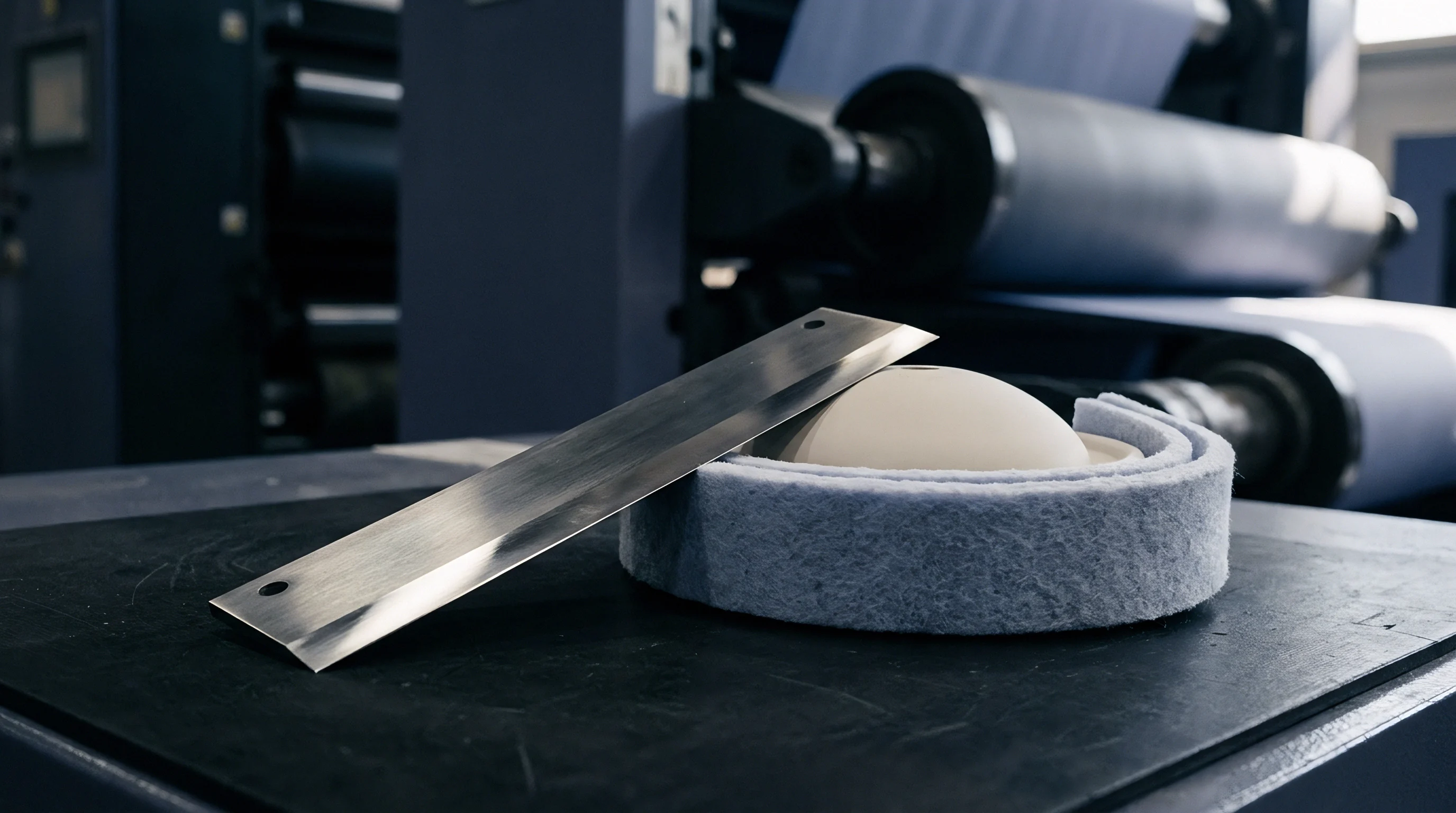
Rotary die cutting in corrugated board conversion drives hardened steel serrated rule edges directly into cast polyurethane blankets mounted over a precision steel cylinder. The elastomeric backing supports containerboard liners and fluting mediums while absorbing the penetration stroke of the rule without blunting its cutting bevel. Polyurethane blankets deform under continuous penetration.
Knife penetration depth ranges from 1.20 millimeters to 1.80 millimeters into an uncompressed blanket caliper of 8.00 millimeters to 10.00 millimeters, generating extreme localized shear stress and internal hysteresis heat within the polymeric chains. Production lines running double-wall board at 300 meters per minute subject every segment of the sleeve to three to four knife impacts per second. The steel cylinder holds true.
Thermal accumulation within the polyurethane matrix accelerates polymer degradation, lowering tensile strength and tear resistance during extended converting runs. Temperature profiles across high-speed rotary die cutters reveal localized core blanket temperatures exceeding 85 degrees Celsius in dense tooling zones, well above the ambient operating window of 20 to 25 degrees Celsius specified for Shore A hardness stability. When blanket temperature surpasses 70 degrees Celsius, cast thermoset polyurethanes based on toluene diisocyanate and polytetramethylene ether glycol lose up to 35 percent of their mechanical cut resistance, initiating rapid chunking and irregular surface voiding.
Thermoset polyurethane anvil blankets experience rapid mechanical shear loss when core hysteretic operating temperatures exceed seventy degrees Celsius.
Elastomeric Blanket Formulation and Dynamic Shear Properties
Performance distinctions between competitive anvil covers stem from the isocyanate-polyol backbone chemistry selected during casting. Prepolymer systems synthesized from naphthalene-1,5-diisocyanate offer superior dynamic fatigue properties and heat dissipation compared to conventional 4,4-diphenylmethane diisocyanate formulations, yet market pricing reflects a 40 percent surcharge that packaging converters frequently avoid on high-volume standard brown box lines. The trade-off appears directly on the machine floor: lower-grade covers develop severe track gouging 1.5 million revolutions earlier under identical converting tonnage.
| Polyurethane Grade Chemistry | Hardness (Shore A) | Tensile Strength (MPa) | Rebound Resilience (%) | DIN 53516 Abrasion Volume (mm³) | Service Threshold (Revolutions) |
|---|---|---|---|---|---|
| TDI-PTMEG Cast Elastomer | 88 to 90 | 42.5 | 62 | 38 | 4.5 × 10⁶ |
| NDI-Polyester High-Dynamic Elastomer | 90 to 92 | 51.0 | 71 | 22 | 7.2 × 10⁶ |
| MDI-Polyether Standard Elastomer | 85 to 87 | 34.0 | 54 | 55 | 3.1 × 10⁶ |
| Aliphatic Hybrid Specialty Elastomer | 92 to 94 | 46.0 | 58 | 32 | 5.8 × 10⁶ |
| Hardness measured in accordance with ISO 7619-1; abrasion loss determined per DIN 53516 under a 10 Newton load using a 60-grit abrasive sheet. | |||||

Mating Geometry in Rotary Die Conversion
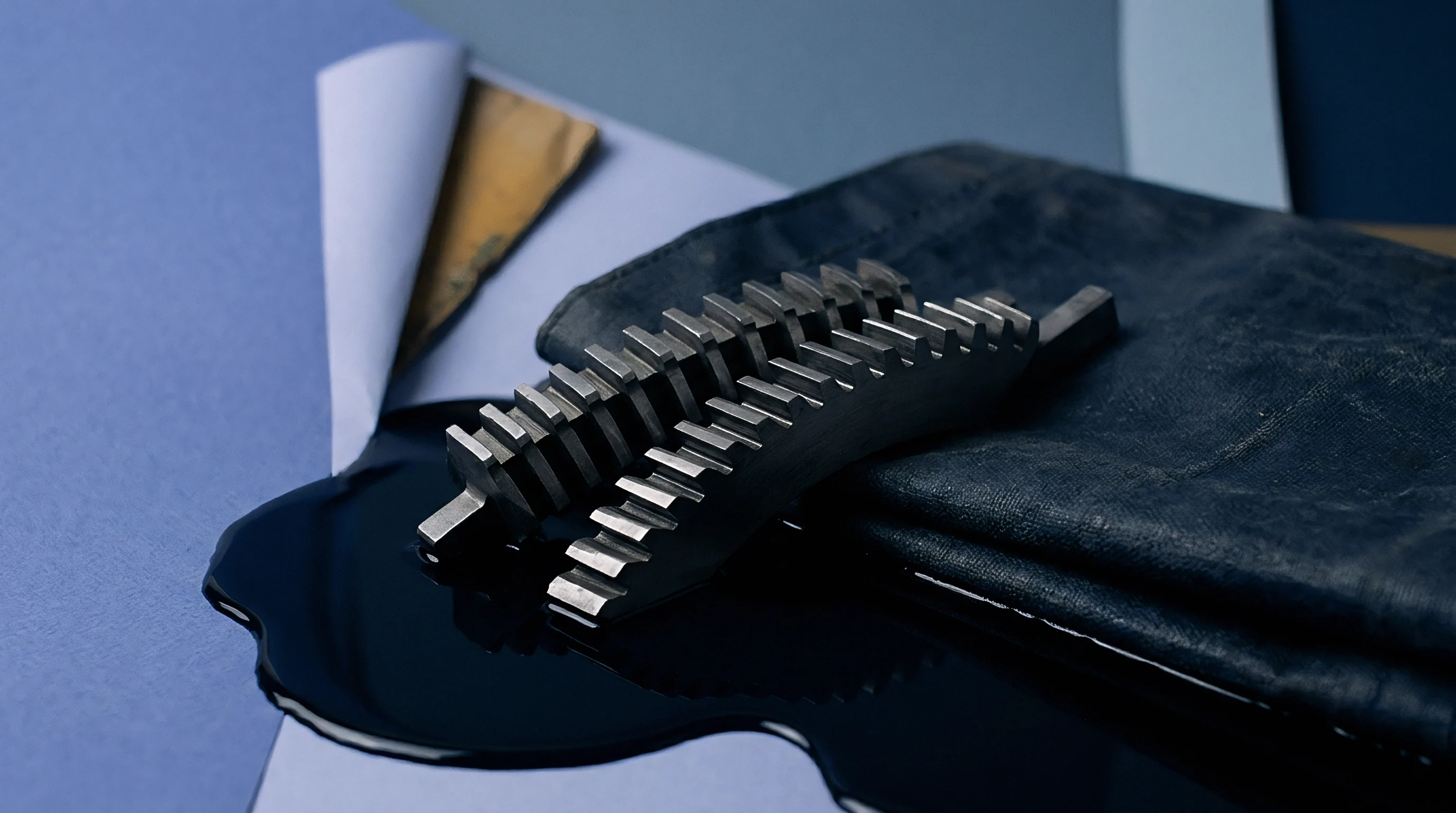
Serrated rule geometries press board fibers against the curved anvil face until tensile failure occurs in the linerboards. Standard serration profiles employ 8 to 12 teeth per inch, with teeth ground to a 54-degree or 60-degree included angle. Ground teeth bite directly into the elastomer, displacing material laterally rather than slicing clean voids.
Under proper operation, the polyurethane snaps back through elastic recovery as the die cylinder clears the cut nip. High line velocities compress the cycle dwell time below 15 milliseconds, causing residual strain accumulation when the material’s relaxation rate lags behind the rotational frequency. Polyurethane sleeves sold under extended-life marketing claims fail prematurely when converters run them past chemical fatigue boundaries without monitoring baseline hardness creep, which suppliers defend by asserting that running waste stems from dull rule knives rather than depleted elastomeric resilience.
Groove
Localized channeling appears wherever rule knives repeatedly penetrate the polymeric matrix along identical circumferential tracking lines. Serrated rules cut corrugated flutes while grinding away micro-fragments of polyurethane at the tooth entry point. Over several hundred thousand impressions, these micro-fissures coalesce into pronounced trenches matching the die knife perimeter.
Cut quality degrades rapidly. The anvil diameter decreases locally at the groove, which reduces penetration resistance and leaves hanging paperboard tags along outer container slots.
Uneven circumferential wear patterns destabilize the line. While transverse cutting rules strike the sleeve intermittently across its width, longitudinal slotting knives and lead-edge trim blades strike continuously along narrow paths. These concentrated track lines hollow out deep ruts while adjacent anvil areas remain at factory caliper.
An irregular surface topology forces converting crews to close the cylinder center distance, over-compressing the high ridges to force cuts in the troughs.
A soft backing yields inconsistent cuts regardless of rule sharpness.
Converting lines experience specific mechanical failure modes when running against channeled anvil surfaces:
- Hanging internal trim scrap occurs when shallow blade penetration through deep grooves fails to shear the bottom linerboard cleanly, jamming downstream vacuum transfer belts.
- Corrugated flute crush develops across non-cut zones because closing the cylinder nip to overcome tracking valleys forces the un-worn polyurethane ridges to compress adjacent flutes beyond elasticity limits.
- Liner fracture along score lines follows excessive anvil cylinder pressure, where rigid creasing rules pinch outer testliner fibers against compressed elastomer and tear the top surface open.
- Erratic blank stripping results from uncut nicks and fibrous micro-bridges holding die-cut blanks inside waste skeletons, producing high-speed jams inside bundle stackers.
A grooved sleeve alters machine kinematics. Because the effective operating radius of the anvil cylinder shrinks within the worn tracking paths, the surface speed of the polyurethane at the groove bottom drops below the linear speed of the cutting die. This speed differential drags the board through the cut zone rather than rolling cleanly through it.
Blade penetration depth decides longevity.
Scan
Direct manual inspection using dial micrometers and vernier depth gauges interrupts production shifts while introducing significant human error across wide cylinder faces. Manual measurements rarely capture localized trough profiles accurately because operators place gauge anvils across high ridges rather than down inside micro-fissures. Modern high-volume corrugated converting lines integrate fixed optical sensors, contact linear variable differential transformers, or automated laser triangulation heads mounted on transverse traverse rails.
These sensor heads sweep the cylinder face during die changeover cycles to compile full two-dimensional surface maps. Scored liners fracture along flutes.
Continuous monitoring relies on distinguishing surface roughness changes from actual volumetric elastomer loss. In rail vehicle engineering and heavy logistics, solid polyurethane suspension buffers undergo volumetric fatigue under cyclic compressive loading, where micro-cracking deep within the polymer core manifests as sudden stiffness loss before exterior surface cracks appear. Anvil blankets follow this exact degradation arc: high-frequency shear impacts soften the internal polyurethane matrix, causing progressive caliper loss under load that optical scanners detect as a drop in dynamic working thickness long before macroscopic chunking tears the surface.

Can Optical Triangulation Map Circumferential Caliper Loss?
Laser triangulation sensors project a calibrated blue or red laser line onto the rotating anvil cover while a complementary metal-oxide-semiconductor camera records reflected displacement at sampling frequencies up to 10 kilohertz. Scanning at this density resolves radial wear to within 0.02 millimeters across an entire 2.8-meter anvil cylinder width. The resulting profile isolates circumferential track depth, average sleeve diameter, and total surface wear volume without removing the sleeve from the machine core.
Surface topography shifts across production.
Non-contact laser profiling resolves anvil cover depth loss to within twenty micrometers under continuous shop floor ambient vibration.
Implementation of an automated scanning inspection sequence proceeds through four sequential phases during scheduled make-ready stops:
- Position the optical sensor carriage at the drive-side reference datum while locking out cutting cylinder drive motors.
- Rotate the anvil cylinder at a constant calibration speed of 10 revolutions per minute to establish baseline radial runout.
- Traverse the optical profiling head across the full face length at 50 millimeters per second while capturing continuous surface coordinates.
- Generate a differential height map against baseline factory thickness to pinpoint groove depth exceeding 1.50 millimeters.
Data gathered through optical profiling feeds conversion predictive models, yet uncertainty persists regarding how to separate harmless surface cracking from critical structural shear failure. Ultrasonic pulse-velocity methods measure acoustic attenuation through the blanket wall, where a 15 percent drop in acoustic wave velocity signals severe subsurface micro-voiding. The baseline velocity through virgin TDI-PTMEG elastomer measures 1,680 meters per second at 20 degrees Celsius, but this figure shifts by 3.5 meters per second per degree change in bulk temperature.
Packaging plants lacking temperature-compensated ultrasonic heads face ambiguous readings on hot cylinders, leaving open the operational question of whether a soft blanket reading indicates chemical reversion or simply un-dissipated running heat.

Ratio
Rotational synchronization between the tooling cylinder and the backing sleeve governs the spatial dispersion of knife penetrations across the elastomeric circumference. If the anvil cylinder and the die cylinder operate at a fixed 1:1 gear ratio, steel rule teeth penetrate identical spots on the polyurethane on every single rotation. Clean separation ceases.
Knife marks rapidly cut the sleeve into shreds within fifty thousand revolutions. To prevent this destruction, converting machinery builders incorporate mechanical or electronic differential drive mechanisms that introduce a controlled rotational speed differential between the cylinders.
The speed ratio offset forces the anvil cylinder to rotate slightly faster or slower than the die cylinder, shifting the impact landing zone of each rule by a fraction of a millimeter per revolution. A typical ratio offset runs between 1.002:1 and 1.015:1. This continuous displacement disperses knife penetrations across the entire cylindrical surface over several thousand impressions, smoothing out localized tracking channels into broad, uniform wear bands across the sleeve.
Could Differential Drive Synchronization Extend Blanket Life?
Electronic line shafts govern independent servo drives that adjust the anvil rotational speed dynamically as the outer diameter wears down. As knives gouge and trim operations remove damaged polymer, the effective diameter of the anvil shrinks. A cylinder ground down by 1.50 millimeters has a smaller circumference, causing its surface velocity to lag behind board feed speed unless motor RPM increases to compensate.
Modern drive controls compute this diameter reduction based on laser scan feedback, modulating the gear ratio to maintain zero relative velocity at the exact cutting nip point. Rotational speed mismatch accelerates wear.
Converters evaluating wear mitigation mechanisms assess specific operational parameters:
- Axial oscillation stroke frequency dictates lateral dispersion, moving the anvil cylinder side-to-side by 25 to 50 millimeters across a cycle of 30 to 60 seconds to spread longitudinal slot knife wear across wide bands.
- Linear grinding pass depth defines the material removed during mechanical anvil trimming, where rotating grinding rolls shave off 0.25 to 0.50 millimeters of damaged polyurethane to restore a flat surface profile.
- Diameter tracking compensation algorithms recalibrate servo rotational speed after each grinding operation to prevent speed mismatch that tears corrugated linerboard during conversion passes.
- Interlocking sleeve seam integrity maintains structural latching under differential torque, preventing split covers from separating at high rotational velocities.
Contractual procurement guidelines for rotary converting machinery establish clear accountability for speed synchronization performance. When machine specifications incorporate DIN EN 1010-1 safety and mechanical performance standards, line builders must guarantee velocity tracking precision within 0.05 percent under varying acceleration curves, invalidating warranty exclusions that machine builders invoke when converters experience early blanket failure under rapid-cycling order schedules.
Scrap
Diminished backing resistance forces converting operators to escalate cutting nip pressure to achieve complete blank separation. The mechanical penalty lands directly on box integrity. When an operator drops the die cylinder by 0.50 millimeters to force dull knives through deep anvil tracks, the crush force exerted on corrugated fluting outside the cutting path surges by 40 to 65 percent.
Outer plies tear open. A box blank cut on an over-compressed, worn anvil displays collapsed flutes along every score line, destroying the structural stacking strength of the finished corrugated container.
Packaging buyers verify structural performance through Box Compression Tests (BCT) governed by ISO 12048 and Edge Crush Tests (ECT) per ISO 3037. Running a corrugated order of 200-gram Kraftliner outer and 120-gram semi-chemical fluting against an anvil cover worn past a 1.20-millimeter groove depth reduces finished box compression resistance by 18 to 22 percent. The converter delivers boxes that fail in cold-storage warehouses under pallet stacking loads, resulting in immediate load rejections and commercial claims.
Finished corrugated packaging loses up to twenty-two percent of its vertical box compression resistance when converted over anvil blankets with groove depths exceeding one millimeter.
Crushed Flutes and Delamination Costs
Waste piles multiply quickly. Flute destruction shows up immediately at the folder-gluer section of flexo-folder-gluers. Corrugated blanks with crushed trailing edges feed erratically into folding belts, skewing the box panels and producing fishtailing at the glue tab.
A slot depth variation of 1.50 millimeters caused by uneven knife penetration causes automatic packaging machinery at client filling plants to jam, halting high-speed packing lines running at 40 cartons per minute. Tooling clearances tighten under heat.
| Mean Anvil Wear Depth (mm) | Added Die Penetration (mm) | Flute Caliper Loss (%) | ECT Strength Retention (%) | Stripping Jam Rate (%) | Total Shift Scrap Rate (%) |
|---|---|---|---|---|---|
| 0.00 to 0.30 (New) | 0.00 | 1.2 | 99.5 | 0.08 | 0.85 |
| 0.31 to 0.70 (Moderate) | 0.25 | 3.8 | 97.0 | 0.22 | 1.15 |
| 0.71 to 1.10 (Advanced) | 0.50 | 8.5 | 92.4 | 0.65 | 2.40 |
| 1.11 to 1.60 (Severe) | 0.85 | 16.2 | 84.1 | 1.85 | 5.20 |
| Over 1.60 (Depleted) | 1.20 | 24.0 | 77.8 | 4.50 | 9.80 |

Conversion Ledger for Blanket Replacement Intervals
Consider a standard flexo folder-gluer running B-flute board with a production volume of 25 million square meters annually, representing roughly 45,000 metric tons of converted board. An anvil blanket set costs 3,200 dollars for a complete cylinder wrap, while planned replacement make-ready requires two hours of maintenance downtime valued at 450 dollars per machine hour. Postponing replacement allows average groove wear to slip from 0.70 millimeters to 1.50 millimeters, pushing line scrap rates from 1.15 percent to 5.20 percent.
On a production run of 150,000 square meters of 400 gsm corrugated board priced at 0.85 dollars per square meter, this scrap expansion generates 5,163 dollars in wasted board stock and processing energy in a single 16-hour shift. Line stops drain operational margin.
The arithmetic proves decisive. Attempting to extract an additional 500,000 impressions from a grooved anvil cover to save 800 dollars in prorated blanket depreciation burns over 5,000 dollars in board spoilage and triggers customer deducts for compressed boxes. Dimensional variations compound across cartons.
When converting plants ignore progressive anvil wear monitoring, bottom-line margins vanish beneath unscheduled line stoppages, un-stripped waste pallets, and full-trailer commercial rejections.