Predicting Set off Migration in Stacked Packaging Board under Non Uniform Compression
Predicting set-off migration requires calculating local pressure peaks across board caliper variations to set safe pile heights and barrier coat weights.

Stack
Palletized folding boxboard undergoes heavy force concentration while sitting in post-print storage. In a delivery stack holding six thousand sheets of 350 grams per square meter solid bleached board, vertical force distribution strays sharply from simple weight calculations. Where theoretical models divide total load evenly across the sheet, physical measurements show compressive stress ranging from 12 kilopascals in open central areas to 280 kilopascals along narrow perimeters and die-cut contact points.
Thickness variations from mill manufacturing drive much of this load concentration. Standard mill caliper tolerances of plus or minus five percent create subtle waves across press sheets. When thousands of sheets stack in a delivery pile, these high-caliper zones line up directly over each other, creating vertical ridges that carry most of the top-load weight.
Strapping bands pulled tight around finished pallets add further stress: tension across the corners pushes local pressure above 320 kilopascals, forcing wet or fresh ink into tight contact with reverse-side clay coatings.

Mechanical Stress Distribution Mechanisms
Die-cutting creases and embossed details further alter force distribution across the pallet. Elevated geometric features concentrate vertical load onto narrow areas, turning fold lines, score edges, and stamped foil borders into high-pressure contact points within the pile.
Delivery piles also retain residual heat from production. Sheetfed offset and energy-curable presses discharge printed stock at temperatures between 30 and 42 degrees Celsius, and heavy pressure on warm, thermoplastic ink films speeds up physical consolidation. Sheets near the bottom experience sustained compression while upper layers expand and contract with ambient room conditions.
| Substrate Grade | Grammage (g/m²) | Mean Stack Pressure (kPa) | Peak Edge Pressure (kPa) | Ridge Deformation Delta (µm) |
|---|---|---|---|---|
| Solid Bleached Board (SBB) | 300 | 18.4 | 210.5 | 4.2 |
| Folding Boxboard (FBB) | 350 | 22.1 | 265.0 | 8.7 |
| White Lined Chipboard (WLC) | 400 | 26.8 | 315.2 | 14.1 |
| Coated Kraft Back (CKB) | 380 | 24.3 | 288.0 | 11.3 |
Gaps between pallet deck slats create sudden pressure drops across the bottom sheets. The board sags over open timber spaces under the mass above, generating internal shear stress while concentrating heavy compressive loads directly over the solid wooden slats. Overhang beyond the pallet edge shifts stress vectors further, creating lateral slip between fresh ink films and uncoated reverse fibers.
At a stack height of 1.4 meters under standard 23 degree Celsius conditioning, perimeter compressive load reaches fourteen times central stack pressure.
Set-off transfer is often blamed on incomplete ink drying rather than stack pressure, on the premise that standard offset vehicle formulations require forty-eight hours of ambient pile aeration before banding.
Diffusion
Chemical transfer between contacting surfaces takes place through direct mechanical set-off and molecular migration. Set-off happens when wet or partially cured ink vehicles squeeze onto adjacent reverse sheets under weight. Migration involves volatile and semi-volatile compounds dissolving into and traveling through reverse-side mineral or polymer coatings.
Heavy compression shrinks inter-sheet air gaps from an uncompressed baseline of 15 micrometers down to sub-micron distances, opening rapid pathways across contact boundaries.
Unreacted photoinitiators in UV-cured inks are particularly mobile. Molecules like isopropylthioxanthone, 2-hydroxy-2-methylpropiophenone, and benzophenone have molecular weights under 350 Daltons, allowing them to migrate through paperboard pore networks. Stack pressure drives these small compounds out of resin matrices into adjacent reverse-side coatings.
Monomeric acrylic residues like trimethylolpropane triacrylate and hexanediol diacrylate behave similarly whenever curing efficiency drops below ninety-eight percent.

Pressure Driven Molecular Transport Modes
Mineral oil hydrocarbons in conventional sheetfed offset inks migrate quickly under uneven stack loads. Saturated (MOSH) and aromatic (MOAH) fractions, with chain lengths from C10 to C35, are forced out of open ink pores as pressure squeezes the liquid phase into reverse clay coatings. Uncoated board surfaces readily draw up these low-viscosity fractions through capillary action, producing visible staining and chemical contamination.
Ambient moisture, such as the standard relative humidity levels defined in ISO 187, changes cellulose mobility. Absorbed water acts as a plasticizer in paper fibers, lowering the board’s glass transition temperature. Under high pressure, moist fibers yield and flatten surface micro-roughness peaks, expanding real contact area between sheets and accelerating mass transport across the boundary.
High contact pressure eliminates air gaps between stacked sheets to expand the real contact area available for molecular transfer.
- Photoinitiator Bleed Unreacted UV photoinitiators migrate from cured varnish into reverse food-contact coatings beneath stack pressure peaks over 150 kilopascals.
- Hydrocarbon Solvation Mineral oil fractions break down reverse barrier coatings as compressive loads collapse microporous starch matrices during extended storage.
- Monomer Entrapment Acrylic monomers squeezed from under-cured flexo inks sink into reverse uncoated fibers, leaving strong off-odors in the board.
- Plasticizer Exudation Polymeric additives leach from soft varnish layers into reverse clay coatings when continuous stack pressure exceeds material yield points.
Excessive stack compression ultimately leads to severe reverse-side staining, ink picking on carton converting lines, and immediate regulatory disqualification for direct food packaging.


Gradient
Stress-dependent diffusion coefficients govern mass transport across contacting board surfaces. Standard Fickian equations must incorporate pressure-dependent terms to account for these dynamics, introducing activation volume parameters that reflect structural compression within polymer coatings:
D(P) = D_0 exp(-P V_a / (R T))
Where D_0 is the diffusion coefficient at atmospheric pressure, P is local pressure in Pascals, V_a is activation volume for diffusion, R is the universal gas constant, and T is absolute temperature in Kelvin. As pressure flattens board topography past its surface yield stress, real contact area approaches geometric surface area, driving mass transfer rates up exponentially.

Predictive Mathematical Model Construction
Calculating total migrant transfer across a sheet requires solving non-steady-state transport equations over a non-uniform pressure field. A comprehensive model evaluates four distinct layers: printed ink film, barrier varnish, reverse coating, and board substrate. Local pressure distribution P(x,y) across sheet dimensions x and y is derived from pile height and board caliper profiles.
| Compressive Stress (kPa) | Contact Area Fraction (%) | Benzophenone Transfer (mg/dm²) | MOSH C16-C35 Migration (mg/kg) | Equivalent Storage Time (Days) |
|---|---|---|---|---|
| 10 | 12.5 | 0.02 | 0.4 | 30 |
| 50 | 38.0 | 0.14 | 2.1 | 30 |
| 100 | 67.2 | 0.48 | 6.8 | 30 |
| 200 | 89.5 | 1.25 | 18.4 | 30 |
| 300 | 96.8 | 2.10 | 32.1 | 30 |
In a 350 grams per square meter folding boxboard printed with low-migration UV offset ink and stacked 1.2 meters high, peripheral edge pressure reaches 220 kilopascals while the center reads just 15 kilopascals. Over ten days at 25 degrees Celsius, migrant transfer along the compressed edge reaches 1.6 milligrams per square decimeter, compared to just 0.08 milligrams per square decimeter in the center. That twenty-fold disparity across a single sheet highlights how heavily localized compression dictates migration rates.
300 kilopascals of local stack pressure increases photoinitiator migration by one hundred times compared to uncompressed standing sheets.
Barrier coatings slow this movement by extending physical resistance pathways. Water-based acrylic dispersions cut migrant flow when applied at dry coat weights above 4.5 grams per square meter. However, heavy compression can collapse pinholes within the dispersion film, creating direct channels for low molecular weight compounds that bypass calculated barrier ratings.
Applying anti-set-off spray powder between sheets preserves physical air gaps, helping limit molecular migration across the full pallet area.

Probe
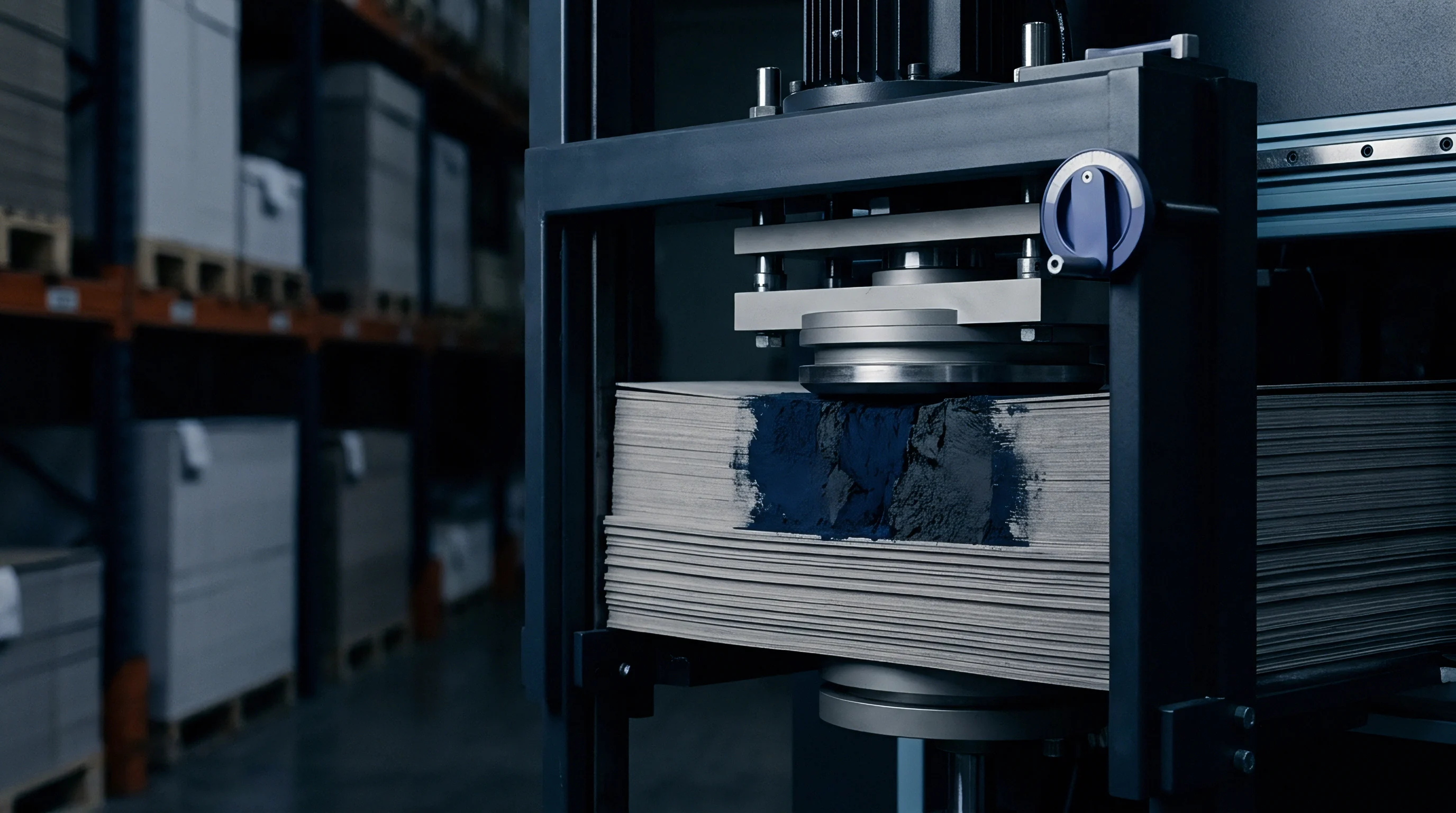
Accurate set-off testing requires reproducing real, non-uniform stress states in the lab. Standard methods like EN 1230-1 and EN 1230-2 measure odor and flavor transfer under flat clamping blocks applying static loads around 2 kilopascals. Because these standard tests ignore localized peak pressures, they regularly miss migration risks found in full production stacks.
Advanced protocols rely on hydraulic compression cells with tactile sensor arrays to map true load distributions during conditioning.
How Does Pressure Cell Conditioning Replicate Pallet Core Heat Retention?
Hydraulic cells apply target pressure profiles inside environmental chambers with controlled temperature and humidity. Test samples undergo multi-stage loading protocols designed from actual pallet stress maps. In modified Tenax extraction testing, food simulant powder sits directly against the reverse board surface while under active pressure, after which gas chromatography-mass spectrometry quantifies chemical species extracted over set exposure times.
- Cut 100 by 100 millimeter test specimens from high-caliper, mid-sheet, and creased areas of printed production stock.
- Load specimens into multi-sample compression cells, separated by clean reverse-coated receptor board blanks.
- Calibrate the load actuator to apply non-uniform pressures from 10 to 300 kilopascals across sample faces.
- Move loaded assemblies into an environmental chamber set to 40 degrees Celsius and 50 percent relative humidity per ISO 187.
- Hold load and temperature for ten days to replicate thirty days of ambient pallet storage.
- Extract receptor board blanks using hexane and ethanol solvent mixtures before running gas chromatography analysis.
Instrumental analysis measures individual migrant species transferred to the receptor sheets. Flame ionization detection measures mineral oil fractions MOSH and MOAH down to 0.1 milligrams per kilogram, while photoinitiators and acrylate monomers are quantified with electron ionization mass spectrometry against internal deuterated standard curves.
EN 13130 compliance testing demands total migration limits below 60 milligrams per kilogram of food simulant under worst-case storage conditioning.
Discrepancies between flat-plate lab tests and actual pallet performance remain a source of friction for converter quality teams. Because standard methods ignore localized stress peaks, lab reports frequently understate true field migration risks.

Compliance
Regulations set strict boundaries on substance transfer from packaging into food. Regulation EU 1935/2004 mandates that packaging materials must not transfer components in amounts that threaten human health, alter food composition unacceptably, or impair flavor and odor. Uneven stack pressure directly jeopardizes compliance by creating localized hot spots where migrant levels exceed these legal limits.
European Union Regulation 10/2011 establishes Specific Migration Limits for individual chemical species, capping benzophenone at 0.6 milligrams per kilogram of food and unreacted acrylate monomers at 0.05 milligrams per kilogram. Mineral oil fractions face additional national restrictions; the Swiss Ordinance on Materials and Articles in Contact with Food sets action limits for MOAH fractions down to a non-detectable threshold of 0.1 milligrams per kilogram.

Legal and Commercial Risk Mitigation Protocols
Extended Producer Responsibility schemes and European recyclability guidelines penalize barrier coatings that impede repulping. While heavy fluorochemical or extruded plastic layers effectively block pressure-driven migration, they penalize paperboard recyclability ratings under EN 13430. Water-soluble acrylic dispersion varnishes offer a practical middle ground, blocking migration under weight while remaining fully repulpable in standard mill systems.
Risk management for converters relies on thorough documentation across raw materials, press logs, and batch testing dossiers. Ink technical datasheets must explicitly state low-migration certification status under EuPIA guidelines for food contact applications.
- Declaration of Compliance Formal document certifying that printed board packages satisfy Regulation EU 1935/2004 and Regulation EU 10/2011 under specified load and thermal conditions.
- Raw Material Dossiers Technical files containing chemical identities, CAS numbers, and toxicological data for all ink components, photoinitiators, and varnish resins.
- Analytical Test Certificates Gas chromatography-mass spectrometry reports confirming specific migration stays within legal limits under simulated stack pressure.
- Recyclability Grading Audit Laboratory evaluation confirming barrier coatings will not hinder fiber recovery or trigger penalties under national waste schemes.
Supply contracts typically stipulate that migration exceeding legal thresholds invalidates batch acceptance, shifting recall costs and inventory liabilities directly back to the converter.