Capillary Absorption Testing in Lightweight Coated Graphic Papers
Dynamic absorption testing via ISO 18522 measures subsecond ink vehicle uptake on lightweight coated paper, preventing pressroom strike-through failures.

Pore
Base paper substrates in lightweight coated graphic grades rely on groundwood or thermo-mechanical pulps blended with kraft fibres to maintain opacity at low grammages. These base sheets typically range between 35 and 50 grams per square metre. Coating formulations applied at 5 to 10 grams per square metre per side alter the microstructural void network dramatically.
The finished paper presents a complex dual-porosity substrate where two distinct pore size distributions govern fluid movement. Intra-coating pores exist within the fine mineral structure, created by packed ground calcium carbonate and kaolin clay particles. Inter-fibre voids exist within the underlying cellulosic base sheet.
Fluid transport across these boundaries dictates how offset fountain solutions, ink solvents, and inkjet vehicle liquids deposit on the moving web.
Capillary Structure of Pigmented Coatings
Ground calcium carbonate and kaolin clay particles create an interconnected void network during high-speed blade application. Mineral particle size distribution dictates the average radius of intra-coating capillary channels. Platy kaolin clay alignment produces narrow, tortuous channels measuring between 20 and 80 nanometers in diameter.
Blocky ground calcium carbonate particles generate larger, more isometric void structures measuring between 100 and 300 nanometers. Latex binders and starch additives partially occupy these mineral interstitial spaces. Pigment shapes alter voids.
The ratio of pigment to binder controls total pore volume and effective capillary radius. High binder ratios seal capillary openings, whereas low binder ratios leave exposed capillary throats capable of rapid fluid uptake.
Coating layers under ten grams per square metre depend entirely on intra-mineral capillary pore networks for initial ink vehicle uptake.
Fibre orientation affects absorption. The mechanical core underneath the mineral coating contains open voids measuring between 1 and 10 micrometers. When a liquid vehicle penetrates through the thin coating layer, it transitions from fine intra-coating capillaries into coarse inter-fibre voids.
Surface energy drives uptake. The capillary pressure exerted by a narrow pore scales inversely with its effective radius. Fine coating pores generate immense capillary suction, drawing low-viscosity liquid phases rapidly out of applied ink films.
Viscosity resists fluid movement.
Lucas Washburn Dynamics in Subsecond Wetting
Liquid absorption into thin mineral layers proceeds through capillary driving pressure balanced against viscous resistance. Classical interfacial fluid flow across porous substrates follows the Lucas-Washburn relationship. The depth of liquid penetration scales with the square root of contact time.
Pore radius governs velocity. The rate of capillary uptake depends on liquid surface tension, contact angle against the pore wall, dynamic fluid viscosity, and effective pore radius. Liquid penetration rate increases when pore radius grows, provided capillary pressure remains high enough to overcome viscous drag.
Subsecond contact times characterize modern printing processes. On high-speed heatset web offset presses running at 15 metres per second, ink nip contact lasts less than 5 milliseconds. High-speed inkjet jetting deposits solvent droplets that must absorb within 10 to 50 milliseconds to prevent lateral dot gain.
Fluid temperature alters viscosity. Under these microsecond conditions, macro-scale water absorption measurements fail to reflect fluid movement. Contact angle dictates wetting.
Capillary uptake within the first 100 milliseconds is governed almost entirely by intra-coating pore geometry rather than base paper absorption capacity. Solvent absorption occurs rapidly.
How micro-scale structural compression during supercalendering alters intra-coating capillary pore radius distribution across local grammage fluctuations remains a point of investigation.

Instrument
Measuring fluid penetration across millisecond intervals requires apparatus engineered to separate initial contact surface delay from volumetric capillary uptake. Standard bench testing using static immersion or long-duration water contact fails to capture subsecond fluid transfer mechanics. Modern paper physics relies on dynamic sorptivity instruments that apply liquid to a moving paper surface under controlled contact times ranging from 10 milliseconds to 2 seconds.

Bristow Wheel Apparatus for Short Time Sorption
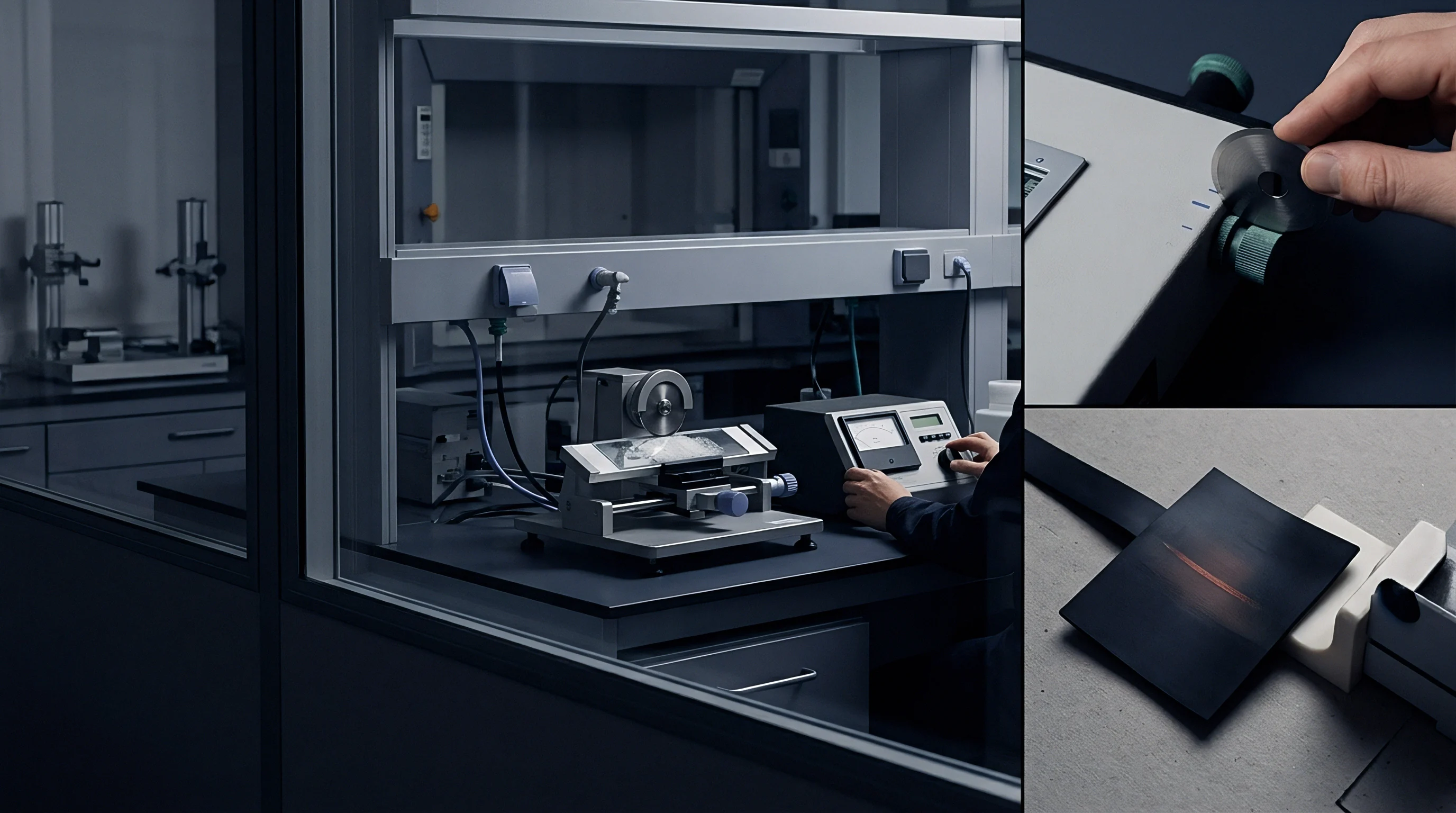
A liquid droplet transfers from a stationary applicator nozzle onto a specimen strip mounted to a spinning wheel rim. Wheel rotational speed determines liquid-paper contact duration. As the specimen passes beneath the applicator slot under precise head pressure, liquid absorbs into the coating layer, leaving a continuous trace on the sheet surface.
Measuring track area against known liquid volume yields the absorption volume per unit surface area. Plotting absorbed volume against the square root of time establishes the dynamic sorptivity profile.
The resulting linear plot yields two critical physical values. The slope of the line represents the absorption coefficient, expressed in millilitres per square metre per square root second. The intercept on the time axis defines the wetting delay, expressed in milliseconds.
Wetting delay captures the time required for the liquid phase to overcome air displacement and surface energy barriers before capillary uptake begins. Roughness delays liquid uptake. High surface roughness increases initial liquid hold-up without advancing true capillary penetration into the pore network.
Dynamic Contact Angle and Drop Shape Analysis
Optical cameras record droplet profile evolution over milliseconds to track baseline diameter growth alongside contact angle decay. Automated optical drop shape analyzers dispense micro-droplets measuring between 0.1 and 1.0 microlitres onto the coating surface. High-speed video captures baseline wetting and droplet volume change simultaneously.
Rapid contact angle decay without baseline expansion indicates fast capillary absorption into intra-coating pores. Fast baseline expansion with slow contact angle decay indicates lateral surface spreading driven by low surface tension rather than capillary suction.
Ultrasonic attenuation instruments provide a complementary acoustic measurement route. Immersion testing inside an acoustic cell measures ultrasonic signal transmission changes as liquid penetrates the sheet. Water uptake displaces air inside intra-coating pores, increasing acoustic coupling and raising signal transmission amplitude.
The time-dependent attenuation curve separates rapid coating layer saturation from slower base paper penetration, offering continuous real-time depth profiling across thick and thin stock alike.
Standard Cobb testing under ISO 535 measured at sixty seconds overestimates initial coating absorbency on lightweight stocks by two orders of magnitude compared to sub-second dynamic absorption testing.
| Test Method | Standard Standard Designation | Contact Time Domain | Measured Output Parameter | Primary Diagnostic Purpose |
|---|---|---|---|---|
| Bristow Wheel Absorption Tester | TAPPI T 553 / ISO 18522 | 10 ms to 2000 ms | Absorption Coefficient, Wetting Delay | Short-time solvent uptake and ink vehicle setting rates |
| Dynamic Contact Angle Analyzer | ASTM D7334 / ISO 15989 | 10 ms to 10 s | Contact Angle Decay Rate, Droplet Volume | Surface energy balance and initial droplet spreading behaviour |
| Ultrasonic Penetration Analyzer | Emco PDA Standard Protocol | 50 ms to 60 s | Ultrasonic Attenuation Curve Slope | Z-direction fluid front progression into mechanical base core |
| Standard Water Cobb Tester | ISO 535 / TAPPI T 441 | 60 s to 120 s | Total Water Mass Absorbed per Area | Macro-scale sizing degree and moisture barrier evaluation |
Paper mill technical sales teams frequently assert that standard Cobb test values adequately guarantee press performance, dismissing sub-second dynamic absorption deviations as minor bench artifacts.

Defect
Printing presses running lightweight coated graphic stocks at high web speeds expose any mismatch between ink vehicle viscosity and substrate pore radius. When coating sorptivity drifts away from specified target windows, converting floors encounter immediate running defects. Subsecond absorption imbalance manifests as severe visual defects, web instability, or post-press drying failures.
Ink Vehicle Strike through and Bleed Mechanisms
Solvents from heatset offset inks penetrate deeply into thin thirty-five gram base sheets when surface energy exceeds viscous drag. Excessive capillary sorptivity inside the mineral coating layer accelerates solvent extraction from the printed ink film. Liquid mineral oils travel rapidly through intra-coating pores, cross the coating-base interface, and enter mechanical pulp voids.
Strike-through reduces printed image density while creating objectionable visual show-through on the unprinted reverse side of thirty-eight gram publication stocks.
Why Does Coating Pore Radius Control Solvent Penetration?
Capillary pressure increases inversely with void size according to classical interfacial mechanics. Narrow intra-coating pores measuring under 50 nanometers exert high capillary suction forces on low-viscosity ink oils. When an over-refined groundwood base paper combines with an open, low-binder GCC coating, solvent extraction rates spike.
Binder migration seals voids. Fast solvent loss leaves ink pigments stranded on the surface without sufficient fluid medium, compromising rub resistance and rub-off stability during high-speed folding.

Surface Mottling and Set off Impairment
Non-uniform latex binder distribution creates localized absorption variations across the paper web. During high-speed infrared drying in blade coaters, water evaporation draws soluble binders and latex particles toward the wet coating surface. Localized binder concentration seals mineral pore throats, creating regions of extremely low capillary sorptivity adjacent to open, high-sorptivity zones.
Print density variations emerge across the printed image, generating visual ink mottle in solid mid-tone areas.
Excessive binder migration toward the coating surface seals capillary entry points and delays ink vehicle setting during high-speed printing.
Fast presses demand speed. Low dynamic sorptivity delays ink film setting. When ink vehicles fail to absorb into the coating layer within 100 milliseconds after nip exit, wet ink transfers onto reverse impression cylinders or adjacent sheets in the delivery stack.
Set-off smearing forces press operators to reduce press speed or increase thermal dryer temperature, elevating electrical power expenses across publication printing runs.
- Ink Strike-Through occurs when rapid solvent capillary drainage pulls mineral oils into the mechanical pulp core, generating severe reverse-side visual show-through.
- Set-Off Smearing manifests when low sorptivity delays solvent extraction, leaving wet ink vehicle on the coating surface at press delivery rollers.
- Heatset Web Blistering develops when excessive coating surface binder sealing traps moisture vapor inside the mechanical pulp core during 200°C dryer pass-through.
- Coating Pick-Out arises when ultra-fast capillary vehicle drainage depletes ink film fluid, raising ink film tack beyond coating surface structural strength.
Inadequate capillary absorption control leads to press downtime, wasted tonnage, rejected print runs, and unrecoverable converter costs.


Trial
Bench testing of fifty-four gram per square metre lightweight stock begins with specimen conditioning at twenty-three degrees Celsius and fifty percent relative humidity under ISO 187. Laboratory qualification evaluates dynamic liquid sorptivity to verify that delivered paper lots match mill certificate declarations. Testing employs a standardized water-glycol test fluid calibrated to 10 millipascal seconds viscosity to simulate heatset offset ink vehicle rheology.
Worked Absorption Calculation and Sorptivity Derivation
Evaluating a fifty-two gram publication sheet carrying six grams of coating per side requires isolating the liquid transfer volume from the roughness wetting delay. Test strips measuring 25 millimetres wide by 900 millimetres long undergo rotational scanning on a Bristow wheel tester across five discreet rim speeds. Applied liquid volume stays fixed at 50 microlitres inside a 15-millimetre-wide track nozzle.
The laboratory records track lengths across five contact durations: 20, 50, 100, 500, and 1000 milliseconds. Track lengths yield calculated absorption volumes per unit area. At 20 milliseconds, absorbed volume equals 1.45 millilitres per square metre.
At 50 milliseconds, absorbed volume reaches 1.85 millilitres per square metre. At 100 milliseconds, absorbed volume measures 2.30 millilitres per square metre. At 500 milliseconds, absorbed volume reaches 4.10 millilitres per square metre.
At 1000 milliseconds, absorbed volume totals 5.45 millilitres per square metre.
Plotting absorbed volume against the square root of time in seconds converts contact durations to square root values: 0.141, 0.224, 0.316, 0.707, and 1.000 square root seconds. Linear regression across these data points produces a line with a slope of 4.66 millilitres per square metre per square root second. This slope represents the absorption coefficient.
Extrapolating the regression line back to zero contact time isolates a surface roughness filling capacity of 0.80 millilitres per square metre, yielding a calculated wetting delay of 12 milliseconds.
| Contact Time (ms) | Square Root Time (s^1/2) | Track Length (mm) | Transfer Volume (mL/m²) | Calculated Parameter |
|---|---|---|---|---|
| 20 | 0.141 | 133.3 | 1.45 | Initial Surface Roughness Fill Phase |
| 50 | 0.224 | 104.5 | 1.85 | Wetting Delay Transition Point |
| 100 | 0.316 | 84.1 | 2.30 | Intra-Coating Pore Capillary Suction |
| 500 | 0.707 | 47.2 | 4.10 | Coating-Base Interface Crossing |
| 1000 | 1.000 | 35.5 | 5.45 | Base Sheet Inter-Fibre Pore Penetration |

Laboratory Test Sequence for Dynamic Sorptivity
Specimen preparation protocols demand precise directional cutting relative to the paper machine line. Test strips cut along the machine direction exhibit slightly lower wetting delay values than cross-direction strips due to mineral particle alignment along blade coater shears. Moisture content shifts calibration.
Moisture variations over 0.5 percent alter contact angle readings significantly.
- Cut paper test specimens to 25 millimetres width by 900 millimetres length along the machine direction using a double-blade precision strip cutter.
- Condition all cut specimens inside an ISO 187 environmental chamber at 23°C and 50% relative humidity for a minimum of twenty-four hours prior to testing.
- Clean the Bristow wheel applicator track nozzle using micro-filtered isopropyl alcohol to eliminate trace organic contamination.
- Load 50 microlitres of calibrated test fluid into the applicator channel using a micro-syringe certified to within 0.5 microlitre accuracy.
- Mount the conditioned paper strip onto the wheel perimeter band under 100 newtons of uniform tension.
- Execute track runs across five programmed tangential wheel velocities corresponding to contact durations from 10 to 1000 milliseconds.
- Measure total track length using a digital planimeter and calculate absorbed volume per unit area for each contact duration.
- Regress transferred volume values against square root time values to determine the dynamic absorption coefficient and wetting delay parameter.
High absorption coefficients paired with short wetting delays reliably predict clean ink setting without strike-through across fast publication presses.
Contract
Technical specifications for publication grade purchases define clear acceptance limits for absorption parameters alongside grammage, bulk, and opacity tolerances. Buyers purchasing paper by the metric tonne for conversion into catalogs, magazines, and commercial inserts evaluate yield against landed pressroom risk. Substituting lightweight substrates without modifying sorptivity specifications exposes press operations to costly web breaks and strike-through claims.
Verification Dossiers and Mill Certificate Validation
Pallet inspection protocols at receipt check batch certificates against laboratory benchmark values prior to pressroom clearance. Mill certificates reporting only standard sixty-second Cobb values conceal batch-to-batch variations in intra-coating pore volume. A 54 gram lightweight coated sheet displaying an acceptable Cobb 60 value of 25 grams per square metre can still fail on press if binder migration shifted the subsecond absorption coefficient from 4.5 down to 1.8 millilitres per square metre per square root second.
Receiving inspection routines require dynamic sorptivity reporting under TAPPI T 553 or ISO 18522 on all mill certificates of analysis. Pallet checks reveal variations. When incoming reel certificates indicate dynamic sorptivity coefficient drift exceeding 15 percent from qualified baseline values, technical buyers hold the batch for bench verification before mounting reels onto press unwinds.
Dry coat weights vary. Grammage variations across web trim alter total coating volume directly.

Yield Optimization and Commercial Downgauging Risks
Substituting a fifty-one gram sheet for a fifty-four gram grade reduces raw tonnage expenses while raising ink strike-through exposure on heatset web offset presses. Tonnage price includes transport. Downgauging reduces the cellulosic base paper mass from 42 grams per square metre down to 39 grams per square metre while holding coat weight fixed at 6 grams per side.
The thinner mechanical core provides less Z-direction volume to store absorbed ink solvents, lowering the margin for excessive dynamic sorptivity.
Technical delivery specifications that incorporate ISO 18522 dynamic sorptivity thresholds protect publication buyers against ink strike-through claims on downgauged paper grades.
Commercial contracts protect buyer headroom by binding mill suppliers to strict dynamic sorptivity windows. Sourcing specifications stipulate target ranges for absorption coefficient and wetting delay, paired with economic adjustment mechanisms when delivered reels drift outside qualified limits.
- Batch Certificate Limits demand full TAPPI T 553 dynamic sorptivity declarations alongside standard ISO 536 grammage and ISO 534 thickness parameters.
- Acceptance Sampling Frequency dictates testing one reel per tambour set across machine width during paper machine production runs.
- Downgauging Headroom Checks require bench sorptivity re-qualification whenever base sheet grammage reductions exceed two grams per square metre.
- Claim Adjustment Clauses establish financial credits for ink vehicle strike-through spoilage caused by dynamic sorptivity values exceeding agreed upper tolerance bands.
The standard purchasing addendum specifies that delivered reels exhibiting dynamic sorptivity outside agreed tolerance bands trigger automatic mill credit for press spoilage exceeding two percent.