Polymer Architecture Optimization for Eliminating Viscoelastic Ink Misting in High Velocity Converting
Branched and dendritic polymer architectures eliminate ink misting at 500 m/min by cutting extensional relaxation times below 1.5 ms without loss of shear hold.


Rupture

Dynamics of Filament Extension
Ink misting in wide-web flexographic and offset print units occurs when liquid splitting between high-velocity counter-rotating cylinders forms elongated filaments. At web speeds over 450 meters per minute, centrifugal force, air drag, and surface tension stretch these threads. The fluid thins until capillary pinch-off snaps the liquid bridge into central droplets and satellite beads.
If the fluid has strong elastic recoil, the thread resists clean breakup, stretching into high-aspect filaments that shatter into airborne droplets between 0.5 and 12 micrometers in aerodynamic diameter.
Particles under 5 micrometers will not settle by gravity onto the moving web inside the boundary air layer. Ambient ventilation and boundary turbulence sweep them into mechanical assemblies, optical registration sensors, and press-room enclosures. Increasing web speed from 300 to 600 meters per minute quadruples the filament strain rate in the exit nip, transferring far more mechanical energy into elastic polymer chain deformation.
Trouton Ratio Escalation
Standard rotational rheometers measure shear viscosity, which fails to predict misting severity on high-velocity converting lines. Fluid elements separating in a forward roll undergo uniaxial elongation rather than pure rotational shear. The dimensionless Trouton ratio, representing the quotient of extensional viscosity to shear viscosity, governs filament stability against capillary breakup:
Trouton Ratio = ηE(ε̇) / ηS(γ̇)
Newtonian liquids hold a constant Trouton ratio of 3 across all strain rates. By contrast, converting inks formulated with high-molecular-weight linear resin binders reach Trouton values over 120 at Hencky strain rates above 10,000 reciprocal seconds. High extensional viscosity keeps the liquid bridge intact well past the mechanical nip boundary.
When surface tension finally overcomes tensile resistance, stored elastic energy snaps the filament, flinging fine satellites out of the nip as airborne mist.
A liquid thread with an extensional Trouton ratio above 80 at 10,000 reciprocal seconds generates ten times the aerosol mass of an inelastic fluid running at identical shear viscosity.
Formulators often mistake strong shear-thinning for misting control. Adding conventional linear thickeners lowers high-shear viscosity under the doctor blade, but it also increases elastic energy retention as the ink exits the nip. Designing the polymer architecture suppresses extensional stress growth while maintaining the low-shear recovery needed to prevent ink sagging on coated paperboard.
Press-room humidity or static charge dissipation are often blamed when misting deposits ink across printing plates and impression cylinders.


Topology
Chain Architecture and Entanglement Density
Linear polymer chains above their critical entanglement weight form temporary networks through physical chain overlaps. Fast extensional strain pulls these linear coils into taut, oriented structures that resist necking. The resulting strain hardening keeps filaments intact longer, storing significant elastic energy.
Switching the binder resin from a linear configuration to a branched, dendritic, or hyperbranched topology alters how the fluid deforms.
Branched topologies shorten the longest polymer relaxation times. A macromolecule with multiple short arms radiating from a central core undergoes far less intermolecular entanglement than a linear chain of the same molar mass. Arm retraction happens orders of magnitude faster than the reptation typical of linear chains.
As a result, hyperbranched polymers maintain low extensional viscosity and a flat Trouton profile under rapid nip expansion.
| Polymer Topology | Weight-Average Mass (kg/mol) | Polydispersity Index | Shear Viscosity at 10,000 s⁻¹ (mPa·s) | Extensional Viscosity at 5,000 s⁻¹ (Pa·s) | Relaxation Time (ms) | Aerosol Generation (mg/m²) |
|---|---|---|---|---|---|---|
| Linear Polyamide | 85.4 | 2.8 | 42.1 | 14.8 | 18.4 | 142.6 |
| Linear Acrylic Resin | 45.0 | 3.1 | 38.6 | 9.2 | 11.2 | 84.1 |
| Four-Arm Star Acrylic | 52.3 | 1.4 | 39.2 | 2.1 | 2.4 | 16.8 |
| Hyperbranched Polyester | 38.0 | 1.9 | 41.5 | 0.8 | 0.6 | 4.2 |
| Dendritic Polyol Core | 26.5 | 1.2 | 44.0 | 0.5 | 0.3 | 1.8 |
Relaxation Time Reductions
Filament persistence depends directly on fluid relaxation time, λ. When operating conditions drive the Weissenberg number (Wi = λ × ε̇) above 0.5, polymer chains stretch faster than thermal motion can relax them back to equilibrium. Exit nips running at converting speeds of 500 meters per minute impose strain rates between 8,000 and 25,000 reciprocal seconds.
Relaxation times under 1.0 millisecond prevent coil-stretch transitions within the nip gap. Hyperbranched polyesteramides and compact star polyacrylates limit molecular alignment along extensional streamlines. Filament rupture shifts from elastic fracture to capillary-driven Rayleigh separation right near the roll meniscus, keeping the ink on the target surfaces.
Narrowing molecular weight distribution removes the high-molar-mass fraction that drives elastic behavior. Less than 0.5 percent of high-molecular-weight tails by binder weight is enough to inflate elasticity and cause misting. Controlled radical polymerization techniques like ATRP or RAFT yield narrow polydispersity indices below 1.3, eliminating the elastomeric fraction that creates satellite droplets.
A contract specification that fixes resin polydispersity below 1.4 eliminates batch-level variation in high-speed ink throw without altering press-room solvent additions.
Crosslinked microgels work through a similar mechanism. Internally crosslinked acrylic or polyurethane particles stay within defined colloidal dimensions (30 to 80 nanometers), preventing long-range entanglements. They provide yield stress and shear-thinning under the doctor blade without building extensional stress as the rolls separate.
Excessive branching that drops glass transition temperatures below room conditions degrades rub resistance on finished carton stock.
Furnish
Coated Folding Boxboard Demands
Converting speeds on multi-ply folding boxboard lines hit immediate runnability limits when ink chemistry conflicts with surface properties. Mineral-coated boards like solid bleached sulfate (SBS) and folding boxboard (FBB) create rigid interfaces where web splitting occurs against high-modulus rolls. When inks mist on high-speed cartonboard presses, fine aerosols land on unprinted borders, glue flaps, and optical scan targets.
Mineral coatings control pore size distribution, ink vehicle absorption, and initial film immobilization. A triple-coated FBB grade with a fine calcium carbonate and kaolin topcoat has average pore diameters between 0.05 and 0.15 micrometers. Splitting an ink film against this dense, rigid surface relies on fluid cohesion to divide the wet layer cleanly between the applicator roll and the board face.
| Substrate Classification | Basis Weight (g/m², ISO 536) | Bendtsen Roughness (ml/min, ISO 8791-2) | Cobb 60 Absorption (g/m², ISO 535) | Target Dynamic Viscosity (mPa·s) | Maximum Extensional Relaxation Time (ms) |
|---|---|---|---|---|---|
| Solid Bleached Sulfate (SBS) | 280 ± 4% | 45 ± 10 | 22 ± 3 | 650 – 850 | 1.2 |
| Folding Boxboard (FBB) | 350 ± 4% | 60 ± 12 | 26 ± 3 | 700 – 900 | 1.0 |
| White Lined Chipboard (WLC) | 320 ± 5% | 180 ± 25 | 42 ± 5 | 950 – 1200 | 0.7 |
| Unbleached Kraftliner | 175 ± 3% | 450 ± 50 | 75 ± 6 | 450 – 600 | 2.5 |
| Glassine Release Base | 62 ± 2% | 25 ± 5 | 14 ± 2 | 350 – 500 | 0.4 |
Absorption Dynamics in Recycled Furnish
Recycled white-lined chipboard introduces structural variability through high porosity, uneven internal sizing, and inconsistent surface smoothness. Short-fiber recycled furnishes need heavier surface starch applications to meet Scott internal bond strength thresholds (at least 150 J/m² under TAPPI T 569). These variations in surface energy alter local ink wetting.
Inks with linear acrylic binders fail to decouple shear viscosity from extensional resilience. When converters add water or alcohol solvents to improve transfer onto rough recycled top-liners, shear viscosity drops while the elastic network remains intact. The lower shear resistance thickens the ink film inside the nip, increasing fluid thread volume during separation.
Adding solvents ultimately worsens aerosol generation on recycled packaging lines.
Controlling binder topology fixes this runnability constraint directly. Star and hyperbranched architectures allow formulators to increase total solids from 42 percent to 56 percent by weight without toughening the extensional filament. High-solids, low-relaxation systems dewater predictably into the macroporous surface of unbleached kraftliner and break cleanly without throwing satellite spray.
Ignoring extensional parameters during substrate qualification leads to constant operator intervention, print-density drift, and persistent plate contamination.

Dispersants

Steric Stabilization Chemistry
Pigment dispersion stability directly affects the extensional rheology of the binder matrix. Unstabilized or weakly flocculated pigment clusters form loose networks that break under extensional strain, creating stress concentrations along the thinning filament. These localized stress points accelerate thread rupture, causing turbulent breakup and broadening the aerosol size distribution.
Polymeric dispersants with defined block-copolymer structures protect organic and inorganic pigments against flocculation. An anchor block carrying amine, phosphate, or carboxylic groups adsorbs onto the pigment surface, while a solvated brush block extends into the continuous resin phase, maintaining particle spacing under shear and elongation.
Under ISO 187 conditioning at 23 C and 50 percent relative humidity, a properly stabilized pigment phase reduces total extensional filament lifetime by 35 percent relative to partially flocculated suspensions.
Traditional random copolymer dispersants loop across multiple pigment particles, forming physical bridges that behave like elastic networks under fast strain. Comb and block dispersants prevent this interparticle bridging. Their solvated branches extend into the continuous phase without entangling with binder resins, preventing secondary viscoelastic networks from forming.
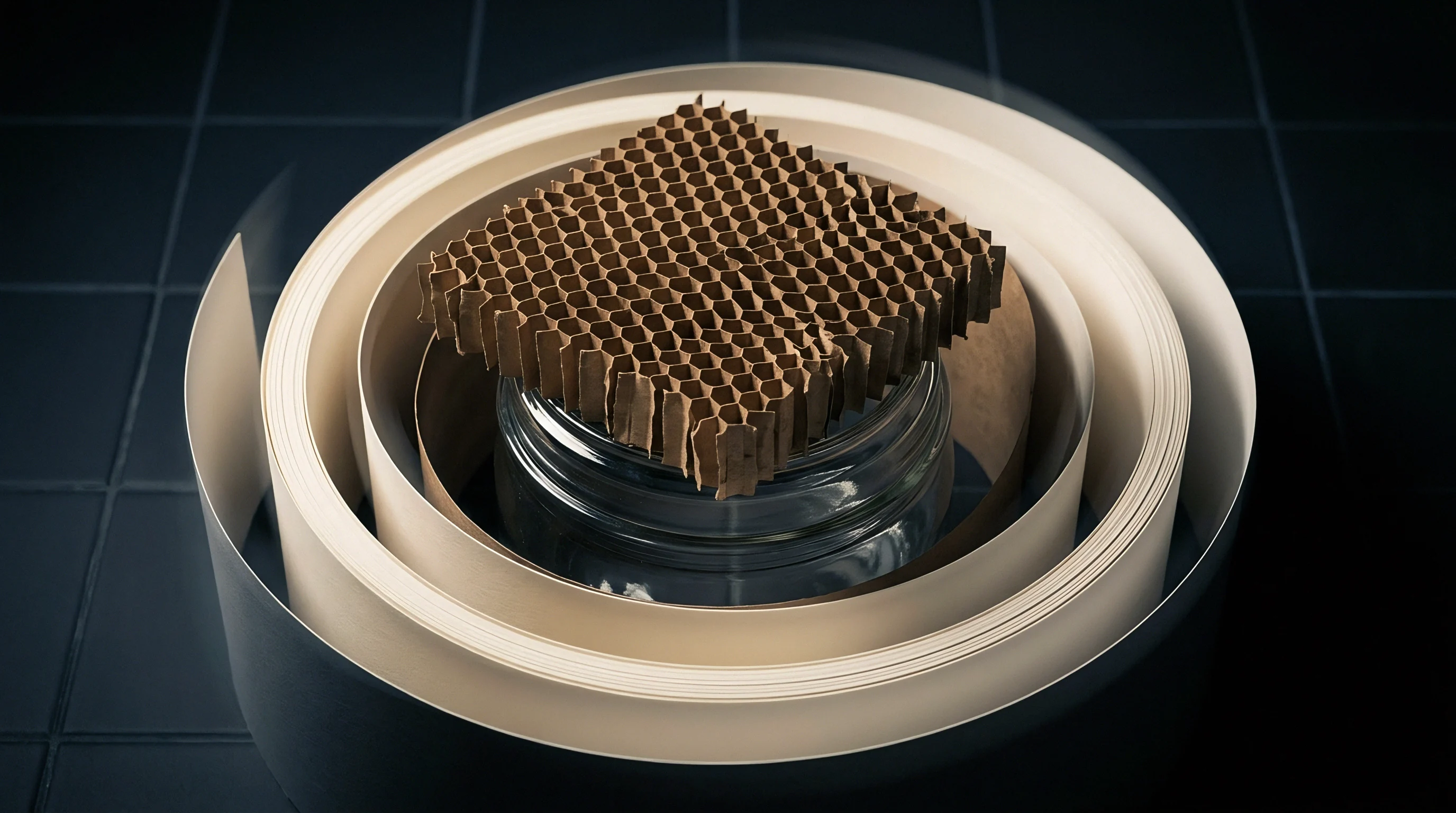
Can Polymer Architecture Suppress Extensional Strain Hardening?
Tailoring polymer architecture maintains clean, Newtonian-like thread breakup under high strain rates. Replacing linear chains with spherical core-shell or multi-arm polymer systems shifts the dynamic response:
- Core-shell emulsion resins shield rigid hydrophobic cores inside water-soluble acrylic acid shells, preventing chain entanglement during exit-nip extension.
- Dendritic polyester architectures present dense surface hydroxyl groups to promote pigment wetting, while their compact molecular radius eliminates long-range reptation modes.
- Comb-branched acrylic comb polymers place pendant polyether segments along an inert backbone to decouple shear thinning from extensional stress buildup.
- Hyperbranched polyurethane polyols add flexibility and scuff resistance on coated SBS board while keeping Trouton ratios below 15 at print speeds over 550 meters per minute.
Linear binders stretch into oriented filaments that store elastic energy like springs. Dendritic and comb architectures deform by rotating and rearranging local segments rather than stretching out full chains. Energy dissipates through viscous friction instead of elastic storage.
Meniscus splitting proceeds through uniform capillary pinching, leaving a smooth ink film on the paper without throwing satellite droplets.
Signing an RFQ without specifying extensional rheology thresholds leaves press wash-up downtime as an unrecoverable operating cost.
Evaluation
Capillary Breakup Extensional Rheometry
Standard quality control relies on Ford or Zahn efflux cups and rotational viscometers running shear rates below 1,200 reciprocal seconds. These methods offer no insight into nip misting. Capillary Breakup Extensional Rheometry (CaBER) provides precise, repeatable measurement of fluid elasticity under conditions that simulate roll splitting.
In a CaBER test, a 0.20-milliliter ink droplet sits between two 6.0-millimeter circular plates. The upper plate steps upward 5.0 millimeters in under 50 milliseconds, forming an unstable fluid bridge. A laser micrometer tracks the midpoint filament diameter as capillary pressure, viscous resistance, and extensional stress drive it toward rupture.
The test records decay kinetics from step completion until the bridge snaps.
Filament diameter decay follows an exponential trajectory in fluids dominated by polymer elasticity:
Dmid(t) = D0 × (G × D0 / (4 × σ))1/3 × exp(−t / (3 × λE))
Here, σ is surface tension, G is elastic modulus, and λE is extensional relaxation time. Linear binders yield λE values from 8.0 to 45.0 milliseconds. Advanced branched systems compress λE to under 1.5 milliseconds.
Inks with relaxation times under 2.0 milliseconds produce no airborne misting at speeds up to 600 meters per minute on folding boxboard lines.
Aerosol Collection Protocols
Verifying misting performance requires standardized physical measurement under simulated press conditions. Optical particle counters and gravimetric collection units give reproducible aerosol counts when mounted directly behind the print nip.
- Condition substrates and ink samples in an environmental room set to ISO 187 parameters (23 ± 1 C, 50 ± 2% relative humidity) for 24 hours before testing.
- Accelerate a dual-roll pilot nip assembly to target web surface speed (minimum 450 meters per minute) while holding nip pressure at 0.40 MPa.
- Position optical aerosol spectrometer sensors 150 millimeters downstream from the exit nip to record particle counts across size channels from 0.3 to 20 micrometers over a continuous 120-second run.
- Draw air through an isokinetic sampling probe into a calibrated PTFE membrane filter cassette at 28.3 liters per minute to capture total particulate mass.
- Weigh the membrane mass gain to 0.01 milligram precision on analytical balances to calculate aerosol emissions per square meter of web surface.
This protocol links polymer architecture directly to press cleanliness and contamination limits. Setting a maximum aerosol threshold of 10 milligrams per square meter at 500 meters per minute eliminates misting-related reject rolls on pharmaceutical cartonboard runs.
Whether inline acoustic particle measurement can distinguish solvent evaporation aerosols from viscoelastic ink throw under fluctuating press-room drafts remains an open question.

Yield
Landed Substrate Economics
The economic case for modified polymer ink systems comes down to converted yield and fewer press stops. Misting from standard linear binders adds costs that compound over multi-million-pack production runs. Aerosols on barcode targets, registration sensors, and glue flaps drive finished carton reject rates up by 1.5 to 4.0 percent on high-speed boxboard lines.
A flexographic converting line running 280 g/m² SBS board at 500 meters per minute on an 850-millimeter web converts 119 metric tonnes of board every 24 hours. At 1,450 USD per metric tonne, each 1.0 percent increase in scrap burns 1,725.50 USD a day in raw board stock alone, before factoring in lost machine hours and make-ready waste.
| Operational Cost Element | Linear Resin System (Baseline) | Hyperbranched System (Optimized) | Unit Financial Variance (USD/Month) |
|---|---|---|---|
| Base Ink Formulating Cost (USD/kg) | 4.20 | 5.85 | +13,200 |
| Press Cleaning Downtime (Hours/Month) | 38.5 | 4.0 | −25,875 |
| Substrate Scrap from Mist Contamination (%) | 2.8% | 0.4% | −41,412 |
| Plate Wash Solvent Consumption (L/Month) | 1,850 | 320 | −4,896 |
| Sensor and Optical Hardware Replacement | 3,200 | 400 | −2,800 |
| Net Operational Variance (USD/Month) | — | — | −61,783 |
Converting Window Headroom
Optimizing extensional rheology opens up converting speed headroom without sacrificing print quality. When linear ink misting caps line velocity at 320 meters per minute on heavy board, press productivity stays well below machine capacity. Switching to hyperbranched binders decouples web speed from aerosol generation, unlocking line speeds over 500 meters per minute.
Hyperbranched or dendrimer-modified resin systems carry a 25 to 40 percent cost premium over commodity linear acrylic binders. Since raw binder resin represents 15 to 22 percent of total formulated ink weight, the net price increase for finished ink is 0.80 to 1.65 USD per kilogram. Spread across millions of folding cartons, scrap reduction and lower downtime quickly offset the higher ink cost.
Converters running short-fiber recycled furnishes gain even more. Clean nip splitting prevents surface fiber picking. Linear inks with high extensional tack pull surface fibers and mineral fillers from recycled white-lined chipboard, contaminating the ink train and requiring frequent blanket washes.
Branched topologies break cleanly, maintaining runnability on high-recycled board without compromising print quality or press hygiene.
In short-run folding boxboard production, the press that runs clean at full speed settles the margin before the first reel reaches the rewind stand.