Dynamic Acoustic Matrix Quantification of Microbuckling in High Velocity Platen Converted Packaging Cores
Dynamic acoustic matrix monitoring isolates microbuckling in high-speed platen converted packaging cores, preventing hidden structural score line failure.


Dynamics
High-velocity platen conversion subjects paperboard cores to severe compressive impact within microsecond time windows. Platen closure rates between 1.2 and 1.8 meters per second create transient impact strain rates exceeding 100 per second. Under these high strain rates, cellulose fiber matrices within paperboard cores undergo microbuckling, where individual cell walls and inter-fiber bonds collapse before macro-scale fold deformation takes place.
This localized structural instability reduces structural stiffness across score lines and edges, creating invisible strength loss prior to carton erection.
Cellulose fibers exhibit pronounced strain-rate sensitivity. Under slow static compression, inter-fiber bonds redistribute stress through plastic yield. At platen impact velocities, stress redistribution ceases.
Structural failure shifts from distributed plastic yield to localized kink band formation and cell wall Euler microbuckling. Fiber lumens buckle inward, causing irreversible density variations across the converting zone. Platen impact induces localized shear.
Fibers buckle before complete crushing occurs.
| Caliper (µm) | Impact Velocity (m/s) | Strain Rate (s⁻¹) | Microbuckling Threshold (µJ) | Primary Failure Mode |
|---|---|---|---|---|
| 280 | 1.2 | 145 | 38.2 | Cell Wall Buckling |
| 350 | 1.5 | 210 | 45.6 | Kink Band Formation |
| 450 | 1.8 | 285 | 52.1 | Inter-Ply Shear Separation |
| 600 | 1.8 | 320 | 61.4 | Delamination Microbuckling |
A 450-micrometer solid bleached board loaded at strain rates above 200 per second initiates microbuckling at 42 percent of nominal compressive yield strength under ISO 187 standard conditioning.
Quantifying microbuckling during high-speed production requires capturing transient strain energy releases before stress waves dissipate into surrounding tooling frames. Traditional off-line edge crush testing according to ISO 12192 measures ultimate compressive failure, but misses the onset of microbuckling during high-speed scoring. When a packaging core undergoes platen impact, localized cell wall collapse releases high-frequency acoustic strain energy.
Measuring this energy release provides real-time detection of structural microbuckling as it occurs inside the platen nip.
Whether ultra-high-density micro-fibrillated cellulose additives can suppress cell wall buckling at strain rates exceeding 1,000 per second without increasing total sheet grammage remains unproven.


Acoustics
Transient elastic stress waves propagate through fiber networks whenever cell walls buckle under rapid axial loads. Piezoelectric broad-band sensors mounted to die chasing capture high-frequency strain pulses between 100 kHz and 500 kHz, isolating material failure signals from low-frequency mechanical platen noise. Core density governs wave velocity.
Acoustic signals travel along fibers. Cross direction attenuation runs higher.
Paperboard exhibits orthotropic acoustic wave propagation due to preferential fiber alignment during wet-end sheet formation. Longitudinal wave velocities along the machine direction typically range from 2,200 to 2,800 meters per second. Cross direction wave velocities drop to between 1,200 and 1,600 meters per second.
High attenuation in the z-direction absorbs high-frequency components, requiring multi-channel sensor arrays to reconstruct internal microbuckling events across multi-ply packaging board structures.

Transient Signal Classification
Acoustic emissions generated during platen contact split into distinct frequency and amplitude domains based on the underlying failure mechanism.
- Inter-Ply Delamination generates high-amplitude bursts between 120 kHz and 180 kHz with long decay times indicative of planar crack propagation.
- Kink Band Formation yields sharp burst pulses between 200 kHz and 280 kHz with rise times under five microseconds.
- Matrix Fiber Splitting produces continuous low-amplitude emissions spanning 300 kHz to 450 kHz as individual cell walls fracture.
- Coating Shear Cracking generates high-frequency signals above 450 kHz with immediate signal attenuation due to polymer damping layer interactions.
Higher density board stocks always require wider transducer spacing to prevent overlapping energy signals from masking primary fiber failure.

Array
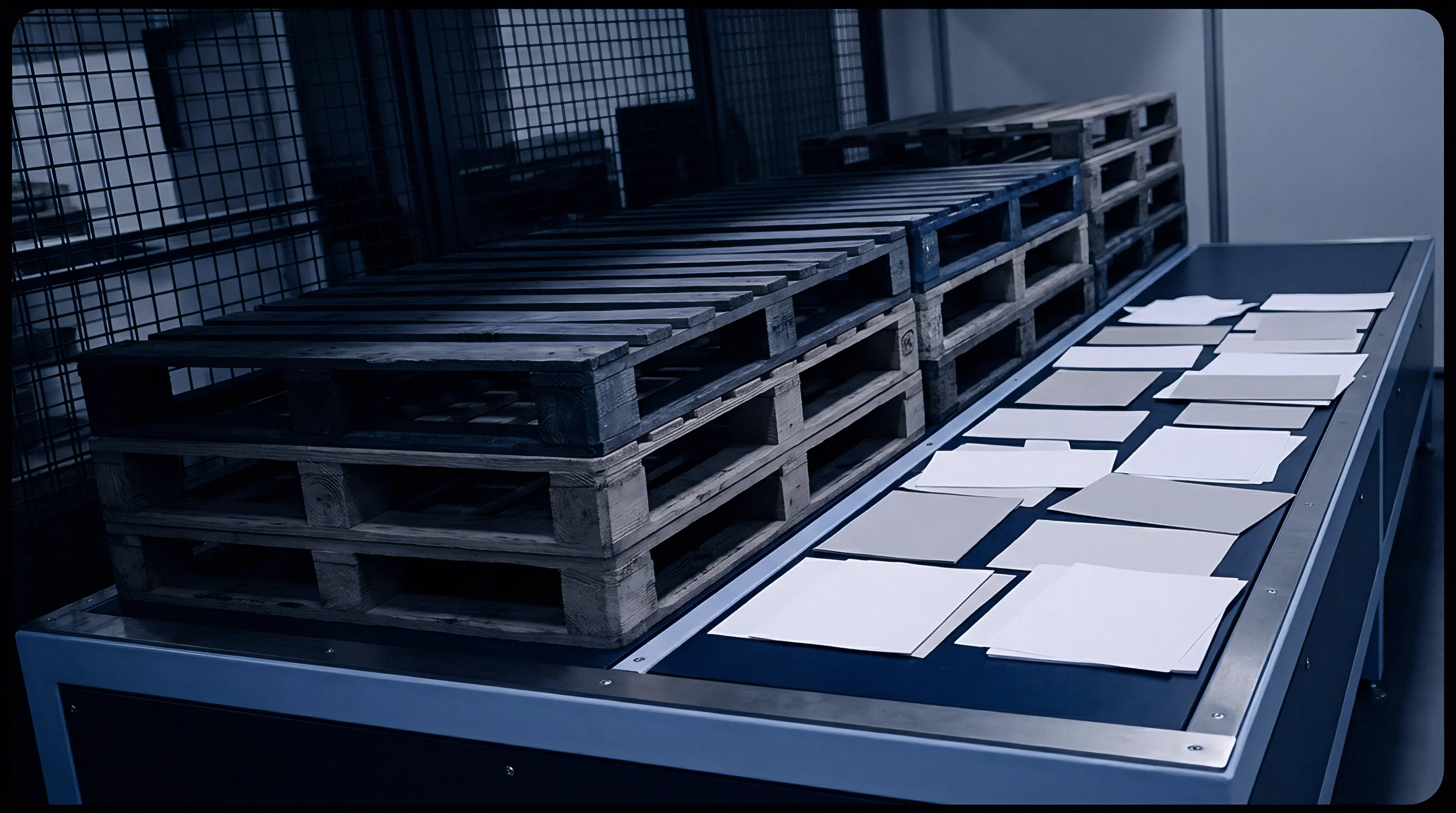
Piezoelectric transducers positioned in a calibrated matrix across the upper die platen receive acoustic stress waves through acoustic couplant interfaces. Clamping pressure holds each sensor at a constant contact force of 15 Newtons, eliminating variation in signal attenuation across the tool surface. Sensor placement governs signal clarity.
Die vibration masks faint pulses.

Can Acoustic Wave Amplification Detect Sub-Surface Fiber Shear?
Sub-surface fiber shear releases transient strain energy that travels upward through the sheet thickness, creating surface displacements measurable by piezoelectric arrays. Signal processing algorithms use arrival time differences between four array channels to locate microbuckling events within a two-millimeter spatial resolution on the platen plane.
Setting up an acoustic detection array on an operational flatbed platen convertor follows a precise sequence to isolate fiber failure from machine vibration.
- Clean upper platen chase mounting locations using isopropyl alcohol to eliminate oil film impedance.
- Apply high-vacuum silicone acoustic couplant to piezoelectric transducer faces at a uniform film thickness of 50 micrometers.
- Torque mechanical mounting brackets to 4.5 Newton-meters to secure constant contact pressure against the platen housing.
- Perform Hsu-Nielsen pencil-lead break tests adjacent to scoring rules to calibrate directional wave velocity maps.
- Adjust high-pass filters to 100 kHz to suppress mechanical drive noise and toggling impact signals.
- Record ambient noise baselines during dry machine cycling at target operating speeds up to 9,000 sheets per hour.
Compliance with ISO 13820 calibration protocol limits transducer signal drift to less than 1.5 decibels across an eight-hour continuous converting shift.
Improper transducer coupling alters attenuation profiles, causing the processing matrix to miscalculate failure coordinates and misattribute machine vibration to material degradation.
Shear
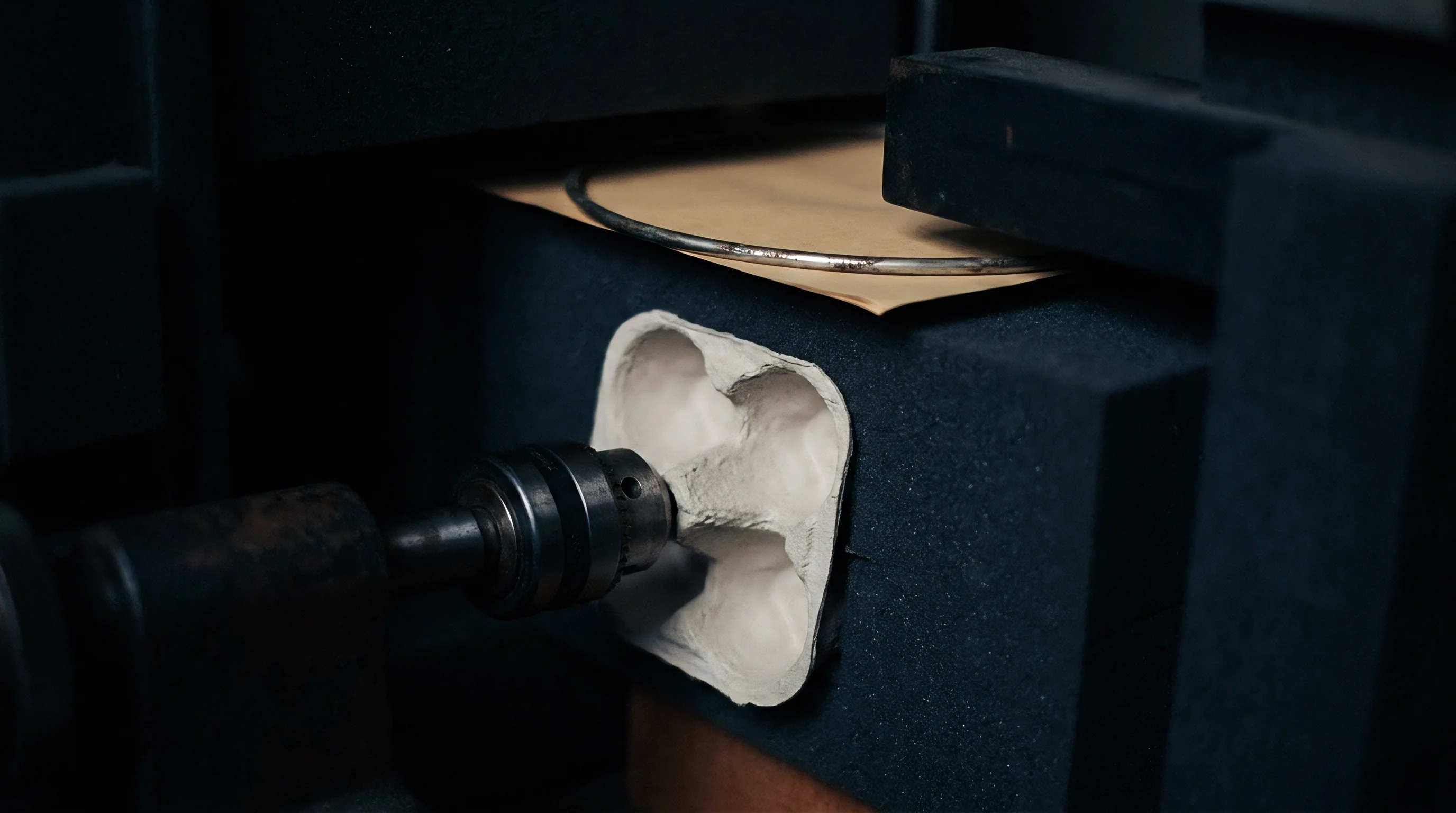
Surface finishing passes change stress distribution profiles through core plies during platen closure. Film lamination using 12-micrometer biaxially oriented polypropylene or polyethylene terephthalate adds high-tensile surface skins. These polymer layers suppress external surface fiber cracking, while concentrating internal shear stresses within middle core plies.
Surface films alter stress concentration. Soft coatings absorb high-frequency waves.
Varnishes and barrier coatings alter acoustic signal transmission through the sheet thickness. Water-based dispersion coatings increase surface stiffness slightly without dampening acoustic waves. Soft-touch polyolefin coatings introduce a viscoelastic damping layer that attenuates acoustic signal amplitudes by up to 6 decibels per millimeter of coating thickness.
This attenuation requires recalibrating matrix threshold values to avoid underreporting microbuckling events beneath heavy polymer passes.
| Finish Configuration | Pass Count | Attenuation Rate (dB/mm) | Microbuckling Onset Shift (%) | Delamination Index |
|---|---|---|---|---|
| Uncoated Board Base | 1 | 1.8 | 0.0 | 0.22 |
| Dispersion Varnish | 2 | 2.1 | -3.5 | 0.25 |
| UV High-Gloss Varnish | 2 | 2.9 | -8.2 | 0.31 |
| 12 µm BOPP Lamination | 2 | 4.5 | +14.0 | 0.48 |
| 12 µm PET Lamination | 2 | 5.2 | +18.5 | 0.54 |
| Soft-Touch Polyolefin Film | 2 | 7.8 | +11.2 | 0.51 |
Heavy film laminates shift structural failure from surface rupture to internal core shear without altering total energy dissipation.
Material suppliers frequently maintain that lamination compensates for lower core board stiffness, omitting the increased incidence of hidden inter-ply microbuckling under high-velocity converting conditions.


Verification
Distinguishing true microbuckling signals from background converting noise requires evaluating signal rise time, peak energy, and frequency spectrum distribution. High-speed digitizers sample array channels at 10 Megasamples per second, feeding raw waveform data to a matrix processor running real-time fast Fourier transforms. Noise filtering prevents false rejects.
Die wear increases impact noise.
Consider a qualification protocol for a 40-tonne order of 350 gsm folding boxboard running on a high-speed flatbed platen die cutter at 8,500 sheets per hour. The baseline noise floor produces acoustic energy pulses below 12 microjoules. Fiber microbuckling events generate discrete acoustic emissions between 35 and 85 microjoules.
Setting a rejection threshold at 28 microjoules captures microbuckling onset while maintaining zero false positive rejects from mechanical platen strike noise.

Qualification Protocol Requirements
Engineers assessing converted core integrity must audit four specific operational parameters before releasing board stock for volume production runs.
- Baseline Noise Floor Isolation determines machine-generated signal thresholds during empty platen impression strokes.
- Wave Velocity Calibration Matrix maps directional wave speeds across machine and cross directions for each specific board grammage.
- Amplitude Threshold Setting establishes lower energy bounds for true core microbuckling events above background noise.
- Post-Convert Edge Crush Audit correlates live acoustic emission count data with physical ISO 12192 test performance on converted blanks.
Compliance with DIN 55437 crease quality specifications establishes that core delamination index values exceeding 0.35 trigger automatic batch rejection regardless of surface film appearance.

Accounting
Adding finishing passes increases production line step costs while altering end-of-life material fees under European packaging regulations. Film lamination introduces extra setup waste, adds film material pass costs, and shifts finished packaging into higher fee tiers under extended producer responsibility schemes. Extra passes compound waste costs.
Recyclability grades dictate final fees.
Film-laminated cartonboard faces financial penalties under packaging waste legislation such as the EU Packaging and Packaging Waste Regulation. Packages containing non-separable plastic films over five percent of total mass lose recyclable classification under EN 13430 standard assessments. Modulated extended producer responsibility fees penalize laminated structures by up to 220 Euros per tonne compared to mono-material paperboard finished with dispersion varnishes.
| Specification Architecture | Added Pass Count | Make-Ready Waste (%) | EPR Fee Category | Net Landed Unit Cost Ratio |
|---|---|---|---|---|
| Uncoated Mono-Material Board | 0 | 1.5 | Standard Paper Stream | 1.00 |
| Dispersion Varnish Pass | 1 | 2.2 | Standard Paper Stream | 1.08 |
| Double Dispersion Pass | 2 | 3.1 | Standard Paper Stream | 1.14 |
| BOPP Film Lamination Pass | 1 | 4.5 | Penalized Composite Stream | 1.32 |
| PET Film Lamination Pass | 1 | 5.0 | Penalized Composite Stream | 1.41 |
| Soft-Touch Film + Spot UV Pass | 2 | 6.8 | Non-Recyclable Waste Stream | 1.58 |
Film lamination increases eco-fee penalties by forty percent while masking core microbuckling defects during high-speed platen converting.
Evaluating total job economics requires balancing surface appearance benefits against potential yield losses caused by internal microbuckling. Selecting an inline dispersion coating eliminates an extra lamination pass, maintains material recyclability grading under EN 13430, and lowers make-ready waste by over two percent across a typical 100,000-sheet production run.