Platen Kinematics and Multi-Ply Core Shear Shifts in Laminated Boards
Dynamic platen drift drives severe internal core shear in laminated boards, requiring balanced die resistance, wider creasing channels, and lower tonnage.

Drift
Mechanical Strain in Flatbed Diecutters
Flatbed platen diecutters subject laminated paperboard to rapid cycles of compressive impact and instantaneous deceleration. During each stroke, a movable platen driven by an eccentric toggle mechanism accelerates toward a stationary bed, delivering closing forces between 200 and 400 tonnes across sheet surfaces often exceeding one square meter. The mechanical intent centers on driving steel cutting and creasing rules through multi-ply solid bleached sulfate, folding boxboard, or film-laminated cartonboard.
The physical reality of this stroke involves microsecond-scale non-uniformities in platen parallelism. Dynamic deflection of the cast iron bed, bearing clearance in the main toggle knuckles, and asymmetrical rule distribution create transient lateral displacements across the platen face. These micro-displacements, termed platen kinematics drift, exert severe in-plane shear forces on the multi-ply structure of laminated paperboard.
When multi-ply boards undergo flatbed diecutting, the outer plies experience direct clamping friction from the steel counterplate and the matrix channel shoulders. The internal core plies, typically composed of mechanical pulp, thermomechanical pulp, or recycled fibers with lower density and lower inter-fiber bonding strength, absorb the transmitted transverse shear. The introduction of polymeric film laminations, such as oriented polypropylene, polyethylene terephthalate, or metallized polyester, alters the flexural rigidity and neutral axis of the sheet.
Polymeric barrier films increase the tensile modulus of the surface layer to more than 2,000 MPa, preventing localized surface relief while the underlying cellulose core bears the entire lateral strain. Core shear failure manifests as microscopic fiber detachment along internal ply interfaces. This defect compromises carton stiffness, reduces side-seam gluing integrity, and creates visible edge bubbling along crease profiles.
ISO 187 conditioning at 23 degrees Celsius and 50 percent relative humidity establishes the mechanical baseline for measuring in-plane board displacement.
The operational takeaway centers on machine geometry, makeready calibration, and structural core selection. Standard diecutting operations compensate for vertical cutting depth by carbon paper leveling and selective patching beneath the cutting plate. This approach fails to address dynamic horizontal platen movement.
Mitigating core shear shifts requires controlling four interdependent variables: dynamic platen tilt, cutting rule profile geometry, matrix counterplate channel width, and the z-directional tensile strength of the paperboard core.
Kinematics

Toggle Linkage Deflection and Dynamic Skew
Industrial platen presses translate rotary flywheel inertia into linear platen closure via double-toggle or four-bar mechanical linkages. Under static conditions, precision alignment achieves parallelism tolerances below 0.02 mm across the bed. Under dynamic load at speeds ranging from 5,000 to 9,000 sheets per hour, instantaneous peak resistance generates localized elastic deformation within the toggle journals, eccentric shafts, and platen cast structures.
If the layout of cutting rules, creasing rules, and embossing blocks concentrates resistance toward the rear or side guide of the chase, the platen tilts off its nominal axis. This mechanical skew converts pure normal compression into a coupled vector of normal compression and lateral slip across the sheet plane.
Dynamic platen skew generates horizontal shear vectors along the board plane. The magnitude of this horizontal displacement ranges between 15 and 80 micrometers during the final 1.5 millimeters of stroke closure. While an 80-micrometer shift appears small on an open chase layout, it exceeds the elastic shear limit of standard recycled fiber or groundwood core layers.
Unlaminated boards partially accommodate this lateral movement through local fiber compaction and micro-buckling across the surface. Board surfaces reinforced with biaxially oriented polypropylene or polyester films exhibit high in-plane tensile stiffness and high frictional coefficients against steel cutting plates. The surface film resists localized stretching, transferring the entire kinematic displacement into the weakest internal interfaces of the multi-ply board.
Creasing Matrix Engagement and Ply Splitting
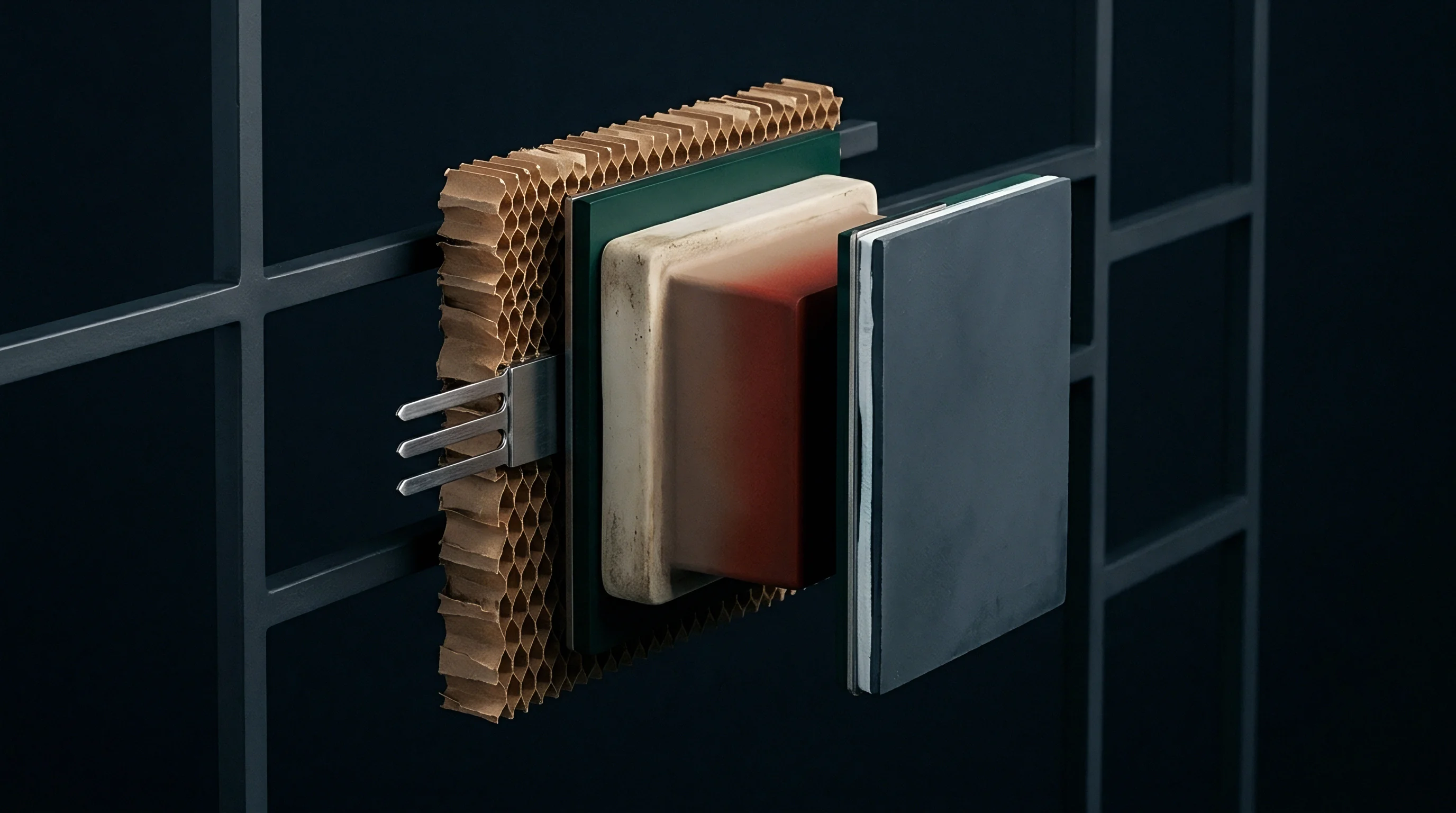
The creasing pass forces the board into a matrix groove using a rounded steel rule, deliberately shearing the internal fiber networks to create an internal delamination hinge. In unlaminated folding boxboard, this controlled internal split permits clean right-angle folding without exterior surface cracking. The presence of dynamic platen lateral drift disrupts this symmetry.
As the creasing rule enters the matrix channel, horizontal drift biases the tool toward one shoulder of the counterplate. One side of the crease groove experiences elevated compressive shear, while the opposite side experiences tensile pull.
The asymmetric loading produces unbalanced internal ply delamination. Instead of creating a centered, double-hinge delamination pocket within the mechanical pulp core, the shear vector forces the core to rupture along a single, jagged shear plane that propagates outward from the crease root. When the carton moves to high-speed folder-gluers running at 400 meters per minute, the asymmetric hinge generates uneven folding resistance, twisting the carton blank out of square and triggering feed jams within the packing line.

Cores

Fiber Morphology across Board Classifications
Multi-ply paperboards utilize stratified fiber blends optimized for caliper generation, bending stiffness, and raw material economy. The mechanical response of the core layer under platen-induced shear depends directly on fiber morphology, refining degree, and inter-fiber bonding agents. The table below outlines the mechanical parameters governing shear resistance across standard packaging board classifications conditioned under ISO 187 parameters.
| Board Classification | Core Fiber Furnish | Scott Internal Ply Bond (J/m²) | Transverse Shear Modulus (MPa) | Critical Shear Displacement (μm) |
|---|---|---|---|---|
| Solid Bleached Sulfate (SBS) | Bleached chemical hardwood and softwood | 190 to 260 | 32 to 45 | 65 to 90 |
| Folding Boxboard (FBB) | Bleached chemical liners with stone groundwood or TMP core | 120 to 170 | 18 to 26 | 35 to 55 |
| Coated Recycled Board (CRB/WLC) | Mixed secondary fiber, deinked pulp, and mechanical waste | 80 to 130 | 12 to 19 | 20 to 38 |
| Solid Unbleached Sulfate (SUS) | Unbleached chemical softwood with high lignin retention | 220 to 310 | 38 to 52 | 80 to 110 |
Solid Bleached Sulfate relies entirely on refined chemical pulps where hydroxyl groups on cellulose fibrils form dense hydrogen bonding networks. These networks yield Scott Bond values exceeding 190 J/m² according to TAPPI T 569, providing high resistance to platen shear vectors. Folding Boxboard incorporates stone groundwood or thermomechanical pulp in its internal plies to maximize bulk and bending stiffness per unit of grammage.
Lignin encrustations on mechanical pulp fibers prevent extensive hydrogen bonding, lowering the core transverse shear modulus to 18–26 MPa. Under the lateral forces of an uncalibrated or skewed platen stroke, mechanical pulp cores fail along fiber wall interfaces. Coated Recycled Board exhibits the lowest shear threshold, where shortened recycled fibers and residual ash content limit the critical shear displacement to under 38 micrometers before internal fracturing occurs.
Influence of Film Lamination on the Neutral Axis
Adhering a polymer film to paperboard using solventless polyurethane, water-based acrylic, or thermal extrusion adhesives creates a structural sandwich. The lamination pass introduces a non-porous layer possessing a high tensile modulus and an elongation at break exceeding 80 percent. When this laminated structure undergoes combined compressive and lateral loading during the diecutting dwell phase, the polymer film shifts the neutral mechanical axis toward the laminated face.
The adhesive bond line between the film and the top coating layer typically demonstrates peel strengths exceeding 3.5 N/15mm, transferring surface shear forces directly into the paperboard sub-layers.
Because the polymer film cannot compress or fail under standard platen tonnage, lateral kinetic energy dissipates into the cellulose stratum. The shear stress profile through the board thickness peaks sharply at the transition zone between the stiff, chemical pulp liner and the compressible, high-bulk core. If the platen’s horizontal displacement exceeds the core’s critical shear displacement limit, internal cleavage develops instantly across the entire sheet area surrounding the cutting rules.

Tooling

Rule Profiles, Chamfers, and Ejection Rubber Dynamics
Steel cutting rule selection dictates the primary load entry into the laminated board during diecutting. Standard cutting rules utilize a center bevel configuration with a 42-degree or 52-degree edge angle. As the rule penetrates the sheet, the wedge geometry displaces board material laterally away from the cutting tip.
In a balanced die layout, opposed rules generate equal and opposite lateral displacement forces, neutralizing gross horizontal movement. If the die contains asymmetric rule layouts, such as consecutive parallel cuts along a carton nesting flank, the lateral displacement acts in a single direction, driving local core shear shifts.
Long-bevel rules reduce total cutting resistance by up to 25 percent compared to standard bevels, decreasing peak platen tonnage requirements and lowering the dynamic deflection of the press frame. However, the extended wedge increases the total lateral displacement duration as the rule penetrates the multi-ply board. Side-bevel rules eliminate lateral displacement on one side of the rule, directing the entire material shift into the scrap skeleton or into the active carton blank.
The table below details how tooling variables modify shear distribution across laminated boards.
| Tooling Component | Standard Specification | Optimized Low-Shear Specification | Mechanism Of Shear Reduction |
|---|---|---|---|
| Cutting Rule Bevel | Center bevel, 52-degree angle, 0.71 mm body | Long center bevel, 42-degree angle, ground edge | Reduces wedge-driven lateral displacement forces by 18 to 22 percent |
| Creasing Rule Profile | Flat-faced, sharp-radiused shoulders, 0.71 mm to 1.05 mm | Full-radius crowned head, polished finish | Eliminates sharp stress concentrations at crease shoulders |
| Ejection Rubber Shore A | Solid neoprene, 45 to 60 Shore A, open-cell sponge | Profiled cellular polyurethane, 25 Shore A core with 60 Shore A cap | Controls progressive sheet clamping prior to rule contact |
| Matrix Channel Material | Milled phenolic or preshaped plastic on steel carrier | Precision CNC-milled steel counterplate or brass matrix | Maintains absolute channel wall parallelism under high lateral loads |

Differential Clamping through Ejection Rubber Selection
Ejection rubber serves a dual function: it strips the sheet from the cutting chase after the stroke and clamps the paperboard against the counterplate during rule entry. Uncontrolled rubber placement generates localized lateral shear before the cutting rules engage the board. Conventional open-cell sponge rubber expands laterally when compressed vertically, imparting outward frictional forces onto the board surface.
If high-hardness rubber sits near a cutting rule, its lateral expansion pushes the laminated top ply sideways while the knife tip pins the lower plies.
Cellular micro-cellular polyurethane rubbers eliminate lateral expansion during compression, collapsing vertically into internal voids without imparting horizontal friction to the sheet surface. Strategic zoning of rubber hardness controls the sequence of board engagement: low-durometer rubber secures sheet position without surface friction, while high-durometer, narrow-profile rubber immediately adjacent to the knives provides clean stripping after ply separation. Misalignment of rubber placement creates differential friction zones that buckle the laminated surface and trigger internal core shear.


Qualification
Shall Counterplate Micro-Topography Dictate Shear Resistance?
The interface between the counterplate and the unprinted back liner of the board dictates friction levels during platen impact. A smooth, ground steel counterplate exhibits low sliding friction, allowing the entire board package to slide laterally if dynamic platen tilt occurs. This slip prevents localized shear concentration by distributing lateral displacement across the perimeter waste areas.
A textured counterplate, or one coated with high-friction anti-marking patterns, locks the bottom ply firmly in place. When the platen skews, the top ply moves with the upper die while the bottom ply remains anchored to the counterplate. This condition forces 100 percent of the kinetic displacement into the core layer.
Standard qualification procedures assess creasing channel dimensions and rule heights but ignore interface friction. A rigorous tooling audit verifies counterplate micro-topography using stylus profilometry, requiring average surface roughness values between 0.8 and 1.6 micrometers Ra. This roughness window provides sufficient traction to avoid sheet bounce during high-speed feeder cycles without pinning the back liner during dynamic platen skew. Process auditors confirm counterplate hardness between 35 and 48 HRC to prevent channel shoulder collapse under high volume runs.
A counterplate hardness below 32 HRC causes channel shoulder deformation within twenty thousand impressions, escalating lateral matrix clearance.
The qualification protocol evaluates tooling accuracy, machine kinematics, and board shear integrity prior to production release:
- Platen Parallelism Check verifies dynamic platen level under 70 percent operational tonnage using four electronic load cells positioned at platen corners, rejecting installations with corner-to-corner load differentials exceeding eight percent.
- Crease Indentation Profiling measures creasing depth across both machine direction and cross direction via laser micrometer, establishing whether symmetrical internal delamination occurs without liner shearing.
- Z-Directional Core Assessment checks post-diecut board samples for core integrity via Scott Internal Ply Bond testing under TAPPI T 569, verifying that diecut samples retain at least 85 percent of raw board ply bond strength.
- Edge Delamination Inspection subjects diecut perimeter blanks to edge-wicking dye penetration testing, identifying micro-cracks in core fibers along sheared crease roots.
Skipping this protocol risks releasing compromised cartons into packaging runs where side-panel bulging and cartoner feed failures stop high-speed filling lines.

Remedies

Operational Corrections on the Converting Floor
When multi-ply core shear shifts emerge during production, converting teams must adjust operational variables without invalidating approved tooling. Press operators often increase cutting pressure when cuts appear incomplete or stringy. This action accelerates the failure mechanism.
Elevating platen tonnage intensifies frame deflection, deepens dynamic toggle skew, and drives the cutting rule bevel further into the counterplate, increasing horizontal material displacement. The correct remedy involves decreasing total cutting tonnage to the absolute minimum required to achieve separation, supported by targeted spot-shimming beneath individual cutting rules.
Adjusting the creasing matrix dimensions offers an immediate method for mitigating core rupture. When film lamination stiffens the outer surface of folding boxboard or coated recycled board, the formula for creasing channel width requires adjustment. Standard commercial formulas determine matrix width by multiplying board caliper by 1.5 and adding the creasing rule thickness.
For laminated boards exhibiting core shear failure, increasing the channel multiplier to 1.7 or 1.8 relieves lateral compression on the internal mechanical pulp core, preserving the ply bond hinge.
Increasing matrix channel width by 15 percent lowers lateral shear strain below the critical rupture threshold of mechanical pulp cores.
The converting team applies five sequential floor interventions to stabilize running jobs experiencing ply shear:
- Tonnage De-escalation lowers main press pressure until cutting rules fail to sever the bottom liner, followed by selective 0.03 mm tissue patching directly beneath uncut segments.
- Creasing Matrix Widening replaces installed matrix channels with wider profiles matching the 1.75-caliper formula, eliminating channel shoulder friction against the board sides.
- Rubber Profile Trimming cuts clearance gaps between cutting rules and adjacent ejection rubber to 1.5 mm, relieving horizontal expansion forces during dwell.
- Feeder Velocity Throttling reduces press operating speed by 10 to 15 percent, dampening dynamic toggle knuckle vibrations and platen tilt harmonics.
- Atmospheric Moisture Recovery allows exposed board stacks to equilibrate in humidity-controlled bays, preventing dry core embrittlement where moisture content drops below 6.0 percent.
A supplier will typically assert that board fiber quality complies with Scott Bond purchase specifications, attributing crease delamination entirely to improper matrix channel selection.

Balance

Symmetrical Stress Distribution in Structural Die Layouts
The layout of carton blanks within the die form dictates the spatial distribution of mechanical resistance during the platen stroke. Asymmetrical nesting creates unbalanced moments of force relative to the center of platen pressure. If a run places heavy embossing dies, high-density perforation rules, or clustered cutting profiles along the drive side of the press while the operator side contains open scrap areas, the platen tilts elastically toward the drive side during each impression.
This dynamic tilting vector drives lateral shear displacement directly across the carton blanks located along the center line.
Achieving mechanical balance requires placing balancing rules or bearer blocks within open scrap areas of the chase. Balancing rules consist of blunt steel rules ground lower than cutting height, positioned to engage high-durometer rubber blocks mounted on the chase perimeter. These dummy elements absorb impact energy along lightly loaded quadrants, equalizing the opposing force vectors across the platen face.
Balancing rules prevent dynamic platen tilt, keeping the stroke vector purely perpendicular to the board plane.
The financial impact of core shear defects emerges clearly when analyzing running waste and line efficiencies across multi-pass operations. Consider a worked scenario: a packaging order of 500,000 laminated cosmetic cartons produced from 350 gsm Folding Boxboard with an extrusion-laminated 12-micron metallized PET barrier. The raw substrate costs 1,450 USD per metric ton, representing a board value of approximately 25,400 USD for the run.
The printing pass adds 4,200 USD, while the film lamination pass adds 3,800 USD and requires a three-day staging window for adhesive cross-linking.
If unmitigated platen drift causes core shear along main scorelines, the structural damage remains invisible until cartons reach high-speed folder-gluers or automated packing facilities. A carton blank with an internally sheared core exhibits erratic folding torque. Folding resistance variations exceeding 20 percent cause automated cartoner pushers to skew cartons, tripping line stops.
If the defect forces the rejection of 12 percent of the diecut blanks during folder-gluer operations, the converter loses 4,012 USD in direct material value, alongside 18 hours of lost folder-gluer capacity valued at 3,240 USD. If defective blanks escape to the brand client’s filling plant, sorting operations, downtime claims, and emergency reprint passes double the direct loss. Balancing the die form through bearer blocks and precise tonnage distribution costs less than 350 USD in make-ready labor and scrap steel rules, protecting the run ledger from five-figure quality penalties.
The standard packaging supply agreement clause designating carton warp or folding torque variations as substrate tolerance limits protects the converter only until mechanical testing proves the defect originated from platen-induced core shear rather than mill-supplied fiber variation.